Maine: Pedestrians — Part 1 Practice Test
Questions in this part include: “The manual's list of when to yield to waiting pedestrians includes which situation?” · “Where may school zones be found?”
Independent educational site · not affiliated with any government agency or DMV
Ready? Test yourself
- Instant feedback with an explanation
- Every answer cites its source in the manual
- Your best score is saved on this device
Questions are original and based on the official manual "Maine Driver’s License Manual" (Rev 4/24), Maine Bureau of Motor Vehicles.
All 18 questions in this practice test
Take the test above first, then use this list to study. Tap “Show answer” to see the correct answer and explanation.
Show the questions and answersHide the questions
-
What must you do about a vehicle that has stopped for pedestrians in a crosswalk?
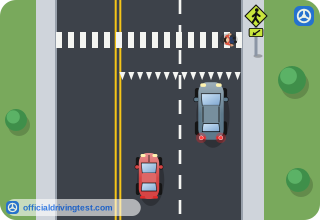
- Pass it on the right side only
- Pass it slowly while sounding your horn
- Pass it if no oncoming traffic is in sight
- Do not pass the stopped vehicle
Show answer
Correct answer: Do not pass the stopped vehicle
Do not pass any vehicle that has stopped for pedestrians in a crosswalk.
Source: Maine Driver’s License Manual (Rev 4/24), page 6-2 · Open this page in the manual (Manual page 6-2)
-
The manual's list of when to yield to waiting pedestrians includes which situation?
- Only when a police officer is directing traffic
- Only when the pedestrians are children
- Only when it is dark
- At an intersection with no traffic lights or police
Show answer
Correct answer: At an intersection with no traffic lights or police
You yield to pedestrians in a marked crosswalk when there are no traffic lights or police at the intersection.
Source: Maine Driver’s License Manual (Rev 4/24), page 6-2 · Open this page in the manual (Manual page 6-2)
-
When a car is turning a corner and the pedestrians are crossing with the light, what must the driver do?
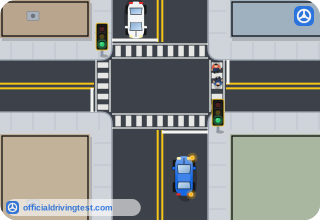
- Yield the right-of-way to the pedestrians
- Go first, because the car is already moving
- Go first if the turn signal is on
- Honk and continue slowly
Show answer
Correct answer: Yield the right-of-way to the pedestrians
A driver turning a corner must yield the right-of-way to waiting pedestrians who are crossing with the light.
Source: Maine Driver’s License Manual (Rev 4/24), page 6-2 · Open this page in the manual (Manual page 6-2)
-
Cars coming out of a driveway or alley must wait for whom?
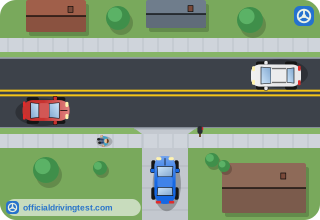
- Only vehicles on the public way
- Only pedestrians on the sidewalk
- Pedestrians and traffic
- Only vehicles coming from the left
Show answer
Correct answer: Pedestrians and traffic
Cars coming out of a driveway or alley must wait for pedestrians and traffic.
Source: Maine Driver’s License Manual (Rev 4/24), page 6-2 · Open this page in the manual (Manual page 6-2)
-
When must you yield the right-of-way to school children crossing a street?
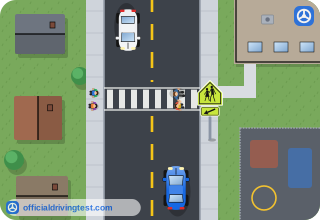
- Only in a school zone
- Always
- Only when a crossing guard is present
- Only during school hours
Show answer
Correct answer: Always
The manual says to always yield the right-of-way to school children crossing a street.
Source: Maine Driver’s License Manual (Rev 4/24), page 6-2 · Open this page in the manual (Manual page 6-2)
-
What do crosswalks show?
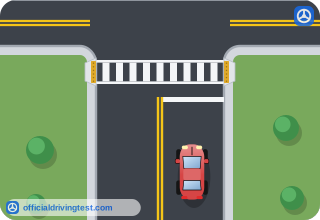
- Where vehicles may park along the road
- Where drivers should pass
- Where school zones begin
- Where pedestrians may cross the road
Show answer
Correct answer: Where pedestrians may cross the road
Crosswalks show where pedestrians may cross the road.
Source: Maine Driver’s License Manual (Rev 4/24), page 6-11 · Open this page in the manual (Manual page 6-11)
-
Where must you stop when crosswalks are not marked at an intersection?
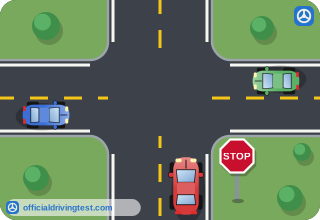
- At least 30 feet back from the edge of the intersection
- Before the intersection, close enough to see approaching traffic
- In the middle of the intersection
- At the corner of the nearest building
Show answer
Correct answer: Before the intersection, close enough to see approaching traffic
If crosswalks are not marked, you must stop before the intersection close enough to see approaching traffic.
Source: Maine Driver’s License Manual (Rev 4/24), page 6-11 · Open this page in the manual (Manual page 6-11)
-
At an intersection there is a stop line before the crosswalk. Where must you stop?
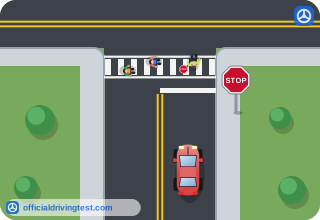
- In the crosswalk
- Past the crosswalk
- At the stop line
- At the far edge of the intersection
Show answer
Correct answer: At the stop line
If there is a stop line before the crosswalk, you must stop at the stop line.
Source: Maine Driver’s License Manual (Rev 4/24), page 6-11 · Open this page in the manual (Manual page 6-11)
-
How are crosswalks often marked?
- With red or green lines
- With blue or orange lines
- With black lines only
- With yellow or white lines
Show answer
Correct answer: With yellow or white lines
Crosswalks are often marked with yellow or white lines, and there may be warning signs.
Source: Maine Driver’s License Manual (Rev 4/24), page 6-11 · Open this page in the manual (Manual page 6-11)
-
Where are most crosswalks located?
- At intersections
- Only near traffic signals
- Only near schools
- Only on divided highways
Show answer
Correct answer: At intersections
Most crosswalks are at intersections, but sometimes they are in the middle of a block.
Source: Maine Driver’s License Manual (Rev 4/24), page 6-11 · Open this page in the manual (Manual page 6-11)
-
Where may school zones be found?
- Only in town, near large buildings
- In the country as well as in town
- Only on divided highways
- Only on one-way streets
Show answer
Correct answer: In the country as well as in town
You should be alert for school zones in the country as well as in town.
Source: Maine Driver’s License Manual (Rev 4/24), page 6-11 · Open this page in the manual (Manual page 6-11)
-
What must you do when a school crossing guard directs you?
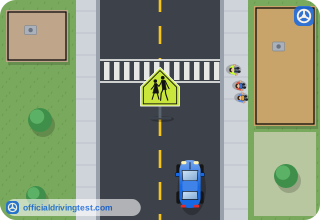
- Slow down and keep going
- Sound your horn
- Stop
- Go around the guard
Show answer
Correct answer: Stop
You must stop when the school crossing guard directs you.
Source: Maine Driver’s License Manual (Rev 4/24), page 6-11 · Open this page in the manual (Manual page 6-11)
-
What should you always do for schoolchildren crossing the street?
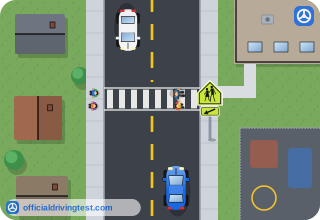
- Sound your horn to warn them
- Pass them before they step into the road
- Flash your headlights
- Yield the right-of-way
Show answer
Correct answer: Yield the right-of-way
You should always yield the right-of-way to any schoolchildren crossing the street.
Source: Maine Driver’s License Manual (Rev 4/24), page 6-11 · Open this page in the manual (Manual page 6-11)
-
Why are stop lines usually painted on the roadway a distance from an intersection?
- To give pedestrians a walkway in front of stopped cars
- To mark where cars may wait in line to park at the curb
- To mark where passing begins
- To show the edge of the lane
Show answer
Correct answer: To give pedestrians a walkway in front of stopped cars
Stop lines are painted at a distance from the intersection to give pedestrians a walkway in front of stopped cars.
Source: Maine Driver’s License Manual (Rev 4/24), page 6-12 · Open this page in the manual (Manual page 6-12)
-
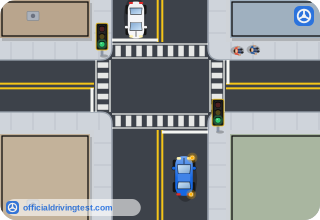
When you are turning a corner on a green light, what should you remember about pedestrians?
- The light is always red for them
- The light may also be green for them
- They must wait for you to pass
- They may not cross until you signal
Show answer
Correct answer: The light may also be green for them
If you have a green light, the light may also be green for pedestrians, so you must watch for people about to cross.
Source: Maine Driver’s License Manual (Rev 4/24), page 6-12 · Open this page in the manual (Manual page 6-12)
-
To whom must you yield when turning a corner?
- Only pedestrians who are crossing in a marked crosswalk
- Only pedestrians who have a signal
- Pedestrians in a crosswalk, marked or unmarked
- Only children
Show answer
Correct answer: Pedestrians in a crosswalk, marked or unmarked
You must yield to pedestrians in a crosswalk, marked or unmarked.
Source: Maine Driver’s License Manual (Rev 4/24), page 6-12 · Open this page in the manual (Manual page 6-12)
-
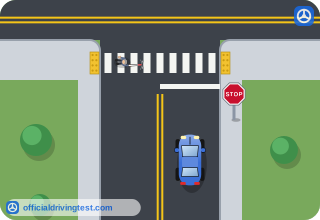
What does a person who is blind or visually impaired and uses a white cane or a guide dog always have?
- A separate signal to wait for
- A requirement to yield to vehicles
- The right of way only at crosswalks
- The right of way
Show answer
Correct answer: The right of way
A visually impaired person with a white cane or guide dog always has the right of way.
Source: Maine Driver’s License Manual (Rev 4/24), page 6-12 · Open this page in the manual (Manual page 6-12)
-
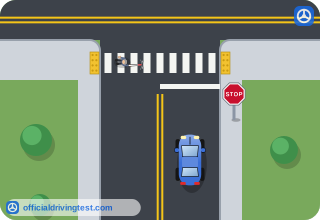
If you see anyone in the roadway with a white cane or guide dog, how far away must you stop at least?
- 3 feet
- 10 feet
- 20 feet
- 50 feet
Show answer
Correct answer: 10 feet
You must stop at least 10 feet away and wait until the person is out of danger.
Source: Maine Driver’s License Manual (Rev 4/24), page 6-12 · Open this page in the manual (Manual page 6-12)