Maine: Emergencies and crashes — Part 3 Practice Test
Avoiding crashes, skids, brake and tire problems, a stuck gas pedal, breakdowns, what to do after a crash, and winter and flood driving. — Part 3
Independent educational site · not affiliated with any government agency or DMV
Ready? Test yourself
- Instant feedback with an explanation
- Every answer cites its source in the manual
- Your best score is saved on this device
Questions are original and based on the official manual "Maine Driver’s License Manual" (Rev 4/24), Maine Bureau of Motor Vehicles.
All 34 questions in this practice test
Take the test above first, then use this list to study. Tap “Show answer” to see the correct answer and explanation.
Show the questions and answersHide the questions
-
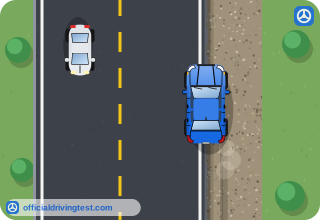
After you have slowed down with your right wheels on the shoulder, what should you do before turning back onto the road?
- Speed up to match the traffic
- Check for traffic ahead and behind
- Sound your horn twice
- Stop completely and wait a minute
Show answer
Correct answer: Check for traffic ahead and behind
After you've slowed down, you check the road for traffic ahead and behind before turning your wheels to reenter the road.
Source: Maine Driver’s License Manual (Rev 4/24), page 9-5 · Open this page in the manual (Manual page 9-5)
-
According to the manual, how can you avoid most breakdowns?
- By keeping the fuel tank at least half full
- By replacing all four tires every single year
- By driving only short trips close to home
- By following your owner’s manual maintenance schedule
Show answer
Correct answer: By following your owner’s manual maintenance schedule
You can avoid most breakdowns by following the maintenance schedule in your owner’s manual.
Source: Maine Driver’s License Manual (Rev 4/24), page 9-5 · Open this page in the manual (Manual page 9-5)
-
What does a brake warning light tell you?
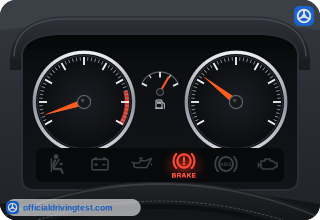
- That your brakes are not working
- That the brake fluid was just changed
- That the tires need air
- That the ABS is working normally
Show answer
Correct answer: That your brakes are not working
A brake warning light tells you that your brakes are not working, and you should not drive if you see it.
Source: Maine Driver’s License Manual (Rev 4/24), page 9-5 · Open this page in the manual (Manual page 9-5)
-
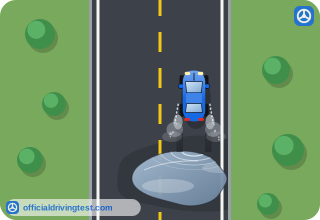
What should you always do after driving through deep water?
- Turn on the windshield wipers
- Check the tire pressure
- Test the brakes
- Shift to a lower gear for a mile
Show answer
Correct answer: Test the brakes
You always test the brakes after driving through deep water.
Source: Maine Driver’s License Manual (Rev 4/24), page 9-5 · Open this page in the manual (Manual page 9-5)
-
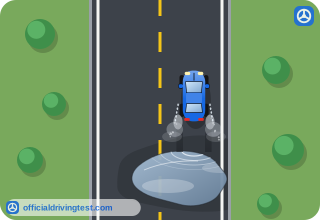
What can happen to your brakes after driving through deep water?
- They will always work better than before
- They may pull you to one side or not work at all
- They will lock the wheels at once at any speed
- They will only work at low speeds
Show answer
Correct answer: They may pull you to one side or not work at all
After deep water the brakes may pull you to one side, or they may not work at all.
Source: Maine Driver’s License Manual (Rev 4/24), page 9-5 · Open this page in the manual (Manual page 9-5)
-
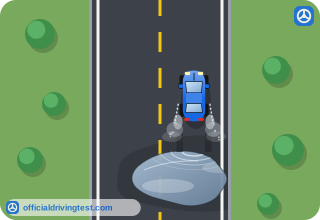
How does the manual say to "dry" wet brakes?
- Drive fast so the wind blows the water away
- Pump the brakes hard while stopped
- Keep your foot off the brake for a full mile
- Drive slowly and brake lightly for a short distance
Show answer
Correct answer: Drive slowly and brake lightly for a short distance
You dry the brakes by driving slowly and putting your brakes on lightly for a short distance.
Source: Maine Driver’s License Manual (Rev 4/24), page 9-5 · Open this page in the manual (Manual page 9-5)
-
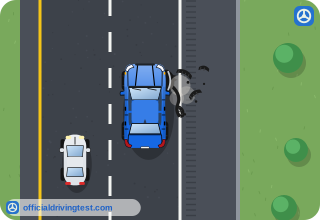
What happens if a front tire blows out?
- Your vehicle pulls hard toward the blown tire
- Your vehicle pulls hard away from the blown tire
- Your vehicle wobbles and shakes but stays straight
- Your vehicle steers normally
Show answer
Correct answer: Your vehicle pulls hard toward the blown tire
If a front tire blows out, your vehicle will pull hard toward the blown tire.
Source: Maine Driver’s License Manual (Rev 4/24), page 9-5 · Open this page in the manual (Manual page 9-5)
-
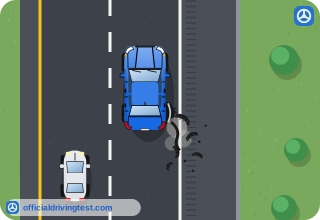
What happens if a rear tire blows out?
- The vehicle pulls hard away from the blown tire
- The vehicle drifts straight with no change
- It wobbles, shakes, and pulls toward the blown tire
- The rear of the vehicle lifts and stops quickly
Show answer
Correct answer: It wobbles, shakes, and pulls toward the blown tire
If a rear tire blows out, the vehicle will wobble, shake, and pull toward the blown tire.
Source: Maine Driver’s License Manual (Rev 4/24), page 9-5 · Open this page in the manual (Manual page 9-5)
-
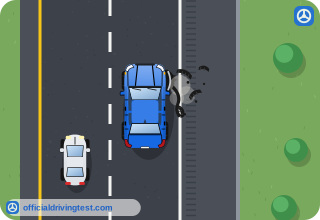
If a tire goes flat, how should you handle the steering wheel?
- Turn it sharply toward the blown tire
- Grip it firmly and steer straight
- Loosen your grip and let the car drift
- Steer toward the shoulder at once
Show answer
Correct answer: Grip it firmly and steer straight
When a tire goes flat you grip the steering wheel firmly and steer straight.
Source: Maine Driver’s License Manual (Rev 4/24), page 9-5 · Open this page in the manual (Manual page 9-5)
-
If a tire goes flat, how should you slow the vehicle?
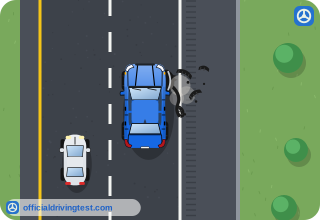
- Slam on the brakes to stop quickly
- Press the gas pedal to keep speed until you reach the shoulder
- Shift into park right away
- Slow gradually and take your foot off the gas pedal
Show answer
Correct answer: Slow gradually and take your foot off the gas pedal
When a tire goes flat, take your foot off the gas pedal and let the vehicle slow down gradually.
Source: Maine Driver’s License Manual (Rev 4/24), page 9-5 · Open this page in the manual (Manual page 9-5)
-
After a tire blowout, where should you stop the vehicle?
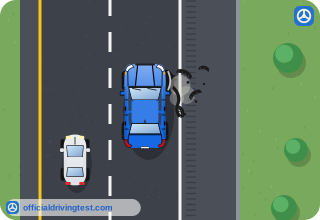
- Pull off in a safe place and turn on emergency flashers
- In the middle of the road with the hood up
- Right where the tire blew out, in your own lane
- In the left lane, away from the shoulder
Show answer
Correct answer: Pull off in a safe place and turn on emergency flashers
You do not stop on the road; you pull off the road in a safe place and turn on the emergency flashers.
Source: Maine Driver’s License Manual (Rev 4/24), page 9-6 · Open this page in the manual (Manual page 9-6)
-
If your vehicle is speeding out of control because of a stuck gas pedal, where should you keep your eyes?
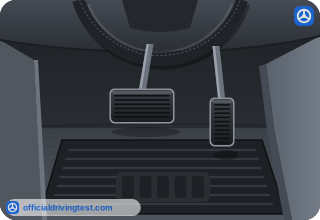
- On the speedometer
- On the gas pedal
- On the road
- On the gearshift
Show answer
Correct answer: On the road
With a stuck gas pedal you keep your eyes on the road.
Source: Maine Driver’s License Manual (Rev 4/24), page 9-6 · Open this page in the manual (Manual page 9-6)
-
If your vehicle is speeding out of control because of a stuck gas pedal, what does the manual say to do with the gearshift?
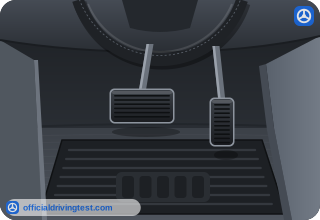
- Shift to park
- Shift to neutral
- Shift to reverse
- Shift to the highest gear
Show answer
Correct answer: Shift to neutral
With a stuck gas pedal you shift to neutral.
Source: Maine Driver’s License Manual (Rev 4/24), page 9-6 · Open this page in the manual (Manual page 9-6)
-
When the gas pedal is stuck, how should you use the steering and brakes?
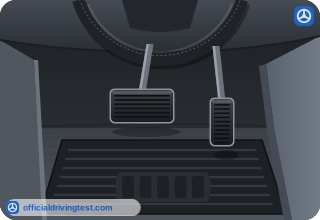
- Brake as hard as you can and then steer
- Steer sharply and avoid the brakes
- Pump the brakes and take your hands off the wheel
- Steer smoothly and gently put on the brakes
Show answer
Correct answer: Steer smoothly and gently put on the brakes
The manual says to steer smoothly and gently put on the brakes.
Source: Maine Driver’s License Manual (Rev 4/24), page 9-6 · Open this page in the manual (Manual page 9-6)
-
With a stuck gas pedal, when does the manual say to turn off the engine?
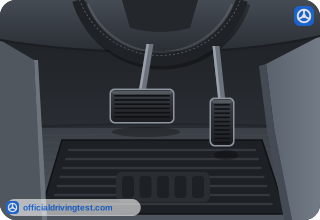
- As you bring your car to a stop
- Immediately, before you steer
- Before you shift to neutral
- After you get out of the car
Show answer
Correct answer: As you bring your car to a stop
You turn off the engine as you bring your car to a stop after finding a safe place to pull off.
Source: Maine Driver’s License Manual (Rev 4/24), page 9-6 · Open this page in the manual (Manual page 9-6)
-
If you cannot free a stuck gas pedal so that it does not get stuck again, what should you do?
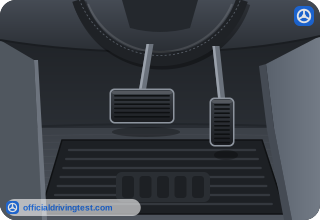
- Drive slowly to the nearest repair shop
- Drive using only the brakes
- Call for assistance and do not try to drive the car
- Hold the pedal up with your foot while you drive
Show answer
Correct answer: Call for assistance and do not try to drive the car
If you cannot free the pedal so that it does not get stuck again, you call for assistance and do not try to drive the car.
Source: Maine Driver’s License Manual (Rev 4/24), page 9-6 · Open this page in the manual (Manual page 9-6)
-
Why does the manual say you should make sure other drivers can see a vehicle that has broken down?
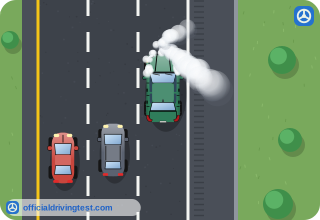
- Police will tow any vehicle that other drivers cannot see
- Drivers may not see it until it is too late to stop
- Disabled vehicles always catch fire within a few minutes
- Insurance rules require every vehicle to be visible
Show answer
Correct answer: Drivers may not see it until it is too late to stop
Crashes often happen because drivers do not see a disabled vehicle until it’s too late to stop.
Source: Maine Driver’s License Manual (Rev 4/24), page 9-6 · Open this page in the manual (Manual page 9-6)
-
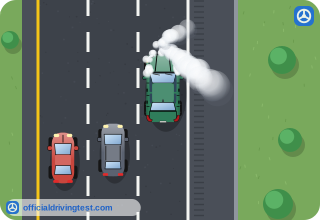
If your vehicle breaks down, what does the manual say to do with it first?
- Leave it in the lane and stand behind it
- Push it into the left lane
- Leave it running and walk for help
- Get it off the road and away from traffic
Show answer
Correct answer: Get it off the road and away from traffic
If you have a breakdown, you get your vehicle off the road and away from traffic.
Source: Maine Driver’s License Manual (Rev 4/24), page 9-6 · Open this page in the manual (Manual page 9-6)
-
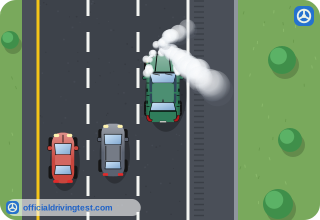
If your vehicle breaks down, which lights should you turn on?
- Your emergency flashers
- Your high beams
- Your fog lights
- Your interior dome light only
Show answer
Correct answer: Your emergency flashers
When you have a breakdown you turn on your emergency flashers.
Source: Maine Driver’s License Manual (Rev 4/24), page 9-6 · Open this page in the manual (Manual page 9-6)
-
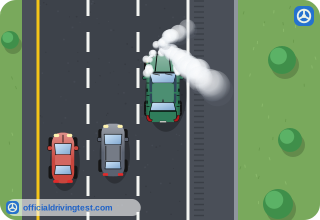
If your vehicle breaks down, whom does the manual say to call about the breakdown?
- The BMV
- Your auto insurance company
- The police
- The railroad
Show answer
Correct answer: The police
After a breakdown you call the police about the breakdown.
Source: Maine Driver’s License Manual (Rev 4/24), page 9-6 · Open this page in the manual (Manual page 9-6)
-
What does the manual say causes an engine to become flooded?
- Too little oil in the engine
- Too much gas in the cylinders
- A weak battery
- Water in the radiator
Show answer
Correct answer: Too much gas in the cylinders
Engines become flooded when there is too much gas in the cylinders, which makes it impossible for the gas to burn.
Source: Maine Driver’s License Manual (Rev 4/24), page 9-6 · Open this page in the manual (Manual page 9-6)
-
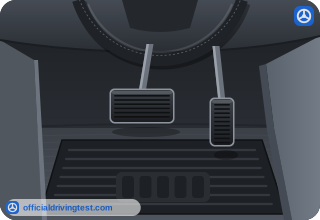
If your engine floods, what should you do with the gas pedal while you turn the key?
- Pump it quickly several times in a row
- Keep your foot off it until the engine starts
- Tap it lightly once and then let go
- Press it to the floor and hold it there
Show answer
Correct answer: Press it to the floor and hold it there
For a flooded engine you press the gas pedal to the floor and hold it there, and do not pump the gas pedal.
Source: Maine Driver’s License Manual (Rev 4/24), page 9-6 · Open this page in the manual (Manual page 9-6)
-
If your engine floods and you are holding the gas pedal down, when should you let off the pedal?
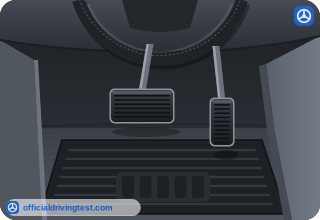
- When the engine starts
- As soon as you turn the key
- After ten minutes
- After the engine has cooled
Show answer
Correct answer: When the engine starts
You turn the key and let off on the pedal when the engine starts.
Source: Maine Driver’s License Manual (Rev 4/24), page 9-6 · Open this page in the manual (Manual page 9-6)
-
If pressing the gas pedal to the floor does not start a flooded engine, what does the manual say to do?
- Pump the gas pedal quickly until it starts
- Pour a little water into the engine cylinders
- Wait about ten minutes, and then repeat the steps
- Restart the engine at once and keep trying
Show answer
Correct answer: Wait about ten minutes, and then repeat the steps
If the first attempt doesn't work, you wait about ten minutes and then repeat the steps.
Source: Maine Driver’s License Manual (Rev 4/24), page 9-6 · Open this page in the manual (Manual page 9-6)
-
If there is an oncoming car in your lane, how should you warn the other driver?
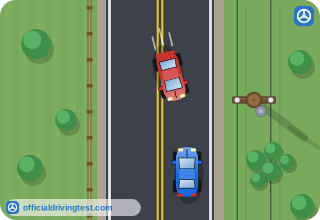
- Blow your horn and flash your lights
- Turn on your emergency flashers only
- Wave your arm out the window
- Turn off your headlights
Show answer
Correct answer: Blow your horn and flash your lights
You blow your horn and flash your lights to warn the other driver.
Source: Maine Driver’s License Manual (Rev 4/24), page 9-7 · Open this page in the manual (Manual page 9-7)
-
If there is an oncoming car in your lane, how should you brake?
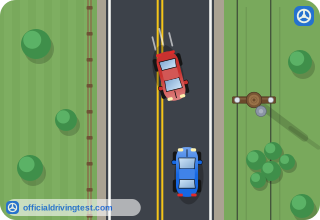
- Brake only after you reach the shoulder
- Do not brake and speed up to pass the other car
- Brake quickly, but not so fast that you lock the wheels
- Brake gently so you do not alarm the other driver
Show answer
Correct answer: Brake quickly, but not so fast that you lock the wheels
You brake quickly, but not so fast that you lock your wheels and lose control.
Source: Maine Driver’s License Manual (Rev 4/24), page 9-7 · Open this page in the manual (Manual page 9-7)
-
If there is an oncoming car in your lane, where should you go?
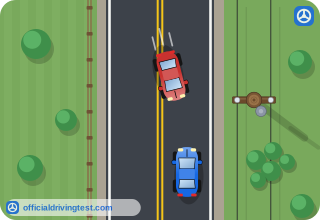
- Into the left lane
- Into the right shoulder or ditch
- Straight ahead without changing lanes
- Into the center of the road
Show answer
Correct answer: Into the right shoulder or ditch
You quickly pull off into the right shoulder or ditch and do not drive into the left lane.
Source: Maine Driver’s License Manual (Rev 4/24), page 9-7 · Open this page in the manual (Manual page 9-7)
-
When jump-starting a car, where does the first jumper cable attach?
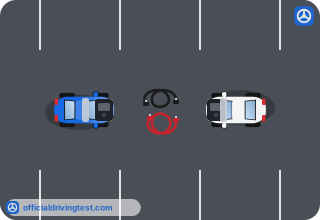
- To the negative terminal of the dead battery
- To the negative terminal of the good battery
- To the engine block of the working car
- To the positive terminal of the dead battery
Show answer
Correct answer: To the positive terminal of the dead battery
The first jumper cable is attached to the positive terminal of the dead battery.
Source: Maine Driver’s License Manual (Rev 4/24), page 9-7 · Open this page in the manual (Manual page 9-7)
-
When jump-starting a car, one cable is on the positive terminal of the dead battery. Where does the other end of that cable go?
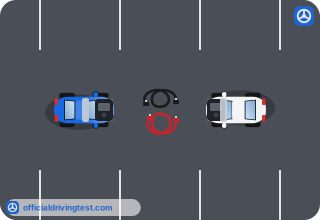
- To the positive terminal of a working battery
- To the negative terminal of a working battery
- To the engine block of the stalled engine
- To the negative terminal of the dead battery
Show answer
Correct answer: To the positive terminal of a working battery
The other end of that cable goes to the positive terminal of a working battery.
Source: Maine Driver’s License Manual (Rev 4/24), page 9-7 · Open this page in the manual (Manual page 9-7)
-
When jump-starting, after the first cable joins the positive terminals of both batteries, where does the second cable attach on the good battery?
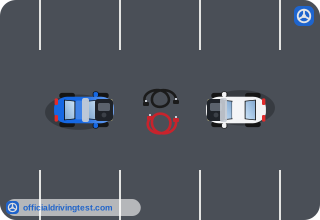
- To the positive terminal
- To the engine block
- To the negative terminal
- To the hood latch
Show answer
Correct answer: To the negative terminal
The second cable is attached to the negative terminal of the good battery.
Source: Maine Driver’s License Manual (Rev 4/24), page 9-7 · Open this page in the manual (Manual page 9-7)
-
When jump-starting a car, where does the last clamp attach?
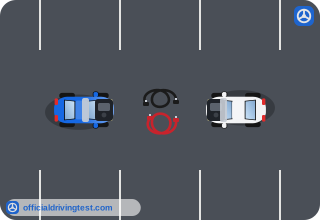
- To the negative terminal of the dead battery
- To the engine block of the stalled engine
- To the positive terminal of the good battery
- To the frame of the working car
Show answer
Correct answer: To the engine block of the stalled engine
The last clamp is attached to the engine block of the stalled engine.
Source: Maine Driver’s License Manual (Rev 4/24), page 9-7 · Open this page in the manual (Manual page 9-7)
-
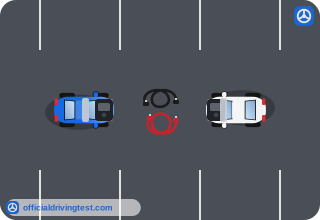
When jump-starting a car, which car do you start first?
- The car with the dead battery
- Both at the same time
- Neither, until the clamps are removed
- The car with the good battery
Show answer
Correct answer: The car with the good battery
You start the car with the good battery first, and after a bit of charging start the car with the dead battery.
Source: Maine Driver’s License Manual (Rev 4/24), page 9-7 · Open this page in the manual (Manual page 9-7)
-
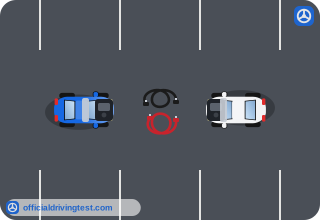
After a jump-start, how long does the manual say to let both cars run?
- For a few minutes
- For at least one hour
- Only until the dead car starts
- For ten minutes with the lights on
Show answer
Correct answer: For a few minutes
You allow both cars to run for a few minutes to more fully recharge the dead battery.
Source: Maine Driver’s License Manual (Rev 4/24), page 9-7 · Open this page in the manual (Manual page 9-7)
-
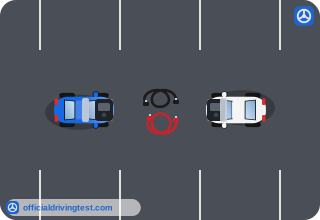
Once the car is started after a jump-start, in what order do you remove the clamps?
- In the same order that the connections were made
- Starting with the positive terminals
- In the reverse order that the connections were made
- Starting with the engine block, then any order
Show answer
Correct answer: In the reverse order that the connections were made
You remove the clamps in the reverse order that the connections were made.
Source: Maine Driver’s License Manual (Rev 4/24), page 9-7 · Open this page in the manual (Manual page 9-7)