Louisiana: Interstate driving
Entering and exiting the interstate, merging, lane choice, keeping a space cushion and the parts of the highway system. Split into 3 shorter tests so you're not stuck in one long quiz.
Independent educational site · not affiliated with any government agency or DMV
Choose a part
Interstate driving — Part 1
Questions in this part include: “On what is the design of a highway based?”
StartInterstate driving — Part 2
Questions in this part include: “Why does the manual tell you to plan your interstate route in advance?”
StartInterstate driving — Part 3
Questions in this part include: “About how much room do you need to get up to the speed of interstate traffic when you enter from a full stop?”
StartAll 55 Interstate driving questions with answers
Choose a part above to take a practice test, or study every question and answer here.
Show the questions and answersHide the questions
-
On what is the design of a highway based?
- The number of crashes on other highways in the same parish
- The size of the parish that regulates and maintains it
- The speed limit set by the nearest traffic court
- The anticipated volume and composition of the traffic using it
Show answer
Correct answer: The anticipated volume and composition of the traffic using it
The manual says the design of a highway, including lane width, shoulder width and the median, is based on the anticipated volume and composition of the traffic using it.
Source: Class D & E Driver’s Guide (Revised August 2025 (DPSMV2052 R08/25)), page 20 · Open this page in the manual (Manual page 20)
-
Which direction do EVEN numbered Interstate highways run?
- East and West
- North and South
- Northeast and Southwest
- Northwest and Southeast
Show answer
Correct answer: East and West
The manual says EVEN numbered Interstate highways go East and West.
Source: Class D & E Driver’s Guide (Revised August 2025 (DPSMV2052 R08/25)), page 20 · Open this page in the manual (Manual page 20)
-
What is a parish road?
- A road that is regulated by the state and numbered like LA 1
- A nationally regulated road that came before the Interstate program
- A road that is regulated and maintained by a certain parish
- A divided road with lots of trees and plants that is usually scenic
Show answer
Correct answer: A road that is regulated and maintained by a certain parish
The manual defines a parish road as a road that is regulated and maintained by a certain parish.
Source: Class D & E Driver’s Guide (Revised August 2025 (DPSMV2052 R08/25)), page 20 · Open this page in the manual (Manual page 20)
-
Which route does the manual give as an example of a state highway?
- US 1
- LA 1
- US 6
- Parish 1
Show answer
Correct answer: LA 1
The manual describes a state highway as a highway regulated by the state and gives LA 1 as the example.
Source: Class D & E Driver’s Guide (Revised August 2025 (DPSMV2052 R08/25)), page 20 · Open this page in the manual (Manual page 20)
-
Which type of highway is nationally regulated and is a predecessor to the Interstate Highway program?
- A parish road
- A state highway
- A parkway
- A U.S. highway
Show answer
Correct answer: A U.S. highway
The manual describes a U.S. highway as a nationally regulated highway that is a predecessor to the Interstate Highway program.
Source: Class D & E Driver’s Guide (Revised August 2025 (DPSMV2052 R08/25)), page 20 · Open this page in the manual (Manual page 20)
-
According to the manual, who created the Interstate Highways in the 1950s?
- Dwight D. Eisenhower
- Theodore Roosevelt
- Franklin D. Roosevelt
- Harry S. Truman
Show answer
Correct answer: Dwight D. Eisenhower
The manual says the Interstate Highways were created by Dwight D. Eisenhower in the 1950s.
Source: Class D & E Driver’s Guide (Revised August 2025 (DPSMV2052 R08/25)), page 20 · Open this page in the manual (Manual page 20)
-
An expressway is a divided highway with at least how many lanes?
- 2
- 3
- 4
- 6
Show answer
Correct answer: 4
The manual defines expressways as divided highways with at least 4 lanes.
Source: Class D & E Driver’s Guide (Revised August 2025 (DPSMV2052 R08/25)), page 20 · Open this page in the manual (Manual page 20)
-
Which term, meaning the same as expressway, is used out west, especially in California?
- Parkway
- Freeway
- Toll road
- Parish road
Show answer
Correct answer: Freeway
The manual says freeway means the same as expressway and is the term used out west, especially in California.
Source: Class D & E Driver’s Guide (Revised August 2025 (DPSMV2052 R08/25)), page 20 · Open this page in the manual (Manual page 20)
-
On a toll way, tollbooths are usually how far apart?
- About ten miles
- About twenty-five miles
- About fifty miles
- A couple of miles
Show answer
Correct answer: A couple of miles
The manual says tolls are usually collected from tollbooths a couple of miles apart on a toll way.
Source: Class D & E Driver’s Guide (Revised August 2025 (DPSMV2052 R08/25)), page 20 · Open this page in the manual (Manual page 20)
-
Which pair describes how a toll may be collected on a toll way?
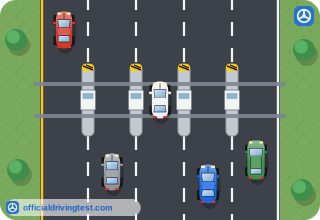
- By ticket or by a prepaid pass
- Only by a ticket from a tollbooth
- Only by a prepaid pass bought in advance
- By cash paid to an officer at the roadside
Show answer
Correct answer: By ticket or by a prepaid pass
The manual says the toll on a toll way may be collected by ticket or a prepaid pass.
Source: Class D & E Driver’s Guide (Revised August 2025 (DPSMV2052 R08/25)), page 20 · Open this page in the manual (Manual page 20)
-
Which kind of divided highway has lots of trees and plants around it and is usually very beautiful and scenic?
- A freeway
- An expressway
- A parkway
- A limited access highway
Show answer
Correct answer: A parkway
The manual describes a parkway as a divided highway with lots of trees and plants around it, usually very beautiful and scenic.
Source: Class D & E Driver’s Guide (Revised August 2025 (DPSMV2052 R08/25)), page 20 · Open this page in the manual (Manual page 20)
-
What is a divided highway?
- A highway whose lanes are divided by painted stripes into speed zones
- A highway with lanes going in opposite directions divided by a median or barrier
- A highway split into sections regulated by different parishes
- A highway that carries toll traffic in one lane and free traffic in another
Show answer
Correct answer: A highway with lanes going in opposite directions divided by a median or barrier
The manual defines a divided highway as a highway with lanes going in opposite directions divided by a median or some sort of barrier between them.
Source: Class D & E Driver’s Guide (Revised August 2025 (DPSMV2052 R08/25)), page 20 · Open this page in the manual (Manual page 20)
-
What is a limited access highway?
- A highway that carries only vehicles under a set weight
- A highway that collects tolls from the drivers who use it
- A highway with no median or barrier between opposing lanes
- A highway where access is limited to signed exits
Show answer
Correct answer: A highway where access is limited to signed exits
The manual defines a limited access highway as one where access is limited to signed exits.
Source: Class D & E Driver’s Guide (Revised August 2025 (DPSMV2052 R08/25)), page 20 · Open this page in the manual (Manual page 20)
-
What is a partial access highway?
- A highway that allows access at other streets, but not at driveways
- A highway where access is allowed only at signed exits
- A highway that has no median or barrier between opposing lanes
- A highway that allows driveways but not access from other streets
Show answer
Correct answer: A highway that allows access at other streets, but not at driveways
The manual says a partial access highway allows access at other streets, while driveways and other forms of access are not allowed.
Source: Class D & E Driver’s Guide (Revised August 2025 (DPSMV2052 R08/25)), page 20 · Open this page in the manual (Manual page 20)
-
Newer highways are designed with which features in an effort to reduce the number of crashes?
- Narrower shoulders, sharper curves and steeper grades
- More roadside signs, trees and utility poles
- Wider shoulders, gentle curves and grades
- Shorter exit ramps and fewer lanes
Show answer
Correct answer: Wider shoulders, gentle curves and grades
The manual says newer highways are designed with wider shoulders, gentle curves and grades in an effort to reduce the number of crashes.
Source: Class D & E Driver’s Guide (Revised August 2025 (DPSMV2052 R08/25)), page 20 · Open this page in the manual (Manual page 20)
-
Why is reduction of roadside obstacles necessary?
- To make it easier for drivers to read road signs from far away
- To reduce the severity of injury if a vehicle leaves the highway
- To allow vehicles to park safely beside the highway at any time
- To let engineers build narrower shoulders on newer highways
Show answer
Correct answer: To reduce the severity of injury if a vehicle leaves the highway
The manual says reducing roadside obstacles is necessary to reduce the severity of injury if a vehicle leaves the highway.
Source: Class D & E Driver’s Guide (Revised August 2025 (DPSMV2052 R08/25)), page 20 · Open this page in the manual (Manual page 20)
-
In areas of the country where snow is common, engineers design roads with areas beside them for what?
- Parking
- Snow storage
- Toll collection
- Truck weighing
Show answer
Correct answer: Snow storage
The manual says that where snow is common, engineers design roads with areas beside them for snow storage.
Source: Class D & E Driver’s Guide (Revised August 2025 (DPSMV2052 R08/25)), page 21 · Open this page in the manual (Manual page 21)
-
Which is an example of forgiving roadside hardware that helps minimize the severity of collisions?
- Breakaway poles and guard rails
- Fixed steel signposts and utility poles
- Concrete walls beside the shoulder
- Rigid metal posts set in concrete
Show answer
Correct answer: Breakaway poles and guard rails
The manual gives breakaway poles and guard rails as examples of forgiving roadside hardware that helps minimize the severity of collisions.
Source: Class D & E Driver’s Guide (Revised August 2025 (DPSMV2052 R08/25)), page 21 · Open this page in the manual (Manual page 21)
-
When a highway is divided into two roadways by a median or barrier, when may you drive across the median or barrier?
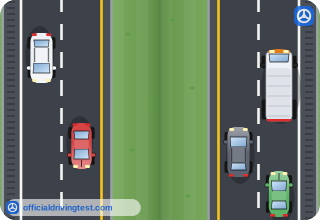
- Whenever no traffic is approaching in either direction
- Only where an approved cross-over is provided
- Only when you are making a legal U-turn at a signal
- Only when a police officer is present to direct traffic
Show answer
Correct answer: Only where an approved cross-over is provided
The guide says you must not drive across the median or barrier except when an approved cross-over is provided.
Source: Class D & E Driver’s Guide (Revised August 2025 (DPSMV2052 R08/25)), page 87 · Open this page in the manual (Manual page 87)
-
Why does the manual tell you to plan your interstate route in advance?
- Entrances and exits may be far apart
- Interstate exits are not marked with signs
- Entrance ramps are closed to new traffic at night
- Each interstate lane changes direction at every exit
Show answer
Correct answer: Entrances and exits may be far apart
Interstate entrances and exits may be far apart, so you should plan your route in advance and know where you will enter and exit.
Source: Class D & E Driver’s Guide (Revised August 2025 (DPSMV2052 R08/25)), page 100 · Open this page in the manual (Manual page 100)
-
Why should you make sure your vehicle is in good working condition before an interstate trip?
- Interstate police stop vehicles that are not inspected
- Tow trucks are not allowed on interstate highways
- There are few service stations along some remote stretches
- Interstate exits are closed to vehicles that break down
Show answer
Correct answer: There are few service stations along some remote stretches
There are few service stations along some remote stretches of interstate, so running out of gas or a breakdown can put you in serious trouble.
Source: Class D & E Driver’s Guide (Revised August 2025 (DPSMV2052 R08/25)), page 100 · Open this page in the manual (Manual page 100)
-
Before an interstate trip you check your gas, water, oil and tires. What else does the manual say not to forget to check?
- Your registration sticker
- Your spare tire
- Your trailer hitch
- Your sun visor
Show answer
Correct answer: Your spare tire
The manual lists gas, water, oil and tires and adds that you should not forget to check your spare tire.
Source: Class D & E Driver’s Guide (Revised August 2025 (DPSMV2052 R08/25)), page 100 · Open this page in the manual (Manual page 100)
-
What should you expect at on ramps and interchanges when driving on an interstate?
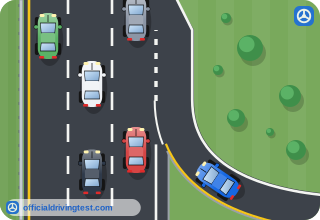
- Pedestrians crossing the lanes
- Cross traffic controlled by stop signs
- Vehicles backing into the lane
- Merging vehicles
Show answer
Correct answer: Merging vehicles
The manual says to expect merging vehicles at on ramps and interchanges.
Source: Class D & E Driver’s Guide (Revised August 2025 (DPSMV2052 R08/25)), page 100 · Open this page in the manual (Manual page 100)
-
On an interstate, what does the manual say you should know so you can use them if you need to?
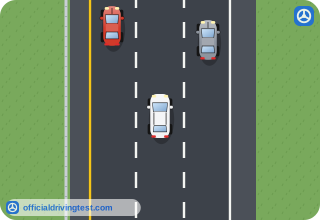
- Which lanes are clear
- Where the next service station is
- Which vehicles are about to exit
- Where the nearest police unit is
Show answer
Correct answer: Which lanes are clear
The manual tells you to leave yourself an out by knowing which lanes are clear so you can use them if you need to.
Source: Class D & E Driver’s Guide (Revised August 2025 (DPSMV2052 R08/25)), page 100 · Open this page in the manual (Manual page 100)
-
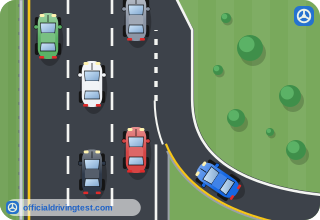
Whenever you enter traffic, what does the manual tell you to do?
- Sound your horn and wait for drivers to make room for you
- Flash your headlights and enter at the minimum posted speed
- Signal and be sure you have enough space to enter safely
- Stop and wait until the lane next to you is empty
Show answer
Correct answer: Signal and be sure you have enough space to enter safely
The manual says that whenever you enter traffic you should signal and be sure you have enough space to enter safely.
Source: Class D & E Driver’s Guide (Revised August 2025 (DPSMV2052 R08/25)), page 100 · Open this page in the manual (Manual page 100)
-
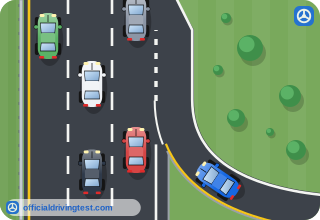
At what speed should you enter the interstate?
- At least 10 mph under the speed of traffic
- At or near the speed of traffic
- At a slow speed until you are in the right-hand lane
- At the speed you will use for exiting
Show answer
Correct answer: At or near the speed of traffic
The manual says to enter the interstate at or near the speed of traffic.
Source: Class D & E Driver’s Guide (Revised August 2025 (DPSMV2052 R08/25)), page 100 · Open this page in the manual (Manual page 100)
-
What is the maximum speed allowed on the interstate unless otherwise posted?
- 55 miles per hour
- 60 miles per hour
- 65 miles per hour
- 70 miles per hour
Show answer
Correct answer: 70 miles per hour
The manual says the maximum speed allowed on the interstate is 70 miles per hour unless otherwise posted.
Source: Class D & E Driver’s Guide (Revised August 2025 (DPSMV2052 R08/25)), page 100 · Open this page in the manual (Manual page 100)
-
On the interstate, when may you drive slower than the posted minimum speed?
- When weather or road conditions demand a slower speed
- When you are driving in the right-hand lane of the road
- When you are looking for the exit you want to use
- When no vehicles are close behind you on the road
Show answer
Correct answer: When weather or road conditions demand a slower speed
You should not drive slower than the posted minimum speed unless the weather or road conditions demand a slower speed.
Source: Class D & E Driver’s Guide (Revised August 2025 (DPSMV2052 R08/25)), page 100 · Open this page in the manual (Manual page 100)
-
What should you always try to do about your speed when driving on the interstate?
- Vary it to keep other drivers alert
- Raise it each time you pass an exit
- Drive at a steady speed
- Match the fastest vehicle near you
Show answer
Correct answer: Drive at a steady speed
The manual says to always try to drive at a steady speed on the interstate.
Source: Class D & E Driver’s Guide (Revised August 2025 (DPSMV2052 R08/25)), page 100 · Open this page in the manual (Manual page 100)
-
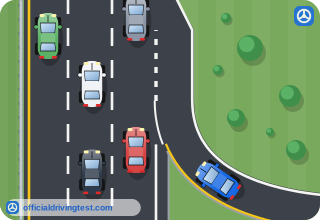
What should you do while you are on the entrance ramp?
- Move slowly to the end of the ramp and stop
- Begin checking traffic and look for a gap in the approaching traffic
- Stop at the start of the ramp until the lane is empty
- Wait at the end of the ramp for traffic to give you space
Show answer
Correct answer: Begin checking traffic and look for a gap in the approaching traffic
The manual says to begin checking traffic while on the entrance ramp and to look for a gap, not to move slowly to the end and stop.
Source: Class D & E Driver’s Guide (Revised August 2025 (DPSMV2052 R08/25)), page 100 · Open this page in the manual (Manual page 100)
-
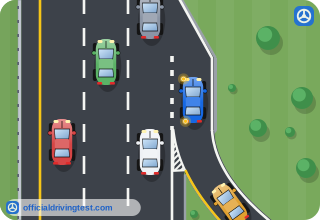
After you look for a gap in the approaching interstate traffic, what does the manual tell you to do?
- Stop at the end of the ramp and wait for it
- Sound your horn so drivers make room
- Wait for a driver to flash you in
- Adjust your speed to meet that gap
Show answer
Correct answer: Adjust your speed to meet that gap
The manual says to look for a gap in the approaching traffic and then adjust your speed to meet that gap.
Source: Class D & E Driver’s Guide (Revised August 2025 (DPSMV2052 R08/25)), page 100 · Open this page in the manual (Manual page 100)
-
As you merge onto the interstate, how fast should you be traveling?
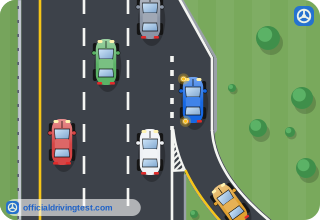
- The same speed as other traffic
- Slower than traffic so drivers notice you
- Faster than traffic so you can pass them
- The speed posted on the ramp
Show answer
Correct answer: The same speed as other traffic
The manual says that as you merge you should make sure you are traveling the same speed as other traffic.
Source: Class D & E Driver’s Guide (Revised August 2025 (DPSMV2052 R08/25)), page 100 · Open this page in the manual (Manual page 100)
-
When may you stop before merging with interstate traffic?
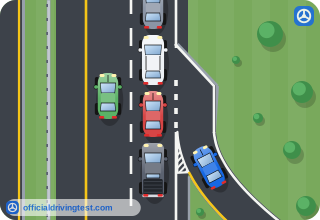
- Whenever traffic is heavy
- Whenever you reach the end of the ramp
- Only when it is absolutely necessary
- Whenever another driver is close behind you
Show answer
Correct answer: Only when it is absolutely necessary
The manual says not to stop before merging with interstate traffic unless it is absolutely necessary.
Source: Class D & E Driver’s Guide (Revised August 2025 (DPSMV2052 R08/25)), page 100 · Open this page in the manual (Manual page 100)
-
Which is true about other drivers when you enter an interstate?
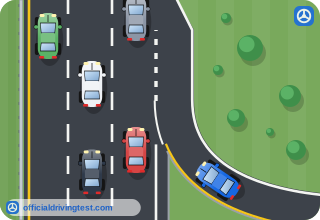
- They must stop to let entering vehicles in
- They will signal when they have left room for you
- They will always see you as you come up the ramp
- You can’t always count on them seeing you or moving over
Show answer
Correct answer: You can’t always count on them seeing you or moving over
The manual warns that you can’t always count on other drivers either seeing you or moving over to give you space to enter.
Source: Class D & E Driver’s Guide (Revised August 2025 (DPSMV2052 R08/25)), page 100 · Open this page in the manual (Manual page 100)
-
When you merge into interstate traffic, what size gap do you need?
- Four seconds
- Two seconds
- Six seconds
- Eight seconds
Show answer
Correct answer: Four seconds
The manual says you need a gap of four seconds when you merge into traffic.
Source: Class D & E Driver’s Guide (Revised August 2025 (DPSMV2052 R08/25)), page 101 · Open this page in the manual (Manual page 101)
-
Besides using your mirrors and turn signals, what should you do before changing lanes on the interstate?
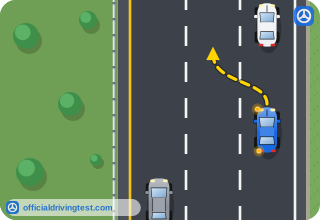
- Move to the center of your lane
- Turn your head to look quickly to the side
- Slow down to the posted minimum speed
- Sound your horn
Show answer
Correct answer: Turn your head to look quickly to the side
The manual says to use your mirrors and turn signals and to turn your head to look quickly to the side before changing lanes.
Source: Class D & E Driver’s Guide (Revised August 2025 (DPSMV2052 R08/25)), page 101 · Open this page in the manual (Manual page 101)
-
At a short acceleration lane in heavy traffic, why is it dangerous when cars stop and wait for a large enough gap?
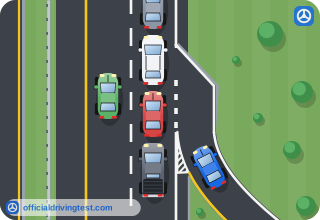
- The acceleration lane is closed to any vehicle that stops
- Interstate traffic must stop to let them in
- Drivers there cannot use turn signals
- Rear-end collision risk and the need for fast acceleration
Show answer
Correct answer: Rear-end collision risk and the need for fast acceleration
The manual calls this situation dangerous because of the risk of rear-end collisions and the need for fast acceleration to enter traffic.
Source: Class D & E Driver’s Guide (Revised August 2025 (DPSMV2052 R08/25)), page 101 · Open this page in the manual (Manual page 101)
-
About how much room do you need to get up to the speed of interstate traffic when you enter from a full stop?
- About a full block
- About one car length
- About a half mile
- About three blocks
Show answer
Correct answer: About a full block
The manual says that to enter traffic from a full stop you will need about a full block to get up to the speed of the other vehicles.
Source: Class D & E Driver’s Guide (Revised August 2025 (DPSMV2052 R08/25)), page 101 · Open this page in the manual (Manual page 101)
-
Where should you stay on the interstate unless you are overtaking and passing, making an exit to the left, or letting another vehicle enter?
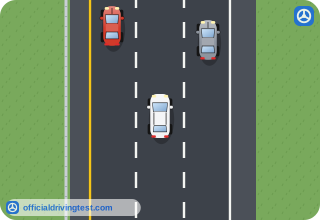
- In the middle lane
- In the far left lane
- In the right-hand lane
- In whichever lane has the least traffic
Show answer
Correct answer: In the right-hand lane
The manual says to stay in the right-hand lane unless overtaking and passing, making an exit to the left, or letting another vehicle enter.
Source: Class D & E Driver’s Guide (Revised August 2025 (DPSMV2052 R08/25)), page 101 · Open this page in the manual (Manual page 101)
-
On an interstate with three or more lanes in one direction, each with a specific function, where may you drive?
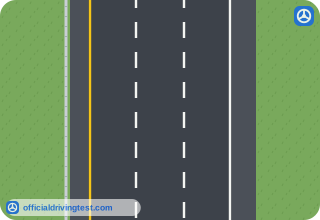
- Only in the right-hand lane
- In any lane
- Only in the middle lane
- Only in the far left lane
Show answer
Correct answer: In any lane
The manual says you may drive in any lane of an interstate with three or more lanes in one direction when each lane has a specific function.
Source: Class D & E Driver’s Guide (Revised August 2025 (DPSMV2052 R08/25)), page 101 · Open this page in the manual (Manual page 101)
-
On an interstate with three or more lanes in one direction, what is the right-hand lane used for?
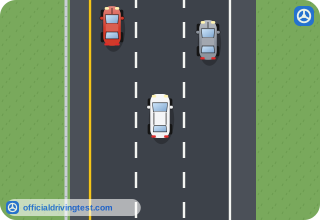
- Passing
- Through travel only
- Emergency vehicles only
- Exiting and entering
Show answer
Correct answer: Exiting and entering
The manual says the right-hand lane is used for exiting and entering.
Source: Class D & E Driver’s Guide (Revised August 2025 (DPSMV2052 R08/25)), page 101 · Open this page in the manual (Manual page 101)
-
On a multi-lane interstate, what is the middle lane often used as?
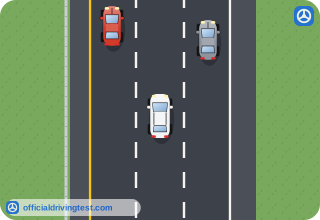
- The “travel” lane
- The slow-vehicle lane
- The emergency-vehicle lane
- The left-turn lane
Show answer
Correct answer: The “travel” lane
The manual says the middle lane is often used as the travel lane.
Source: Class D & E Driver’s Guide (Revised August 2025 (DPSMV2052 R08/25)), page 101 · Open this page in the manual (Manual page 101)
-
On a multi-lane interstate, what is the far left lane used for?
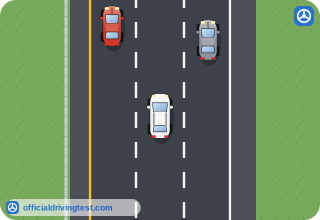
- Entering and exiting
- Slow-moving vehicles only
- Passing
- Emergency stops
Show answer
Correct answer: Passing
The manual says the far left lane is for passing.
Source: Class D & E Driver’s Guide (Revised August 2025 (DPSMV2052 R08/25)), page 101 · Open this page in the manual (Manual page 101)
-
Near most interstate entrance points you see a “merge” sign. What does it warn you to be ready to do?
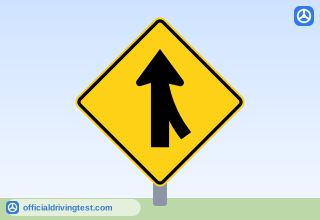
- Stop at the end of the lane and wait for a gap
- Adjust your speed or move into the left lane, if possible
- Leave the interstate at the next available exit
- Move into the right-hand lane to let others pass
Show answer
Correct answer: Adjust your speed or move into the left lane, if possible
The manual says the merge sign warns you to be ready to adjust your speed or move into the left lane, if possible, so other drivers can enter safely.
Source: Class D & E Driver’s Guide (Revised August 2025 (DPSMV2052 R08/25)), page 101 · Open this page in the manual (Manual page 101)
-
When you see an exit sign on the interstate, what should you be alert for in the right-hand lane?
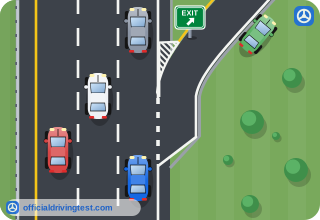
- Vehicles that speed up to pass you on the right
- Vehicles stopped on the shoulder waiting to merge
- Vehicles backing up to reach the exit
- Drivers who suddenly slow or swerve into an exit lane
Show answer
Correct answer: Drivers who suddenly slow or swerve into an exit lane
The manual warns to be alert for drivers who suddenly slow or who swerve into an exit lane at the last second.
Source: Class D & E Driver’s Guide (Revised August 2025 (DPSMV2052 R08/25)), page 101 · Open this page in the manual (Manual page 101)
-
To make room for vehicles entering an interstate, what should you do if there is no one next to you?
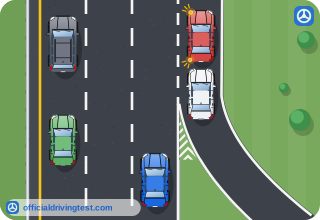
- Speed up past the ramp
- Slow down and stop
- Stay in your lane and flash your headlights
- Move over a lane
Show answer
Correct answer: Move over a lane
The manual says to make room for entering vehicles and, if no one is next to you, to move over a lane.
Source: Class D & E Driver’s Guide (Revised August 2025 (DPSMV2052 R08/25)), page 101 · Open this page in the manual (Manual page 101)
-
About how far before your exit should you check that you are in the correct lane to make the exit?
- About one block
- About 100 feet
- About five miles
- Approximately a mile
Show answer
Correct answer: Approximately a mile
The manual says to check, approximately a mile before your exit, that you are in the correct lane.
Source: Class D & E Driver’s Guide (Revised August 2025 (DPSMV2052 R08/25)), page 102 · Open this page in the manual (Manual page 102)
-
If you need to cross several lanes to reach the lane for your exit, how should you change lanes?
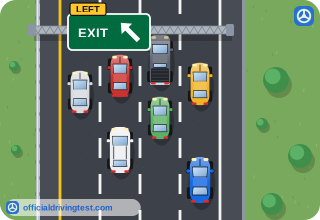
- One at a time
- All at once with a single signal
- Only after you pass the exit
- In one move from the far left lane
Show answer
Correct answer: One at a time
The manual says to change lanes one at a time until you are in the proper lane to make the exit safely.
Source: Class D & E Driver’s Guide (Revised August 2025 (DPSMV2052 R08/25)), page 102 · Open this page in the manual (Manual page 102)
-
For about how long should you signal your intention to leave the interstate?
- About one second
- About two seconds
- About five seconds
- About fifteen seconds
Show answer
Correct answer: About five seconds
The manual says to signal your intention for approximately five seconds.
Source: Class D & E Driver’s Guide (Revised August 2025 (DPSMV2052 R08/25)), page 102 · Open this page in the manual (Manual page 102)
-
When leaving the interstate traffic lane for an exit, why should your speed not be too slow?
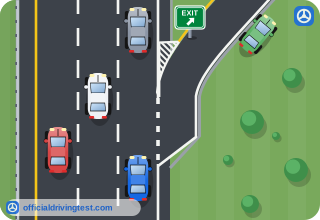
- So the exit sign stays in view
- So the flow of traffic can still move freely
- So the deceleration lane stays empty
- So you can reach the ramp speed sooner
Show answer
Correct answer: So the flow of traffic can still move freely
The manual says to leave the traffic lane at a proper speed, not too slow so the flow of traffic can still move freely.
Source: Class D & E Driver’s Guide (Revised August 2025 (DPSMV2052 R08/25)), page 102 · Open this page in the manual (Manual page 102)
-
If you miss your exit on the interstate, what should you do?
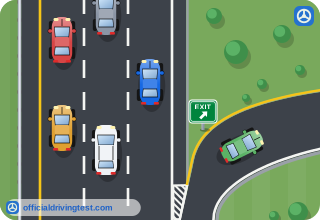
- Stop on the shoulder and wait for traffic to clear
- Back up carefully along the shoulder to your exit
- Slow down and back up in the right-hand lane
- Go on to the next exit and return to the exit you want
Show answer
Correct answer: Go on to the next exit and return to the exit you want
The manual says not to stop or back up if you miss your exit: go on to the next exit, get back on the interstate and return.
Source: Class D & E Driver’s Guide (Revised August 2025 (DPSMV2052 R08/25)), page 102 · Open this page in the manual (Manual page 102)
-
Where should you slow down when leaving the interstate?
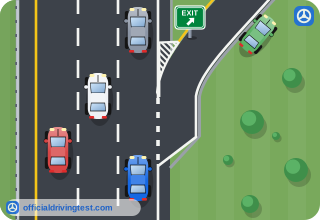
- In the deceleration lane, once you are fully in it
- In the right-hand lane just before the exit begins
- On the shoulder next to the start of the exit
- In the lane used for passing
Show answer
Correct answer: In the deceleration lane, once you are fully in it
The manual says never to slow down on the interstate itself but to wait until you are fully in the deceleration lane.
Source: Class D & E Driver’s Guide (Revised August 2025 (DPSMV2052 R08/25)), page 102 · Open this page in the manual (Manual page 102)
-
Once you are fully in the deceleration lane, to what speed should you reduce your speed?
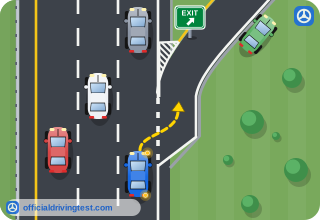
- The posted minimum speed
- The speed of interstate traffic
- The posted ramp speed
- About 20 miles per hour
Show answer
Correct answer: The posted ramp speed
The manual says to reduce your speed to the posted ramp speed once you are fully in the deceleration lane.
Source: Class D & E Driver’s Guide (Revised August 2025 (DPSMV2052 R08/25)), page 102 · Open this page in the manual (Manual page 102)
-
After you exit the interstate, what should you be aware of ahead?
- One-way traffic only
- Two-way traffic
- Higher speed limits
- Traffic signals on the ramp
Show answer
Correct answer: Two-way traffic
The manual says to be aware of two-way traffic ahead after you exit from the interstate.
Source: Class D & E Driver’s Guide (Revised August 2025 (DPSMV2052 R08/25)), page 102 · Open this page in the manual (Manual page 102)
-
What should you look ahead for to find out about the exit you want and the lane you must use?
- The brake lights of the vehicles ahead of you
- The color of the pavement
- Marks on the shoulder
- Signs telling you about the exit and the lane
Show answer
Correct answer: Signs telling you about the exit and the lane
The manual says to look ahead for signs telling you about the exit you want and the lane you must use.
Source: Class D & E Driver’s Guide (Revised August 2025 (DPSMV2052 R08/25)), page 102 · Open this page in the manual (Manual page 102)