Louisiana: Interstate driving — Part 2 Practice Test
Questions in this part include: “Why does the manual tell you to plan your interstate route in advance?” · “On the interstate, when may you drive slower than the posted minimum speed?”
Independent educational site · not affiliated with any government agency or DMV
Ready? Test yourself
- Instant feedback with an explanation
- Every answer cites its source in the manual
- Your best score is saved on this device
Questions are original and based on the official manual "Class D & E Driver’s Guide" (Revised August 2025 (DPSMV2052 R08/25)), Louisiana Office of Motor Vehicles.
All 18 questions in this practice test
Take the test above first, then use this list to study. Tap “Show answer” to see the correct answer and explanation.
Show the questions and answersHide the questions
-
Why does the manual tell you to plan your interstate route in advance?
- Entrances and exits may be far apart
- Interstate exits are not marked with signs
- Entrance ramps are closed to new traffic at night
- Each interstate lane changes direction at every exit
Show answer
Correct answer: Entrances and exits may be far apart
Interstate entrances and exits may be far apart, so you should plan your route in advance and know where you will enter and exit.
Source: Class D & E Driver’s Guide (Revised August 2025 (DPSMV2052 R08/25)), page 100 · Open this page in the manual (Manual page 100)
-
Why should you make sure your vehicle is in good working condition before an interstate trip?
- Interstate police stop vehicles that are not inspected
- Tow trucks are not allowed on interstate highways
- There are few service stations along some remote stretches
- Interstate exits are closed to vehicles that break down
Show answer
Correct answer: There are few service stations along some remote stretches
There are few service stations along some remote stretches of interstate, so running out of gas or a breakdown can put you in serious trouble.
Source: Class D & E Driver’s Guide (Revised August 2025 (DPSMV2052 R08/25)), page 100 · Open this page in the manual (Manual page 100)
-
Before an interstate trip you check your gas, water, oil and tires. What else does the manual say not to forget to check?
- Your registration sticker
- Your spare tire
- Your trailer hitch
- Your sun visor
Show answer
Correct answer: Your spare tire
The manual lists gas, water, oil and tires and adds that you should not forget to check your spare tire.
Source: Class D & E Driver’s Guide (Revised August 2025 (DPSMV2052 R08/25)), page 100 · Open this page in the manual (Manual page 100)
-
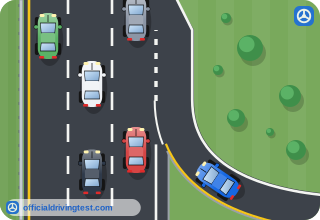
What should you expect at on ramps and interchanges when driving on an interstate?
- Pedestrians crossing the lanes
- Cross traffic controlled by stop signs
- Vehicles backing into the lane
- Merging vehicles
Show answer
Correct answer: Merging vehicles
The manual says to expect merging vehicles at on ramps and interchanges.
Source: Class D & E Driver’s Guide (Revised August 2025 (DPSMV2052 R08/25)), page 100 · Open this page in the manual (Manual page 100)
-
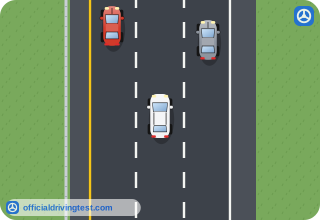
On an interstate, what does the manual say you should know so you can use them if you need to?
- Which lanes are clear
- Where the next service station is
- Which vehicles are about to exit
- Where the nearest police unit is
Show answer
Correct answer: Which lanes are clear
The manual tells you to leave yourself an out by knowing which lanes are clear so you can use them if you need to.
Source: Class D & E Driver’s Guide (Revised August 2025 (DPSMV2052 R08/25)), page 100 · Open this page in the manual (Manual page 100)
-
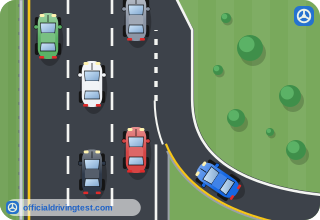
Whenever you enter traffic, what does the manual tell you to do?
- Sound your horn and wait for drivers to make room for you
- Flash your headlights and enter at the minimum posted speed
- Signal and be sure you have enough space to enter safely
- Stop and wait until the lane next to you is empty
Show answer
Correct answer: Signal and be sure you have enough space to enter safely
The manual says that whenever you enter traffic you should signal and be sure you have enough space to enter safely.
Source: Class D & E Driver’s Guide (Revised August 2025 (DPSMV2052 R08/25)), page 100 · Open this page in the manual (Manual page 100)
-
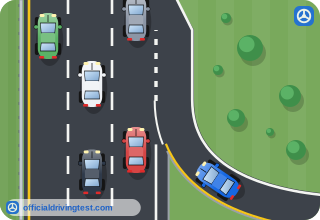
At what speed should you enter the interstate?
- At least 10 mph under the speed of traffic
- At or near the speed of traffic
- At a slow speed until you are in the right-hand lane
- At the speed you will use for exiting
Show answer
Correct answer: At or near the speed of traffic
The manual says to enter the interstate at or near the speed of traffic.
Source: Class D & E Driver’s Guide (Revised August 2025 (DPSMV2052 R08/25)), page 100 · Open this page in the manual (Manual page 100)
-
What is the maximum speed allowed on the interstate unless otherwise posted?
- 55 miles per hour
- 60 miles per hour
- 65 miles per hour
- 70 miles per hour
Show answer
Correct answer: 70 miles per hour
The manual says the maximum speed allowed on the interstate is 70 miles per hour unless otherwise posted.
Source: Class D & E Driver’s Guide (Revised August 2025 (DPSMV2052 R08/25)), page 100 · Open this page in the manual (Manual page 100)
-
On the interstate, when may you drive slower than the posted minimum speed?
- When weather or road conditions demand a slower speed
- When you are driving in the right-hand lane of the road
- When you are looking for the exit you want to use
- When no vehicles are close behind you on the road
Show answer
Correct answer: When weather or road conditions demand a slower speed
You should not drive slower than the posted minimum speed unless the weather or road conditions demand a slower speed.
Source: Class D & E Driver’s Guide (Revised August 2025 (DPSMV2052 R08/25)), page 100 · Open this page in the manual (Manual page 100)
-
What should you always try to do about your speed when driving on the interstate?
- Vary it to keep other drivers alert
- Raise it each time you pass an exit
- Drive at a steady speed
- Match the fastest vehicle near you
Show answer
Correct answer: Drive at a steady speed
The manual says to always try to drive at a steady speed on the interstate.
Source: Class D & E Driver’s Guide (Revised August 2025 (DPSMV2052 R08/25)), page 100 · Open this page in the manual (Manual page 100)
-
What should you do while you are on the entrance ramp?
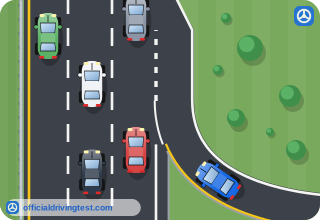
- Move slowly to the end of the ramp and stop
- Begin checking traffic and look for a gap in the approaching traffic
- Stop at the start of the ramp until the lane is empty
- Wait at the end of the ramp for traffic to give you space
Show answer
Correct answer: Begin checking traffic and look for a gap in the approaching traffic
The manual says to begin checking traffic while on the entrance ramp and to look for a gap, not to move slowly to the end and stop.
Source: Class D & E Driver’s Guide (Revised August 2025 (DPSMV2052 R08/25)), page 100 · Open this page in the manual (Manual page 100)
-
After you look for a gap in the approaching interstate traffic, what does the manual tell you to do?
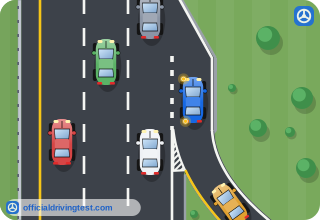
- Stop at the end of the ramp and wait for it
- Sound your horn so drivers make room
- Wait for a driver to flash you in
- Adjust your speed to meet that gap
Show answer
Correct answer: Adjust your speed to meet that gap
The manual says to look for a gap in the approaching traffic and then adjust your speed to meet that gap.
Source: Class D & E Driver’s Guide (Revised August 2025 (DPSMV2052 R08/25)), page 100 · Open this page in the manual (Manual page 100)
-
As you merge onto the interstate, how fast should you be traveling?
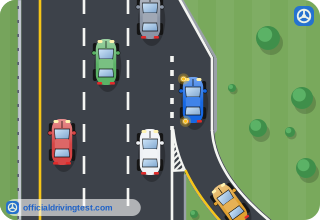
- The same speed as other traffic
- Slower than traffic so drivers notice you
- Faster than traffic so you can pass them
- The speed posted on the ramp
Show answer
Correct answer: The same speed as other traffic
The manual says that as you merge you should make sure you are traveling the same speed as other traffic.
Source: Class D & E Driver’s Guide (Revised August 2025 (DPSMV2052 R08/25)), page 100 · Open this page in the manual (Manual page 100)
-
When may you stop before merging with interstate traffic?
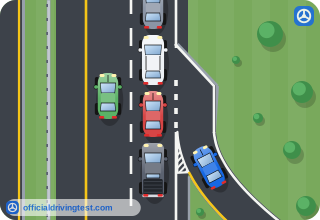
- Whenever traffic is heavy
- Whenever you reach the end of the ramp
- Only when it is absolutely necessary
- Whenever another driver is close behind you
Show answer
Correct answer: Only when it is absolutely necessary
The manual says not to stop before merging with interstate traffic unless it is absolutely necessary.
Source: Class D & E Driver’s Guide (Revised August 2025 (DPSMV2052 R08/25)), page 100 · Open this page in the manual (Manual page 100)
-
Which is true about other drivers when you enter an interstate?
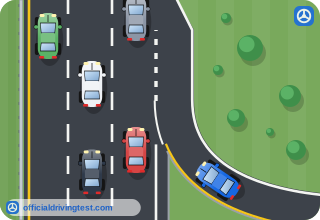
- They must stop to let entering vehicles in
- They will signal when they have left room for you
- They will always see you as you come up the ramp
- You can’t always count on them seeing you or moving over
Show answer
Correct answer: You can’t always count on them seeing you or moving over
The manual warns that you can’t always count on other drivers either seeing you or moving over to give you space to enter.
Source: Class D & E Driver’s Guide (Revised August 2025 (DPSMV2052 R08/25)), page 100 · Open this page in the manual (Manual page 100)
-
When you merge into interstate traffic, what size gap do you need?
- Four seconds
- Two seconds
- Six seconds
- Eight seconds
Show answer
Correct answer: Four seconds
The manual says you need a gap of four seconds when you merge into traffic.
Source: Class D & E Driver’s Guide (Revised August 2025 (DPSMV2052 R08/25)), page 101 · Open this page in the manual (Manual page 101)
-
Besides using your mirrors and turn signals, what should you do before changing lanes on the interstate?
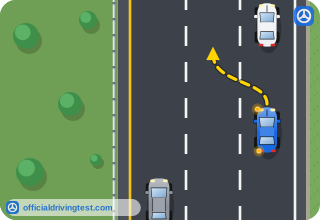
- Move to the center of your lane
- Turn your head to look quickly to the side
- Slow down to the posted minimum speed
- Sound your horn
Show answer
Correct answer: Turn your head to look quickly to the side
The manual says to use your mirrors and turn signals and to turn your head to look quickly to the side before changing lanes.
Source: Class D & E Driver’s Guide (Revised August 2025 (DPSMV2052 R08/25)), page 101 · Open this page in the manual (Manual page 101)
-
At a short acceleration lane in heavy traffic, why is it dangerous when cars stop and wait for a large enough gap?
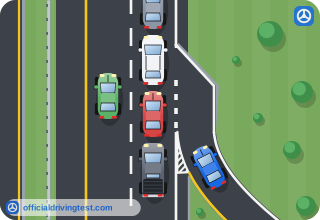
- The acceleration lane is closed to any vehicle that stops
- Interstate traffic must stop to let them in
- Drivers there cannot use turn signals
- Rear-end collision risk and the need for fast acceleration
Show answer
Correct answer: Rear-end collision risk and the need for fast acceleration
The manual calls this situation dangerous because of the risk of rear-end collisions and the need for fast acceleration to enter traffic.
Source: Class D & E Driver’s Guide (Revised August 2025 (DPSMV2052 R08/25)), page 101 · Open this page in the manual (Manual page 101)