Louisiana: Interstate driving — Part 1 Practice Test
Questions in this part include: “On what is the design of a highway based?” · “On a toll way, tollbooths are usually how far apart?”
Independent educational site · not affiliated with any government agency or DMV
Ready? Test yourself
- Instant feedback with an explanation
- Every answer cites its source in the manual
- Your best score is saved on this device
Questions are original and based on the official manual "Class D & E Driver’s Guide" (Revised August 2025 (DPSMV2052 R08/25)), Louisiana Office of Motor Vehicles.
All 19 questions in this practice test
Take the test above first, then use this list to study. Tap “Show answer” to see the correct answer and explanation.
Show the questions and answersHide the questions
-
On what is the design of a highway based?
- The number of crashes on other highways in the same parish
- The size of the parish that regulates and maintains it
- The speed limit set by the nearest traffic court
- The anticipated volume and composition of the traffic using it
Show answer
Correct answer: The anticipated volume and composition of the traffic using it
The manual says the design of a highway, including lane width, shoulder width and the median, is based on the anticipated volume and composition of the traffic using it.
Source: Class D & E Driver’s Guide (Revised August 2025 (DPSMV2052 R08/25)), page 20 · Open this page in the manual (Manual page 20)
-
Which direction do EVEN numbered Interstate highways run?
- East and West
- North and South
- Northeast and Southwest
- Northwest and Southeast
Show answer
Correct answer: East and West
The manual says EVEN numbered Interstate highways go East and West.
Source: Class D & E Driver’s Guide (Revised August 2025 (DPSMV2052 R08/25)), page 20 · Open this page in the manual (Manual page 20)
-
What is a parish road?
- A road that is regulated by the state and numbered like LA 1
- A nationally regulated road that came before the Interstate program
- A road that is regulated and maintained by a certain parish
- A divided road with lots of trees and plants that is usually scenic
Show answer
Correct answer: A road that is regulated and maintained by a certain parish
The manual defines a parish road as a road that is regulated and maintained by a certain parish.
Source: Class D & E Driver’s Guide (Revised August 2025 (DPSMV2052 R08/25)), page 20 · Open this page in the manual (Manual page 20)
-
Which route does the manual give as an example of a state highway?
- US 1
- LA 1
- US 6
- Parish 1
Show answer
Correct answer: LA 1
The manual describes a state highway as a highway regulated by the state and gives LA 1 as the example.
Source: Class D & E Driver’s Guide (Revised August 2025 (DPSMV2052 R08/25)), page 20 · Open this page in the manual (Manual page 20)
-
Which type of highway is nationally regulated and is a predecessor to the Interstate Highway program?
- A parish road
- A state highway
- A parkway
- A U.S. highway
Show answer
Correct answer: A U.S. highway
The manual describes a U.S. highway as a nationally regulated highway that is a predecessor to the Interstate Highway program.
Source: Class D & E Driver’s Guide (Revised August 2025 (DPSMV2052 R08/25)), page 20 · Open this page in the manual (Manual page 20)
-
According to the manual, who created the Interstate Highways in the 1950s?
- Dwight D. Eisenhower
- Theodore Roosevelt
- Franklin D. Roosevelt
- Harry S. Truman
Show answer
Correct answer: Dwight D. Eisenhower
The manual says the Interstate Highways were created by Dwight D. Eisenhower in the 1950s.
Source: Class D & E Driver’s Guide (Revised August 2025 (DPSMV2052 R08/25)), page 20 · Open this page in the manual (Manual page 20)
-
An expressway is a divided highway with at least how many lanes?
- 2
- 3
- 4
- 6
Show answer
Correct answer: 4
The manual defines expressways as divided highways with at least 4 lanes.
Source: Class D & E Driver’s Guide (Revised August 2025 (DPSMV2052 R08/25)), page 20 · Open this page in the manual (Manual page 20)
-
Which term, meaning the same as expressway, is used out west, especially in California?
- Parkway
- Freeway
- Toll road
- Parish road
Show answer
Correct answer: Freeway
The manual says freeway means the same as expressway and is the term used out west, especially in California.
Source: Class D & E Driver’s Guide (Revised August 2025 (DPSMV2052 R08/25)), page 20 · Open this page in the manual (Manual page 20)
-
On a toll way, tollbooths are usually how far apart?
- About ten miles
- About twenty-five miles
- About fifty miles
- A couple of miles
Show answer
Correct answer: A couple of miles
The manual says tolls are usually collected from tollbooths a couple of miles apart on a toll way.
Source: Class D & E Driver’s Guide (Revised August 2025 (DPSMV2052 R08/25)), page 20 · Open this page in the manual (Manual page 20)
-
Which pair describes how a toll may be collected on a toll way?
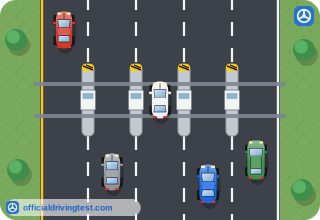
- By ticket or by a prepaid pass
- Only by a ticket from a tollbooth
- Only by a prepaid pass bought in advance
- By cash paid to an officer at the roadside
Show answer
Correct answer: By ticket or by a prepaid pass
The manual says the toll on a toll way may be collected by ticket or a prepaid pass.
Source: Class D & E Driver’s Guide (Revised August 2025 (DPSMV2052 R08/25)), page 20 · Open this page in the manual (Manual page 20)
-
Which kind of divided highway has lots of trees and plants around it and is usually very beautiful and scenic?
- A freeway
- An expressway
- A parkway
- A limited access highway
Show answer
Correct answer: A parkway
The manual describes a parkway as a divided highway with lots of trees and plants around it, usually very beautiful and scenic.
Source: Class D & E Driver’s Guide (Revised August 2025 (DPSMV2052 R08/25)), page 20 · Open this page in the manual (Manual page 20)
-
What is a divided highway?
- A highway whose lanes are divided by painted stripes into speed zones
- A highway with lanes going in opposite directions divided by a median or barrier
- A highway split into sections regulated by different parishes
- A highway that carries toll traffic in one lane and free traffic in another
Show answer
Correct answer: A highway with lanes going in opposite directions divided by a median or barrier
The manual defines a divided highway as a highway with lanes going in opposite directions divided by a median or some sort of barrier between them.
Source: Class D & E Driver’s Guide (Revised August 2025 (DPSMV2052 R08/25)), page 20 · Open this page in the manual (Manual page 20)
-
What is a limited access highway?
- A highway that carries only vehicles under a set weight
- A highway that collects tolls from the drivers who use it
- A highway with no median or barrier between opposing lanes
- A highway where access is limited to signed exits
Show answer
Correct answer: A highway where access is limited to signed exits
The manual defines a limited access highway as one where access is limited to signed exits.
Source: Class D & E Driver’s Guide (Revised August 2025 (DPSMV2052 R08/25)), page 20 · Open this page in the manual (Manual page 20)
-
What is a partial access highway?
- A highway that allows access at other streets, but not at driveways
- A highway where access is allowed only at signed exits
- A highway that has no median or barrier between opposing lanes
- A highway that allows driveways but not access from other streets
Show answer
Correct answer: A highway that allows access at other streets, but not at driveways
The manual says a partial access highway allows access at other streets, while driveways and other forms of access are not allowed.
Source: Class D & E Driver’s Guide (Revised August 2025 (DPSMV2052 R08/25)), page 20 · Open this page in the manual (Manual page 20)
-
Newer highways are designed with which features in an effort to reduce the number of crashes?
- Narrower shoulders, sharper curves and steeper grades
- More roadside signs, trees and utility poles
- Wider shoulders, gentle curves and grades
- Shorter exit ramps and fewer lanes
Show answer
Correct answer: Wider shoulders, gentle curves and grades
The manual says newer highways are designed with wider shoulders, gentle curves and grades in an effort to reduce the number of crashes.
Source: Class D & E Driver’s Guide (Revised August 2025 (DPSMV2052 R08/25)), page 20 · Open this page in the manual (Manual page 20)
-
Why is reduction of roadside obstacles necessary?
- To make it easier for drivers to read road signs from far away
- To reduce the severity of injury if a vehicle leaves the highway
- To allow vehicles to park safely beside the highway at any time
- To let engineers build narrower shoulders on newer highways
Show answer
Correct answer: To reduce the severity of injury if a vehicle leaves the highway
The manual says reducing roadside obstacles is necessary to reduce the severity of injury if a vehicle leaves the highway.
Source: Class D & E Driver’s Guide (Revised August 2025 (DPSMV2052 R08/25)), page 20 · Open this page in the manual (Manual page 20)
-
In areas of the country where snow is common, engineers design roads with areas beside them for what?
- Parking
- Snow storage
- Toll collection
- Truck weighing
Show answer
Correct answer: Snow storage
The manual says that where snow is common, engineers design roads with areas beside them for snow storage.
Source: Class D & E Driver’s Guide (Revised August 2025 (DPSMV2052 R08/25)), page 21 · Open this page in the manual (Manual page 21)
-
Which is an example of forgiving roadside hardware that helps minimize the severity of collisions?
- Breakaway poles and guard rails
- Fixed steel signposts and utility poles
- Concrete walls beside the shoulder
- Rigid metal posts set in concrete
Show answer
Correct answer: Breakaway poles and guard rails
The manual gives breakaway poles and guard rails as examples of forgiving roadside hardware that helps minimize the severity of collisions.
Source: Class D & E Driver’s Guide (Revised August 2025 (DPSMV2052 R08/25)), page 21 · Open this page in the manual (Manual page 21)
-
When a highway is divided into two roadways by a median or barrier, when may you drive across the median or barrier?
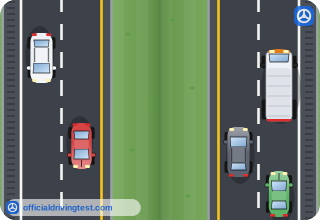
- Whenever no traffic is approaching in either direction
- Only where an approved cross-over is provided
- Only when you are making a legal U-turn at a signal
- Only when a police officer is present to direct traffic
Show answer
Correct answer: Only where an approved cross-over is provided
The guide says you must not drive across the median or barrier except when an approved cross-over is provided.
Source: Class D & E Driver’s Guide (Revised August 2025 (DPSMV2052 R08/25)), page 87 · Open this page in the manual (Manual page 87)