Kansas: Parking rules
Where Kansas law forbids parking and how far to stay from hydrants, signs and crossings, parking on hills, parallel and angle parking, and painted curbs. Split into 3 shorter tests so you're not stuck in one long quiz.
Independent educational site · not affiliated with any government agency or DMV
Choose a part
Parking rules — Part 1
Questions in this part include: “How close to a fire hydrant is parking NOT allowed?”
StartParking rules — Part 2
Questions in this part include: “When entering your vehicle on the street, how should you approach the driver’s door?”
StartParking rules — Part 3
Questions in this part include: “How are some parking restrictions indicated?”
StartAll 56 Parking rules questions with answers
Choose a part above to take a practice test, or study every question and answer here.
Show the questions and answersHide the questions
-
How close to a fire hydrant is parking NOT allowed?
- Within 5 feet
- Within 15 feet
- Within 10 feet
- Within 25 feet
Show answer
Correct answer: Within 15 feet
Parking is not allowed within 15 feet of a fire hydrant.
Source: Kansas Driving Handbook (Revised February 2022), page 19
-
How far from a curb may a vehicle NOT be parked?
- More than 6 inches
- More than 18 inches
- More than 12 inches
- More than 24 inches
Show answer
Correct answer: More than 12 inches
Parking more than 12 inches from a curb is not allowed.
Source: Kansas Driving Handbook (Revised February 2022), page 19
-
How close to a traffic control signal, stop sign or flashing beacon at the side of the roadway is parking NOT allowed, approaching it?
- Within 30 feet
- Within 10 feet
- Within 25 feet
- Within 40 feet
Show answer
Correct answer: Within 30 feet
Parking is not allowed within the 30 feet approaching any traffic control signal, stop sign or flashing beacon at the side of the roadway.
Source: Kansas Driving Handbook (Revised February 2022), page 19
-
How close to the nearest rail at a railroad crossing is parking NOT allowed?
- Within 10 feet
- Within 25 feet
- Within 100 feet
- Within 50 feet
Show answer
Correct answer: Within 50 feet
Parking is not allowed within 50 feet of the nearest rail at railroad crossings.
Source: Kansas Driving Handbook (Revised February 2022), page 19
-
How close to a fire station's driveway entrance, on the same side of the street, is parking NOT allowed?
- Within 5 feet
- Within 20 feet
- Within 10 feet
- Within 40 feet
Show answer
Correct answer: Within 20 feet
Parking is not allowed within 20 feet of the driveway entrance to a fire station.
Source: Kansas Driving Handbook (Revised February 2022), page 19
-
On the side of the street opposite a fire station's entrance, how close to the entrance is parking NOT allowed?
- Within 25 feet
- Within 45 feet
- Within 75 feet
- Within 100 feet
Show answer
Correct answer: Within 75 feet
Parking on the side of the street opposite the entrance to a fire station is not allowed within 75 feet of the entrance.
Source: Kansas Driving Handbook (Revised February 2022), page 19
-
How close to points on the curb opposite the ends of a safety zone is parking NOT allowed?
- Within 10 feet
- Within 15 feet
- Within 45 feet
- Within 30 feet
Show answer
Correct answer: Within 30 feet
Parking is not allowed between a safety zone and the adjacent curb, or within 30 feet of points on the curb opposite the ends of the safety zone.
Source: Kansas Driving Handbook (Revised February 2022), page 19
-
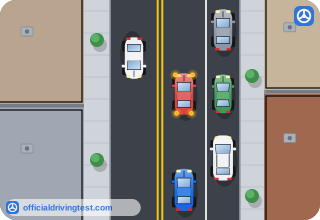
What does Kansas law say about parking double, also called "two-deep", along the curb or side of the street?
- It is not allowed
- It is allowed for up to five minutes
- It is allowed with your hazard lights on
- It is allowed if the driver stays in the vehicle
Show answer
Correct answer: It is not allowed
Parking double, or two-deep, along the curb or side of the street is not allowed.
Source: Kansas Driving Handbook (Revised February 2022), page 19
-
Where is parking NOT allowed, according to the Kansas parking rules?
- Parallel to the curb on a street with two lanes and no signs
- On a bridge or other elevated structure upon a highway, or within a tunnel
- Parallel to the curb, within 12 inches of it, on an open street
- Alongside a curb on a residential street with no posted signs
Show answer
Correct answer: On a bridge or other elevated structure upon a highway, or within a tunnel
Parking is not allowed on a bridge or other elevated structure upon a highway or within a tunnel.
Source: Kansas Driving Handbook (Revised February 2022), page 19
-
Where must a parked vehicle be so that it is not a hazard?
- Close enough to the travel lane to be seen, even if it narrows the lane for passing traffic
- Out of sight of traffic, such as just past a bend, so that it does not distract drivers
- Visible only to vehicles approaching from behind, and as near the lane as you like
- Away from travel lanes so as not to interfere, and visible from either direction
Show answer
Correct answer: Away from travel lanes so as not to interfere, and visible from either direction
A parked vehicle must be far enough from any travel lane to avoid interfering with traffic and visible to vehicles coming from either direction.
Source: Kansas Driving Handbook (Revised February 2022), page 52
-
When you park along the roadway and there is a curb, where should you park?
- As close to the curb as possible
- About three feet from the curb so you can open the door freely
- Partly on the curb so that traffic can pass
- Wherever there is room, as long as you are visible
Show answer
Correct answer: As close to the curb as possible
When parking along the roadway you park as far away from traffic as possible and, if there is a curb, as close to it as possible.
Source: Kansas Driving Handbook (Revised February 2022), page 52
-
Which of these should you always do when you park?
- Leave your headlights on
- Leave the ignition keys in the vehicle
- Set your parking brake
- Leave the engine running
Show answer
Correct answer: Set your parking brake
The manual says to always set your parking brake when you park.
Source: Kansas Driving Handbook (Revised February 2022), page 52
-
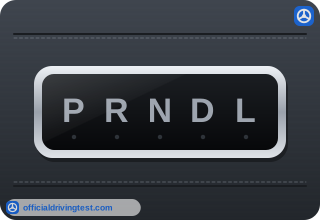
You are parking a vehicle with an automatic transmission. After setting the parking brake, where do you place it?
- In neutral
- In “park”
- In reverse
- In drive
Show answer
Correct answer: In “park”
After setting the parking brake, an automatic transmission is placed in “park”.
Source: Kansas Driving Handbook (Revised February 2022), page 52
-
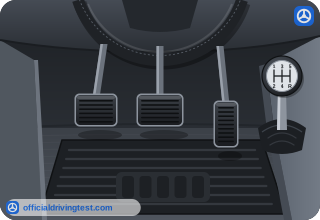
You are parking a vehicle with a manual transmission. After setting the parking brake, where do you place it?
- In neutral
- In park
- Left with the clutch pedal pressed down
- In gear
Show answer
Correct answer: In gear
After setting the parking brake, a manual transmission is placed in gear.
Source: Kansas Driving Handbook (Revised February 2022), page 52
-
Which items should you turn off before removing your key when you park?
- Your headlights and engine
- Your radio and heater
- Your turn signals and windshield wipers
- Your parking brake and mirrors
Show answer
Correct answer: Your headlights and engine
Headlights and engine are turned off before you remove the key from a parked vehicle.
Source: Kansas Driving Handbook (Revised February 2022), page 52
-
What should you check before opening the door of your parked vehicle?
- Your fuel gauge and dashboard lights
- Your parking brake and tire pressure
- Your mirrors and traffic
- Your registration and insurance papers
Show answer
Correct answer: Your mirrors and traffic
Before opening the door you check your mirrors and traffic.
Source: Kansas Driving Handbook (Revised February 2022), page 52
-
After getting out of your parked vehicle, when should you shut the door?
- After you have finished unloading
- As soon as you can
- Only after you have locked the vehicle with the key
- When traffic has completely cleared
Show answer
Correct answer: As soon as you can
The door should be shut as soon as you can after getting out.
Source: Kansas Driving Handbook (Revised February 2022), page 52
-
What does the manual say about the ignition keys of a parked vehicle?
- Leave them in the ignition if you will be back soon
- Leave them under the seat for safekeeping
- Leave them in the ignition if the doors are locked
- Never leave them in the vehicle
Show answer
Correct answer: Never leave them in the vehicle
Ignition keys must never be left in a parked vehicle.
Source: Kansas Driving Handbook (Revised February 2022), page 52
-
What is described as a good habit whenever you leave your vehicle?
- Locking the doors
- Leaving a window open a crack for air
- Leaving the engine idling
- Leaving the headlights on
Show answer
Correct answer: Locking the doors
The manual calls it a good habit to lock the doors whenever you leave your vehicle.
Source: Kansas Driving Handbook (Revised February 2022), page 52
-
When entering your vehicle on the street, how should you approach the driver’s door?
- From behind the vehicle while searching for your key
- Through the passenger door and then across the seat
- From the front of the vehicle with your key in hand
- From the traffic side while looking at your phone
Show answer
Correct answer: From the front of the vehicle with your key in hand
Approaching the driver’s door from the front of the vehicle with your key in hand increases your awareness of oncoming traffic.
Source: Kansas Driving Handbook (Revised February 2022), page 52
-
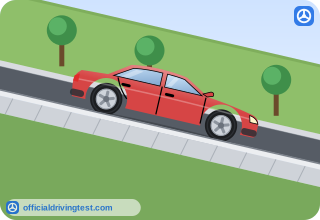
When you park downhill, with or without a curb, which way do you turn the steering wheel?
- Sharply away from the curb or road edge
- Sharply toward the curb or road edge
- Slightly toward the center of the road
- Straight ahead
Show answer
Correct answer: Sharply toward the curb or road edge
Turning the wheel sharply toward the road edge or curb means that a rolling vehicle will roll away from traffic.
Source: Kansas Driving Handbook (Revised February 2022), page 52
-
When parking downhill, how close should the vehicle be to the curb or road edge?
- Parallel to it and within 6 inches
- Parallel to it and within 24 inches
- At an angle to it, with the front wheels touching
- Parallel to it and within 12 inches
Show answer
Correct answer: Parallel to it and within 12 inches
The vehicle is stopped parallel to and within 12 inches of the curb or road edge.
Source: Kansas Driving Handbook (Revised February 2022), page 52
-
When you park downhill with a curb, where do you stop the vehicle?
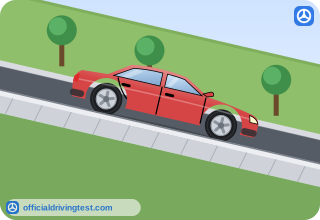
- As the tire closest to the curb touches it, as a block
- After rolling back until the tire touches the curb
- When the front bumper is even with the next parked car
- When the tire is a foot from the curb, leaving room to roll
Show answer
Correct answer: As the tire closest to the curb touches it, as a block
The curb is used as a block: you stop as the tire nearest the curb just touches it, so a rolling vehicle goes away from traffic.
Source: Kansas Driving Handbook (Revised February 2022), page 52
-
When you park uphill with a curb, which way do you turn the steering wheel?
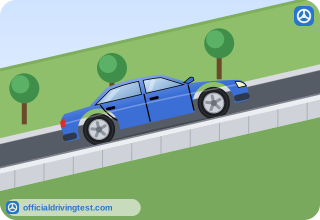
- Sharply toward the curb
- Straight ahead
- Sharply away from the curb
- Slightly toward the curb
Show answer
Correct answer: Sharply away from the curb
Uphill with a curb, you turn the wheel sharply away from the curb so that a rolling vehicle goes away from traffic.
Source: Kansas Driving Handbook (Revised February 2022), page 52
-
You are parking uphill with a curb and have turned the wheel sharply away from the curb. What do you do next?
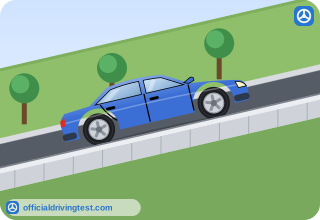
- Keep moving forward until the front tire touches the curb
- Roll slowly back until the tire touches the curb
- Straighten the wheels and leave the vehicle where it stopped
- Turn the wheel toward the curb and accelerate slightly
Show answer
Correct answer: Roll slowly back until the tire touches the curb
You stop, then let the vehicle roll slowly back until the tire touches the curb, which keeps it from rolling into traffic.
Source: Kansas Driving Handbook (Revised February 2022), page 52
-
When you park uphill without a curb, which way do you turn the steering wheel?
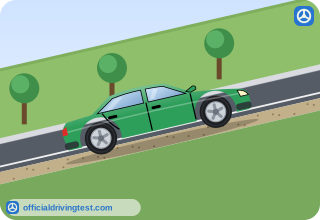
- Sharply toward the center of the road
- Straight ahead
- Slightly away from the edge of the road
- Sharply toward the edge of the road
Show answer
Correct answer: Sharply toward the edge of the road
Uphill without a curb, the wheel is turned sharply toward the edge of the road so the vehicle rolls away from traffic if it moves.
Source: Kansas Driving Handbook (Revised February 2022), page 53
-
When you park uphill without a curb, when do you stop moving forward?
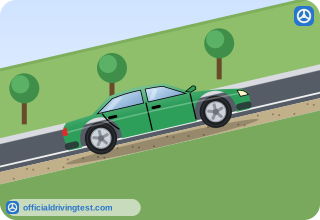
- When the tire nearest the road edge reaches the edge
- After the vehicle has rolled back to the edge of the road
- When the front bumper reaches the edge of the road
- When the tire is 12 inches from the edge of the road
Show answer
Correct answer: When the tire nearest the road edge reaches the edge
You stop when the tire closest to the road edge reaches the edge of the road.
Source: Kansas Driving Handbook (Revised February 2022), page 53
-
As you approach a perpendicular or angle parking space, where do you position your vehicle?
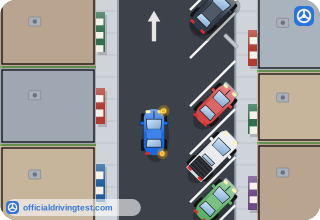
- As close to the parking space as possible
- Directly in line with the middle of the space
- As far away from the parking space as possible
- Against the vehicle parked next to the space
Show answer
Correct answer: As far away from the parking space as possible
You position the vehicle as far from the space as possible before moving forward slowly and turning into it.
Source: Kansas Driving Handbook (Revised February 2022), page 53
-
When you enter a perpendicular or angle parking space, how far forward do you move while turning the steering wheel?
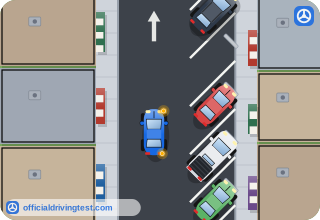
- Until the front bumper touches the end of the space
- Until the vehicle reaches the middle of the space
- Until the vehicle is past the first line of the space
- Until the rear wheels are clear of the lane
Show answer
Correct answer: Until the vehicle reaches the middle of the space
You move forward slowly, turning the wheel, until the vehicle reaches the middle of the space.
Source: Kansas Driving Handbook (Revised February 2022), page 53
-
In a perpendicular or angle space, after you center the vehicle and straighten the wheels, what do you do?
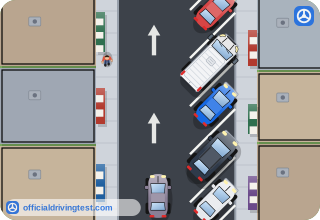
- Back up until the rear bumper is even with the lines
- Turn off the engine and leave the vehicle where it is
- Shift to reverse and check for traffic
- Move to the front of the space, stop and secure the vehicle
Show answer
Correct answer: Move to the front of the space, stop and secure the vehicle
After centering and straightening the wheels, you move to the front of the space, stop and secure the vehicle.
Source: Kansas Driving Handbook (Revised February 2022), page 53
-
When backing out of a perpendicular or angle parking space, which way do you signal?
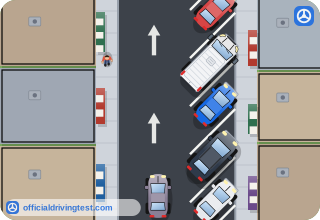
- In the direction you are turning
- Toward the vehicle parked beside you
- Opposite to the direction you are turning
- You do not signal while backing
Show answer
Correct answer: In the direction you are turning
You shift to reverse and signal in the direction you are turning.
Source: Kansas Driving Handbook (Revised February 2022), page 53
-
When backing out of a perpendicular or angle parking space, how far straight back do you move before turning the wheel?
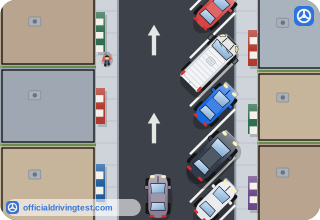
- Until your rear bumper is in the traffic lane
- Until your front wheels reach the line of the space
- Until your front bumper clears the vehicle parked beside you
- Until your rear wheels touch the vehicle behind
Show answer
Correct answer: Until your front bumper clears the vehicle parked beside you
You move straight back until your front bumper clears the vehicle parked beside you, on the side opposite the way you are turning.
Source: Kansas Driving Handbook (Revised February 2022), page 53
-
When backing out of a perpendicular or angle space, in which direction do you turn the steering wheel sharply?
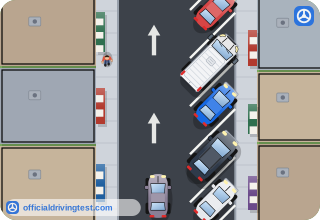
- The direction the front of your vehicle should move
- The direction the rear of your vehicle should move
- Away from the direction you are turning
- Toward the vehicle parked beside you
Show answer
Correct answer: The direction the rear of your vehicle should move
The wheel is turned sharply in the direction that the rear of the vehicle should move.
Source: Kansas Driving Handbook (Revised February 2022), page 53
-
You are about to enter a parallel parking space and traffic is coming from behind. What should you do?
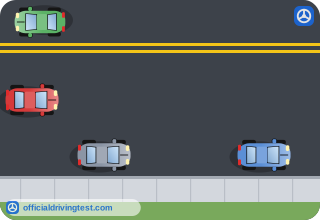
- Pull into the space quickly before the traffic behind reaches you
- Stop in the travel lane ahead of the space and wave traffic around
- Back into the space without waiting, with your turn signal on
- Stop beside the vehicle you will park behind and let traffic pass
Show answer
Correct answer: Stop beside the vehicle you will park behind and let traffic pass
You stop parallel to the vehicle you are going to park behind and allow following vehicles to pass before parking.
Source: Kansas Driving Handbook (Revised February 2022), page 54
-
When traffic is clear and you shift to reverse to enter a parallel parking space, where do you look?
- To the rear, in the direction the vehicle will be moving
- Straight ahead at the vehicle in front of the space
- Only at the curb beside your door
- Only at your dashboard and mirrors
Show answer
Correct answer: To the rear, in the direction the vehicle will be moving
After shifting to reverse you look to the rear in the direction the vehicle will be moving.
Source: Kansas Driving Handbook (Revised February 2022), page 54
-
When backing into a parallel parking space, you continue backing until your front bumper is in line with what?
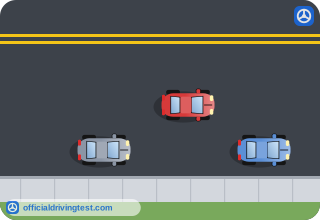
- The front bumper of the vehicle you are parking behind
- The rear bumper of the vehicle behind you
- The rear bumper of the vehicle you are parking behind
- The middle of the parking space
Show answer
Correct answer: The rear bumper of the vehicle you are parking behind
You keep backing until your front bumper is in line with the rear bumper of the vehicle you are parking behind, then turn to center in the space.
Source: Kansas Driving Handbook (Revised February 2022), page 54
-
When backing into a parallel parking space, when do you stop?
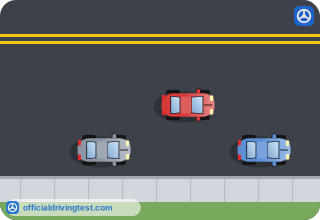
- When your rear bumper lightly touches the vehicle behind
- Before touching the bumper of the vehicle to the rear
- When your front wheels are in line with the curb ahead
- When your rear wheels touch the curb
Show answer
Correct answer: Before touching the bumper of the vehicle to the rear
You stop before touching the bumper of the vehicle behind, then shift to drive and adjust within the space.
Source: Kansas Driving Handbook (Revised February 2022), page 54
-
When leaving a parallel parking space, after shifting to reverse, how far do you back up?
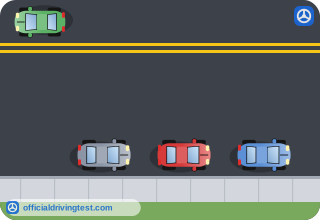
- Only a few inches
- Until your rear bumper is even with the lane
- Until your front wheels are straight
- As much as possible, to the vehicle behind
Show answer
Correct answer: As much as possible, to the vehicle behind
You back as much as possible to the vehicle parked behind you to gain room before pulling out.
Source: Kansas Driving Handbook (Revised February 2022), page 54
-
While steering into the lane of traffic from a parallel parking space, what must you make certain of?
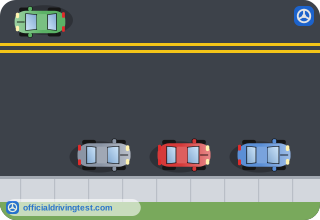
- That the front bumper of your vehicle will clear the vehicle ahead
- That the rear bumper of your vehicle is touching the vehicle behind
- That your passenger door is clear of the curb
- That your parking brake is still set
Show answer
Correct answer: That the front bumper of your vehicle will clear the vehicle ahead
You check that the front bumper will clear the vehicle ahead before you pull out.
Source: Kansas Driving Handbook (Revised February 2022), page 54
-
When leaving a parallel parking space, when do you straighten the wheels and move forward into the lane of traffic?
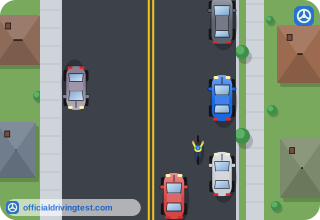
- When your front bumper reaches the rear bumper of the vehicle ahead
- When your rear bumper clears the vehicle behind you
- When the door post of your vehicle clears the rear bumper of the vehicle ahead
- As soon as you shift to drive
Show answer
Correct answer: When the door post of your vehicle clears the rear bumper of the vehicle ahead
You straighten the wheels and move into the lane when the door post of your vehicle clears the rear bumper of the vehicle parked ahead.
Source: Kansas Driving Handbook (Revised February 2022), page 54
-
How are some parking restrictions indicated?
- By different pavement textures
- By colored curb markings
- By flags beside the road
- By painted lane numbers
Show answer
Correct answer: By colored curb markings
Besides signs, some parking restrictions are shown by colored curb markings.
Source: Kansas Driving Handbook (Revised February 2022), page 54
-
When is it against the rules to park in a construction area?
- Only when workers are present
- Only when equipment is operating
- Only during daytime hours
- If your vehicle will block traffic
Show answer
Correct answer: If your vehicle will block traffic
You must not park in a construction area if your vehicle will block traffic.
Source: Kansas Driving Handbook (Revised February 2022), page 54
-
Which of these is a place where you must not park?
- In a designated parking area
- Parallel to the curb, in the direction of traffic
- In a marked space in a parking lot
- In an intersection
Show answer
Correct answer: In an intersection
Parking in an intersection is not allowed.
Source: Kansas Driving Handbook (Revised February 2022), page 54
-
Which of these is a place where you must not park?
- On a crosswalk or sidewalk
- In a space at a store parking lot
- Along the curb in the direction of traffic
- In a designated parking area
Show answer
Correct answer: On a crosswalk or sidewalk
Parking on a crosswalk or sidewalk is not allowed.
Source: Kansas Driving Handbook (Revised February 2022), page 54
-
Which of these is a place where you must not park?
- In a marked space in a parking lot
- Parallel to the curb where no sign prohibits parking
- Blocking a driveway, alley or private road
- In a designated parking area on the street
Show answer
Correct answer: Blocking a driveway, alley or private road
Parking so that you block a driveway, alley, private road or an area of curb lowered for sidewalk access is not allowed.
Source: Kansas Driving Handbook (Revised February 2022), page 54
-
Which of these is a place where you must not park?
- On the right side of the street in the direction of traffic
- In a designated parking area
- In a marked space in a parking lot
- On the opposite side of the street against traffic flow
Show answer
Correct answer: On the opposite side of the street against traffic flow
Parking on the opposite side of the street, against the flow of traffic, is not allowed.
Source: Kansas Driving Handbook (Revised February 2022), page 54
-
When may you park in a space marked for the handicapped?
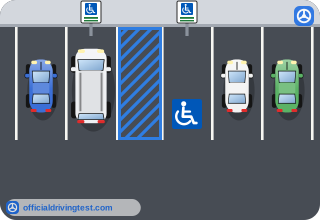
- Only with a handicap plate, tag or sticker
- When you will be gone for only a few minutes
- When no other space is open nearby
- When you leave your hazard lights on
Show answer
Correct answer: Only with a handicap plate, tag or sticker
A space marked for the handicapped is off limits unless you have a handicap license plate, tag or sticker.
Source: Kansas Driving Handbook (Revised February 2022), page 54
-
Which of these is a place where you must not park?
- Beside a curb that has no painted color
- Wherever a sign indicates you cannot park
- On any street with more than two lanes
- Anywhere in a residential area
Show answer
Correct answer: Wherever a sign indicates you cannot park
Parking is not allowed wherever a sign indicates you cannot park.
Source: Kansas Driving Handbook (Revised February 2022), page 54
-
What does a white painted curb indicate?
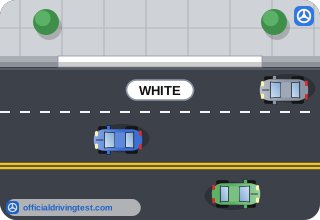
- A loading zone
- A handicap restriction
- Fire zone restrictions
- Short stops only
Show answer
Correct answer: Short stops only
A white curb means that only short stops are permitted.
Source: Kansas Driving Handbook (Revised February 2022), page 55
-
What does a yellow painted curb indicate?
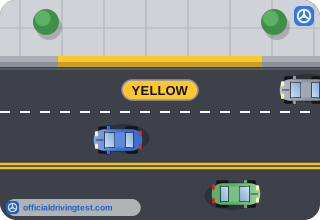
- A loading zone or other restriction
- Only short stops are permitted
- A handicap restriction
- Fire zone restrictions
Show answer
Correct answer: A loading zone or other restriction
A yellow curb indicates a loading zone or some other restriction.
Source: Kansas Driving Handbook (Revised February 2022), page 55
-
What does a blue painted curb indicate?
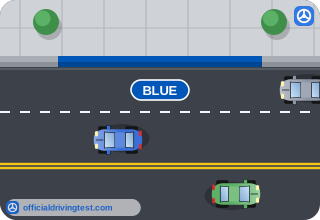
- Only short stops are permitted
- A loading zone
- A handicap restriction
- Fire zone restrictions
Show answer
Correct answer: A handicap restriction
A blue curb indicates a handicap restriction.
Source: Kansas Driving Handbook (Revised February 2022), page 55
-
What does a red painted curb indicate?
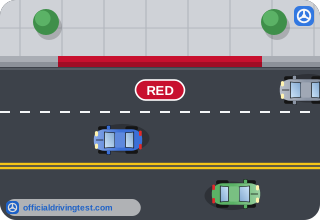
- Only short stops are permitted
- Fire zone restrictions
- A loading zone or some other restriction
- A handicap restriction
Show answer
Correct answer: Fire zone restrictions
A red curb indicates fire zone restrictions.
Source: Kansas Driving Handbook (Revised February 2022), page 55
-
What is a driver responsible for when parking?
- Only that the vehicle is locked
- Where the vehicle is parked and that it will not roll away
- Only that the vehicle is parked in the shade
- Only that the vehicle is parked with its lights on
Show answer
Correct answer: Where the vehicle is parked and that it will not roll away
You are responsible for where you park and that your vehicle will not roll away, such as on a hill, and for not impeding traffic or pedestrians.
Source: Kansas Driving Handbook (Revised February 2022), page 70
-
In the parallel park exercise, how close must you bring the vehicle to the curb side of the space?
- Within 12 inches
- Within 6 inches
- Within 24 inches
- Within 36 inches
Show answer
Correct answer: Within 12 inches
You must bring the vehicle within 12 inches of the curb side of the space without crossing the side or rear boundaries.
Source: Kansas Driving Handbook (Revised February 2022), page 102
-
How do you enter the parking space in the parallel park exercise?
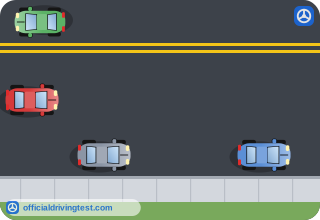
- Pull forward directly into it
- Drive in nose-first and then back out
- Drive past the space and back into it
- Back in from the far side of the road
Show answer
Correct answer: Drive past the space and back into it
For both parallel parks you drive past the parking space and back into it, ending completely within the space.
Source: Kansas Driving Handbook (Revised February 2022), page 102
-
Which exercise is described as one of the best indicators that you have the basic skills to safely operate a motor vehicle?
- Forward two-point turnabout
- Parallel park
- Reverse two-point turnabout
- Three-point turnabout
Show answer
Correct answer: Parallel park
The handbook says a parallel park is one of the best indicators that you have the basic skills necessary to safely operate a motor vehicle.
Source: Kansas Driving Handbook (Revised February 2022), page 102