Kansas: Parking rules — Part 1 Practice Test
Questions in this part include: “How close to a fire hydrant is parking NOT allowed?” · “Where must a parked vehicle be so that it is not a hazard?”
Independent educational site · not affiliated with any government agency or DMV
Ready? Test yourself
- Instant feedback with an explanation
- Every answer cites its source in the manual
- Your best score is saved on this device
Questions are original and based on the official manual "Kansas Driving Handbook" (Revised February 2022), Kansas Department of Revenue, Division of Vehicles.
All 19 questions in this practice test
Take the test above first, then use this list to study. Tap “Show answer” to see the correct answer and explanation.
Show the questions and answersHide the questions
-
How close to a fire hydrant is parking NOT allowed?
- Within 5 feet
- Within 15 feet
- Within 10 feet
- Within 25 feet
Show answer
Correct answer: Within 15 feet
Parking is not allowed within 15 feet of a fire hydrant.
Source: Kansas Driving Handbook (Revised February 2022), page 19
-
How far from a curb may a vehicle NOT be parked?
- More than 6 inches
- More than 18 inches
- More than 12 inches
- More than 24 inches
Show answer
Correct answer: More than 12 inches
Parking more than 12 inches from a curb is not allowed.
Source: Kansas Driving Handbook (Revised February 2022), page 19
-
How close to a traffic control signal, stop sign or flashing beacon at the side of the roadway is parking NOT allowed, approaching it?
- Within 30 feet
- Within 10 feet
- Within 25 feet
- Within 40 feet
Show answer
Correct answer: Within 30 feet
Parking is not allowed within the 30 feet approaching any traffic control signal, stop sign or flashing beacon at the side of the roadway.
Source: Kansas Driving Handbook (Revised February 2022), page 19
-
How close to the nearest rail at a railroad crossing is parking NOT allowed?
- Within 10 feet
- Within 25 feet
- Within 100 feet
- Within 50 feet
Show answer
Correct answer: Within 50 feet
Parking is not allowed within 50 feet of the nearest rail at railroad crossings.
Source: Kansas Driving Handbook (Revised February 2022), page 19
-
How close to a fire station's driveway entrance, on the same side of the street, is parking NOT allowed?
- Within 5 feet
- Within 20 feet
- Within 10 feet
- Within 40 feet
Show answer
Correct answer: Within 20 feet
Parking is not allowed within 20 feet of the driveway entrance to a fire station.
Source: Kansas Driving Handbook (Revised February 2022), page 19
-
On the side of the street opposite a fire station's entrance, how close to the entrance is parking NOT allowed?
- Within 25 feet
- Within 45 feet
- Within 75 feet
- Within 100 feet
Show answer
Correct answer: Within 75 feet
Parking on the side of the street opposite the entrance to a fire station is not allowed within 75 feet of the entrance.
Source: Kansas Driving Handbook (Revised February 2022), page 19
-
How close to points on the curb opposite the ends of a safety zone is parking NOT allowed?
- Within 10 feet
- Within 15 feet
- Within 45 feet
- Within 30 feet
Show answer
Correct answer: Within 30 feet
Parking is not allowed between a safety zone and the adjacent curb, or within 30 feet of points on the curb opposite the ends of the safety zone.
Source: Kansas Driving Handbook (Revised February 2022), page 19
-
What does Kansas law say about parking double, also called "two-deep", along the curb or side of the street?
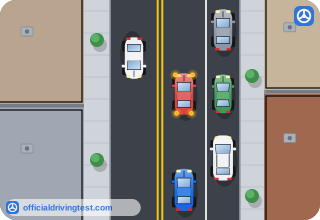
- It is not allowed
- It is allowed for up to five minutes
- It is allowed with your hazard lights on
- It is allowed if the driver stays in the vehicle
Show answer
Correct answer: It is not allowed
Parking double, or two-deep, along the curb or side of the street is not allowed.
Source: Kansas Driving Handbook (Revised February 2022), page 19
-
Where is parking NOT allowed, according to the Kansas parking rules?
- Parallel to the curb on a street with two lanes and no signs
- On a bridge or other elevated structure upon a highway, or within a tunnel
- Parallel to the curb, within 12 inches of it, on an open street
- Alongside a curb on a residential street with no posted signs
Show answer
Correct answer: On a bridge or other elevated structure upon a highway, or within a tunnel
Parking is not allowed on a bridge or other elevated structure upon a highway or within a tunnel.
Source: Kansas Driving Handbook (Revised February 2022), page 19
-
Where must a parked vehicle be so that it is not a hazard?
- Close enough to the travel lane to be seen, even if it narrows the lane for passing traffic
- Out of sight of traffic, such as just past a bend, so that it does not distract drivers
- Visible only to vehicles approaching from behind, and as near the lane as you like
- Away from travel lanes so as not to interfere, and visible from either direction
Show answer
Correct answer: Away from travel lanes so as not to interfere, and visible from either direction
A parked vehicle must be far enough from any travel lane to avoid interfering with traffic and visible to vehicles coming from either direction.
Source: Kansas Driving Handbook (Revised February 2022), page 52
-
When you park along the roadway and there is a curb, where should you park?
- As close to the curb as possible
- About three feet from the curb so you can open the door freely
- Partly on the curb so that traffic can pass
- Wherever there is room, as long as you are visible
Show answer
Correct answer: As close to the curb as possible
When parking along the roadway you park as far away from traffic as possible and, if there is a curb, as close to it as possible.
Source: Kansas Driving Handbook (Revised February 2022), page 52
-
Which of these should you always do when you park?
- Leave your headlights on
- Leave the ignition keys in the vehicle
- Set your parking brake
- Leave the engine running
Show answer
Correct answer: Set your parking brake
The manual says to always set your parking brake when you park.
Source: Kansas Driving Handbook (Revised February 2022), page 52
-
You are parking a vehicle with an automatic transmission. After setting the parking brake, where do you place it?

- In neutral
- In “park”
- In reverse
- In drive
Show answer
Correct answer: In “park”
After setting the parking brake, an automatic transmission is placed in “park”.
Source: Kansas Driving Handbook (Revised February 2022), page 52
-
You are parking a vehicle with a manual transmission. After setting the parking brake, where do you place it?
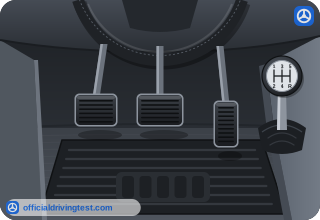
- In neutral
- In park
- Left with the clutch pedal pressed down
- In gear
Show answer
Correct answer: In gear
After setting the parking brake, a manual transmission is placed in gear.
Source: Kansas Driving Handbook (Revised February 2022), page 52
-
Which items should you turn off before removing your key when you park?
- Your headlights and engine
- Your radio and heater
- Your turn signals and windshield wipers
- Your parking brake and mirrors
Show answer
Correct answer: Your headlights and engine
Headlights and engine are turned off before you remove the key from a parked vehicle.
Source: Kansas Driving Handbook (Revised February 2022), page 52
-
What should you check before opening the door of your parked vehicle?
- Your fuel gauge and dashboard lights
- Your parking brake and tire pressure
- Your mirrors and traffic
- Your registration and insurance papers
Show answer
Correct answer: Your mirrors and traffic
Before opening the door you check your mirrors and traffic.
Source: Kansas Driving Handbook (Revised February 2022), page 52
-
After getting out of your parked vehicle, when should you shut the door?
- After you have finished unloading
- As soon as you can
- Only after you have locked the vehicle with the key
- When traffic has completely cleared
Show answer
Correct answer: As soon as you can
The door should be shut as soon as you can after getting out.
Source: Kansas Driving Handbook (Revised February 2022), page 52
-
What does the manual say about the ignition keys of a parked vehicle?
- Leave them in the ignition if you will be back soon
- Leave them under the seat for safekeeping
- Leave them in the ignition if the doors are locked
- Never leave them in the vehicle
Show answer
Correct answer: Never leave them in the vehicle
Ignition keys must never be left in a parked vehicle.
Source: Kansas Driving Handbook (Revised February 2022), page 52
-
What is described as a good habit whenever you leave your vehicle?
- Locking the doors
- Leaving a window open a crack for air
- Leaving the engine idling
- Leaving the headlights on
Show answer
Correct answer: Locking the doors
The manual calls it a good habit to lock the doors whenever you leave your vehicle.
Source: Kansas Driving Handbook (Revised February 2022), page 52