Kansas: Parking rules — Part 2 Practice Test
Questions in this part include: “When entering your vehicle on the street, how should you approach the driver’s door?” · “When parking downhill, how close should the vehicle be to the curb or road edge?”
Independent educational site · not affiliated with any government agency or DMV
Ready? Test yourself
- Instant feedback with an explanation
- Every answer cites its source in the manual
- Your best score is saved on this device
Questions are original and based on the official manual "Kansas Driving Handbook" (Revised February 2022), Kansas Department of Revenue, Division of Vehicles.
All 19 questions in this practice test
Take the test above first, then use this list to study. Tap “Show answer” to see the correct answer and explanation.
Show the questions and answersHide the questions
-
When entering your vehicle on the street, how should you approach the driver’s door?
- From behind the vehicle while searching for your key
- Through the passenger door and then across the seat
- From the front of the vehicle with your key in hand
- From the traffic side while looking at your phone
Show answer
Correct answer: From the front of the vehicle with your key in hand
Approaching the driver’s door from the front of the vehicle with your key in hand increases your awareness of oncoming traffic.
Source: Kansas Driving Handbook (Revised February 2022), page 52
-
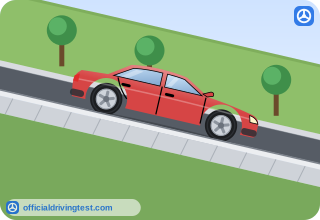
When you park downhill, with or without a curb, which way do you turn the steering wheel?
- Sharply away from the curb or road edge
- Sharply toward the curb or road edge
- Slightly toward the center of the road
- Straight ahead
Show answer
Correct answer: Sharply toward the curb or road edge
Turning the wheel sharply toward the road edge or curb means that a rolling vehicle will roll away from traffic.
Source: Kansas Driving Handbook (Revised February 2022), page 52
-
When parking downhill, how close should the vehicle be to the curb or road edge?
- Parallel to it and within 6 inches
- Parallel to it and within 24 inches
- At an angle to it, with the front wheels touching
- Parallel to it and within 12 inches
Show answer
Correct answer: Parallel to it and within 12 inches
The vehicle is stopped parallel to and within 12 inches of the curb or road edge.
Source: Kansas Driving Handbook (Revised February 2022), page 52
-
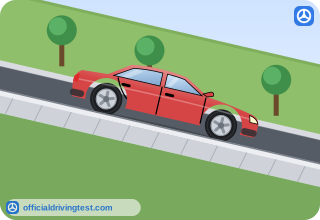
When you park downhill with a curb, where do you stop the vehicle?
- As the tire closest to the curb touches it, as a block
- After rolling back until the tire touches the curb
- When the front bumper is even with the next parked car
- When the tire is a foot from the curb, leaving room to roll
Show answer
Correct answer: As the tire closest to the curb touches it, as a block
The curb is used as a block: you stop as the tire nearest the curb just touches it, so a rolling vehicle goes away from traffic.
Source: Kansas Driving Handbook (Revised February 2022), page 52
-
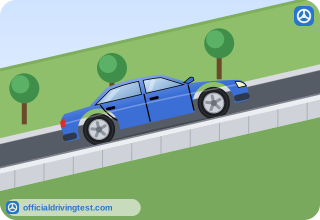
When you park uphill with a curb, which way do you turn the steering wheel?
- Sharply toward the curb
- Straight ahead
- Sharply away from the curb
- Slightly toward the curb
Show answer
Correct answer: Sharply away from the curb
Uphill with a curb, you turn the wheel sharply away from the curb so that a rolling vehicle goes away from traffic.
Source: Kansas Driving Handbook (Revised February 2022), page 52
-
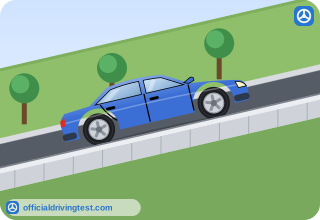
You are parking uphill with a curb and have turned the wheel sharply away from the curb. What do you do next?
- Keep moving forward until the front tire touches the curb
- Roll slowly back until the tire touches the curb
- Straighten the wheels and leave the vehicle where it stopped
- Turn the wheel toward the curb and accelerate slightly
Show answer
Correct answer: Roll slowly back until the tire touches the curb
You stop, then let the vehicle roll slowly back until the tire touches the curb, which keeps it from rolling into traffic.
Source: Kansas Driving Handbook (Revised February 2022), page 52
-
When you park uphill without a curb, which way do you turn the steering wheel?
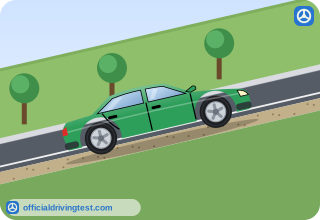
- Sharply toward the center of the road
- Straight ahead
- Slightly away from the edge of the road
- Sharply toward the edge of the road
Show answer
Correct answer: Sharply toward the edge of the road
Uphill without a curb, the wheel is turned sharply toward the edge of the road so the vehicle rolls away from traffic if it moves.
Source: Kansas Driving Handbook (Revised February 2022), page 53
-
When you park uphill without a curb, when do you stop moving forward?
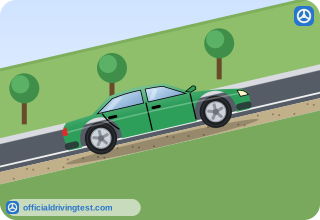
- When the tire nearest the road edge reaches the edge
- After the vehicle has rolled back to the edge of the road
- When the front bumper reaches the edge of the road
- When the tire is 12 inches from the edge of the road
Show answer
Correct answer: When the tire nearest the road edge reaches the edge
You stop when the tire closest to the road edge reaches the edge of the road.
Source: Kansas Driving Handbook (Revised February 2022), page 53
-
As you approach a perpendicular or angle parking space, where do you position your vehicle?
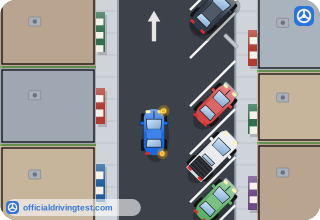
- As close to the parking space as possible
- Directly in line with the middle of the space
- As far away from the parking space as possible
- Against the vehicle parked next to the space
Show answer
Correct answer: As far away from the parking space as possible
You position the vehicle as far from the space as possible before moving forward slowly and turning into it.
Source: Kansas Driving Handbook (Revised February 2022), page 53
-
When you enter a perpendicular or angle parking space, how far forward do you move while turning the steering wheel?
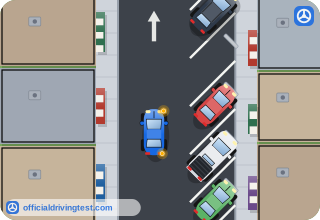
- Until the front bumper touches the end of the space
- Until the vehicle reaches the middle of the space
- Until the vehicle is past the first line of the space
- Until the rear wheels are clear of the lane
Show answer
Correct answer: Until the vehicle reaches the middle of the space
You move forward slowly, turning the wheel, until the vehicle reaches the middle of the space.
Source: Kansas Driving Handbook (Revised February 2022), page 53
-
In a perpendicular or angle space, after you center the vehicle and straighten the wheels, what do you do?
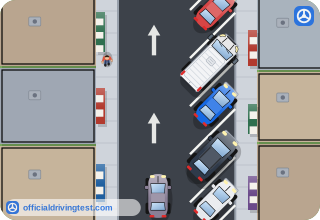
- Back up until the rear bumper is even with the lines
- Turn off the engine and leave the vehicle where it is
- Shift to reverse and check for traffic
- Move to the front of the space, stop and secure the vehicle
Show answer
Correct answer: Move to the front of the space, stop and secure the vehicle
After centering and straightening the wheels, you move to the front of the space, stop and secure the vehicle.
Source: Kansas Driving Handbook (Revised February 2022), page 53
-
When backing out of a perpendicular or angle parking space, which way do you signal?
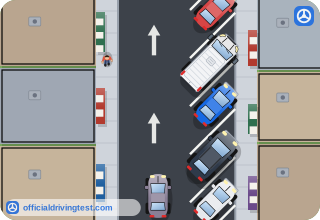
- In the direction you are turning
- Toward the vehicle parked beside you
- Opposite to the direction you are turning
- You do not signal while backing
Show answer
Correct answer: In the direction you are turning
You shift to reverse and signal in the direction you are turning.
Source: Kansas Driving Handbook (Revised February 2022), page 53
-
When backing out of a perpendicular or angle parking space, how far straight back do you move before turning the wheel?
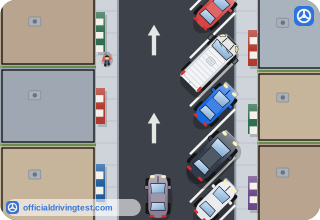
- Until your rear bumper is in the traffic lane
- Until your front wheels reach the line of the space
- Until your front bumper clears the vehicle parked beside you
- Until your rear wheels touch the vehicle behind
Show answer
Correct answer: Until your front bumper clears the vehicle parked beside you
You move straight back until your front bumper clears the vehicle parked beside you, on the side opposite the way you are turning.
Source: Kansas Driving Handbook (Revised February 2022), page 53
-
When backing out of a perpendicular or angle space, in which direction do you turn the steering wheel sharply?
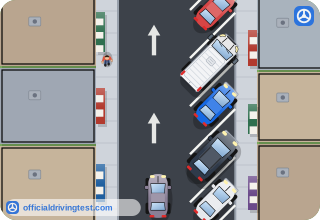
- The direction the front of your vehicle should move
- The direction the rear of your vehicle should move
- Away from the direction you are turning
- Toward the vehicle parked beside you
Show answer
Correct answer: The direction the rear of your vehicle should move
The wheel is turned sharply in the direction that the rear of the vehicle should move.
Source: Kansas Driving Handbook (Revised February 2022), page 53
-
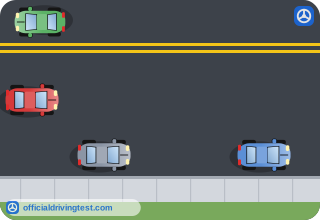
You are about to enter a parallel parking space and traffic is coming from behind. What should you do?
- Pull into the space quickly before the traffic behind reaches you
- Stop in the travel lane ahead of the space and wave traffic around
- Back into the space without waiting, with your turn signal on
- Stop beside the vehicle you will park behind and let traffic pass
Show answer
Correct answer: Stop beside the vehicle you will park behind and let traffic pass
You stop parallel to the vehicle you are going to park behind and allow following vehicles to pass before parking.
Source: Kansas Driving Handbook (Revised February 2022), page 54
-
When traffic is clear and you shift to reverse to enter a parallel parking space, where do you look?
- To the rear, in the direction the vehicle will be moving
- Straight ahead at the vehicle in front of the space
- Only at the curb beside your door
- Only at your dashboard and mirrors
Show answer
Correct answer: To the rear, in the direction the vehicle will be moving
After shifting to reverse you look to the rear in the direction the vehicle will be moving.
Source: Kansas Driving Handbook (Revised February 2022), page 54
-
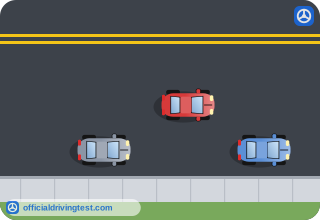
When backing into a parallel parking space, you continue backing until your front bumper is in line with what?
- The front bumper of the vehicle you are parking behind
- The rear bumper of the vehicle behind you
- The rear bumper of the vehicle you are parking behind
- The middle of the parking space
Show answer
Correct answer: The rear bumper of the vehicle you are parking behind
You keep backing until your front bumper is in line with the rear bumper of the vehicle you are parking behind, then turn to center in the space.
Source: Kansas Driving Handbook (Revised February 2022), page 54
-
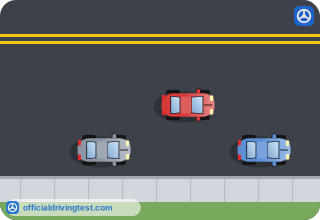
When backing into a parallel parking space, when do you stop?
- When your rear bumper lightly touches the vehicle behind
- Before touching the bumper of the vehicle to the rear
- When your front wheels are in line with the curb ahead
- When your rear wheels touch the curb
Show answer
Correct answer: Before touching the bumper of the vehicle to the rear
You stop before touching the bumper of the vehicle behind, then shift to drive and adjust within the space.
Source: Kansas Driving Handbook (Revised February 2022), page 54
-
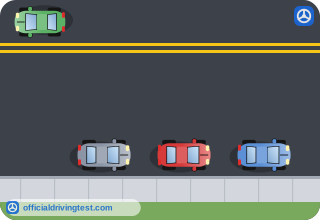
When leaving a parallel parking space, after shifting to reverse, how far do you back up?
- Only a few inches
- Until your rear bumper is even with the lane
- Until your front wheels are straight
- As much as possible, to the vehicle behind
Show answer
Correct answer: As much as possible, to the vehicle behind
You back as much as possible to the vehicle parked behind you to gain room before pulling out.
Source: Kansas Driving Handbook (Revised February 2022), page 54