Kansas: Freeway driving Practice Test
Turning around on the interstate, the median and emergency crossovers, and entering and leaving high-speed roads.
Independent educational site · not affiliated with any government agency or DMV
Ready? Test yourself
- Instant feedback with an explanation
- Every answer cites its source in the manual
- Your best score is saved on this device
Questions are original and based on the official manual "Kansas Driving Handbook" (Revised February 2022), Kansas Department of Revenue, Division of Vehicles.
All 14 questions in this practice test
Take the test above first, then use this list to study. Tap “Show answer” to see the correct answer and explanation.
Show the questions and answersHide the questions
-
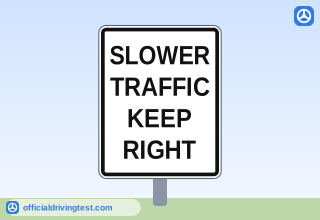
Where is a SLOWER TRAFFIC KEEP RIGHT sign posted, and what does it tell slow drivers?
- On a two-lane road, to pull onto the shoulder
- On an exit ramp, to slow to the ramp speed
- On a multilane highway, to stay in the right lane
- On a one-way street, to stay in the left lane
Show answer
Correct answer: On a multilane highway, to stay in the right lane
This sign is posted on a multilane highway for those driving slower than the normal speed of traffic and tells them to stay in the right lane.
Source: Kansas Driving Handbook (Revised February 2022), page 41
-
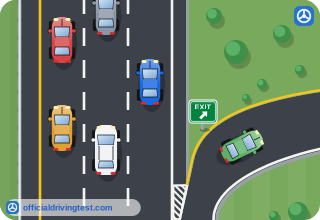
If you are on the interstate system and need to turn around, what should you do?
- Stop on the shoulder and back up to the last exit
- Make a U-turn at the first wide place on the road
- Go to the next exit and turn around
- Wait on the shoulder for a gap and turn across the lanes
Show answer
Correct answer: Go to the next exit and turn around
On the interstate system, go to the next exit and turn around.
Source: Kansas Driving Handbook (Revised February 2022), page 47
-
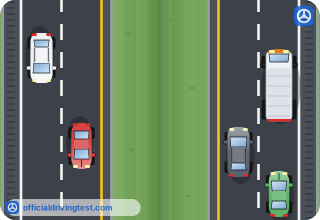
Which of these is illegal when you are on the interstate system?
- Turning around at the next exit
- Using crossover areas reserved for emergency vehicles
- Signaling before leaving the interstate
- Driving in the center lane of a multi-lane section
Show answer
Correct answer: Using crossover areas reserved for emergency vehicles
It is illegal to cross the median strip or to use the crossover areas reserved for emergency vehicles.
Source: Kansas Driving Handbook (Revised February 2022), page 47
-
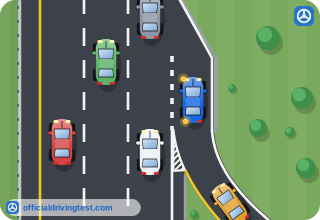
When merging with traffic flow, at what speed should you try to enter?
- A speed well below the other traffic
- The posted ramp speed no matter the traffic
- A speed above the other traffic
- The same speed that other traffic is moving
Show answer
Correct answer: The same speed that other traffic is moving
When merging with traffic flow, you should try to enter at the same speed that the other traffic flow is moving.
Source: Kansas Driving Handbook (Revised February 2022), page 60
-
What should you use the acceleration lane for?
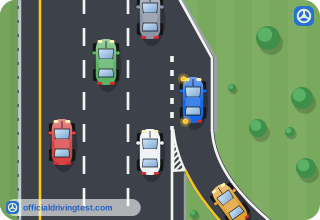
- To reach the speed of other vehicles before pulling onto the roadway
- To pass slower traffic traveling on the main roadway lanes
- To stop at the end of the lane and wait for a gap to open up
- To park and rest for a short time between legs of a trip
Show answer
Correct answer: To reach the speed of other vehicles before pulling onto the roadway
You use the acceleration lane to reach the speed of other vehicles before pulling onto the roadway.
Source: Kansas Driving Handbook (Revised February 2022), page 60
-
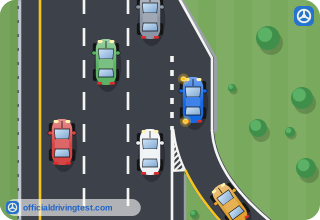
Why should you not drive to the end of the acceleration lane and stop?
- Drivers on the main roadway are required to yield to a stopped vehicle there
- Your vehicle will use too much fuel when it must start again from a stop
- You will not have room to reach traffic speed and drivers behind will not expect it
- The lane always ends at a ditch or guardrail, so there is no room to stop
Show answer
Correct answer: You will not have room to reach traffic speed and drivers behind will not expect it
Stopping at the end of the acceleration lane leaves too little room to get up to the speed of traffic, and drivers to the rear will not expect your vehicle to stop.
Source: Kansas Driving Handbook (Revised February 2022), page 60
-
You must wait for a gap in traffic while on an acceleration lane. Which line must you not cross?
- The solid yellow line
- The solid white line
- The broken white line
- The double yellow line
Show answer
Correct answer: The solid white line
If you have to wait for a gap, slow down on the acceleration lane and do not cross the solid white line.
Source: Kansas Driving Handbook (Revised February 2022), page 60
-
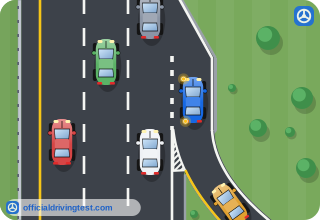
Before pulling onto the roadway from an acceleration lane, how should you check traffic?
- Check your mirrors only and then pull out when the lane looks clear
- Look straight ahead and sound your horn so other drivers can see you
- Watch only the vehicle ahead of you and merge when that vehicle does
- Look over your shoulder in the direction you plan to move and check your mirrors
Show answer
Correct answer: Look over your shoulder in the direction you plan to move and check your mirrors
Before pulling onto the roadway you check traffic by looking over your shoulder in the direction you plan to move and checking your mirrors.
Source: Kansas Driving Handbook (Revised February 2022), page 60
-
In heavy traffic, about how far before your exit should you plan to be in the proper lane?
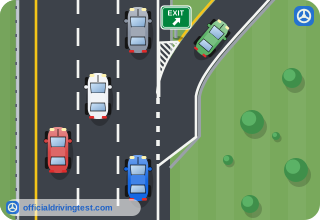
- About one-half mile
- About 100 feet
- About one block
- About two miles
Show answer
Correct answer: About one-half mile
Since it is frequently difficult to change lanes in heavy traffic, you should plan to get into the proper lane about one-half mile before the exit.
Source: Kansas Driving Handbook (Revised February 2022), page 60
-
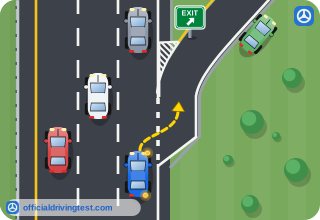
When using a deceleration lane, when should you begin to slow down?
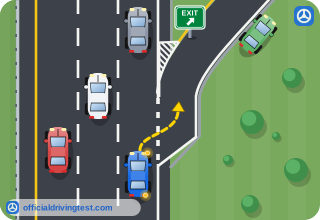
- As soon as you see the exit sign on the main roadway
- When you are one-half mile from the exit
- Once the vehicle has moved onto the deceleration lane
- Before you leave the main roadway
Show answer
Correct answer: Once the vehicle has moved onto the deceleration lane
You should not slow down until the vehicle has moved onto the deceleration lane, then use that lane to reduce speed safely.
Source: Kansas Driving Handbook (Revised February 2022), page 61
-
What is the deceleration lane used for?
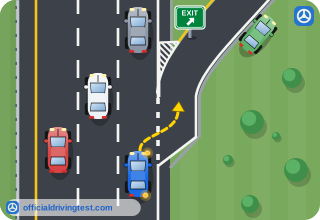
- Passing slower vehicles on the main roadway
- Reducing speed safely to exit traffic flow
- Waiting for a gap in the traffic flow
- Building up speed before merging with traffic
Show answer
Correct answer: Reducing speed safely to exit traffic flow
You use the deceleration lane to reduce speed safely to exit traffic flow.
Source: Kansas Driving Handbook (Revised February 2022), page 61
-
When exiting a multiple-lane, limited access roadway, what should you check for the deceleration lane?
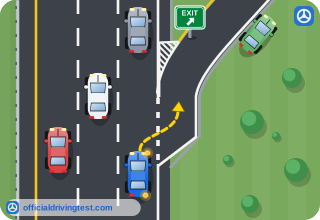
- Its toll amount
- Its length in miles
- Its pavement color
- Its posted speed
Show answer
Correct answer: Its posted speed
When exiting from a multiple-lane, limited access roadway you check the posted speed for the deceleration lane and look to the rear before reducing speed.
Source: Kansas Driving Handbook (Revised February 2022), page 61
-
When entering the expressway on the road test, how should you merge?
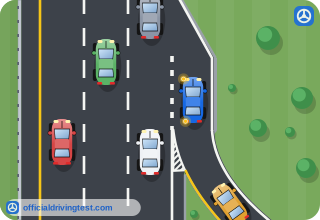
- Slowly, stopping at the end of the ramp until it is clear
- Smoothly, without stopping or crossing solid painted lines
- Quickly, crossing the solid line if the gap is big
- At ramp speed, then change lanes at the first solid line
Show answer
Correct answer: Smoothly, without stopping or crossing solid painted lines
While increasing speed you smoothly merge into the proper lane without stopping or crossing over any solid painted lines.
Source: Kansas Driving Handbook (Revised February 2022), page 105
-
When exiting the expressway on the road test, when should you begin to brake smoothly?
- Once you reach the end of the exit ramp
- After you pass the first exit sign
- After you have left the expressway completely
- Once you enter the deceleration lane
Show answer
Correct answer: Once you enter the deceleration lane
You use proper signals and brake smoothly once you enter the deceleration lane, then continue to decelerate within the lane markings.
Source: Kansas Driving Handbook (Revised February 2022), page 105