Iowa: Speed and following distance — Part 5 Practice Test
Iowa speed limits, following and stopping distances, adaptive cruise control, night driving and driving in bad weather. — Part 5
Independent educational site · not affiliated with any government agency or DMV
Ready? Test yourself
- Instant feedback with an explanation
- Every answer cites its source in the manual
- Your best score is saved on this device
Questions are original and based on the official manual "Iowa Driver’s License Manual" (July 2026), Iowa Department of Transportation.
All 16 questions in this practice test
Take the test above first, then use this list to study. Tap “Show answer” to see the correct answer and explanation.
Show the questions and answersHide the questions
-
Why can you not always rely on dust clouds on a gravel road?
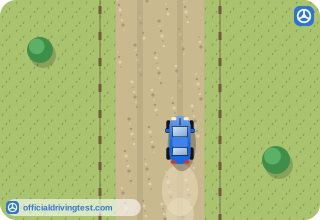
- They may not show whether crossing vehicles are approaching
- Dust clouds only form behind slow-moving vehicles
- Dust clouds are always too thick for a driver to see through
- Dust clouds only appear at night
Show answer
Correct answer: They may not show whether crossing vehicles are approaching
You can't always rely on dust clouds to tell you whether crossing vehicles are approaching.
Source: Iowa Driver’s License Manual (July 2026), page 55
-
How do shoulders on rural roads typically compare with the center of the roadway?
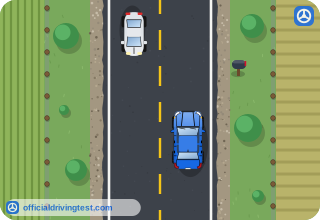
- They are firmer and better paved
- They are wider and flatter
- They are soft and less compact
- They are cleared of loose gravel
Show answer
Correct answer: They are soft and less compact
Shoulders on rural roads are typically soft and less compact than the center of the roadway.
Source: Iowa Driver’s License Manual (July 2026), page 55
-
Where will loose gravel or debris on a shoulder pull your vehicle?
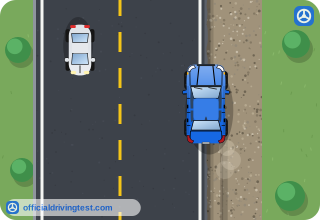
- Toward the ditch
- Toward the center of the road
- Back onto the pavement
- Into the oncoming lane
Show answer
Correct answer: Toward the ditch
Shoulders with loose gravel or debris make vehicles harder to control and pull your vehicle toward the ditch.
Source: Iowa Driver’s License Manual (July 2026), page 55
-
When should you always slow down on a gravel road, according to the manual?
- Only when you are driving through heavy clouds of dust
- Only when you are approaching an uncontrolled intersection
- When you meet another vehicle or drive near or on the shoulder
- Only when you are driving at night on a gravel road
Show answer
Correct answer: When you meet another vehicle or drive near or on the shoulder
Always slow down when encountering another vehicle or anytime you're driving near or on the shoulder of a gravel road.
Source: Iowa Driver’s License Manual (July 2026), page 55
-
Before reaching the crest of a hill or entering a curve on a rural road, what should you do?
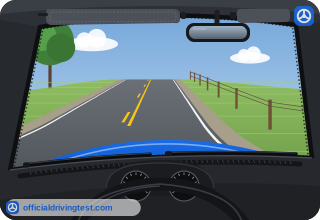
- Slow down, move to the right side of the road and watch for oncoming vehicles
- Keep your speed and move toward the center of the road for a better view ahead
- Speed up to get through it quickly and stay on the left side of the road
- Hold your speed and flash your headlights at oncoming vehicles
Show answer
Correct answer: Slow down, move to the right side of the road and watch for oncoming vehicles
Hills and curves on rural roads are often steeper and sharper than on highways, so slow down, move to the right side and watch for oncoming vehicles before the crest or curve.
Source: Iowa Driver’s License Manual (July 2026), page 56
-
To compensate for reduced visibility when driving in the dark, what should you do?
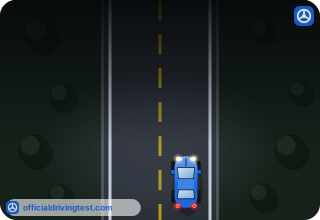
- Lower your speed and shorten your following distance
- Lower your speed and increase your following distance
- Keep your usual speed and follow other vehicles more closely
- Raise your speed to leave the dark stretch sooner
Show answer
Correct answer: Lower your speed and increase your following distance
To compensate for reduced visibility at night, lower your speed and increase your following distance.
Source: Iowa Driver’s License Manual (July 2026), page 56
-
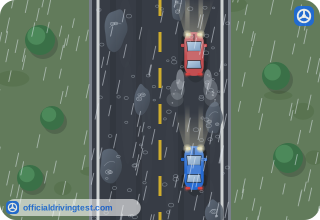
If you must drive in inclement weather, what should you do?
- Slow down and shorten your following distance
- Keep your speed and increase your following distance
- Slow down and increase your following distance
- Speed up to leave the weather behind you
Show answer
Correct answer: Slow down and increase your following distance
In inclement weather, slow down and increase your following distance, which gives you more time to stop.
Source: Iowa Driver’s License Manual (July 2026), page 59
-
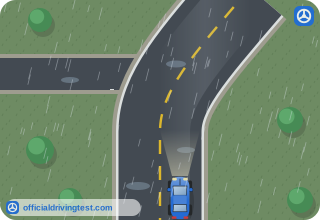
What should you do on curves and when approaching intersections on wet roads?
- Keep your normal speed and brake late
- Speed up to get through quickly
- Stay in the center of the roadway
- Be more cautious and slow down
Show answer
Correct answer: Be more cautious and slow down
The manual says to be more cautious and slow down on curves and when approaching intersections in wet conditions.
Source: Iowa Driver’s License Manual (July 2026), page 60
-
Hydroplaning occurs as a result of water on the road that is deeper than what?
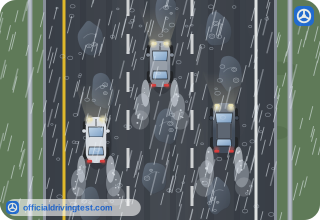
- The height of the bumper
- The width of the tire
- The depth of the lane grooves
- The tire tread
Show answer
Correct answer: The tire tread
Hydroplaning occurs when water on the road is deeper than the tire tread; the layer of water reduces friction and can cause loss of control.
Source: Iowa Driver’s License Manual (July 2026), page 60
-
Which of these tells you your car could hydroplane?
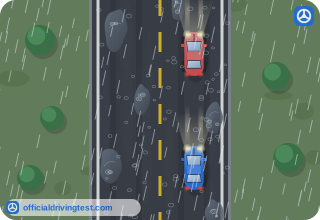
- The car ahead leaves no tracks on the water
- The road surface is covered with dry leaves
- The car ahead brakes lightly
- Your tires make a loud squeal
Show answer
Correct answer: The car ahead leaves no tracks on the water
The manual says that if the car ahead leaves no tracks on the water, your car could hydroplane, so you should slow down.
Source: Iowa Driver’s License Manual (July 2026), page 60
-
In fog, how far should you slow down?
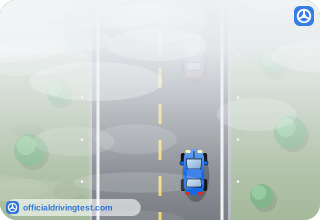
- Until your speed matches your ability to see
- To half of the posted speed limit
- To a crawl of 10 mph or less
- Only enough to keep the lights from glaring
Show answer
Correct answer: Until your speed matches your ability to see
The manual says to slow down until your speed matches your ability to see.
Source: Iowa Driver’s License Manual (July 2026), page 60
-
When starting to drive from a stopped position on ice or snow, what should you do?
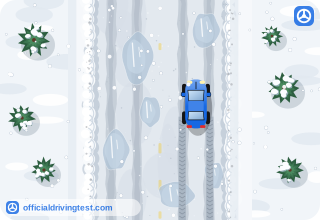
- Keep the wheels straight ahead and accelerate gently
- Turn the wheels and accelerate hard
- Keep the wheels straight and accelerate quickly
- Rock the vehicle with sharp turns of the wheel
Show answer
Correct answer: Keep the wheels straight ahead and accelerate gently
To avoid spinning the tires, keep the wheels straight ahead and accelerate gently.
Source: Iowa Driver’s License Manual (July 2026), page 61
-
How should you make up for a loss of traction on ice or snow?
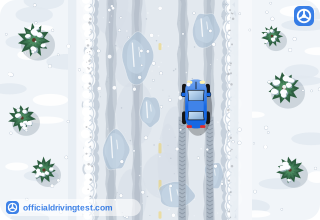
- Increase your speed
- Tailgate the car ahead
- Decrease your speed
- Use cruise control
Show answer
Correct answer: Decrease your speed
Decrease your speed to make up for a loss of traction.
Source: Iowa Driver’s License Manual (July 2026), page 61
-
When driving on ice or snow, when should you brake?
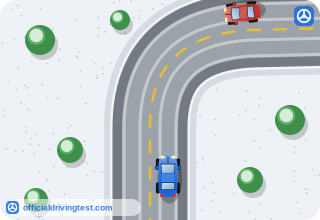
- Only while going around a curve
- Only while turning at an intersection
- Only after you start to skid
- Only when traveling in a straight line
Show answer
Correct answer: Only when traveling in a straight line
Begin slowing down long before a stop, and brake only when traveling in a straight line.
Source: Iowa Driver’s License Manual (July 2026), page 61
-
Stopping distances can be how much greater in ice and snow?
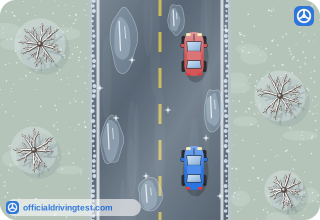
- 10 times greater
- 2 times greater
- 3 times greater
- 5 times greater
Show answer
Correct answer: 10 times greater
Stopping distances can be 10 times greater in ice and snow.
Source: Iowa Driver’s License Manual (July 2026), page 61
-
Why should you stay far behind the vehicle ahead on ice or snow?
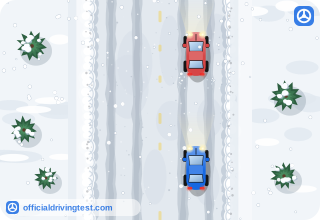
- So the car ahead can see your headlights
- So snow thrown by its tires misses you
- So you will not need a sudden stop that causes skidding
- So you can pass it more easily when the road clears
Show answer
Correct answer: So you will not need a sudden stop that causes skidding
Staying far behind means you will not need to come to a sudden stop, which can cause skidding.
Source: Iowa Driver’s License Manual (July 2026), page 61