Iowa: Emergencies — Part 3 Practice Test
Questions in this part include: “What will the steering wheel be like if the engine stalls while you are driving?” · “If the brake pedal does not work, how should you use the parking brake?”
Independent educational site · not affiliated with any government agency or DMV
Ready? Test yourself
- Instant feedback with an explanation
- Every answer cites its source in the manual
- Your best score is saved on this device
Questions are original and based on the official manual "Iowa Driver’s License Manual" (July 2026), Iowa Department of Transportation.
All 19 questions in this practice test
Take the test above first, then use this list to study. Tap “Show answer” to see the correct answer and explanation.
Show the questions and answersHide the questions
-
After a tire goes flat, what should you do if at all possible?
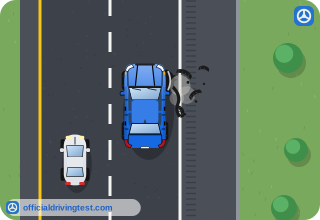
- Stop in your lane and turn on the flashers
- Stop at once in the travel lane
- Keep driving on the flat until the next exit
- Avoid stopping on the road; pull off to a safe place
Show answer
Correct answer: Avoid stopping on the road; pull off to a safe place
Do not stop on the road if at all possible; pull off the road to a safe place.
Source: Iowa Driver’s License Manual (July 2026), page 62
-
A front tire blowout will jerk the car violently toward which side?
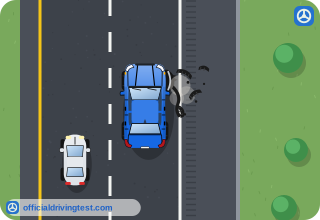
- The side of the car with the flat
- The side opposite the flat
- The center of the road
- Always toward the right shoulder
Show answer
Correct answer: The side of the car with the flat
A front tire blowout will jerk the car violently towards the side of the car with the flat.
Source: Iowa Driver’s License Manual (July 2026), page 62
-
What mistake should you avoid when steering after a front tire blowout?
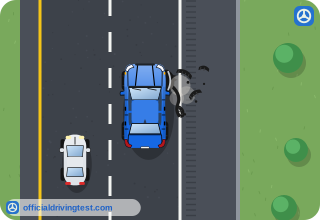
- Gripping the steering wheel
- Looking down the road
- Overcorrecting
- Using both hands
Show answer
Correct answer: Overcorrecting
Be careful not to overcorrect when steering after a front tire blowout.
Source: Iowa Driver’s License Manual (July 2026), page 62
-
After a front tire blowout, once you have straightened the car out, what should you do?
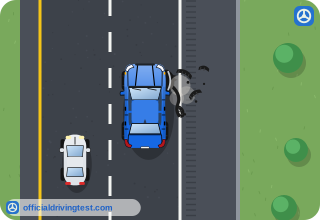
- Stop at once in your lane
- Gradually move to the right shoulder as soon as possible
- Move to the left shoulder
- Turn sharply across traffic to the nearest exit
Show answer
Correct answer: Gradually move to the right shoulder as soon as possible
Try to straighten the car out, then gradually move to the right shoulder of the roadway as soon as possible.
Source: Iowa Driver’s License Manual (July 2026), page 62
-
If your headlights suddenly go out, what should you try?
- Removing the key and putting it back
- Pumping the brake pedal
- Shifting to neutral
- The headlight switch a few times
Show answer
Correct answer: The headlight switch a few times
If your headlights suddenly go out, try the headlight switch a few times.
Source: Iowa Driver’s License Manual (July 2026), page 62
-
If your headlights do not come back on when you try the switch, what should you turn on?
- Emergency flashers, turn signals or fog lights
- The windshield wipers and the defroster together
- The interior dome light only
- Nothing, because lights are not needed
Show answer
Correct answer: Emergency flashers, turn signals or fog lights
Turn on the emergency flashers, turn signals or fog lights if the headlights do not come back on.
Source: Iowa Driver’s License Manual (July 2026), page 62
-
After your headlights go out, what should you do as soon as possible?
- Speed up to reach the next exit
- Keep driving to your destination and pull over there
- Pull off the road
- Brake hard in the lane
Show answer
Correct answer: Pull off the road
After your headlights go out, pull off the road as soon as possible.
Source: Iowa Driver’s License Manual (July 2026), page 62
-
What will the steering wheel be like if the engine stalls while you are driving?
- Locked in place until the engine restarts
- Difficult to turn, but you can turn it
- Locked in place
- Easier to turn than normal
Show answer
Correct answer: Difficult to turn, but you can turn it
If the engine stalls, the steering wheel will be difficult to turn, but you can turn it, so keep a strong grip.
Source: Iowa Driver’s License Manual (July 2026), page 62
-
What will the brakes be like if the engine stalls while you are driving?
- They stop working completely
- They work only if the engine is restarted first
- They become easier to press
- They still work, but you must push very hard
Show answer
Correct answer: They still work, but you must push very hard
After an engine stall, the brakes will still work, but you will have to push very hard on the brake pedal.
Source: Iowa Driver’s License Manual (July 2026), page 62
-
If the motor does not slow down when you take your foot off the accelerator, what should you do quickly?
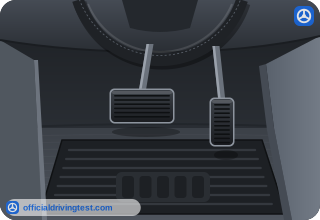
- Shift to neutral
- Pull the parking brake all the way up
- Shift to reverse
- Pump the brake pedal several times
Show answer
Correct answer: Shift to neutral
With a stuck gas pedal, quickly shift to neutral, pull off the road when safe, then turn off the engine after stopping.
Source: Iowa Driver’s License Manual (July 2026), page 62
-
With a stuck gas pedal, when should you turn off the engine?
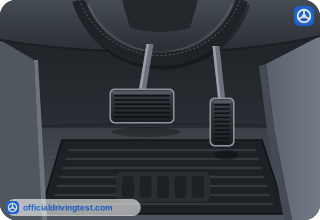
- Right away, before shifting
- Before pulling off the road
- After stopping
- Only after reaching your destination
Show answer
Correct answer: After stopping
With a stuck gas pedal, turn off the engine after stopping.
Source: Iowa Driver’s License Manual (July 2026), page 62
-
With a stuck gas pedal, where should you keep your eyes?
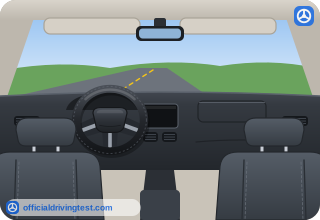
- On the gas pedal
- On the road
- On the gearshift
- On the speedometer
Show answer
Correct answer: On the road
If the motor speeds up with your foot off the accelerator, keep your eyes on the road.
Source: Iowa Driver’s License Manual (July 2026), page 62
-
In a vehicle with a steering lock system, what happens if you remove the key while driving?
- The brakes will lock
- The engine will keep running normally
- The headlights will turn off
- The steering wheel will lock
Show answer
Correct answer: The steering wheel will lock
If the key is removed, the steering wheel will lock, which may cause loss of control and a crash.
Source: Iowa Driver’s License Manual (July 2026), page 62
-
If your brakes stop working, what should you do first?
- Pump the brake pedal several times
- Turn off the engine
- Remove the key from the ignition
- Shift into reverse
Show answer
Correct answer: Pump the brake pedal several times
Pumping the brake pedal several times will often build up enough brake pressure to allow you to stop.
Source: Iowa Driver’s License Manual (July 2026), page 62
-
If the brake pedal does not work, how should you use the parking brake?
- Engage it fully at once so the car stops as quickly as possible
- Engage it only after turning off the engine
- Engage it slowly and be ready to release it if the vehicle skids
- Engage it and hold it down even if the car skids
Show answer
Correct answer: Engage it slowly and be ready to release it if the vehicle skids
Engage the parking brake slowly so you do not lock the rear wheels and cause a skid, and be ready to release it if a skid starts.
Source: Iowa Driver’s License Manual (July 2026), page 62
-
If pumping the brake and using the parking brake do not work, what should you do next?
- Shift to neutral and coast to a stop in your lane
- Shift to lower gears and look for a safe place to stop
- Turn off the engine and coast
- Keep driving to the next exit and ask for help
Show answer
Correct answer: Shift to lower gears and look for a safe place to stop
If brakes fail, start shifting to lower gears and look for a safe place to slow to a stop, off the roadway; do not drive without brakes.
Source: Iowa Driver’s License Manual (July 2026), page 62
-
After a crash, what should you do with your vehicle if possible?
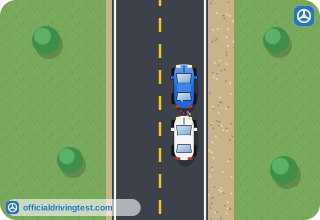
- Leave it where it stopped with the engine running and the lights on
- Move it far from the crash site and leave
- Keep it in the lane with the flashers on
- Get it out of the path of traffic, turned off and no longer moving
Show answer
Correct answer: Get it out of the path of traffic, turned off and no longer moving
If possible, ensure your vehicle is out of the path of traffic, is turned off, and no longer moving.
Source: Iowa Driver’s License Manual (July 2026), page 63
-
How does the manual say to report a crash to law enforcement?
- By calling 911
- By driving to the nearest police station
- By mailing a letter to the Iowa DOT
- By waiting for an officer to pass by
Show answer
Correct answer: By calling 911
Contact law enforcement to report the crash by calling 911.
Source: Iowa Driver’s License Manual (July 2026), page 63
-
When you call 911 to report a crash, what should you describe?
- Only the name and address of the other driver
- Only the make, model and color of the vehicles
- As many details as possible, including injuries and location
- Who you think caused the crash and why it happened there
Show answer
Correct answer: As many details as possible, including injuries and location
Describe as many details as possible, including possible injuries and the location of the crash.
Source: Iowa Driver’s License Manual (July 2026), page 63