Iowa: Emergencies
Breakdowns, tire blowouts, brake and headlight failures, floods, tornadoes, winter driving, animals on the road, and what to do after a crash. Split into 3 shorter tests so you're not stuck in one long quiz.
Independent educational site · not affiliated with any government agency or DMV
Choose a part
Emergencies — Part 1
Questions in this part include: “Before a trip, which of these does the manual say you should stay informed about?”
StartEmergencies — Part 2
Questions in this part include: “What does a tornado watch mean?”
StartEmergencies — Part 3
Questions in this part include: “What will the steering wheel be like if the engine stalls while you are driving?”
StartAll 57 Emergencies questions with answers
Choose a part above to take a practice test, or study every question and answer here.
Show the questions and answersHide the questions
-
Under Iowa’s Steer It-Clear It law, what must you do if you are in a crash with no injuries and the vehicle can be safely moved?
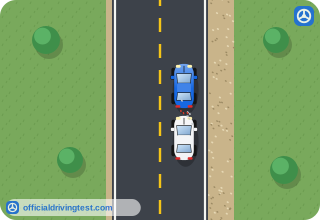
- Move your vehicle out of the driving lanes of traffic
- Leave the vehicle where it stopped until police arrive
- Stay in the driving lane with your hazard lights on
- Leave the vehicle and walk away from the road
Show answer
Correct answer: Move your vehicle out of the driving lanes of traffic
Iowa law requires moving an operable vehicle out of the driving lanes after a no-injury crash if it can be safely moved.
Source: Iowa Driver’s License Manual (July 2026), page 22
-
Before a trip, which of these does the manual say you should stay informed about?
- Fuel prices at the stations along your route
- Adverse weather, road construction, and crashes
- Parking prices at your final destination
- Local sports and community events nearby
Show answer
Correct answer: Adverse weather, road construction, and crashes
Planning ahead includes staying informed of things that will impact your trip, such as adverse weather, road construction, and crashes.
Source: Iowa Driver’s License Manual (July 2026), page 38
-
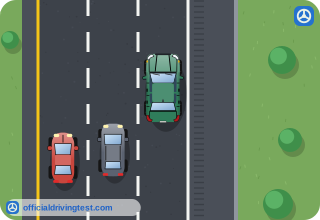
If your vehicle breaks down on the road, what should you turn on to show you are having trouble?
- Your high-beam headlights
- Your emergency hazard lights
- Your left turn signal
- Your interior dome light
Show answer
Correct answer: Your emergency hazard lights
If your vehicle breaks down, turn on your emergency hazard lights to show you are having trouble.
Source: Iowa Driver’s License Manual (July 2026), page 49
-
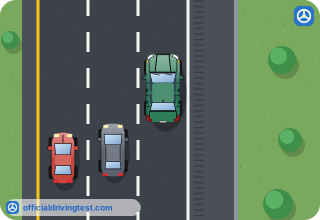
If your vehicle breaks down and you can move it, where should you take it?
- To the center of the road so others can see it
- Just over a nearby hill where the road is flat
- Safely off the road and away from traffic
- To the left lane so other drivers can pass
Show answer
Correct answer: Safely off the road and away from traffic
If possible, safely move your vehicle off the road and away from traffic.
Source: Iowa Driver’s License Manual (July 2026), page 49
-
If you cannot get your disabled vehicle off the roadway, where should you try to stop?
- Where other drivers have a clear view of your vehicle
- Just over a hill so other drivers slow down
- Just around a curve where traffic moves slowly
- In the lane with the least traffic
Show answer
Correct answer: Where other drivers have a clear view of your vehicle
Try to stop where other drivers have a clear view of your vehicle, and not just over a hill or just around a curve.
Source: Iowa Driver’s License Manual (July 2026), page 49
-
If you are stalled in a traveled lane, what should you and your passengers do?
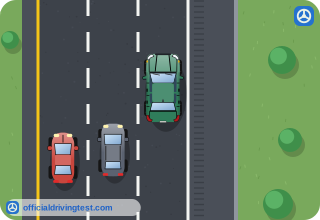
- Exit the vehicle quickly and stand in a safe area
- Stand behind the vehicle to wave traffic around it
- Stay inside and keep the engine running to stay warm
- Wait on the shoulder beside the vehicle close to traffic
Show answer
Correct answer: Exit the vehicle quickly and stand in a safe area
You and your passengers should exit the vehicle quickly and stand in a safe area, away from the shoulder of the road and far from moving vehicles when possible.
Source: Iowa Driver’s License Manual (July 2026), page 49
-
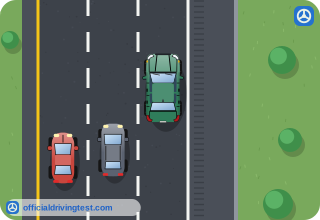
What does the manual say to do when your vehicle has broken down, in addition to making it visible?
- Leave your high beams on for the whole time until help comes
- Walk along the shoulder of the road to find the nearest phone
- Notify authorities that you or someone else has broken down
- Wave down the next driver and ask for a ride to town
Show answer
Correct answer: Notify authorities that you or someone else has broken down
One guideline for a vehicle breakdown is to notify authorities that you or someone else has broken down.
Source: Iowa Driver’s License Manual (July 2026), page 49
-
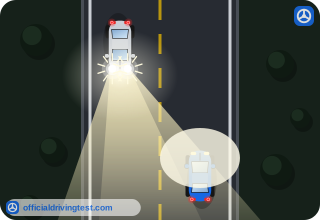
If you are blinded by another vehicle's headlights, what should you do?
- Brake hard and stop in your lane until the glare is gone completely
- Slow down and watch the white stripe at the right edge of the pavement
- Look directly at the headlights until your eyes adjust
- Move toward the center line to get away from the glare
Show answer
Correct answer: Slow down and watch the white stripe at the right edge of the pavement
Slow down and watch the white stripe at the right edge of the pavement; the feeling of being blinded quickly disappears.
Source: Iowa Driver’s License Manual (July 2026), page 56
-
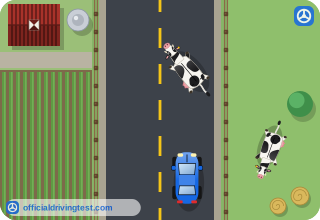
If an animal is encountered on the road and there isn't time to stop, what should you do?
- Swerve into the other lane to avoid it
- Veer onto the shoulder to go around it
- Steer sharply toward the roadside ditch
- Not swerve or veer
Show answer
Correct answer: Not swerve or veer
Swerving or veering for an animal will likely result in a more severe crash.
Source: Iowa Driver’s License Manual (July 2026), page 57
-
If you hit a deer or other animal, what does the manual say to follow?
- Drive on if the damage seems minor
- A special animal-collision law
- The rules for a parked vehicle
- Standard crash protocol
Show answer
Correct answer: Standard crash protocol
If you hit a deer or other animal, you follow the standard crash protocol.
Source: Iowa Driver’s License Manual (July 2026), page 57
-
If you see someone suffering from symptoms of heat stroke, what should you do?
- Wait to see whether the symptoms pass
- Give the person food and wait an hour
- Call 911 and seek medical attention immediately
- Drive the person home as quickly as possible
Show answer
Correct answer: Call 911 and seek medical attention immediately
If you see someone suffering from symptoms of heat stroke, call 911 and seek medical attention immediately.
Source: Iowa Driver’s License Manual (July 2026), page 59
-
In which situation does the manual say it is legal in Iowa to break a vehicle's window?
- To retrieve belongings that were left inside a parked vehicle
- To provide medical attention to a person or animal trapped inside
- To move a vehicle that is blocking your driveway
- To check the registration of a vehicle left in a parking lot
Show answer
Correct answer: To provide medical attention to a person or animal trapped inside
In Iowa it is legal to break a vehicle's window in order to provide medical attention to a person or animal trapped inside.
Source: Iowa Driver’s License Manual (July 2026), page 59
-
According to the manual, what is the best way to prepare for inclement weather driving?
- Drive faster to get ahead of the storm
- Wait until the weather arrives and then decide
- Follow other vehicles more closely
- Avoid getting caught by surprise
Show answer
Correct answer: Avoid getting caught by surprise
The best way to prepare for inclement weather driving is to avoid getting caught by surprise.
Source: Iowa Driver’s License Manual (July 2026), page 59
-
Why should you do your research before you go when inclement weather is possible?
- To determine if you need to adjust or postpone your trip
- To find the shortest route to your destination
- To learn the speed limit on each road you will use
- To decide which lane to drive in on the highway
Show answer
Correct answer: To determine if you need to adjust or postpone your trip
Researching conditions before you go lets you determine if you need to adjust or postpone your trip.
Source: Iowa Driver’s License Manual (July 2026), page 59
-
How should you ensure your vehicle is prepared for any inclement weather?
- By warming it up for an hour before each trip
- By driving it only in daylight
- By carrying extra passengers for weight
- By following routine maintenance
Show answer
Correct answer: By following routine maintenance
To prepare your vehicle for inclement weather, follow routine maintenance.
Source: Iowa Driver’s License Manual (July 2026), page 59
-
What is it a good idea to keep with you at all times, especially during winter?
- A vehicle emergency kit
- A set of tire chains
- A paper road atlas
- A spare set of keys
Show answer
Correct answer: A vehicle emergency kit
It is a good idea to keep a vehicle emergency kit with you at all times, especially during winter.
Source: Iowa Driver’s License Manual (July 2026), page 59
-
Which of these items is part of the winter survival kit shown in the manual?
- A tow rope
- Road flares
- Jumper cables
- A paper road map
Show answer
Correct answer: Jumper cables
The winter survival kit lists a first aid kit, cellphone charger, full tank of gas, water/snacks, flashlight, ice scraper/snow brush, boots/gloves/warm clothes, music/games and jumper cables.
Source: Iowa Driver’s License Manual (July 2026), page 59
-
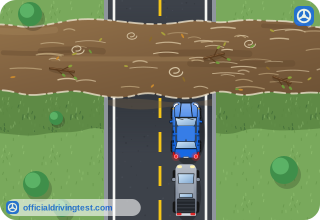
How little moving water may sweep away a vehicle, including SUVs and pickups?
- 2 feet
- 18 inches
- 6 inches
- 3 feet
Show answer
Correct answer: 6 inches
As little as 6 inches of water may sweep away a vehicle, including SUVs and pickups.
Source: Iowa Driver’s License Manual (July 2026), page 60
-
What should you do when you come to a flooded road or bridge?
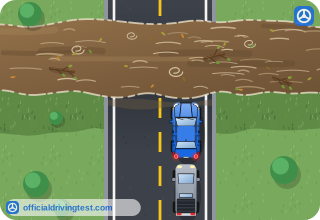
- Drive through slowly in a low gear
- Turn around and find a different route
- Follow the car ahead through the water
- Drive through quickly to limit time in the water
Show answer
Correct answer: Turn around and find a different route
The manual says never to drive through a flooded road or bridge; turn around and find a different route.
Source: Iowa Driver’s License Manual (July 2026), page 60
-
Why should you never drive through a flooded road or bridge?
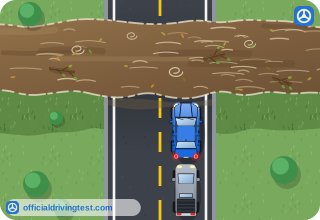
- Floodwater always damages the brakes
- Water entering the exhaust will always stall the engine
- The tires will lose air pressure
- The road surface beneath the water could be entirely washed out
Show answer
Correct answer: The road surface beneath the water could be entirely washed out
The road surface beneath the water could be entirely washed out, so you should turn around.
Source: Iowa Driver’s License Manual (July 2026), page 60
-
If your vehicle is stalled in floodwater, what should you do?
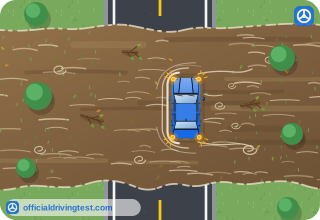
- Abandon it and move to higher ground
- Stay inside and wait for the water to drop
- Restart the engine until it runs again
- Roll up the windows and wait for help
Show answer
Correct answer: Abandon it and move to higher ground
Do not stay in a flooded vehicle: abandon the vehicle and move to higher ground.
Source: Iowa Driver’s License Manual (July 2026), page 60
-
If your car is swept into the water and submerged, when are the doors easier to open?
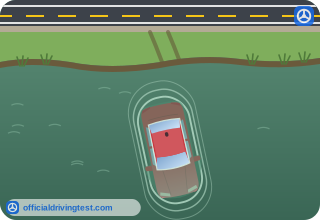
- As soon as the car goes under
- Only after the engine is turned off
- Once the vehicle is full of water
- After the headlights go out
Show answer
Correct answer: Once the vehicle is full of water
Wait for the vehicle to fill with water; once it is full the doors are easier to open, then hold your breath and swim to the surface.
Source: Iowa Driver’s License Manual (July 2026), page 60
-
If conditions in fog require it, what should you do?
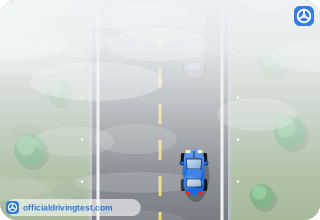
- Stop in the travel lane and turn on the flashers
- Follow the taillights of the car ahead closely
- Get off the road and find a safe place to park
- Speed up to get out of the fog quickly
Show answer
Correct answer: Get off the road and find a safe place to park
If needed, get off the road and find a safe place to park.
Source: Iowa Driver’s License Manual (July 2026), page 60
-
What does a tornado watch mean?
- A tornado is imminent in your area
- It only means that a tornado is possible
- A tornado has been seen on the ground nearby
- A tornado has already passed through the area
Show answer
Correct answer: It only means that a tornado is possible
A tornado watch is issued when a severe thunderstorm may possibly produce tornado-like conditions; it only means a tornado is possible.
Source: Iowa Driver’s License Manual (July 2026), page 60
-
If a tornado warning is issued, what does it mean?
- A tornado is possible but not yet likely
- A tornado may form later in the day
- The thunderstorm has passed and the danger is over
- A tornado is imminent, so seek shelter immediately
Show answer
Correct answer: A tornado is imminent, so seek shelter immediately
If a warning is issued, a tornado is imminent and all persons should seek shelter immediately.
Source: Iowa Driver’s License Manual (July 2026), page 60
-
If you are driving during a tornado, what is the best course of action?
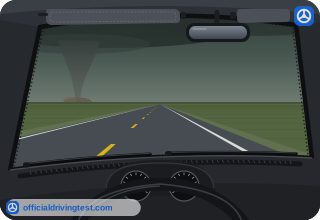
- Find a sturdy building to seek shelter
- Drive under the nearest overpass
- Outrun the storm on the highway
- Stop in the travel lane and wait
Show answer
Correct answer: Find a sturdy building to seek shelter
If you are driving during a tornado, the best course of action is to find a sturdy building to seek shelter.
Source: Iowa Driver’s License Manual (July 2026), page 60
-
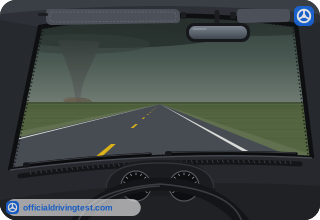
If you cannot reach a shelter during a tornado, what should you do?
- Park under a bridge and unfasten your seat belt to move freely
- Keep driving and lean over the steering wheel to stay low
- Pull over, duck below the windows, keep your seat belt fastened, cover your head
- Stay in your lane with the windows rolled down and the engine running
Show answer
Correct answer: Pull over, duck below the windows, keep your seat belt fastened, cover your head
If you cannot reach a shelter, pull over, duck down below the windows, keep your seat belt fastened and cover your head with your hands or an object.
Source: Iowa Driver’s License Manual (July 2026), page 60
-
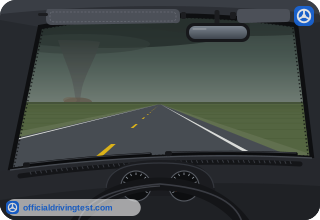
If you can safely exit your vehicle during a tornado and cannot reach a shelter, where can you take cover?
- Under a bridge
- In a low lying ditch or ravine
- Next to a tall tree beside the road
- Under an overpass
Show answer
Correct answer: In a low lying ditch or ravine
As an alternative, take cover in a low lying ditch or ravine while covering your head.
Source: Iowa Driver’s License Manual (July 2026), page 60
-
During a tornado, which places should you stay away from?
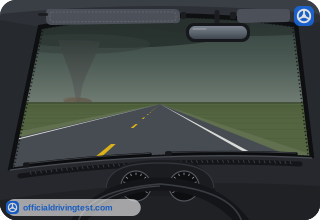
- Sturdy buildings
- Low lying ditches
- Open parking spaces
- Bridges and overpasses
Show answer
Correct answer: Bridges and overpasses
Stay away from bridges and overpasses during a tornado.
Source: Iowa Driver’s License Manual (July 2026), page 60
-
Before driving in snow or ice, how much of your vehicle should you clear?
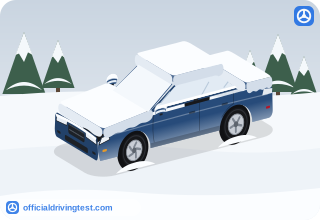
- The entire vehicle, including windows, lights and signals
- Only the windshield and the front side windows
- The windshield and the headlights only
- Only the windows, the mirrors and the windshield wipers
Show answer
Correct answer: The entire vehicle, including windows, lights and signals
Make sure your entire vehicle is clear of snow and ice, including windows, headlights, turn signals and taillights.
Source: Iowa Driver’s License Manual (July 2026), page 61
-
Why is black ice dangerous?
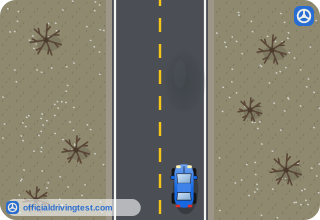
- It only forms in the middle of the day
- It only forms on gravel roads outside of towns
- It is hardly visible and often catches drivers by surprise
- It makes the road look wet and shiny to approaching drivers
Show answer
Correct answer: It is hardly visible and often catches drivers by surprise
Black ice is hardly visible and often catches drivers by surprise.
Source: Iowa Driver’s License Manual (July 2026), page 61
-
Where is black ice common?
- On wide, straight highways
- On bridges and overpasses
- In parking lots only
- In tunnels
Show answer
Correct answer: On bridges and overpasses
Black ice can occur anywhere but is common on bridges and overpasses, where moisture freezes quickly.
Source: Iowa Driver’s License Manual (July 2026), page 61
-
Why may bridges and overpasses be slippery even when other road surfaces are not?
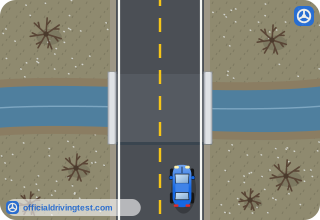
- They are built with smoother pavement than other roads
- They are never treated by snowplows
- Wind pushes snow onto them from the shoulder
- Air circulates above and below, so ice forms there first
Show answer
Correct answer: Air circulates above and below, so ice forms there first
Moisture freezes quickly on bridges and overpasses because of circulating air both above and below the road surface.
Source: Iowa Driver’s License Manual (July 2026), page 61
-
If you become stranded in the snow, what should you do if possible?
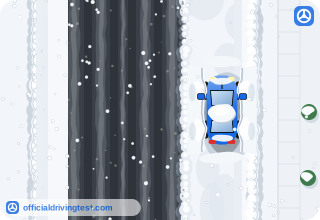
- Pull onto the shoulder and stand beside the vehicle
- Pull onto the shoulder and stay inside the vehicle
- Stop in the nearest lane and turn the engine off
- Turn onto a side road and walk to find help
Show answer
Correct answer: Pull onto the shoulder and stay inside the vehicle
If possible, pull your vehicle onto the shoulder and remain inside to avoid getting hit by other vehicles.
Source: Iowa Driver’s License Manual (July 2026), page 61
-
What can help guide emergency crews to your location when you are stranded in the snow?
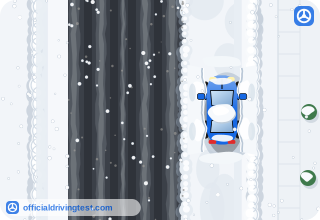
- The color, make and model of your vehicle
- Your license plate number and your home address
- The time you left home
- Exit numbers, mileposts, crossroads or landmarks
Show answer
Correct answer: Exit numbers, mileposts, crossroads or landmarks
Call 911 and look for exit numbers, mileposts, crossroads or landmarks to guide crews to you.
Source: Iowa Driver’s License Manual (July 2026), page 61
-
What is the safest location when you are stranded in the snow?
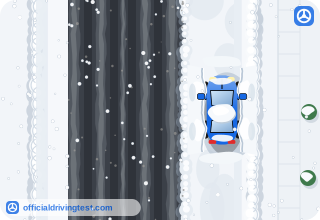
- Inside your vehicle with your seat belt on
- Standing beside your vehicle
- Walking along the shoulder
- Sitting in your vehicle with the seat belt off
Show answer
Correct answer: Inside your vehicle with your seat belt on
The safest location is to remain inside your vehicle with your seat belt on; it is the shelter you may need to survive and lets rescuers find you.
Source: Iowa Driver’s License Manual (July 2026), page 61
-
If your tire suddenly goes flat, how should you hold the steering wheel?
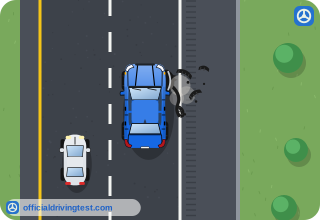
- Loosely, letting the car drift to the flat side
- With one hand, turning toward the flat
- Tightly, keeping the vehicle going straight
- Tightly, steering sharply toward the shoulder
Show answer
Correct answer: Tightly, keeping the vehicle going straight
If a tire goes flat, hold the steering wheel tightly and keep the vehicle going straight.
Source: Iowa Driver’s License Manual (July 2026), page 62
-
How should you slow down after a tire suddenly goes flat?
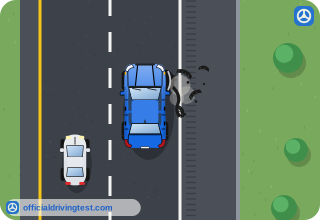
- Brake hard right away to stop in the lane
- Take your foot off the gas pedal and use the brakes lightly
- Shift to neutral and let the car coast to a stop on the road
- Pump the brake pedal several times
Show answer
Correct answer: Take your foot off the gas pedal and use the brakes lightly
Slow down gradually: take your foot off the gas pedal and use the brakes lightly.
Source: Iowa Driver’s License Manual (July 2026), page 62
-
After a tire goes flat, what should you do if at all possible?
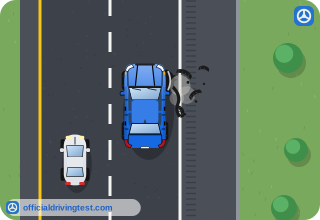
- Stop in your lane and turn on the flashers
- Stop at once in the travel lane
- Keep driving on the flat until the next exit
- Avoid stopping on the road; pull off to a safe place
Show answer
Correct answer: Avoid stopping on the road; pull off to a safe place
Do not stop on the road if at all possible; pull off the road to a safe place.
Source: Iowa Driver’s License Manual (July 2026), page 62
-
A front tire blowout will jerk the car violently toward which side?
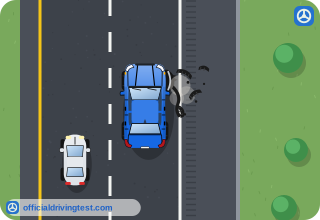
- The side of the car with the flat
- The side opposite the flat
- The center of the road
- Always toward the right shoulder
Show answer
Correct answer: The side of the car with the flat
A front tire blowout will jerk the car violently towards the side of the car with the flat.
Source: Iowa Driver’s License Manual (July 2026), page 62
-
What mistake should you avoid when steering after a front tire blowout?
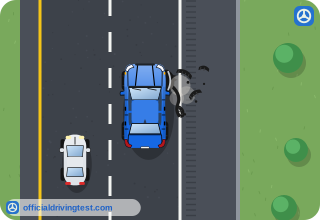
- Gripping the steering wheel
- Looking down the road
- Overcorrecting
- Using both hands
Show answer
Correct answer: Overcorrecting
Be careful not to overcorrect when steering after a front tire blowout.
Source: Iowa Driver’s License Manual (July 2026), page 62
-
After a front tire blowout, once you have straightened the car out, what should you do?
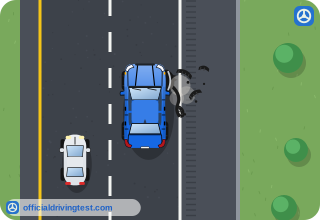
- Stop at once in your lane
- Gradually move to the right shoulder as soon as possible
- Move to the left shoulder
- Turn sharply across traffic to the nearest exit
Show answer
Correct answer: Gradually move to the right shoulder as soon as possible
Try to straighten the car out, then gradually move to the right shoulder of the roadway as soon as possible.
Source: Iowa Driver’s License Manual (July 2026), page 62
-
If your headlights suddenly go out, what should you try?
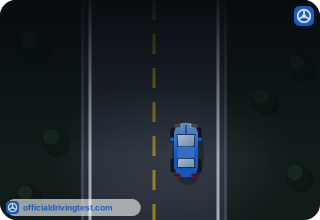
- Removing the key and putting it back
- Pumping the brake pedal
- Shifting to neutral
- The headlight switch a few times
Show answer
Correct answer: The headlight switch a few times
If your headlights suddenly go out, try the headlight switch a few times.
Source: Iowa Driver’s License Manual (July 2026), page 62
-
If your headlights do not come back on when you try the switch, what should you turn on?
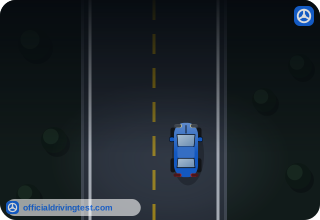
- Emergency flashers, turn signals or fog lights
- The windshield wipers and the defroster together
- The interior dome light only
- Nothing, because lights are not needed
Show answer
Correct answer: Emergency flashers, turn signals or fog lights
Turn on the emergency flashers, turn signals or fog lights if the headlights do not come back on.
Source: Iowa Driver’s License Manual (July 2026), page 62
-
After your headlights go out, what should you do as soon as possible?
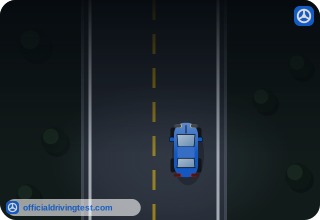
- Speed up to reach the next exit
- Keep driving to your destination and pull over there
- Pull off the road
- Brake hard in the lane
Show answer
Correct answer: Pull off the road
After your headlights go out, pull off the road as soon as possible.
Source: Iowa Driver’s License Manual (July 2026), page 62
-
What will the steering wheel be like if the engine stalls while you are driving?
- Locked in place until the engine restarts
- Difficult to turn, but you can turn it
- Locked in place
- Easier to turn than normal
Show answer
Correct answer: Difficult to turn, but you can turn it
If the engine stalls, the steering wheel will be difficult to turn, but you can turn it, so keep a strong grip.
Source: Iowa Driver’s License Manual (July 2026), page 62
-
What will the brakes be like if the engine stalls while you are driving?
- They stop working completely
- They work only if the engine is restarted first
- They become easier to press
- They still work, but you must push very hard
Show answer
Correct answer: They still work, but you must push very hard
After an engine stall, the brakes will still work, but you will have to push very hard on the brake pedal.
Source: Iowa Driver’s License Manual (July 2026), page 62
-
If the motor does not slow down when you take your foot off the accelerator, what should you do quickly?
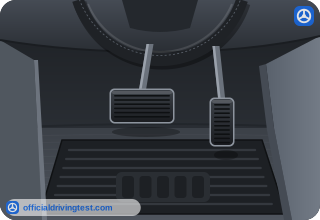
- Shift to neutral
- Pull the parking brake all the way up
- Shift to reverse
- Pump the brake pedal several times
Show answer
Correct answer: Shift to neutral
With a stuck gas pedal, quickly shift to neutral, pull off the road when safe, then turn off the engine after stopping.
Source: Iowa Driver’s License Manual (July 2026), page 62
-
With a stuck gas pedal, when should you turn off the engine?
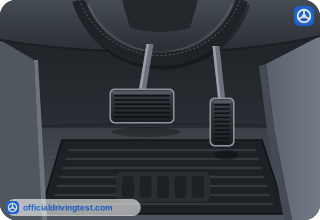
- Right away, before shifting
- Before pulling off the road
- After stopping
- Only after reaching your destination
Show answer
Correct answer: After stopping
With a stuck gas pedal, turn off the engine after stopping.
Source: Iowa Driver’s License Manual (July 2026), page 62
-
With a stuck gas pedal, where should you keep your eyes?
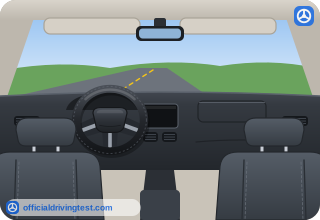
- On the gas pedal
- On the road
- On the gearshift
- On the speedometer
Show answer
Correct answer: On the road
If the motor speeds up with your foot off the accelerator, keep your eyes on the road.
Source: Iowa Driver’s License Manual (July 2026), page 62
-
In a vehicle with a steering lock system, what happens if you remove the key while driving?
- The brakes will lock
- The engine will keep running normally
- The headlights will turn off
- The steering wheel will lock
Show answer
Correct answer: The steering wheel will lock
If the key is removed, the steering wheel will lock, which may cause loss of control and a crash.
Source: Iowa Driver’s License Manual (July 2026), page 62
-
If your brakes stop working, what should you do first?
- Pump the brake pedal several times
- Turn off the engine
- Remove the key from the ignition
- Shift into reverse
Show answer
Correct answer: Pump the brake pedal several times
Pumping the brake pedal several times will often build up enough brake pressure to allow you to stop.
Source: Iowa Driver’s License Manual (July 2026), page 62
-
If the brake pedal does not work, how should you use the parking brake?
- Engage it fully at once so the car stops as quickly as possible
- Engage it only after turning off the engine
- Engage it slowly and be ready to release it if the vehicle skids
- Engage it and hold it down even if the car skids
Show answer
Correct answer: Engage it slowly and be ready to release it if the vehicle skids
Engage the parking brake slowly so you do not lock the rear wheels and cause a skid, and be ready to release it if a skid starts.
Source: Iowa Driver’s License Manual (July 2026), page 62
-
If pumping the brake and using the parking brake do not work, what should you do next?
- Shift to neutral and coast to a stop in your lane
- Shift to lower gears and look for a safe place to stop
- Turn off the engine and coast
- Keep driving to the next exit and ask for help
Show answer
Correct answer: Shift to lower gears and look for a safe place to stop
If brakes fail, start shifting to lower gears and look for a safe place to slow to a stop, off the roadway; do not drive without brakes.
Source: Iowa Driver’s License Manual (July 2026), page 62
-
After a crash, what should you do with your vehicle if possible?
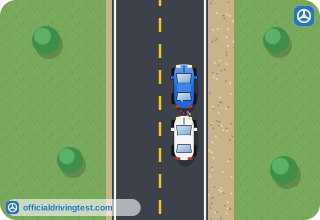
- Leave it where it stopped with the engine running and the lights on
- Move it far from the crash site and leave
- Keep it in the lane with the flashers on
- Get it out of the path of traffic, turned off and no longer moving
Show answer
Correct answer: Get it out of the path of traffic, turned off and no longer moving
If possible, ensure your vehicle is out of the path of traffic, is turned off, and no longer moving.
Source: Iowa Driver’s License Manual (July 2026), page 63
-
How does the manual say to report a crash to law enforcement?
- By calling 911
- By driving to the nearest police station
- By mailing a letter to the Iowa DOT
- By waiting for an officer to pass by
Show answer
Correct answer: By calling 911
Contact law enforcement to report the crash by calling 911.
Source: Iowa Driver’s License Manual (July 2026), page 63
-
When you call 911 to report a crash, what should you describe?
- Only the name and address of the other driver
- Only the make, model and color of the vehicles
- As many details as possible, including injuries and location
- Who you think caused the crash and why it happened there
Show answer
Correct answer: As many details as possible, including injuries and location
Describe as many details as possible, including possible injuries and the location of the crash.
Source: Iowa Driver’s License Manual (July 2026), page 63