Indiana: Emergencies — Part 1 Practice Test
Questions in this part include: “What does the manual say is the most important factor in reducing the chance of a rollover?” · “What happens to the rollover risk of a 15-passenger van as the number of occupants increases?”
Independent educational site · not affiliated with any government agency or DMV
Ready? Test yourself
- Instant feedback with an explanation
- Every answer cites its source in the manual
- Your best score is saved on this device
Questions are original and based on the official manual "Indiana Driver’s Manual" (July 2026), Indiana Bureau of Motor Vehicles.
All 20 questions in this practice test
Take the test above first, then use this list to study. Tap “Show answer” to see the correct answer and explanation.
Show the questions and answersHide the questions
-
Which of these can cause a vehicle to skid?
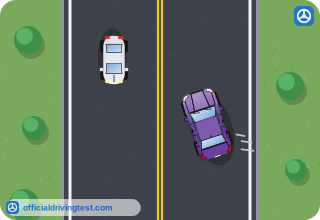
- Sudden turns, lane changes, or hard braking
- Steady acceleration on a dry, straight road
- Driving slowly with the cruise control set
- Gradual turns made at a low speed
Show answer
Correct answer: Sudden turns, lane changes, or hard braking
The manual says sudden turns, lane changes, or hard braking can cause a vehicle to skid.
Source: Indiana Driver’s Manual (July 2026), page 42 · Open this page in the manual (Manual page 42)
-
How does the procedure for correcting a skid differ between front-wheel-drive and rear-wheel-drive vehicles?
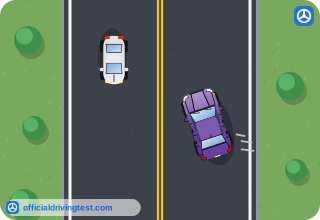
- Front-wheel-drive vehicles must brake hard, rear-wheel-drive must not
- Rear-wheel-drive vehicles must accelerate, front-wheel-drive must not
- It does not differ: the procedure is the same for both
- It depends only on the weight of the vehicle
Show answer
Correct answer: It does not differ: the procedure is the same for both
The manual states the procedure for correcting a skid is the same for both types of vehicles.
Source: Indiana Driver’s Manual (July 2026), page 42 · Open this page in the manual (Manual page 42)
-
What should you do first if your vehicle begins to lose traction or the rear wheels slide sideways?
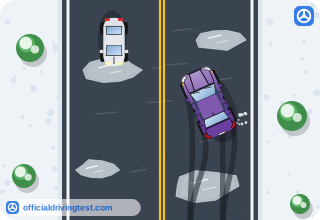
- Accelerate to regain traction
- Ease off the gas pedal
- Make a fast turn away from the skid
- Steer as far as the wheel will turn
Show answer
Correct answer: Ease off the gas pedal
The manual says to ease off the gas pedal and not to make a fast turn away from the skid or steer too far.
Source: Indiana Driver’s Manual (July 2026), page 42 · Open this page in the manual (Manual page 42)
-
In a vehicle with conventional brakes, which way should you steer during a skid?
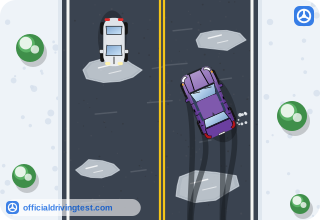
- Opposite to the direction the rear is sliding
- Straight ahead, holding the wheel firmly
- Toward the nearest side of the road
- In the direction the rear of the car is sliding
Show answer
Correct answer: In the direction the rear of the car is sliding
With conventional brakes, turn the steering wheel in a controlled manner in the direction the rear of the car is sliding.
Source: Indiana Driver’s Manual (July 2026), page 42 · Open this page in the manual (Manual page 42)
-
What should you do with the brake pedal in a skid if your vehicle has an anti-lock brake system (ABS)?
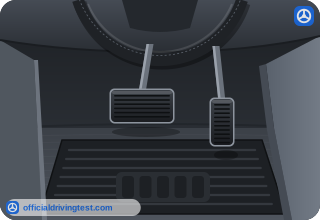
- Keep firm, continuous pressure on it while steering normally
- Pump it rapidly several times while steering normally
- Release it completely and coast until the skid ends
- Tap it lightly several times until the car stops sliding
Show answer
Correct answer: Keep firm, continuous pressure on it while steering normally
With ABS, keep your foot on the brake with firm and continuous pressure while steering normally, and do not pump the brakes.
Source: Indiana Driver’s Manual (July 2026), page 42 · Open this page in the manual (Manual page 42)
-
What indicates that your anti-lock brake system (ABS) is working?
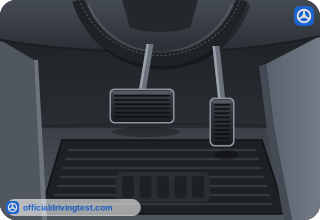
- The brake pedal slowly sinking toward the floor as you press
- The brake pedal becoming completely silent, soft, and still
- A mechanical noise, vibration, or increased resistance in the pedal
- A burning smell coming from the wheels as the car slows
Show answer
Correct answer: A mechanical noise, vibration, or increased resistance in the pedal
The manual says a mechanical sound or noise and vibration or increased resistance in the brake pedal indicates ABS is working.
Source: Indiana Driver’s Manual (July 2026), page 42 · Open this page in the manual (Manual page 42)
-
Many rollovers occur when drivers do what?
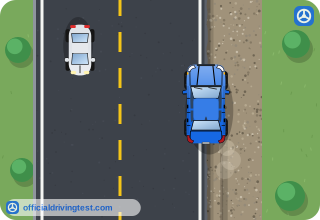
- Brake too gently after leaving the roadway
- Overcorrect their steering in a panicked reaction
- Drive too slowly on the highway
- Use the turn signal too early
Show answer
Correct answer: Overcorrect their steering in a panicked reaction
The manual says many rollovers occur when drivers overcorrect their steering as a panicked reaction to an emergency.
Source: Indiana Driver’s Manual (July 2026), page 42 · Open this page in the manual (Manual page 42)
-
If your vehicle leaves the roadway, what should you do to reduce the risk of a rollover?
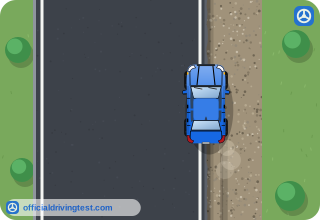
- Turn back onto the pavement right away to avoid the ditch
- Brake hard and turn sharply back toward the pavement
- Accelerate to climb back onto the pavement quickly
- Ease up on the gas and gradually turn back when it is safe
Show answer
Correct answer: Ease up on the gas and gradually turn back when it is safe
The manual says not to turn back onto the pavement right away, but to ease up on the gas and gradually turn back when safe.
Source: Indiana Driver’s Manual (July 2026), page 42 · Open this page in the manual (Manual page 42)
-
What does the manual say is the most important factor in reducing the chance of a rollover?
- Maintaining vehicle control
- Staying on interstate highways
- Using cruise control at all times
- Driving only in daylight hours
Show answer
Correct answer: Maintaining vehicle control
Improperly inflated and worn tires inhibit vehicle control, which is the most important factor in reducing the chance of rollover.
Source: Indiana Driver’s Manual (July 2026), page 42 · Open this page in the manual (Manual page 42)
-
Where can you find the maximum safe load and proper load distribution for your vehicle?
- On your vehicle registration
- On your vehicle title
- In your vehicle's owner manual
- In the Indiana Driver's Manual
Show answer
Correct answer: In your vehicle's owner manual
The manual says the maximum safe load and proper load distribution are in the vehicle's owner manual.
Source: Indiana Driver’s Manual (July 2026), page 42 · Open this page in the manual (Manual page 42)
-
On which kind of roads are rollovers more likely to occur?
- Divided roads that have barriers along the median
- Undivided, two-way roads or divided roads with no barriers
- Interstate highways with wide paved shoulders
- Straight, level roads inside towns and cities
Show answer
Correct answer: Undivided, two-way roads or divided roads with no barriers
The manual says rollovers are more likely on undivided, two-way roads or divided roads with no barriers.
Source: Indiana Driver’s Manual (July 2026), page 42 · Open this page in the manual (Manual page 42)
-
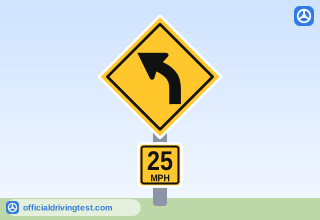
What does the manual say about advisory speeds on curves and ramps?
- They may be exceeded in good weather
- They apply only at night
- They apply only to trucks
- They should not be exceeded
Show answer
Correct answer: They should not be exceeded
Advisory speeds are provided on curves and ramps, and these advisory speeds should not be exceeded.
Source: Indiana Driver’s Manual (July 2026), page 42 · Open this page in the manual (Manual page 42)
-
What happens to the rollover risk of a 15-passenger van as the number of occupants increases?
- It increases dramatically
- It decreases slightly
- It stays the same
- It decreases dramatically
Show answer
Correct answer: It increases dramatically
The manual says the rollover risk of a 15-passenger van increases dramatically as the number of occupants increases.
Source: Indiana Driver’s Manual (July 2026), page 42 · Open this page in the manual (Manual page 42)
-
Why does the manual advise driving with a full tank of gas in very cold conditions?

- So the heater can stay on as long as possible if stranded
- So the fuel line cannot freeze while you are driving
- So the car has more weight for traction
- So the engine needs less time to warm up
Show answer
Correct answer: So the heater can stay on as long as possible if stranded
A full tank means that if stranded, the heater can remain in use for as long as possible.
Source: Indiana Driver’s Manual (July 2026), page 43 · Open this page in the manual (Manual page 43)
-
Which item does the manual say to consider carrying in a winter survival kit?
- A spare set of windshield wipers
- A tow rope and a tire jack
- A portable air compressor
- Sand or strips of carpet for traction
Show answer
Correct answer: Sand or strips of carpet for traction
The winter survival kit the manual describes includes sand or strips of carpet for traction, booster cables, blankets and more.
Source: Indiana Driver’s Manual (July 2026), page 43 · Open this page in the manual (Manual page 43)
-
What should you do if fog closes in completely and visibility is reduced to near zero?

- Slow down and keep following the road carefully
- Carefully pull off the road as far as possible and stop
- Stop in your lane and wait for the fog to lift
- Speed up to drive out of the fog as quickly as you can
Show answer
Correct answer: Carefully pull off the road as far as possible and stop
The manual says to carefully pull off the road as far as possible and stop.
Source: Indiana Driver’s Manual (July 2026), page 44 · Open this page in the manual (Manual page 44)
-
Which roadway weather event causes more deaths each year than any other?
- Fog
- Ice and snow
- Flash flooding
- High winds
Show answer
Correct answer: Flash flooding
The manual says flash flooding causes more deaths than any other roadway weather event each year.
Source: Indiana Driver’s Manual (July 2026), page 44 · Open this page in the manual (Manual page 44)
-
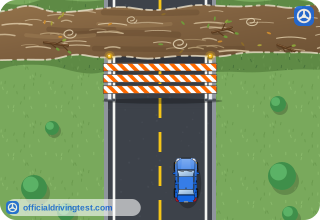
What should you do about traffic barricades and road closed signs during a flash flood?
- Drive around them if the water looks shallow
- Do not drive around the barricades or past the signs
- Move the barricade if you are alone
- Pass them only at a very low speed
Show answer
Correct answer: Do not drive around the barricades or past the signs
The manual says not to drive around traffic barricades or past road closed signs.
Source: Indiana Driver’s Manual (July 2026), page 44 · Open this page in the manual (Manual page 44)
-
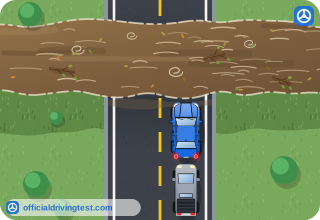
During flash flooding, which of these may be washed away or undermined by floodwaters?
- Traffic signals and utility poles
- Guardrails and road signs
- Railroad crossing gates
- Bridges, culverts, and roadbeds
Show answer
Correct answer: Bridges, culverts, and roadbeds
The manual says to watch for bridges, culverts, and roadbeds that may be washed away or undermined by floodwaters.
Source: Indiana Driver’s Manual (July 2026), page 44 · Open this page in the manual (Manual page 44)
-
Why should you not drive where water is over the road?
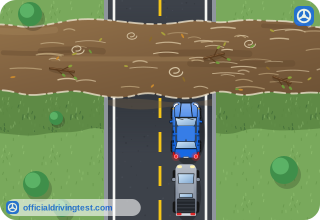
- The depth of the water is not always obvious, and it may hide washouts
- The water may make your horn and headlights stop working at once
- The water will always be deeper than the height of your tires
- Driving through standing water is illegal under Indiana law
Show answer
Correct answer: The depth of the water is not always obvious, and it may hide washouts
The manual says the depth of the water is not always obvious and the water may hide washouts.
Source: Indiana Driver’s Manual (July 2026), page 44 · Open this page in the manual (Manual page 44)