Idaho: Sharing the road — Part 3 Practice Test
Bicyclists, motorcycles, large vehicles, horseback riders, wildlife and open range, and passing and being passed. — Part 3
Independent educational site · not affiliated with any government agency or DMV
Ready? Test yourself
- Instant feedback with an explanation
- Every answer cites its source in the manual
- Your best score is saved on this device
Questions are original and based on the official manual "Idaho Driver's Handbook" (July 2026), Idaho Transportation Department.
All 31 questions in this practice test
Take the test above first, then use this list to study. Tap “Show answer” to see the correct answer and explanation.
Show the questions and answersHide the questions
-
A bicyclist reaches a red light. What may the bicyclist do in Idaho?
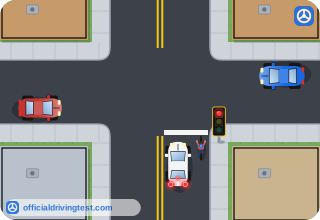
- Proceed without stopping if no pedestrians are present
- Wait for the light to turn green in every case
- Proceed with caution after stopping and yielding to vehicles
- Proceed only if a driver waves the bicyclist through
Show answer
Correct answer: Proceed with caution after stopping and yielding to vehicles
Bicyclists may proceed with caution through a red light after stopping and yielding the right-of-way to vehicles already in the intersection.
Source: Idaho Driver's Handbook (July 2026), page 98 · Open this page in the manual (Manual page 98)
-
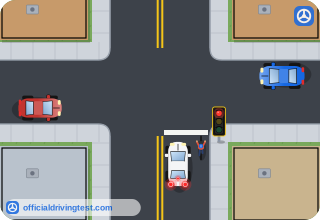
What must a bicyclist do when turning right on a red light in Idaho?
- Come to a complete stop and wait for the green light
- Yield to vehicles in or near the intersection; no full stop needed
- Come to a complete stop and then speed up to turn
- Turn only when no pedestrians are present in the crosswalk
Show answer
Correct answer: Yield to vehicles in or near the intersection; no full stop needed
They do not need to come to a complete stop when turning right on a red light, but must yield the right-of-way to vehicles already in the intersection.
Source: Idaho Driver's Handbook (July 2026), page 99 · Open this page in the manual (Manual page 99)
-
Why should drivers be alert and use extreme caution when encountering bicyclists?
- Bicyclists always have the right-of-way over drivers
- Bicyclists cannot hear any approaching vehicles
- Bicyclists never obey the traffic rules of the road
- They are unprotected, and most collisions injure the cyclist
Show answer
Correct answer: They are unprotected, and most collisions injure the cyclist
Bicyclists are relatively unprotected compared to motor vehicle drivers, and most collisions result in injury to the cyclist.
Source: Idaho Driver's Handbook (July 2026), page 99 · Open this page in the manual (Manual page 99)
-
What does safely sharing the road with bicyclists require?
- Staying in the left lane at all times
- Using the horn to announce your presence
- Cooperation, patience, and understanding
- Driving below the speed limit at all times
Show answer
Correct answer: Cooperation, patience, and understanding
The manual says safely sharing the road with bicyclists requires cooperation, patience, and understanding.
Source: Idaho Driver's Handbook (July 2026), page 99 · Open this page in the manual (Manual page 99)
-
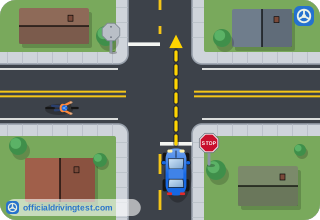
Why should you scan the corners of an intersection more than once?
- Bicyclists must stop at every corner of an intersection
- Bicyclists never use the corners of an intersection
- Cars at the corners may not see the bicyclists there
- A bicyclist can easily travel 50 to 100 feet in a few seconds
Show answer
Correct answer: A bicyclist can easily travel 50 to 100 feet in a few seconds
A bicyclist can easily travel 50 to 100 feet in a few seconds, so what you saw on your first look may change.
Source: Idaho Driver's Handbook (July 2026), page 99 · Open this page in the manual (Manual page 99)
-
May bicyclists ride on sidewalks in Idaho?
- No, sidewalk riding is never legal in Idaho
- Yes, and bicyclists are required to use sidewalks
- Yes, but only children below a certain age may do so
- Yes, legally in most communities, but it is not required
Show answer
Correct answer: Yes, legally in most communities, but it is not required
Bicyclists can legally ride on sidewalks in most communities, although they are not legally required to use them.
Source: Idaho Driver's Handbook (July 2026), page 100 · Open this page in the manual (Manual page 100)
-
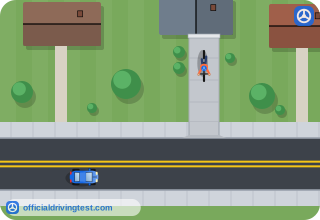
Why must you be extremely cautious when pulling in or out of a driveway where bicyclists may be near?
- Bicyclists must ride on the road in the center
- Young children usually ride on the sidewalk
- Bicyclists are not allowed on sidewalks
- Driveways are marked as bike lanes
Show answer
Correct answer: Young children usually ride on the sidewalk
Young children usually ride on the sidewalk, so you must be extremely cautious when pulling in or out of a driveway.
Source: Idaho Driver's Handbook (July 2026), page 100 · Open this page in the manual (Manual page 100)
-
Should you rush a turn or squeeze past a bicyclist to beat traffic or a traffic light?
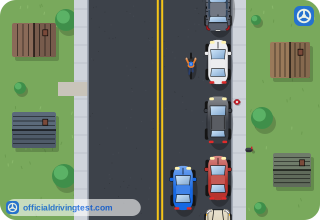
- Yes, if the bicyclist is in the bike lane
- Yes, if you use your turn signal
- No, never
- Yes, if the road is wide
Show answer
Correct answer: No, never
Never rush a turn or squeeze past a bicyclist just to beat traffic or a traffic light.
Source: Idaho Driver's Handbook (July 2026), page 100 · Open this page in the manual (Manual page 100)
-
Why might a bicyclist ride in the center of the travel lane instead of to the right?
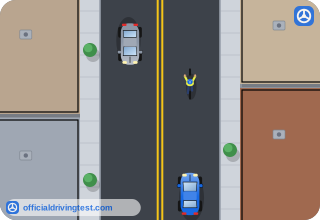
- The street design requires it for safety
- The bicyclist is trying to block the traffic
- The bicyclist is about to turn right
- The bicyclist wants to pass some parked cars
Show answer
Correct answer: The street design requires it for safety
The design of some streets and highways requires bicyclists to occupy the travel lane for safety.
Source: Idaho Driver's Handbook (July 2026), page 100 · Open this page in the manual (Manual page 100)
-
A bicyclist is riding in the center of a narrow stretch of travel lane. What should you not do?
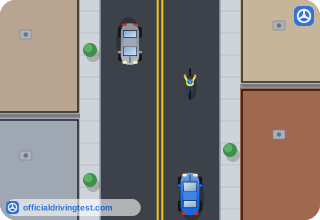
- Follow too closely behind the bicyclist
- Be patient while waiting for a safe place to pass
- Wait until it is safe to pass the bicyclist
- Use your turn signal before changing lanes
Show answer
Correct answer: Follow too closely behind the bicyclist
Be patient and do not follow too closely, because these are brief narrow stretches where passing is unsafe.
Source: Idaho Driver's Handbook (July 2026), page 100 · Open this page in the manual (Manual page 100)
-
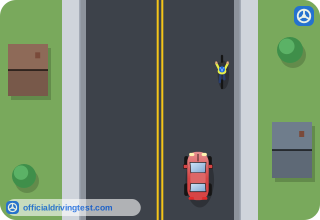
Why must drivers consciously look for bicyclists?
- They ride only at night when it is hard to see
- They are always found in the middle of the lane
- Their position, small size and slow speed hide them
- They ride faster than most motor vehicles do
Show answer
Correct answer: Their position, small size and slow speed hide them
Bicyclists are not as noticeable as motor vehicles because of their position, smaller size and slower speed.
Source: Idaho Driver's Handbook (July 2026), page 100 · Open this page in the manual (Manual page 100)
-
What does the manual say about a typical 12-foot-wide travel lane and bicyclists?
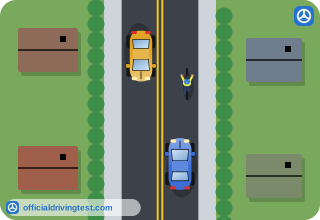
- It is wide enough to pass a bicyclist without leaving your lane
- It is not wide enough to safely share with a bicyclist
- It is wide enough only on straight roads
- It is wide enough if you slow down
Show answer
Correct answer: It is not wide enough to safely share with a bicyclist
A typical 12-foot-wide travel lane is not wide enough to safely share with a bicyclist.
Source: Idaho Driver's Handbook (July 2026), page 100 · Open this page in the manual (Manual page 100)
-
Why are bicyclists taught to ride at least three feet from the edge of the pavement?
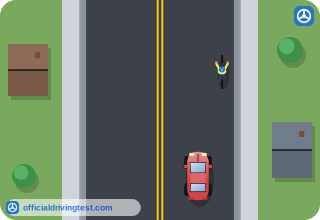
- To avoid pedestrians who walk on the shoulder
- To stay clear of the curb because it is slippery
- To stay inside a marked bike lane at all times
- To avoid edge debris and keep room for an emergency move
Show answer
Correct answer: To avoid edge debris and keep room for an emergency move
Riding three feet from the edge avoids accumulated edge debris and leaves space to the right for an emergency maneuver.
Source: Idaho Driver's Handbook (July 2026), page 101 · Open this page in the manual (Manual page 101)
-
What does the manual say about the passing space drivers should leave at higher speeds?
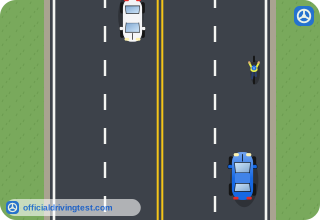
- It stays the same at any speed
- Higher speeds require less passing space
- Higher speeds require more passing space
- Passing space matters only below 25 mph
Show answer
Correct answer: Higher speeds require more passing space
Three feet is the minimum passing space, and higher speeds require more space.
Source: Idaho Driver's Handbook (July 2026), page 101 · Open this page in the manual (Manual page 101)
-
When you pass a bicyclist and oncoming traffic is present, what may passing require?
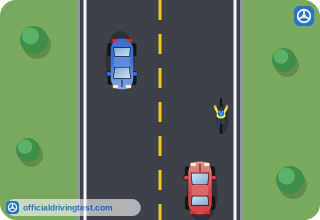
- Waiting for a break in oncoming traffic
- Passing within your own lane at once
- Passing on the bicyclist’s right side
- Sounding your horn before you pass
Show answer
Correct answer: Waiting for a break in oncoming traffic
Passing a bicyclist may require waiting for a break in oncoming traffic; the delay is usually brief.
Source: Idaho Driver's Handbook (July 2026), page 98 · Open this page in the manual (Manual page 98)
-
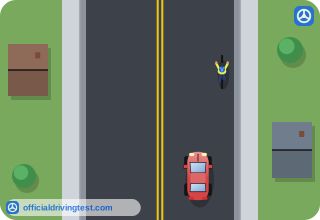
How can you make sure a bicyclist sees you?
- Honk your horn twice to get the bicyclist's attention
- Flash your headlights repeatedly at the bicyclist
- Drive close behind the bicyclist until it moves over
- Wave a hand or nod your head and wait for a reaction
Show answer
Correct answer: Wave a hand or nod your head and wait for a reaction
Wave a hand or nod your head, and wait for the bicyclist's reaction.
Source: Idaho Driver's Handbook (July 2026), page 101 · Open this page in the manual (Manual page 101)
-
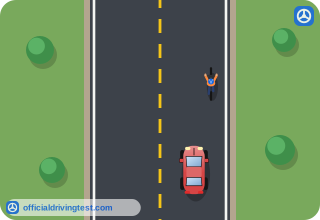
Why should you never honk when close to a bicyclist?
- It is not allowed in residential areas at all
- It may startle the bicyclist and cause a sudden reaction
- Bicyclists are not required to respond to a horn
- It shows that you want the bicyclist to stop riding
Show answer
Correct answer: It may startle the bicyclist and cause a sudden reaction
Honking close to a bicyclist may startle them and cause an unexpected reaction.
Source: Idaho Driver's Handbook (July 2026), page 101 · Open this page in the manual (Manual page 101)
-
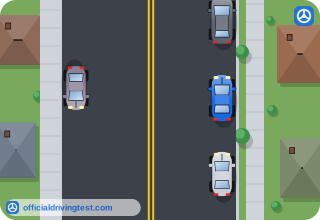
After parallel parking, what must you ensure before opening the driver's door?
- That your engine is running
- That a bicyclist is not approaching
- That the door lock is released from outside
- That your hazard lights are off
Show answer
Correct answer: That a bicyclist is not approaching
Ensure a bicyclist is not approaching before opening the driver's door.
Source: Idaho Driver's Handbook (July 2026), page 101 · Open this page in the manual (Manual page 101)
-
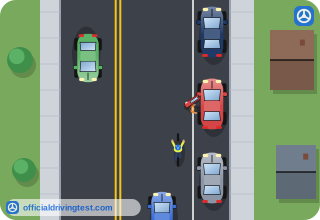
When exiting your car, you reach across your body for the door handle with your opposite hand. What does this force you to do?
- Open the door more slowly than you normally do
- Put the car in park before you open the door
- Look straight ahead through the windshield first
- Turn toward the side mirror and look over your shoulder
Show answer
Correct answer: Turn toward the side mirror and look over your shoulder
It forces you to turn toward the side view mirror and look over your shoulder to be sure a bicyclist is not coming.
Source: Idaho Driver's Handbook (July 2026), page 101 · Open this page in the manual (Manual page 101)
-
How do you make your intentions clear to bicyclists and other drivers?
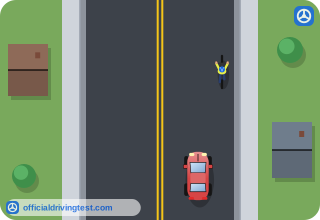
- Always use your turn signal
- Slow down without signaling
- Honk before you turn
- Move to the left of your lane
Show answer
Correct answer: Always use your turn signal
Road safety depends on predictability, so always use your turn signal to show your intent to turn or change lanes.
Source: Idaho Driver's Handbook (July 2026), page 101 · Open this page in the manual (Manual page 101)
-
What rights and responsibilities do motorcyclists have on the highway?
- The same rights and responsibilities as other highway users
- Fewer rights than car drivers, because motorcycles are smaller than cars
- Extra right-of-way over cars at every intersection they approach
- Exemption from traffic laws that are written for four-wheel vehicles
Show answer
Correct answer: The same rights and responsibilities as other highway users
Motorcyclists have the same rights and responsibilities as other highway users and must obey the same traffic laws.
Source: Idaho Driver's Handbook (July 2026), page 103 · Open this page in the manual (Manual page 103)
-
Where can a motorcycle easily be hidden from a driver's view?
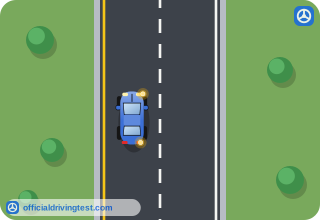
- Behind the car's front bumper
- Under the car's mirrors
- In a car's blind spot
- Inside the car's headlight beam
Show answer
Correct answer: In a car's blind spot
The manual says motorcycles are smaller and harder to see than cars and are easily hidden in a car's blind spot.
Source: Idaho Driver's Handbook (July 2026), page 103 · Open this page in the manual (Manual page 103)
-
What is the correct precaution before turning left in front of an oncoming motorcycle?
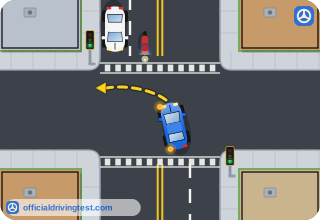
- Assume the motorcycle will slow down because it is smaller than your car
- Look and then look again, so you see the motorcycle and know its speed
- Turn quickly so the motorcycle has less time to reach your path
- Judge the distance by watching the motorcycle's headlight alone
Show answer
Correct answer: Look and then look again, so you see the motorcycle and know its speed
The manual says the correct precaution is to look and then look again until you see the motorcycle and know its speed.
Source: Idaho Driver's Handbook (July 2026), page 103 · Open this page in the manual (Manual page 103)
-
A motorcycle ahead has its turn signal flashing. Before you turn in front of it, what should you be sure of?
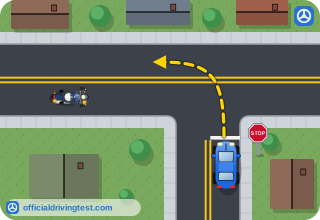
- That the rider has already seen your own turn signal flashing
- That the motorcycle's signal will turn itself off after the turn
- That the motorcycle is traveling below the posted speed limit
- That the motorcycle is turning and not continuing straight into your path
Show answer
Correct answer: That the motorcycle is turning and not continuing straight into your path
Most motorcycle turn signals do not turn off automatically, so a flashing signal may mean the rider forgot to switch it off.
Source: Idaho Driver's Handbook (July 2026), page 103 · Open this page in the manual (Manual page 103)
-
How much of a lane is a motorcycle entitled to?
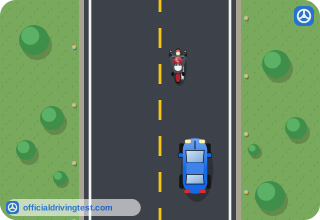
- The same full-lane width as all other motor vehicles
- Half of the lane, so a car may share the other half
- Only the center third of the lane it is traveling in
- Only the width its tires need, as set by the lane's markings
Show answer
Correct answer: The same full-lane width as all other motor vehicles
The manual states that motorcycles are entitled to the same full-lane width as all other motor vehicles.
Source: Idaho Driver's Handbook (July 2026), page 103 · Open this page in the manual (Manual page 103)
-
Why do good motorcycle riders constantly change positions within their lane?
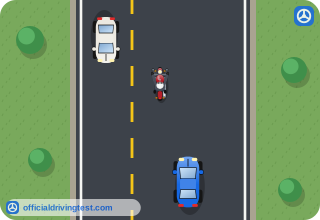
- So that following cars can pass them inside the same lane
- To warn other drivers that they plan to turn at the next corner
- So they can see and be seen, and to avoid objects in the road
- To save fuel and keep the engine from overheating on long trips
Show answer
Correct answer: So they can see and be seen, and to avoid objects in the road
Good riders change lane position so they can see and be seen and to avoid objects in the road.
Source: Idaho Driver's Handbook (July 2026), page 103 · Open this page in the manual (Manual page 103)
-
A motorcycle rider is riding far to one side of a wide lane. What should you do?
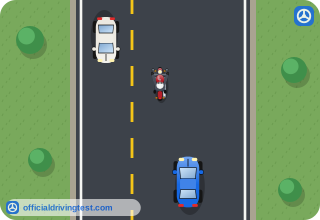
- Share the lane by driving on the open side if you slow down
- Never move into the same lane alongside the motorcycle
- Pass inside the lane as long as you stay close to the edge line
- Move alongside it only when no other traffic is in sight
Show answer
Correct answer: Never move into the same lane alongside the motorcycle
The manual says never to move into the same lane alongside a motorcycle, even if the lane is wide and the rider is far to one side.
Source: Idaho Driver's Handbook (July 2026), page 103 · Open this page in the manual (Manual page 103)
-
How should your following room behind a motorcycle change when it is raining or the road surface is slick?
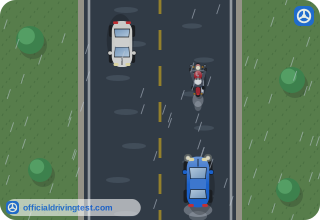
- Keep the same room, because motorcycles stop faster
- Allow less room so the rider can see your vehicle
- Move into the lane beside the rider for better visibility
- Allow even more following room
Show answer
Correct answer: Allow even more following room
Weather and slippery surfaces are serious problems for motorcycles, so the manual says to allow even more following room.
Source: Idaho Driver's Handbook (July 2026), page 104 · Open this page in the manual (Manual page 104)
-
Which of these can force a motorcycle rider to change speed or direction, even though it may not affect other vehicles?
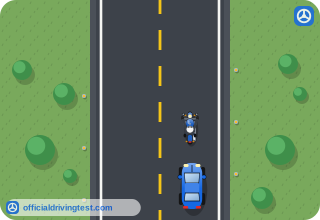
- Gravel, debris, pavement seams, or a manhole cover
- Dry, level pavement with clearly painted lane lines
- A wide shoulder that has been recently swept clean
- A straight road with no other traffic in sight
Show answer
Correct answer: Gravel, debris, pavement seams, or a manhole cover
Gravel, debris, pavement seams, small animals and even manhole covers can force a motorcycle rider to change speed or direction.
Source: Idaho Driver's Handbook (July 2026), page 104 · Open this page in the manual (Manual page 104)
-
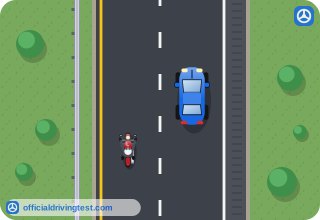
How should you check for motorcycles before entering or leaving a lane of traffic or an intersection?
- Listen for engine noise, since riders are hard to see
- Glance once at the rear-view mirror and then proceed
- Make a visual check of your mirrors and blind spots
- Wait for the rider to signal before you look
Show answer
Correct answer: Make a visual check of your mirrors and blind spots
The manual says to always make a visual check for motorcycles by checking mirrors and blind spots before entering or leaving a lane or intersection.
Source: Idaho Driver's Handbook (July 2026), page 104 · Open this page in the manual (Manual page 104)
-
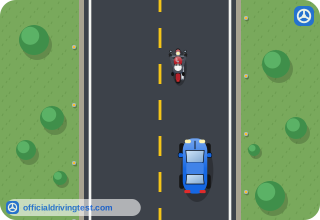
Why should you always use your turn signals and brake lights around motorcycles?
- So the rider knows you will let the motorcycle pass in your lane
- So the rider can anticipate traffic flow and find a safe lane position
- So the rider can ride closer to the back of your vehicle
- So the rider can stop watching the traffic in front of you
Show answer
Correct answer: So the rider can anticipate traffic flow and find a safe lane position
Signaling lets the motorcycle rider anticipate traffic flow and find a safe lane position.
Source: Idaho Driver's Handbook (July 2026), page 104 · Open this page in the manual (Manual page 104)