Pavement markings in Idaho
The Idaho Driver's Handbook shows or names everything on this page: 15 in all, on pages 56, 58–61, 81, 101.
Independent educational site · not affiliated with any government agency or DMV
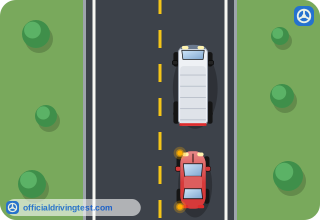
A Dashed Yellow Line
A dashed yellow line means that vehicles in either lane can cross the line if it is safe to do so.
Manual page 58 · Open this page in the manual (Manual page 58)
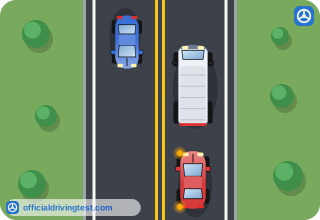
Double Solid Yellow Lines
Two solid yellow lines mean that neither lane of traffic can cross the lines unless they are turning (if it is safe to do so). A driver can cross a double yellow line when turning left into or out of a driveway or entrance to a business. No passing is allowed.
Manual page 58 · Open this page in the manual (Manual page 58)
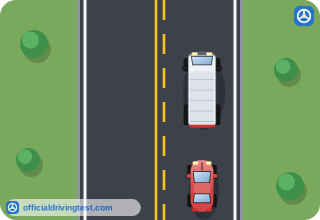
A Solid Yellow Line and A Dashed Yellow Line
One solid yellow line and one dashed yellow line means that only vehicles in the lane with the dashed line ... can cross the lines to pass other vehicles.
Manual page 58 · Open this page in the manual (Manual page 58)
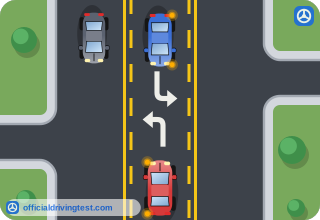
Shared Lanes (Center Left-Turn Lane)
Center lanes are reserved for making left turns (or U-turns when they are permitted) from either direction of travel. Shared center lanes are marked on each side by a solid and yellow dashed lines. You may not travel in the shared turn lanes or interfere with another vehicle preparing to make a turn from the center turn lane.
Manual page 58 · Open this page in the manual (Manual page 58)
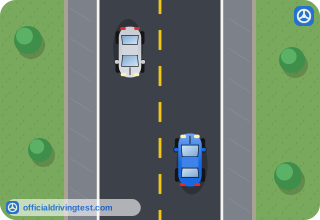
Edge Lines
Solid white lines may be located along the side of the road to show where the edge of the road is located. At night or in bad weather, they help you stay on the road.
Manual page 59 · Open this page in the manual (Manual page 59)
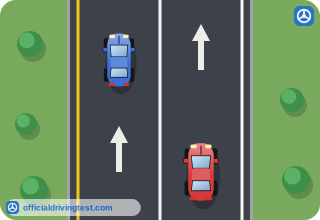
A Solid White Lane Line
Avoid changing lanes where a solid white line separates lanes of traffic moving in the same direction.
Manual page 59 · Open this page in the manual (Manual page 59)
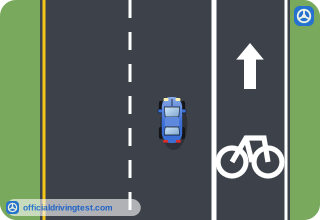
A Solid White Line With a Bicycle Insignia
Located along the side of the road, this indicates the area is designated for bicycle traffic only. Bicycles must travel in the same direction as adjacent traffic.
Manual page 59 · Open this page in the manual (Manual page 59)
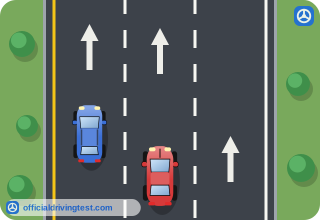
Dashed White Lane Lines
On highways with more than one lane moving in one direction, traffic lanes are separated by broken white lines. Drive within these lines. Never straddle them. Cross over them only when it is safe to change lanes.
Manual page 59 · Open this page in the manual (Manual page 59)
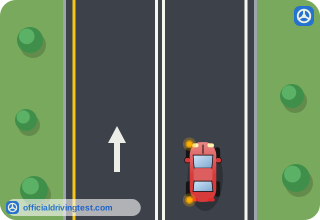
Double Solid White Lane Lines
Lane changes are prohibited in areas where this type of marking is present.
Manual page 59 · Open this page in the manual (Manual page 59)
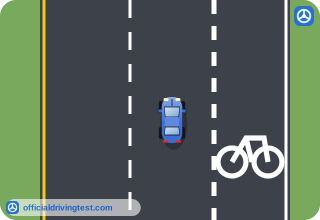
Dashed Bike Lane Lines
The dashed bike lane line indicates that drivers turning right can merge to the right and bicyclists turning left can merge to the left. These are always found at intersections or some driveway areas.
Manual page 59 · Open this page in the manual (Manual page 59)
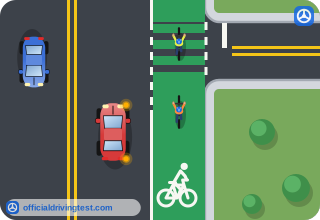
Green Pavement in Bicycle Lanes
Green paint emphasizes where two movements cross over each other. Some bicycle lanes and bicycle lane extensions through intersections are painted green for additional emphasis. Drivers must be aware that bikes may be present and bicyclists must be aware that vehicles cross the bike lane in this area.
Manual page 60 · Open this page in the manual (Manual page 60)
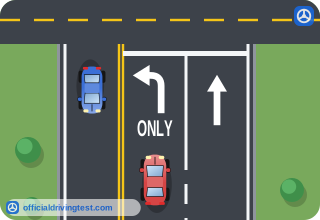
Left-Turn Arrow (Pavement)
Enter the left-turn lanes (marked with a left arrow).
Manual page 56 · Open this page in the manual (Manual page 56)
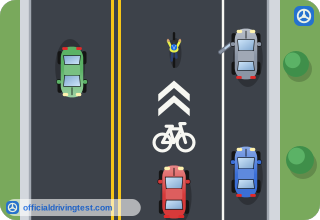
Sharrows
A shared-lane marking or “sharrow” is a street marking placed in the travel lane to indicate where people should preferably cycle.
Manual page 101 · Open this page in the manual (Manual page 101)
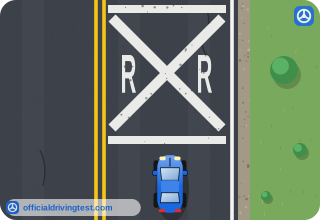
Railroad Crossing Pavement Marking (X and RR)
Many times, pavements are marked in advance of a crossing with an X and the letters RR.
Manual page 61 · Open this page in the manual (Manual page 61)
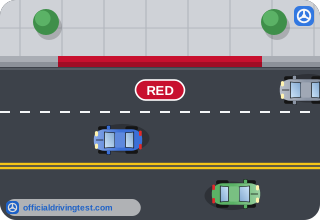
Red Curb
Parking is not allowed: ... Where prohibited by signs or a red-painted curb
Manual page 81 · Open this page in the manual (Manual page 81)