Idaho: Pavement markings Practice Test
Yellow and white lines, lane markings, two-way left turn lanes, bike lanes, crosswalks and the other markings in the Idaho Driver's Handbook.
Independent educational site · not affiliated with any government agency or DMV
Ready? Test yourself
- Instant feedback with an explanation
- Every answer cites its source in the manual
- Your best score is saved on this device
Questions are original and based on the official manual "Idaho Driver's Handbook" (July 2026), Idaho Transportation Department.
All 18 questions in this practice test
Take the test above first, then use this list to study. Tap “Show answer” to see the correct answer and explanation.
Show the questions and answersHide the questions
-
What does a single dashed yellow line between two lanes of traffic mean?
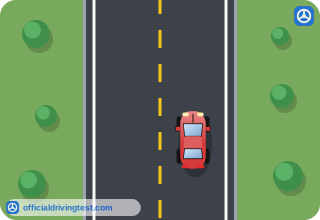
- Vehicles in either lane can cross the line if it is safe to do so
- Only vehicles in the lane nearest the line can cross it
- No vehicle may cross the line unless it is turning left
- Vehicles may cross the line only to pass a slower vehicle
Show answer
Correct answer: Vehicles in either lane can cross the line if it is safe to do so
Per the manual, a dashed yellow line allows vehicles in either lane to cross it when it is safe.
Source: Idaho Driver's Handbook (July 2026), page 58 · Open this page in the manual (Manual page 58)
-
What do two solid yellow lines painted side by side mean?
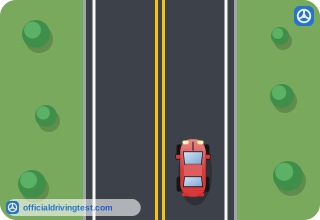
- Vehicles in either lane can cross the lines to pass if it is safe
- Only vehicles in the lane nearest the lines can cross to pass
- Neither lane can cross the lines unless turning; no passing is allowed
- Traffic may cross the lines only to change lanes in heavy traffic
Show answer
Correct answer: Neither lane can cross the lines unless turning; no passing is allowed
Double solid yellow lines mean neither lane may cross them except when turning, and no passing is allowed.
Source: Idaho Driver's Handbook (July 2026), page 58 · Open this page in the manual (Manual page 58)
-
When may a driver cross a double solid yellow line?
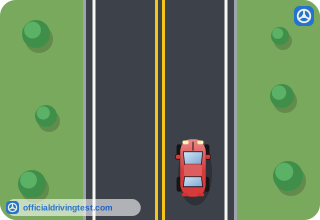
- When passing a slow-moving vehicle and no traffic is coming
- When turning left into or out of a driveway or entrance to a business
- When changing lanes while traffic is light
- When stopping briefly to let a passenger out
Show answer
Correct answer: When turning left into or out of a driveway or entrance to a business
The manual allows crossing a double yellow line when turning left into or out of a driveway or business entrance.
Source: Idaho Driver's Handbook (July 2026), page 58 · Open this page in the manual (Manual page 58)
-
One solid yellow line and one dashed yellow line run side by side down the road. Which vehicles may cross the lines to pass?
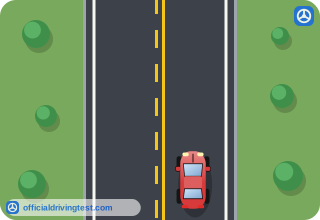
- Only vehicles in the lane next to the solid line
- Vehicles in both lanes
- Vehicles in neither lane
- Only vehicles in the lane next to the dashed line
Show answer
Correct answer: Only vehicles in the lane next to the dashed line
Only vehicles in the lane with the dashed line can cross the lines to pass.
Source: Idaho Driver's Handbook (July 2026), page 58 · Open this page in the manual (Manual page 58)
-
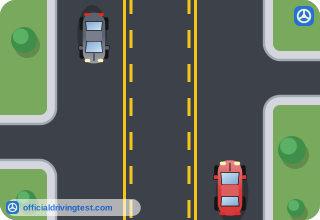
A center lane is marked on each side by a solid and a dashed yellow line. What is that lane reserved for?
- Passing slower vehicles from either direction of travel
- Emergency vehicles traveling in either direction
- Left turns (or U-turns where permitted) from either direction
- Vehicles entering the road from driveways only
Show answer
Correct answer: Left turns (or U-turns where permitted) from either direction
Shared center lanes are reserved for left turns, or U-turns where permitted, from either direction.
Source: Idaho Driver's Handbook (July 2026), page 58 · Open this page in the manual (Manual page 58)
-
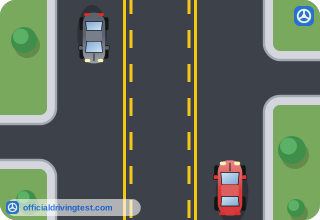
Which action is NOT allowed in a shared center turn lane?
- Interfering with another vehicle preparing to make a turn
- Turning left out of the lane when it is safe to do so
- Making a U-turn from the lane where U-turns are permitted
- Waiting in the lane for a gap in oncoming traffic to turn left
Show answer
Correct answer: Interfering with another vehicle preparing to make a turn
The manual says you may not travel in shared turn lanes or interfere with a vehicle preparing to turn.
Source: Idaho Driver's Handbook (July 2026), page 58 · Open this page in the manual (Manual page 58)
-
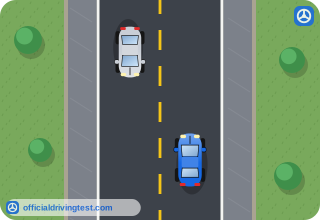
What do solid white lines along the side of the road show?
- Where the lane for slow vehicles begins
- Where parking is permitted
- Where passing on the right is allowed
- Where the edge of the road is located
Show answer
Correct answer: Where the edge of the road is located
Edge lines show where the edge of the road is, and help you stay on the road at night or in bad weather.
Source: Idaho Driver's Handbook (July 2026), page 59 · Open this page in the manual (Manual page 59)
-
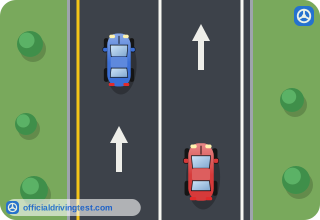
A solid white line separates two lanes of traffic moving in the same direction. What should you do?
- Change lanes only to pass a slower vehicle
- Avoid changing lanes
- Straddle the line to prepare for a turn
- Treat the line as a passing zone marker
Show answer
Correct answer: Avoid changing lanes
The manual says to avoid changing lanes where a solid white line separates lanes going the same way.
Source: Idaho Driver's Handbook (July 2026), page 59 · Open this page in the manual (Manual page 59)
-
A solid white line along the side of the road has a bicycle symbol painted beside it. What does it indicate?
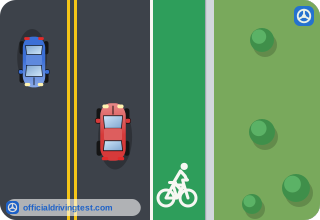
- The area is a shared lane for cars and bicycles
- The area is designated for bicycle traffic only
- The area may be used for parking when no bicycles are present
- The area is a lane where bicyclists must face oncoming traffic
Show answer
Correct answer: The area is designated for bicycle traffic only
A solid white line with a bicycle insignia marks an area designated for bicycle traffic only.
Source: Idaho Driver's Handbook (July 2026), page 59 · Open this page in the manual (Manual page 59)
-
On a highway with more than one lane moving in the same direction, what should you never do with the dashed white lines that separate the lanes?
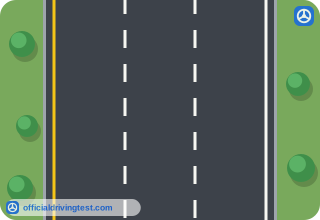
- Straddle them
- Cross them when it is safe to change lanes
- Drive within them
- Use them to see where your lane is
Show answer
Correct answer: Straddle them
Drivers should drive within the dashed white lines and never straddle them.
Source: Idaho Driver's Handbook (July 2026), page 59 · Open this page in the manual (Manual page 59)
-
What do double solid white lane lines mean?
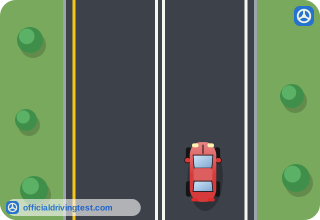
- Lane changes are allowed only to pass
- Lane changes are allowed only for turns
- Lane changes are prohibited
- The lane is reserved for bicycles
Show answer
Correct answer: Lane changes are prohibited
Lane changes are prohibited where double solid white lane lines are present.
Source: Idaho Driver's Handbook (July 2026), page 59 · Open this page in the manual (Manual page 59)
-
Why are some bicycle lanes and bicycle lane extensions through intersections painted green?
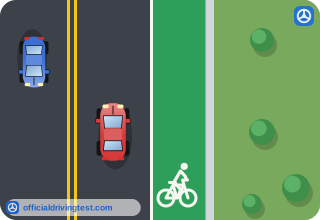
- To emphasize where two movements cross over each other
- To show that bicycles are prohibited in the lane
- To show that vehicles must stop before the lane
- To show that parking is allowed beside the lane
Show answer
Correct answer: To emphasize where two movements cross over each other
Green paint emphasizes where two movements, bicycles and vehicles, cross over each other.
Source: Idaho Driver's Handbook (July 2026), page 60 · Open this page in the manual (Manual page 60)
-
What do solid pavement markings in the center of the road indicate about U-turns?
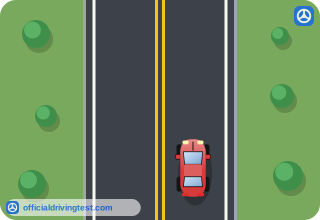
- A U-turn is prohibited
- A U-turn is allowed after a full stop
- A U-turn is allowed from the left lane only
- A U-turn is allowed when no vehicle is in sight
Show answer
Correct answer: A U-turn is prohibited
Solid pavement markings in the center of the road indicate that a U-turn is prohibited.
Source: Idaho Driver's Handbook (July 2026), page 74 · Open this page in the manual (Manual page 74)
-
What do dashed lines marking a bike lane at an intersection indicate?
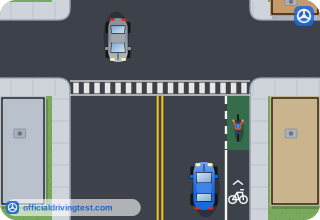
- A merging movement is allowed and expected
- Vehicles may never enter the bike lane
- Bicyclists must stop
- Parking is permitted in the bike lane
Show answer
Correct answer: A merging movement is allowed and expected
Dashed bike lane lines indicate that a merging movement is allowed and expected, so check for bicyclists first.
Source: Idaho Driver's Handbook (July 2026), page 100 · Open this page in the manual (Manual page 100)
-
A street marking placed in the travel lane to show where people should preferably cycle is called what?
- A bike-lane stop bar marking
- A bicycle crossing line marking
- A bicycle turn-lane arrow marking
- A shared-lane marking, or sharrow
Show answer
Correct answer: A shared-lane marking, or sharrow
A shared-lane marking, or sharrow, is a street marking placed in the travel lane to indicate where people should preferably cycle.
Source: Idaho Driver's Handbook (July 2026), page 101 · Open this page in the manual (Manual page 101)
-
What is one purpose of a shared-lane marking?
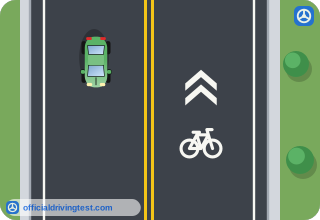
- To mark a lane that only bicycles may use
- To encourage safe passing of bicyclists by drivers
- To show that parking is allowed in the lane
- To mark where bicyclists must stop
Show answer
Correct answer: To encourage safe passing of bicyclists by drivers
Shared-lane markings help bicyclists position themselves and encourage safe passing of bicyclists by drivers.
Source: Idaho Driver's Handbook (July 2026), page 102 · Open this page in the manual (Manual page 102)
-
A white rectangular sign shows a bicycle symbol above the words MAY USE FULL LANE. How may it be used with shared-lane markings?
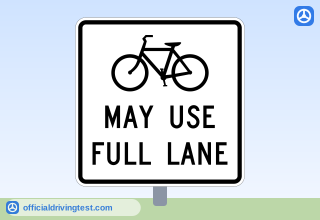
- Only together with the shared-lane markings
- Only on streets where there is no marking
- In addition to, or instead of, the markings
- Only at places where a bike lane ends
Show answer
Correct answer: In addition to, or instead of, the markings
The Bicycles May Use Full Lane sign may be used in addition to, or instead of, the shared lane markings.
Source: Idaho Driver's Handbook (July 2026), page 102 · Open this page in the manual (Manual page 102)
-
When driving in the mountains, what does a solid yellow line in your lane mark?
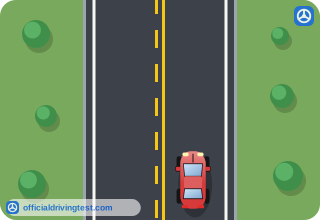
- A no-passing zone
- A lane for slow vehicles
- The end of a steep grade
- A place where you may pull over
Show answer
Correct answer: A no-passing zone
The manual tells mountain drivers to watch for a solid yellow line in their lane, which marks a no-passing zone.
Source: Idaho Driver's Handbook (July 2026), page 107 · Open this page in the manual (Manual page 107)