Idaho: Freeway driving — Part 1 Practice Test
Questions in this part include: “What gives a single point urban interchange (SPUI) its name?” · “Which hazard can freeway driving encourage that the driver must guard against?”
Independent educational site · not affiliated with any government agency or DMV
Ready? Test yourself
- Instant feedback with an explanation
- Every answer cites its source in the manual
- Your best score is saved on this device
Questions are original and based on the official manual "Idaho Driver's Handbook" (July 2026), Idaho Transportation Department.
All 21 questions in this practice test
Take the test above first, then use this list to study. Tap “Show answer” to see the correct answer and explanation.
Show the questions and answersHide the questions
-
What gives a single point urban interchange (SPUI) its name?
- The single lane that serves all of the exit ramps
- The single bridge that carries the highway over the cross street
- The single stop line used by all traffic
- The traffic signals that control turns from a single point at the center
Show answer
Correct answer: The traffic signals that control turns from a single point at the center
A SPUI is named for the traffic signals that control turns from a single point at its center.
Source: Idaho Driver's Handbook (July 2026), page 64 · Open this page in the manual (Manual page 64)
-
At a single point urban interchange, why should you stop at the stop lines?
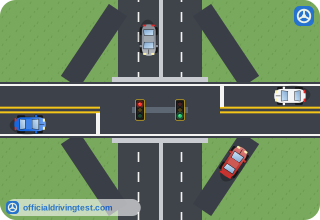
- So you can see the signals at the next interchange ahead of you
- So you are not too far out in the intersection, impeding cross-traffic
- So pedestrians can use the lane beside you to cross the road
- So you can merge onto the highway before other traffic
Show answer
Correct answer: So you are not too far out in the intersection, impeding cross-traffic
Stopping at the stop lines keeps you from being too far out in the intersection and impeding cross-traffic.
Source: Idaho Driver's Handbook (July 2026), page 64 · Open this page in the manual (Manual page 64)
-
Going straight through a single point urban interchange, which lanes should you use?
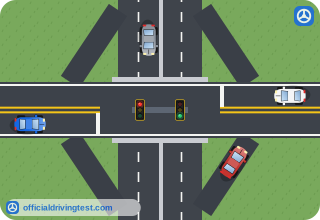
- The left-turn lanes marked with a left arrow
- One of the two through lanes
- The right lane only
- The exit ramp lane
Show answer
Correct answer: One of the two through lanes
To go straight at a SPUI, stay in one of the two through lanes.
Source: Idaho Driver's Handbook (July 2026), page 64 · Open this page in the manual (Manual page 64)
-
You exit a freeway by mistake at a single point urban interchange. What should you do?
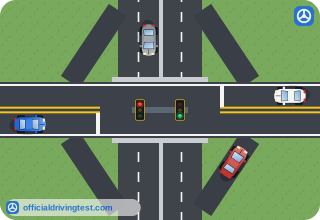
- Travel straight across the highway and get on at the other side
- Stop at the stop line and wait for a signal to turn around
- Back up the exit ramp to the freeway
- Turn left or right and find a safe place to turn around
Show answer
Correct answer: Turn left or right and find a safe place to turn around
If you exit by mistake you cannot go straight across; turn left or right and find a safe place to turn around.
Source: Idaho Driver's Handbook (July 2026), page 64 · Open this page in the manual (Manual page 64)
-
At a single point urban interchange, which lane do drivers stay in when turning right as they exit the interstate?
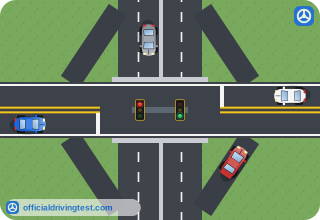
- The right lane
- The left lane
- The center lane
- Either lane
Show answer
Correct answer: The right lane
Drivers turning right stay in the right lane when exiting the interstate.
Source: Idaho Driver's Handbook (July 2026), page 64 · Open this page in the manual (Manual page 64)
-
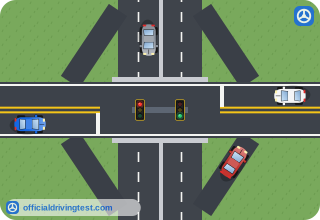
At a single point urban interchange, which lane do drivers use when turning left as they exit the interstate?
- The right lane
- The center lane
- The left lane
- Either lane
Show answer
Correct answer: The left lane
Drivers turning left exit the interstate in the left lane.
Source: Idaho Driver's Handbook (July 2026), page 65 · Open this page in the manual (Manual page 65)
-
What does a diverging diamond interchange (DDI) do?
- Temporarily channels traffic lanes to the right side of the highway to create access to the interstate
- Temporarily channels traffic lanes to the left side of the highway to create direct access with the interstate
- Replaces the signals with a circular intersection to access the interstate
- Uses one signal at the center to control all turns to the interstate
Show answer
Correct answer: Temporarily channels traffic lanes to the left side of the highway to create direct access with the interstate
A DDI temporarily channels traffic lanes to the left side of the highway for direct access to the interstate.
Source: Idaho Driver's Handbook (July 2026), page 65 · Open this page in the manual (Manual page 65)
-
What will drivers notice at a diverging diamond interchange?
- All traffic stays on the right side of the bridge the whole way
- Drivers must stop at the center of the bridge before crossing
- Opposing traffic crosses at the signals on each side of the bridge
- Traffic enters the interchange without any traffic signals
Show answer
Correct answer: Opposing traffic crosses at the signals on each side of the bridge
Drivers will notice that opposing traffic crosses at the signals on each side of the bridge or overpass.
Source: Idaho Driver's Handbook (July 2026), page 65 · Open this page in the manual (Manual page 65)
-
Why must motorists stop at the stop lines at a diverging diamond interchange?
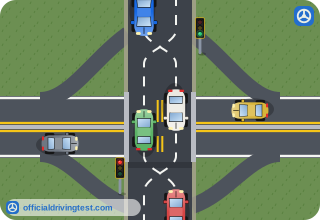
- So they are not out in the intersection impeding cross-traffic, pedestrians, or bicyclists
- So they can check the lane markings on the bridge before entering the interchange
- So they can give way to traffic that is exiting the interstate onto the cross street
- So they can see the signals on the opposite side of the bridge before they enter
Show answer
Correct answer: So they are not out in the intersection impeding cross-traffic, pedestrians, or bicyclists
Stopping at the stop lines keeps motorists out of the intersection where they could impede others.
Source: Idaho Driver's Handbook (July 2026), page 65 · Open this page in the manual (Manual page 65)
-
Going straight over a diverging diamond interchange, where does your lane lead after the first traffic signal?
- To the opposite side of the overpass, then back to the right side
- Straight along the right side of the overpass and onto the highway
- Into a left-turn lane that leads onto the interstate
- To the center island, where you wait for the second signal
Show answer
Correct answer: To the opposite side of the overpass, then back to the right side
Drivers going straight follow their lane to the opposite side of the overpass, then back to the right side after the second signal.
Source: Idaho Driver's Handbook (July 2026), page 66 · Open this page in the manual (Manual page 66)
-
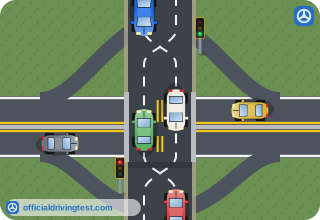
At a diverging diamond interchange, drivers who want to turn onto the highway approach in which lane?
- The right lane
- The center lane
- The left lane
- Any lane
Show answer
Correct answer: The left lane
Drivers who will turn onto the highway approach the interchange in the left lane.
Source: Idaho Driver's Handbook (July 2026), page 66 · Open this page in the manual (Manual page 66)
-
Where is backing always prohibited?
- Only in the travel lanes of freeways, but not on the shoulder
- Only on roads with a posted speed limit above 55 miles per hour
- On freeways and other controlled-access highways, including the shoulder
- Only on roads with more than two lanes
Show answer
Correct answer: On freeways and other controlled-access highways, including the shoulder
Backing is always prohibited on freeways, expressways and other controlled-access highways, including the shoulder.
Source: Idaho Driver's Handbook (July 2026), page 82 · Open this page in the manual (Manual page 82)
-
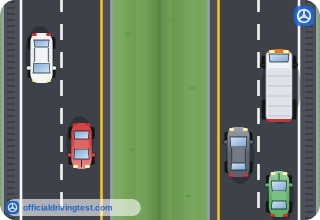
Why are freeways usually safer than other kinds of roads?
- They have lower speed limits and no trucks, buses, or motorcycles
- They have no curves, no hills, and fewer lanes
- They have cross traffic only at signals
- They have one-way traffic, few entrances, and special safety features
Show answer
Correct answer: They have one-way traffic, few entrances, and special safety features
The manual says freeways are usually safer because of one-way traffic, limited entrances and other special safety features.
Source: Idaho Driver's Handbook (July 2026), page 83 · Open this page in the manual (Manual page 83)
-
Which hazard can freeway driving encourage that the driver must guard against?
- Boredom and fatigue
- Frequent cross traffic
- Glare from oncoming headlights
- Frequent stops at signals
Show answer
Correct answer: Boredom and fatigue
The manual says freeways can encourage boredom and fatigue that the driver must guard against.
Source: Idaho Driver's Handbook (July 2026), page 83 · Open this page in the manual (Manual page 83)
-
What should your travel plan for a long freeway trip include stops for?
- Fuel only
- Sightseeing and shopping
- Food, rest, and fuel
- Inspection of the vehicle by a mechanic
Show answer
Correct answer: Food, rest, and fuel
The manual says to plan for food, rest, and fuel stops before a long freeway trip.
Source: Idaho Driver's Handbook (July 2026), page 83 · Open this page in the manual (Manual page 83)
-
What should you know before starting a short freeway trip?
- Only the speed limit of the freeway
- The name, route, entrance, and exit numbers
- Only the weather forecast for the trip
- The length of every freeway on your route
Show answer
Correct answer: The name, route, entrance, and exit numbers
On short trips the manual says to know the name, route, entrance, and exit numbers.
Source: Idaho Driver's Handbook (July 2026), page 83 · Open this page in the manual (Manual page 83)
-
What should you tell someone before a long freeway trip?
- Only your starting time and the make and color of your vehicle
- Your license number and plate number
- Nothing, because the trip is private
- Your plans, route, how long you will be gone, and when to expect you back
Show answer
Correct answer: Your plans, route, how long you will be gone, and when to expect you back
The manual says to let someone know your plans, route, time away and when to expect you back.
Source: Idaho Driver's Handbook (July 2026), page 83 · Open this page in the manual (Manual page 83)
-
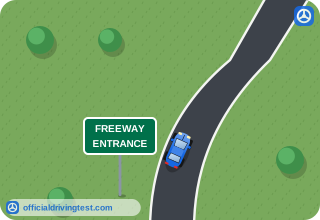
What are the three basic parts of a freeway entrance?
- An entrance ramp, an acceleration lane, and a merging area
- An entrance ramp, a passing lane, and an exit lane
- A merging area, a median, and a shoulder
- A toll booth, an acceleration lane, and a deceleration lane
Show answer
Correct answer: An entrance ramp, an acceleration lane, and a merging area
Freeway entrances usually have an entrance ramp, an acceleration lane and a merging area.
Source: Idaho Driver's Handbook (July 2026), page 83 · Open this page in the manual (Manual page 83)
-
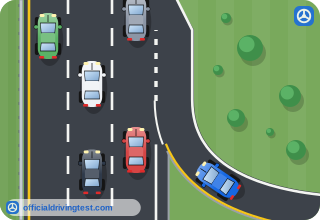
What do you have a chance to do while you are on a freeway entrance ramp?
- Pass slower vehicles
- Stop and rest before merging
- Observe traffic conditions on the freeway
- Reach the full speed limit of the freeway
Show answer
Correct answer: Observe traffic conditions on the freeway
The manual says the entrance ramp gives you a chance to observe traffic conditions on the freeway.
Source: Idaho Driver's Handbook (July 2026), page 83 · Open this page in the manual (Manual page 83)
-
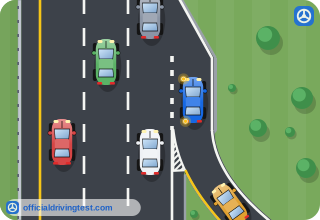
What should you do in the acceleration lane of a freeway entrance?
- Slow down and look for a gap in traffic
- Accelerate to the speed of freeway traffic
- Stop and wait for an opening to appear
- Drive at the speed of traffic on the ramp
Show answer
Correct answer: Accelerate to the speed of freeway traffic
The ramp straightens into the acceleration lane, where you should accelerate to the speed of freeway traffic.
Source: Idaho Driver's Handbook (July 2026), page 83 · Open this page in the manual (Manual page 83)
-
Into which lane must you blend with traffic in the merging area of a freeway entrance?
- The freeway's inside lane
- The freeway's left-most passing lane
- The median lane
- The freeway's outside lane
Show answer
Correct answer: The freeway's outside lane
In the merging area you must blend into the flow of traffic on the freeway's outside lane.
Source: Idaho Driver's Handbook (July 2026), page 83 · Open this page in the manual (Manual page 83)