Hawaii: Pavement markings — Part 2 Practice Test
Questions in this part include: “What are edgelines?” · “What do white arrows or words painted in a traffic lane indicate?”
Independent educational site · not affiliated with any government agency or DMV
Ready? Test yourself
- Instant feedback with an explanation
- Every answer cites its source in the manual
- Your best score is saved on this device
Questions are original and based on the official manual "Hawaii Driver's Manual" (2023), Hawaii Department of Transportation.
All 17 questions in this practice test
Take the test above first, then use this list to study. Tap “Show answer” to see the correct answer and explanation.
Show the questions and answersHide the questions
-
What do red pavement markings or reflectors indicate?
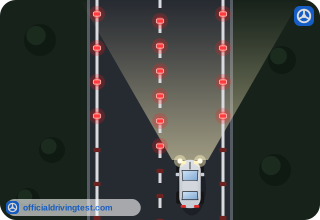
- A roadway that must not be entered or used
- A lane reserved for left turns only
- The exact place at which to stop
- A zone where passing is prohibited
Show answer
Correct answer: A roadway that must not be entered or used
Red pavement markings or reflectors indicate a roadway that must not be entered or used.
Source: Hawaii Driver's Manual (2023), page 35 · Open this page in the manual (Manual page 35)
-
What are edgelines?
- Broken white lines that separate lanes moving in the same direction
- Solid white lines painted across the lanes at intersections or crosswalks
- Double yellow lines that mark the center where passing is prohibited
- Solid white or yellow lines along the edge of the roadway as a safety guide
Show answer
Correct answer: Solid white or yellow lines along the edge of the roadway as a safety guide
Edgelines are solid white or yellow lines along the edge of the roadway to be used as a safety guide.
Source: Hawaii Driver's Manual (2023), page 35 · Open this page in the manual (Manual page 35)
-
On a divided street or highway, which color of edge line may be along the left edge of the roadway?
- White
- Yellow
- Red
- Blue
Show answer
Correct answer: Yellow
White edge lines are used along the right edge of the roadway, and yellow edge lines may be along the left edge on divided streets and highways.
Source: Hawaii Driver's Manual (2023), page 35 · Open this page in the manual (Manual page 35)
-
What do stop lines show?
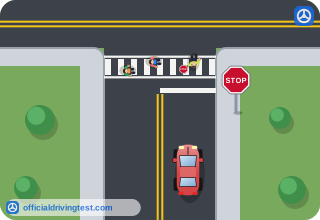
- The exact place at which to stop
- The place where pedestrians must wait
- The start of a no passing zone
- The edge of the roadway
Show answer
Correct answer: The exact place at which to stop
Stop lines are solid white lines painted across the traffic lanes at intersections and pedestrian crosswalks to show the exact place at which to stop.
Source: Hawaii Driver's Manual (2023), page 36 · Open this page in the manual (Manual page 36)
-
What do crosswalk lines show?
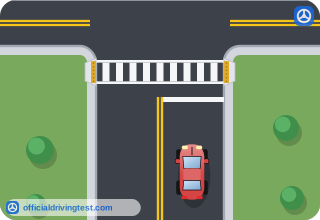
- Where vehicles must stop at a railroad crossing
- Where a lane is reserved for left turns
- Where pedestrians can safely cross the road or street
- Where vehicles may park next to the curb
Show answer
Correct answer: Where pedestrians can safely cross the road or street
Crosswalk lines show pedestrians where to safely cross the road or street.
Source: Hawaii Driver's Manual (2023), page 36 · Open this page in the manual (Manual page 36)
-
For what may a lane in the center of the roadway, marked by a combination of yellow solid and dashed lines, be used by vehicles traveling in either direction?
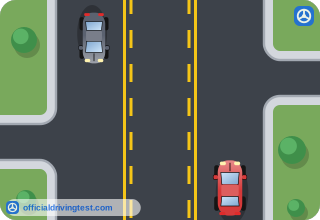
- Passing slower vehicles
- Stopping or parking
- Driving in one direction only
- Left turn maneuvers only
Show answer
Correct answer: Left turn maneuvers only
Two-way left turn channelization markings mark a center lane that may be used by vehicles traveling in either direction for left turn maneuvers only.
Source: Hawaii Driver's Manual (2023), page 36 · Open this page in the manual (Manual page 36)
-
Which statement about a two-way left turn lane in the center of the roadway is correct?
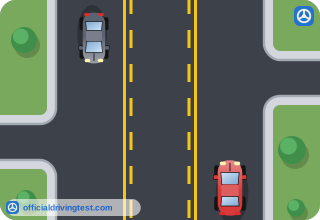
- It may be used for passing when the road ahead is clear
- It may be used only by vehicles traveling in one direction
- It must never be used for passing
- It may be used for passing on the left only
Show answer
Correct answer: It must never be used for passing
The center lane marked by two-way left turn channelization markings must NEVER be used for passing.
Source: Hawaii Driver's Manual (2023), page 36 · Open this page in the manual (Manual page 36)
-
What are obstruction markings?
- Solid lines painted in the traffic lanes to guide you around obstructions
- Dashed white lines painted to show where a traffic lane ends ahead
- White arrows and words painted to show the direction you must go
- Red reflectors or markings that show a roadway must not be used
Show answer
Correct answer: Solid lines painted in the traffic lanes to guide you around obstructions
Obstruction markings are solid lines painted in the traffic lanes to guide you around obstructions, such as bridge supports.
Source: Hawaii Driver's Manual (2023), page 37 · Open this page in the manual (Manual page 37)
-
How must you pass yellow obstruction markings?
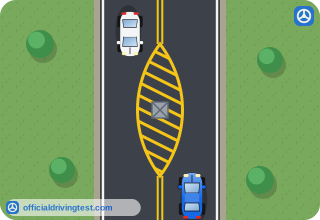
- Only to the left of them
- On either side of them
- You must not pass them
- Only to the right of them
Show answer
Correct answer: Only to the right of them
You must pass only to the right of yellow obstruction markings.
Source: Hawaii Driver's Manual (2023), page 37 · Open this page in the manual (Manual page 37)
-
How may you pass white obstruction markings?
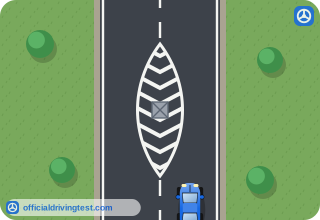
- Only to the right of them
- To either side of them
- Only to the left of them
- You must stop before passing them
Show answer
Correct answer: To either side of them
You may pass to either side of white obstruction markings.
Source: Hawaii Driver's Manual (2023), page 37 · Open this page in the manual (Manual page 37)
-
What do white arrows or words painted in a traffic lane indicate?
- The direction in which you must go
- A lane that is reserved for slow vehicles
- A lane in which passing is allowed
- The place where you must stop
Show answer
Correct answer: The direction in which you must go
Directional markings are white arrows or words painted in the traffic lane to indicate the direction in which you must go.
Source: Hawaii Driver's Manual (2023), page 37 · Open this page in the manual (Manual page 37)
-
What may you do when the arrows painted in your lane indicate more than one direction?
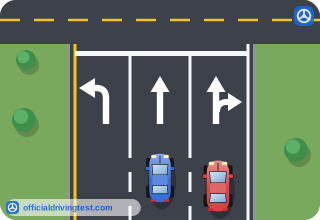
- Move only in the direction of the first arrow
- Move straight ahead only
- Choose any direction indicated
- Change lanes before the intersection
Show answer
Correct answer: Choose any direction indicated
Where arrows indicate more than one direction, you may choose any direction indicated.
Source: Hawaii Driver's Manual (2023), page 37 · Open this page in the manual (Manual page 37)
-
What marks the pavement in the traffic lane before a railroad crossing?
- A large “X” and a red stop line only
- A large “X” and two “R’s”
- Two “RR” letters and a green arrow
- A large circle and a yellow arrow
Show answer
Correct answer: A large “X” and two “R’s”
Railroad crossing markings are white markings painted in the traffic lane, and the pavement is marked with a large “X” and two “R’s”.
Source: Hawaii Driver's Manual (2023), page 38 · Open this page in the manual (Manual page 38)
-
What are traffic islands used for?
- To give you a place to park temporarily
- To let you pass slower traffic
- To direct you into separate traffic lanes
- To mark where a roadway ends
Show answer
Correct answer: To direct you into separate traffic lanes
Traffic islands are used to direct you into separate traffic lanes.
Source: Hawaii Driver's Manual (2023), page 38 · Open this page in the manual (Manual page 38)
-
When are traffic islands called “Safety Islands”?
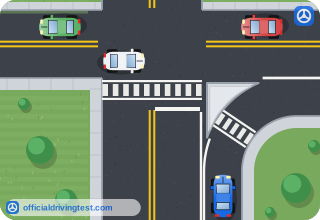
- When they are used to protect pedestrians who may have to stand in the roadway
- When they are made only of curbing and no paint is used on them at all
- When they are only painted markings on the roadway of a busy freeway
- When they are used only to separate traffic moving in opposite directions
Show answer
Correct answer: When they are used to protect pedestrians who may have to stand in the roadway
Traffic islands are called “Safety Islands” when they are used to protect pedestrians who may have to stand in the roadway.
Source: Hawaii Driver's Manual (2023), page 38 · Open this page in the manual (Manual page 38)
-
What should you never do with a traffic island?
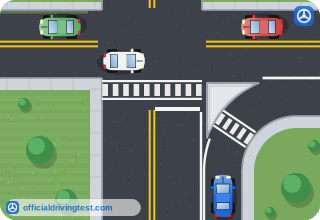
- Drive around it on the right
- Slow down when you approach it
- Look for pedestrians near it
- Drive into or across it
Show answer
Correct answer: Drive into or across it
You should never drive into or across a traffic island.
Source: Hawaii Driver's Manual (2023), page 38 · Open this page in the manual (Manual page 38)
-
What do red lane marking reflectors mean?
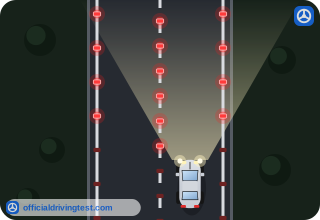
- You are going the wrong direction in the traffic lane
- The lane is reserved for passing slower vehicles
- An exit is ahead
- Road work is ahead
Show answer
Correct answer: You are going the wrong direction in the traffic lane
The manual says red lane marking reflectors mean you are going the wrong direction in the traffic lane.
Source: Hawaii Driver's Manual (2023), page 77 · Open this page in the manual (Manual page 77)