Georgia: Sharing the road
Bicyclists, motorcycles, school buses, commercial trucks and other road users. Split into 5 shorter tests so you're not stuck in one long quiz.
Independent educational site · not affiliated with any government agency or DMV
Choose a part
Sharing the road — Part 1
Questions in this part include: “Trailers wider than what are not permitted on Georgia's highways?”
StartSharing the road — Part 2
Questions in this part include: “If there is a right-turn-only lane, where is the bicycle lane located?”
StartSharing the road — Part 3
Questions in this part include: “What is the penalty for not following the required procedures when approaching a bicycle?”
StartSharing the road — Part 4
Questions in this part include: “Where in a lane do motorcyclists often ride to see traffic better and be more visible?”
StartSharing the road — Part 5
Questions in this part include: “Which of these is listed among Georgia's fines and penalties for the school bus rules?”
StartAll 81 Sharing the road questions with answers
Choose a part above to take a practice test, or study every question and answer here.
Show the questions and answersHide the questions
-
A school bus driver activates the bus's flashing yellow lights. What should drivers approaching the bus do?
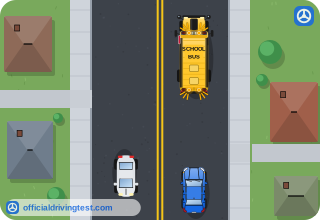
- Speed up to pass before the bus stops
- Stop immediately, wherever they are
- Pass the bus only on the left side
- Slow down and be prepared to stop
Show answer
Correct answer: Slow down and be prepared to stop
Flashing yellow lights mean the bus is preparing to stop, so approaching drivers slow down and prepare to stop.
Source: Georgia Driver's Manual (2023-2024), page 18
-
A school bus's flashing lights have turned red and its stop signs have extended. What is unlawful for vehicles?
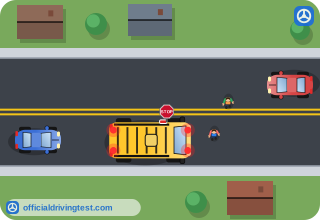
- Passing it while it loads or unloads passengers
- Following the bus at any distance on the same road
- Waiting behind the bus with the engine on
- Stopping within sight of the bus
Show answer
Correct answer: Passing it while it loads or unloads passengers
Once the lights are red and the stop signs are out, it is unlawful for any vehicle to pass the stopped school bus while it loads or unloads.
Source: Georgia Driver's Manual (2023-2024), page 18
-
On a highway divided by a median, are cars on the opposite side from a stopped school bus required to stop?
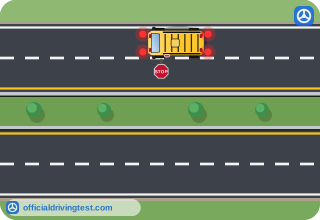
- Yes, whenever the bus has its red lights flashing
- Yes, but only when children are visible near the road
- No, but drivers should watch for children near the roadway
- No, and they do not need to watch for children
Show answer
Correct answer: No, but drivers should watch for children near the roadway
Cars on the opposite side of a median-divided highway need not stop but should remain attentive for children.
Source: Georgia Driver's Manual (2023-2024), page 18
-
Outside a business or residential district, what must drivers of trucks and vehicles pulling trailers leave between themselves and other vehicles of the same kind?
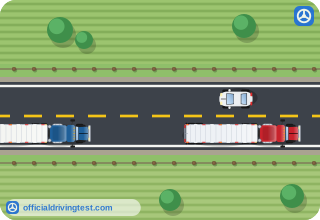
- At least 500 feet of space at all times
- Enough space for a third vehicle to park between them
- Nothing, as long as they stay in the right lane
- Enough space for an overtaking vehicle to enter without danger
Show answer
Correct answer: Enough space for an overtaking vehicle to enter without danger
They must leave sufficient space so that an overtaking vehicle can enter and occupy it without danger.
Source: Georgia Driver's Manual (2023-2024), page 23
-
The law requiring trucks and vehicles pulling trailers to leave sufficient space between them prohibits which act?
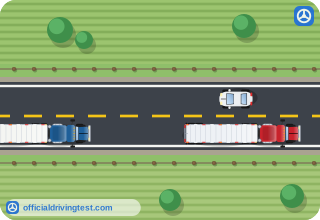
- Caravanning
- Tailgating
- Drafting
- Platooning
Show answer
Correct answer: Caravanning
The manual says this law prohibits the act commonly known as caravanning.
Source: Georgia Driver's Manual (2023-2024), page 23
-
Trailers wider than what are not permitted on Georgia's highways?
- 7 feet
- 8 feet
- 8 feet, 6 inches
- 10 feet
Show answer
Correct answer: 8 feet, 6 inches
The manual says trailers wider than 8 feet, 6 inches are not permitted on Georgia's highways.
Source: Georgia Driver's Manual (2023-2024), page 23
-
Where is it unlawful to dump, deposit, throw or leave litter under Georgia's Litter Control Law?
- Only on public property such as parks and government buildings
- On any public or private property in Georgia, or any waters in Georgia
- Only on state highways and interstates outside of cities
- Only in state parks and recreation areas
Show answer
Correct answer: On any public or private property in Georgia, or any waters in Georgia
The law makes it unlawful to litter on any public or private property or any waters in the State of Georgia.
Source: Georgia Driver's Manual (2023-2024), page 24
-
Which of these is included in the Litter Control Law's definition of "litter"?
- Fresh snow
- Rainwater in a ditch
- Living trees
- Dead animals
Show answer
Correct answer: Dead animals
The definition of litter lists dead animals among rubbish, waste material, trash and discarded materials of every kind.
Source: Georgia Driver's Manual (2023-2024), page 24
-
Which of these is included in "public or private property" under the Litter Control Law?
- The right-of-way of any road or highway
- Only government buildings
- Only designated dumping grounds
- Only interstate highway shoulders
Show answer
Correct answer: The right-of-way of any road or highway
The manual says public or private property includes the right-of-way of any road or highway, bodies of water, parks, and residential or farm properties.
Source: Georgia Driver's Manual (2023-2024), page 24
-
When litter is thrown, deposited, or dropped from a motor vehicle, who has violated the Litter Control Law?
- Only the passenger who threw it
- The registered owner of the vehicle
- The operator of the vehicle
- No one, unless an officer sees it happen
Show answer
Correct answer: The operator of the vehicle
The manual says that whenever litter is thrown from a motor vehicle, the operator of the vehicle has violated the law.
Source: Georgia Driver's Manual (2023-2024), page 24
-
Which agencies are authorized to enforce the Litter Control Law?
- Only the Georgia Department of Transportation
- Only county sanitation departments
- Only the Department of Driver Services
- All Georgia law enforcement agencies
Show answer
Correct answer: All Georgia law enforcement agencies
The manual says all Georgia law enforcement agencies are authorized to enforce compliance of the Litter Control Law.
Source: Georgia Driver's Manual (2023-2024), page 24
-
How does Georgia's Litter Control Law classify littering?
- As damage to property
- As a parking violation
- As a civil infraction
- As a felony offense against persons
Show answer
Correct answer: As damage to property
The manual says the law classifies littering as damage to property.
Source: Georgia Driver's Manual (2023-2024), page 24
-
A conviction under Georgia's Litter Control Law is considered what?
- A felony
- A civil infraction
- A misdemeanor
- A traffic warning
Show answer
Correct answer: A misdemeanor
The manual says a conviction under the Litter Control Law is considered a misdemeanor in Georgia.
Source: Georgia Driver's Manual (2023-2024), page 24
-
What may persons convicted under Georgia's Litter Control Law be assessed?
- A fine up to $100 and a 30 day jail term
- A fine up to $1000 and a 12 month jail term
- A fine up to $500 and a 6 month jail term
- A fine up to $2,000 and a 3 year jail term
Show answer
Correct answer: A fine up to $1000 and a 12 month jail term
The manual says convicted persons may be assessed a fine up to $1000 and a 12 month jail term.
Source: Georgia Driver's Manual (2023-2024), page 24
-
In addition to a fine, what could a judge order a person convicted of littering to do?
- Pick up and remove litter from any designated area
- Attend a defensive driving course
- Surrender the vehicle that was used in the offense
- Pay to have the license reinstated
Show answer
Correct answer: Pick up and remove litter from any designated area
The manual says a judge could order the convicted person to pick up and remove litter from any designated area.
Source: Georgia Driver's Manual (2023-2024), page 24
-
Where are bicycle lanes typically located?
- Between the two farthest left traffic lanes on a multi-lane roadway
- On the sidewalk, beside the curb or the edge of the roadway itself
- Between the farthest right traffic lane and the curb or edge of the roadway
- In the center of the road, beside the median or the center line
Show answer
Correct answer: Between the farthest right traffic lane and the curb or edge of the roadway
Bicycle lanes are solid white lines typically located between the farthest right traffic lane and the curb or edge of the roadway.
Source: Georgia Driver's Manual (2023-2024), page 37
-
Besides solid white lines, how may bicycle lanes be marked?
- With broken yellow lines
- With painted symbols of a bicycle
- With red paint along the curb
- With a green strip in the median
Show answer
Correct answer: With painted symbols of a bicycle
Bicycle lanes may also be marked with painted symbols of a bicycle.
Source: Georgia Driver's Manual (2023-2024), page 37
-
If there is a right-turn-only lane, where is the bicycle lane located?
- To the right of the right-turn-only lane
- Inside the right-turn-only lane
- It ends before the right-turn-only lane
- To the left of the right-turn-only lane
Show answer
Correct answer: To the left of the right-turn-only lane
The bicycle lane is located to the left of the right-turn-only lane so bicycles can go straight through the intersection safely.
Source: Georgia Driver's Manual (2023-2024), page 37
-
What are drivers of motor vehicles prohibited from doing in a bicycle lane?
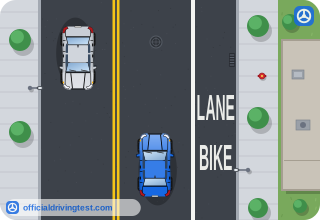
- Parking in it, but they may drive in it to pass slow traffic
- Driving or parking in it, except to cross over it to make a turn
- Driving in it, but they may park in it for a short time
- Stopping in it, but they may drive in it in heavy traffic
Show answer
Correct answer: Driving or parking in it, except to cross over it to make a turn
Drivers may not drive or park in the bicycle lane except to cross over it to make a turn.
Source: Georgia Driver's Manual (2023-2024), page 37
-
What must motorists do when crossing over a bicycle lane to make a turn?
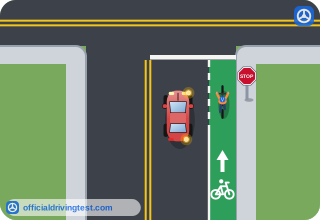
- Yield to bicyclists that are present
- Sound the horn to warn bicyclists
- Speed up to cross before bicyclists arrive
- Stop and always wave bicyclists through
Show answer
Correct answer: Yield to bicyclists that are present
Motorists crossing a bicycle lane to turn must yield to bicyclists that are present.
Source: Georgia Driver's Manual (2023-2024), page 37
-
How may experienced cyclists navigate roundabouts?
- Only on the sidewalk
- Like motorists
- Only by walking their cycles
- Only along the curb
Show answer
Correct answer: Like motorists
Experienced cyclists may navigate roundabouts like motorists.
Source: Georgia Driver's Manual (2023-2024), page 37
-
Where should a cyclist ride in a roundabout to prevent vehicles from passing?
- In the middle of the lane
- Hugging the curb
- At the right edge of the lane
- Beside the center island
Show answer
Correct answer: In the middle of the lane
Cyclists should not hug the curb and should ride in the middle of the lane to prevent vehicles from passing.
Source: Georgia Driver's Manual (2023-2024), page 37
-
What should children or cyclists who are not comfortable entering the flow of traffic do at a roundabout?
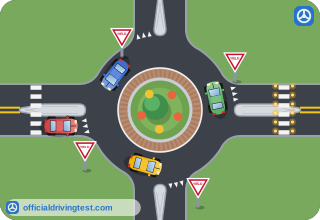
- Ride on the center island
- Ride in the crosswalk at a slow pace
- Wait for motorists to wave them through
- Walk their cycles and act as pedestrians
Show answer
Correct answer: Walk their cycles and act as pedestrians
They should walk their cycles and act as pedestrians.
Source: Georgia Driver's Manual (2023-2024), page 37
-
What should you do to stay out of another driver's blind spot on an expressway?
- Stay close behind it and match its speed exactly
- Stay beside its rear wheels until the driver signals
- Travel just ahead of it in the same lane
- Stay far enough behind to be seen, or pass the vehicle
Show answer
Correct answer: Stay far enough behind to be seen, or pass the vehicle
You should stay far enough behind so the other driver can see you, or pass the vehicle.
Source: Georgia Driver's Manual (2023-2024), page 41
-
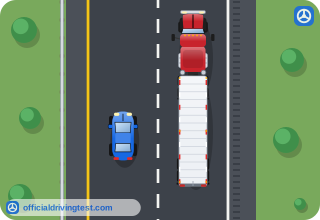
Why should you take special care when driving near tractor-trailer combinations?
- They are not required to obey the posted speed limit
- They cannot use the exit lanes of an expressway
- They have limited visibility because of their size
- They cannot change lanes once they are moving fast
Show answer
Correct answer: They have limited visibility because of their size
Tractor-trailer combinations ("eighteen-wheelers") are limited in their visibility because of their size.
Source: Georgia Driver's Manual (2023-2024), page 41
-
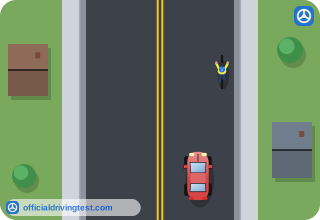
Why do bike-car crashes often happen, according to the manual?
- Bicyclists ride too fast for road conditions
- Drivers do not see bicyclists soon enough
- Bicyclists ignore traffic signals at intersections
- Drivers pass bicyclists too slowly
Show answer
Correct answer: Drivers do not see bicyclists soon enough
The manual says bike-car crashes often happen because drivers do not see bicyclists soon enough.
Source: Georgia Driver's Manual (2023-2024), page 42
-
Where and when do most bike-car crashes in Georgia occur?
- At night on wet, winding roads, typically far from intersections or driveways
- In heavy rain on steep hills, typically near school zones or bus stops
- During rush hour on crowded highways, typically near interstate ramps
- In daylight on straight, dry roads, typically near intersections or driveways
Show answer
Correct answer: In daylight on straight, dry roads, typically near intersections or driveways
In Georgia, most crashes occur during daylight hours on straight, dry roads, typically near intersections or driveways.
Source: Georgia Driver's Manual (2023-2024), page 42
-
Which roads are bicyclists NOT legally entitled to use in Georgia?
- The interstate and interstate-like (limited access) highways
- Roads with a posted speed limit above 35 miles per hour
- Two-lane roads that have no bike lane or paved shoulder
- Roads that have no sidewalks on either side of the street
Show answer
Correct answer: The interstate and interstate-like (limited access) highways
Bicyclists may use every road in Georgia except the interstate and interstate-like highways (limited access highways).
Source: Georgia Driver's Manual (2023-2024), page 42
-
Are bicyclists required to ride in a bike lane when one is present?
- Yes, on every road that has one
- Yes, except when they are turning left
- No, the law allows them use of the full lane
- Yes, unless the speed limit is 25 mph or less
Show answer
Correct answer: No, the law allows them use of the full lane
The law allows bicyclists use of the full lane, and they are not required to be in a bike lane even when one is present.
Source: Georgia Driver's Manual (2023-2024), page 42
-
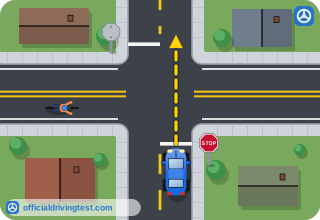
How should you yield the right of way to a bicyclist?
- By sounding your horn and then passing quickly ahead
- In the same way you would yield to another motorist
- By moving onto the shoulder and waiting until it passes
- By flashing your headlights at the rider as you pass
Show answer
Correct answer: In the same way you would yield to another motorist
The manual says to yield to the bicyclist in the same way that you would yield to another motorist.
Source: Georgia Driver's Manual (2023-2024), page 42
-
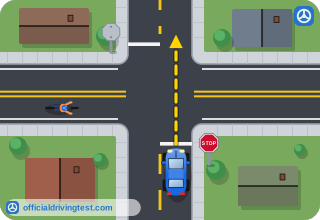
If possible, what should you do with a bicyclist, especially at intersections?
- Flash your headlights
- Sound your horn lightly
- Wave the rider through
- Make eye contact
Show answer
Correct answer: Make eye contact
The manual advises making eye contact with the bicyclist if possible, especially at intersections.
Source: Georgia Driver's Manual (2023-2024), page 42
-
Why should you leave a bicyclist plenty of room when passing?
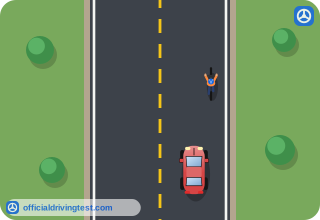
- The rider may have to swerve to miss a pothole or other danger in the road
- Bicyclists cannot hear approaching vehicles behind them on the road
- Bicyclists are required to ride in the center of the traffic lane
- Bicyclists may suddenly stop and dismount at the side of the road
Show answer
Correct answer: The rider may have to swerve to miss a pothole or other danger in the road
Road defects cause more problems for bicycles than for cars, so a rider may have to swerve to miss a pothole or other danger.
Source: Georgia Driver's Manual (2023-2024), page 42
-
What is the minimum legal space for a motorist to pass a bicyclist?
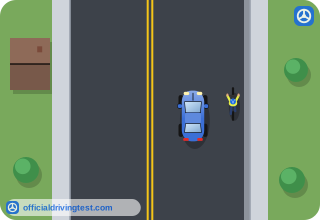
- 2 feet
- 4 feet
- 3 feet
- 5 feet
Show answer
Correct answer: 3 feet
The manual states the minimum legal space for a motorist to pass a bicyclist is 3 feet.
Source: Georgia Driver's Manual (2023-2024), page 42
-
What is the penalty for not following the required procedures when approaching a bicycle?
- A misdemeanor punishable by a fine up to $100.00
- A misdemeanor punishable by a fine up to $250.00
- A misdemeanor punishable by a fine up to $500.00
- A misdemeanor punishable by a fine up to $750.00
Show answer
Correct answer: A misdemeanor punishable by a fine up to $250.00
The manual says the violation is a misdemeanor punishable by a fine up to $250.00.
Source: Georgia Driver's Manual (2023-2024), page 43
-
When approaching a bicycle, what should a motorist do if possible in the existing road and traffic conditions?
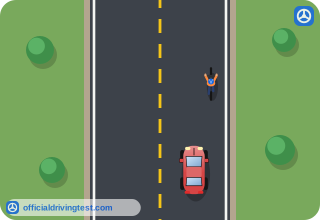
- Slow to a stop until the bicycle has passed
- Sound the horn to warn the rider
- Move onto the shoulder and wait
- Change into a lane not adjacent to the bicycle
Show answer
Correct answer: Change into a lane not adjacent to the bicycle
The first step is a lane change into a lane not adjacent to the bicycle if possible.
Source: Georgia Driver's Manual (2023-2024), page 43
-
If a lane change is impossible, prohibited by law, or unsafe, what speed must you use to go around a bicycle?
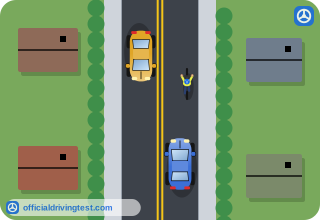
- At least ten mph less than the posted speed limit or 25 mph, whichever is more
- At least five mph less than the posted speed limit or 15 mph, whichever is more
- At least ten mph less than the posted speed limit or 35 mph, whichever is less
- At least twenty mph less than the posted speed limit or 20 mph, whichever is more
Show answer
Correct answer: At least ten mph less than the posted speed limit or 25 mph, whichever is more
The speed must be at least ten miles per hour less than the posted speed limit or 25 miles per hour, whichever is more.
Source: Georgia Driver's Manual (2023-2024), page 43
-
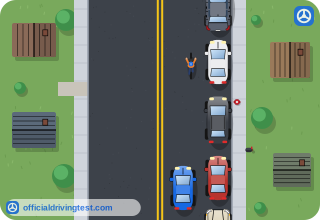
Why might a bicyclist appear to suddenly swerve or turn in front of you?
- The rider is required to cross traffic at every intersection they reach
- The rider is trying to avoid the bike lane markings painted on the road
- The rider may not have had the opportunity to merge left because of traffic speed
- The rider has a legal right to turn without signaling to other drivers
Show answer
Correct answer: The rider may not have had the opportunity to merge left because of traffic speed
Bicyclists sometimes forget or do not have the opportunity to merge left due to traffic speed, in order to be in the left turn position.
Source: Georgia Driver's Manual (2023-2024), page 43
-
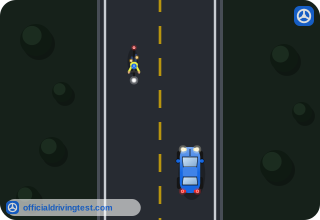
What should you do if you meet an oncoming bicyclist at night?
- Keep your high beams on so the rider can see you
- Dim your lights to avoid blinding the bicyclist
- Flash your lights twice to signal the rider
- Turn off your headlights until you pass
Show answer
Correct answer: Dim your lights to avoid blinding the bicyclist
Night time bicyclists may not have lights, and you should dim your lights to avoid blinding an oncoming bicyclist.
Source: Georgia Driver's Manual (2023-2024), page 43
-
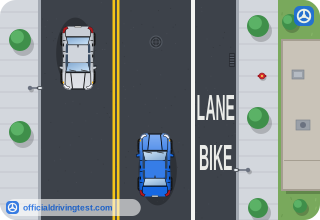
Which statement about bike lanes is correct?
- Motorists may drive in them to turn right, but may not park there
- Motorists may park in them when no bicyclist is present to use them
- Motorists may drive in them briefly, but may not park in them
- They are for bicycles only, and motorists are not to drive or park in them
Show answer
Correct answer: They are for bicycles only, and motorists are not to drive or park in them
Bike lanes and any other bicycle infrastructure are for bicycles only, and motorists are not to drive or park in a bike lane.
Source: Georgia Driver's Manual (2023-2024), page 43
-
Under what condition can bicyclists pass on the right side of motorists?
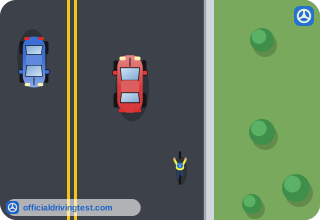
- If there is a dedicated lane or sufficient room in a shared lane, and it is safe
- Never, because bicyclists must always pass other vehicles on the left side
- Only when the motorist signals the rider to pass on the right side of the car
- Only on roads with a posted speed limit below 25 miles per hour
Show answer
Correct answer: If there is a dedicated lane or sufficient room in a shared lane, and it is safe
Bicyclists can pass on the right if there is a dedicated lane or sufficient room in a shared lane and it is safe to do so.
Source: Georgia Driver's Manual (2023-2024), page 43
-
What should bicyclists use their arms to signal to other motorists?
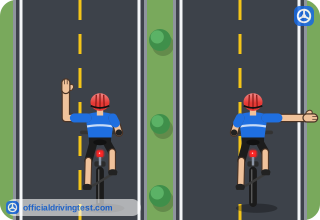
- Only that they intend to turn left at the next intersection
- That a driver traveling behind them should pass on the left
- When they will turn and in which direction, or when slowing or stopping
- Only that they are riding at night and want drivers to dim lights
Show answer
Correct answer: When they will turn and in which direction, or when slowing or stopping
Bicyclists should signal with their arms when turning, the direction of the turn, and when slowing or stopping.
Source: Georgia Driver's Manual (2023-2024), page 43
-
Compared with car drivers, how do motorcyclists involved in a crash fare?
- They are less vulnerable to injury and death
- They are more vulnerable to injury and death
- They are equally vulnerable to injury and death
- They are more vulnerable only with a passenger
Show answer
Correct answer: They are more vulnerable to injury and death
Motorcyclists are more vulnerable to injury and death than car drivers if involved in a crash.
Source: Georgia Driver's Manual (2023-2024), page 43
-
What rights and responsibilities do motorcyclists have compared with automobile drivers?
- Fewer rights but more responsibilities
- More rights because they are more vulnerable
- The same rights but fewer responsibilities
- The same rights and responsibilities
Show answer
Correct answer: The same rights and responsibilities
Motorcyclists have the same rights and responsibilities as automobile drivers.
Source: Georgia Driver's Manual (2023-2024), page 43
-
How can the small profile of a motorcycle affect how it appears to other drivers?
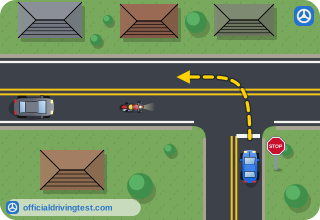
- It may appear farther away and traveling slower than it actually is
- It may appear closer and traveling faster than it actually is
- It may appear larger than a passenger vehicle at a distance
- It may appear to be stopped when it is moving
Show answer
Correct answer: It may appear farther away and traveling slower than it actually is
The small profile may make a motorcycle appear farther away and traveling slower than it actually is.
Source: Georgia Driver's Manual (2023-2024), page 43
-
Because a motorcycle's outline is small, what do drivers need to do?
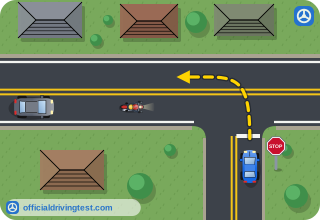
- Assume the rider can see your vehicle
- Rely on mirrors alone and not turn the head
- Take a second look, and then a third
- Stay in the far left lane at intersections
Show answer
Correct answer: Take a second look, and then a third
Drivers need to take a second look, and then a third, because most drivers are not looking for motorcycles.
Source: Georgia Driver's Manual (2023-2024), page 43
-
When should you make a visual check, mirrors too, of blind spots for motorcycles?
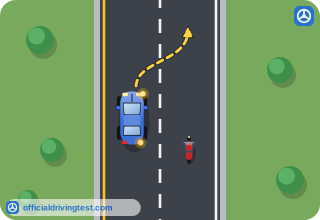
- Only when a motorcycle is directly behind you in the same lane
- Before entering or leaving a lane of traffic and at intersections
- Only when changing to a lane on your left near an intersection
- Only when you hear a motorcycle engine approaching from behind
Show answer
Correct answer: Before entering or leaving a lane of traffic and at intersections
You should always check blind spots before entering or leaving a lane of traffic and at intersections.
Source: Georgia Driver's Manual (2023-2024), page 43
-
How much of a lane are motorcycles allowed in which to maneuver?
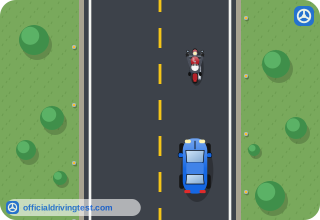
- Half the width of the lane
- The left half of the lane only
- Two-thirds of the width of the lane
- The full width of the lane
Show answer
Correct answer: The full width of the lane
Motorcycles are allowed the full width of a lane in which to maneuver.
Source: Georgia Driver's Manual (2023-2024), page 43
-
It may seem there is enough room in a lane for a car and a motorcycle. What should you do?
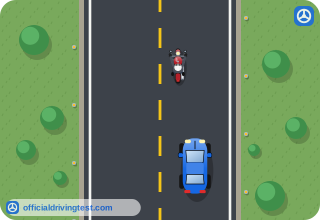
- Not share the lane, because the motorcycle needs the room to maneuver safely
- Share the lane as long as the motorcycle stays to one side of it
- Share the lane as long as you drive slowly and keep a steady speed
- Share the lane only on roads that have wide paved shoulders on both sides
Show answer
Correct answer: Not share the lane, because the motorcycle needs the room to maneuver safely
The motorcycle needs the room to maneuver safely, so you should not share the lane.
Source: Georgia Driver's Manual (2023-2024), page 43
-
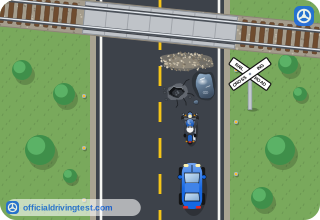
Why may motorcyclists adjust their lane position?
- To show off, as many riders like to do
- To signal drivers that they want to share the lane
- For their own safety, not to be reckless or show off
- To avoid using their turn signals
Show answer
Correct answer: For their own safety, not to be reckless or show off
Motorcyclists may adjust lane position for their own safety, not to be reckless or show off.
Source: Georgia Driver's Manual (2023-2024), page 43
-
Where in a lane do motorcyclists often ride to see traffic better and be more visible?
- Straddling the line between two lanes
- In the left portion of the lane
- On the shoulder of the road
- Directly behind the vehicle ahead
Show answer
Correct answer: In the left portion of the lane
Often, motorcyclists ride in the left portion of the lane for a better view and to be more visible.
Source: Georgia Driver's Manual (2023-2024), page 43
-
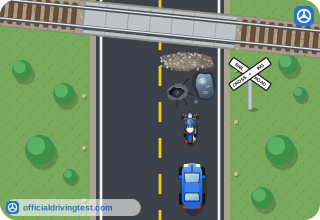
Road conditions that are minor annoyances to motorists can pose what to motorcyclists?
- The same minor annoyances
- Hazards only at night
- Hazards only in rain
- Major hazards
Show answer
Correct answer: Major hazards
The manual says conditions that are minor annoyances to motorists can pose major hazards to motorcyclists.
Source: Georgia Driver's Manual (2023-2024), page 43
-
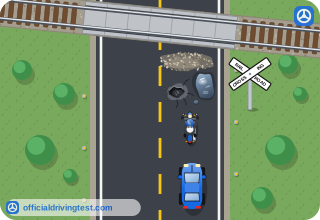
Which of these conditions may cause a motorcycle rider to change speed or lane position suddenly?
- Grooved pavement
- Wide paved shoulders
- Reflective lane markers
- Bicycle lane signs
Show answer
Correct answer: Grooved pavement
The manual lists potholes, gravel, wet surfaces, pavement seams, railroad crossings, and grooved pavement.
Source: Georgia Driver's Manual (2023-2024), page 43
-
Where are car/motorcycle crashes most likely to occur?
- On interstates
- In parking lots
- At intersections
- On curves
Show answer
Correct answer: At intersections
Intersections are the most likely places for car/motorcycle crashes to occur.
Source: Georgia Driver's Manual (2023-2024), page 43
-
What is the usual cause of a car/motorcycle crash at an intersection?
- A motorcyclist running a red light at high speed through the intersection
- A car driver not seeing the motorcycle and turning into its path
- A motorcyclist braking too hard while making a turn at the corner
- A car driver following too far behind a motorcycle in the same lane
Show answer
Correct answer: A car driver not seeing the motorcycle and turning into its path
This usually results from a car driver NOT SEEING the motorcycle and turning into the motorcycle's path.
Source: Georgia Driver's Manual (2023-2024), page 43
-
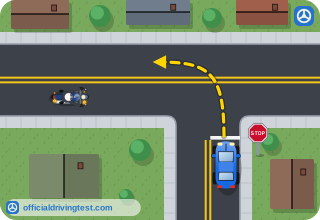
When may you assume what a motorcyclist intends to do?
- As soon as the rider moves to one side of the lane
- When the rider's turn signal begins flashing
- Once the rider slows down
- Not until the maneuver is unmistakably started
Show answer
Correct answer: Not until the maneuver is unmistakably started
Do not assume the rider's intention until the maneuver is unmistakably started.
Source: Georgia Driver's Manual (2023-2024), page 43
-
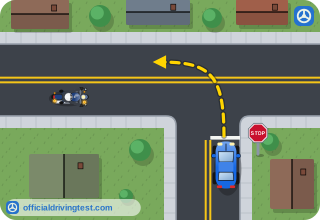
Why should you not be fooled by a flashing turn signal on a motorcycle?
- It may not be self-canceling, and riders sometimes forget to turn it off
- Motorcycle signals flash at half the usual speed and are hard to see
- Motorcycle signals only work for left turns, not for right turns
- Riders use them only to warn other drivers of hazards ahead
Show answer
Correct answer: It may not be self-canceling, and riders sometimes forget to turn it off
Motorcycle signals may not be self-canceling and motorcyclists sometimes forget to turn them off.
Source: Georgia Driver's Manual (2023-2024), page 43
-
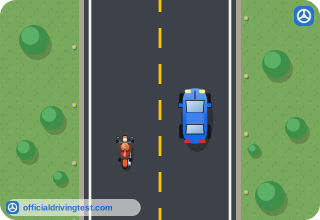
What should a motorist being overtaken by a motorcycle do?
- Move to the right edge and slow down
- Speed up to keep the motorcycle behind
- Move onto the shoulder and stop
- Maintain lane position and speed
Show answer
Correct answer: Maintain lane position and speed
The motorist being overtaken should maintain lane position and speed and let the rider complete the pass.
Source: Georgia Driver's Manual (2023-2024), page 43
-
When passing a motorcycle, how much of a lane should you allow it?
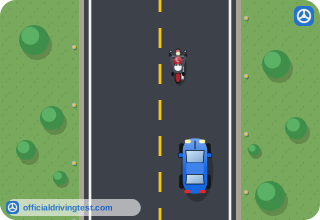
- A full lane
- Half a lane
- Two-thirds of a lane
- The width of the motorcycle plus one foot
Show answer
Correct answer: A full lane
The manual says to allow a full lane to the motorcycle and never crowd into the same lane.
Source: Georgia Driver's Manual (2023-2024), page 43
-
What can happen if you return to the original lane too soon after passing a motorcycle?
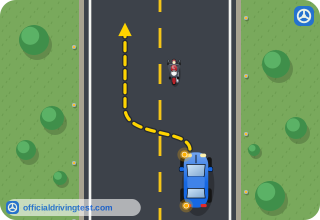
- It can make the rider lose sight of your brake lights and turn signals
- It can force the rider to swerve left into the path of oncoming vehicles
- It can force the rider to swerve to the right into traffic or off the road
- It can cause the rider's turn signal to cancel before the rider turns
Show answer
Correct answer: It can force the rider to swerve to the right into traffic or off the road
Returning to the original lane too soon can force a rider to swerve to the right into traffic or off the road.
Source: Georgia Driver's Manual (2023-2024), page 43
-
In most cases, who must stop when approaching or meeting a stopped school bus that has its lights flashing and is loading or unloading passengers?
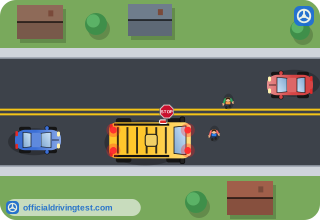
- Only drivers traveling behind the bus
- All drivers
- Only drivers in the lane next to the bus
- Only drivers who can see the bus's stop arm
Show answer
Correct answer: All drivers
The manual says that in most cases all drivers are required to stop for such a school bus.
Source: Georgia Driver's Manual (2023-2024), page 44
-
On a highway separated in the center by a median strip, which vehicles must stop for a stopped school bus with flashing lights?
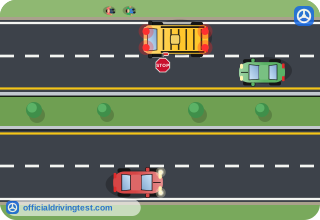
- All vehicles traveling in both directions on both sides of the median
- Only vehicles approaching the bus from the opposite direction of travel
- Only vehicles in the lane closest to the median on either side of it
- Only vehicles following or traveling alongside the bus in the same direction
Show answer
Correct answer: Only vehicles following or traveling alongside the bus in the same direction
When highways are separated by median strips, only vehicles following or traveling alongside the bus in the same direction must stop.
Source: Georgia Driver's Manual (2023-2024), page 44
-
What gives advance warning that a school bus is about to stop?
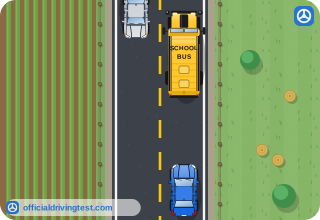
- Flashing red or amber lights on the front and rear of the bus
- A flashing white strobe light on the roof of the bus
- Flashing blue lights on the sides of the bus
- Flashing green lights on the front of the bus
Show answer
Correct answer: Flashing red or amber lights on the front and rear of the bus
A warning is given in advance by the flashing red or amber lights on the front and rear of the bus.
Source: Georgia Driver's Manual (2023-2024), page 44
-
After stopping for a school bus, how long must you remain stopped?
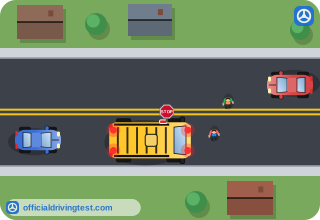
- Until the bus driver signals you to proceed, even if passengers are still in the roadway
- Until the bus has been stopped for one minute, then you may proceed carefully
- Until the bus resumes motion or turns off its warning signals and all passengers have cleared the roadway
- Until the bus driver turns off the engine and opens the passenger door
Show answer
Correct answer: Until the bus resumes motion or turns off its warning signals and all passengers have cleared the roadway
You must remain stopped until the bus resumes motion or deactivates its warning signals AND all passengers have cleared the roadway.
Source: Georgia Driver's Manual (2023-2024), page 44
-
In the Georgia fines and penalties listed with the school bus rules, what is the maximum fine?
- $250
- $1000
- $500
- $2,500
Show answer
Correct answer: $1000
The penalties listed under school buses include a fine of up to $1000.
Source: Georgia Driver's Manual (2023-2024), page 44
-
In the Georgia fines and penalties listed with the school bus rules, how many points on a driving record can a violation bring?
- Up to 2 points
- Up to 3 points
- Up to 4 points
- Up to 6 points
Show answer
Correct answer: Up to 6 points
The listed penalties include up to 6 points on the driving record.
Source: Georgia Driver's Manual (2023-2024), page 44
-
In the Georgia fines and penalties listed with the school bus rules, what happens to a driver under 21 years of age who is convicted?
- The conviction constitutes license suspension
- The conviction adds a required driving course
- The conviction adds a graduated license period
- The conviction raises the insurance requirement
Show answer
Correct answer: The conviction constitutes license suspension
A conviction under 21 years of age constitutes license suspension, according to the listed penalties.
Source: Georgia Driver's Manual (2023-2024), page 44
-
Which of these is listed among Georgia's fines and penalties for the school bus rules?
- Mandatory traffic school
- Mandatory vehicle impoundment
- Mandatory court appearance
- Mandatory community service
Show answer
Correct answer: Mandatory court appearance
The listed penalties include a mandatory court appearance, a fine up to $1000, up to 6 points, and suspension for a conviction under 21.
Source: Georgia Driver's Manual (2023-2024), page 44
-
How does the manual describe drivers of commercial motor vehicles?
- Drivers who need no special license to operate a truck
- Trained, specially licensed driving professionals
- Drivers who are trained only by their own employers
- Drivers who must be at least 25 years old to drive
Show answer
Correct answer: Trained, specially licensed driving professionals
The manual says drivers of commercial motor vehicles are trained, specially licensed driving professionals.
Source: Georgia Driver's Manual (2023-2024), page 44
-
How much do heavy trucks typically weigh?
- 20,000 pounds or more
- 40,000 pounds or more
- 60,000 pounds or more
- 80,000 pounds or more
Show answer
Correct answer: 80,000 pounds or more
The manual says heavy trucks typically weigh 80,000 pounds or more, so drivers should use caution near them.
Source: Georgia Driver's Manual (2023-2024), page 44
-
How do large trucks compare with cars when it comes to turning?
- They turn more sharply than cars
- They need less room but more time
- They require much more room to turn
- They need the same room but more time
Show answer
Correct answer: They require much more room to turn
Large trucks are longer and heavier, more difficult to maneuver, and require much more room to turn.
Source: Georgia Driver's Manual (2023-2024), page 44
-
What are the larger blind spots of large trucks called?
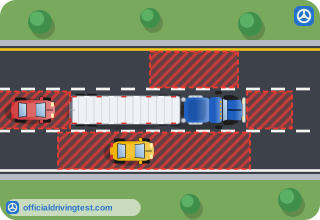
- Dead Zones
- No-Zones
- Stop Zones
- Gap Zones
Show answer
Correct answer: No-Zones
The manual calls the larger blind spots of large trucks "No-Zones."
Source: Georgia Driver's Manual (2023-2024), page 44
-
Which areas around a truck or bus does the manual name as No-Zones?
- Side, rear, and top
- Front, top, and bottom
- Left, right, and roof
- Side, rear, and front
Show answer
Correct answer: Side, rear, and front
The blind spots are the Side No-Zone, Rear No-Zone, and Front No-Zone areas.
Source: Georgia Driver's Manual (2023-2024), page 44
-
If you cannot see a truck driver's face in the side-view mirror, what does that mean?
- The driver cannot see you
- The driver can see you only in the mirror on the other side
- You are outside the truck's No-Zone
- The driver must slow down to let you pass
Show answer
Correct answer: The driver cannot see you
If you cannot see the driver's face in the side-view mirror, the driver cannot see you.
Source: Georgia Driver's Manual (2023-2024), page 45
-
Why is the right side No-Zone of a truck or bus particularly dangerous?
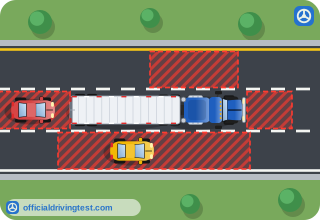
- Truck and bus drivers sit farther from the right side mirror
- Truck and bus drivers stop more often on the right
- Truck and bus drivers must make wide right turns
- Trucks and buses drift to the right as they brake
Show answer
Correct answer: Truck and bus drivers must make wide right turns
The right side No-Zone is particularly dangerous because truck and bus drivers must make wide right turns.
Source: Georgia Driver's Manual (2023-2024), page 45
-
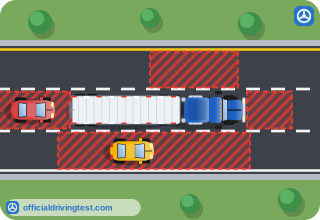
Unlike cars, what do trucks and buses lack that leaves a huge No-Zone directly behind them?
- Rear brake lights
- A rear view mirror
- Rear turn signals
- A rear window
Show answer
Correct answer: A rear view mirror
The manual states that trucks and buses have no rear view mirror, so the driver cannot see your car directly behind.
Source: Georgia Driver's Manual (2023-2024), page 45
-
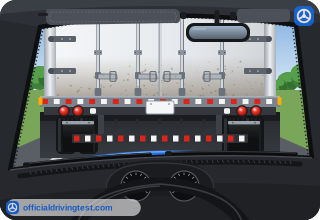
Why is it critical to keep a safe distance behind a truck or bus?
- The driver may suddenly turn into your lane
- The driver may back up without warning
- The driver may need to use the shoulder
- The driver may slow or stop suddenly
Show answer
Correct answer: The driver may slow or stop suddenly
The manual says it is critical to keep a safe distance behind a truck or bus in case the driver slows or stops suddenly.
Source: Georgia Driver's Manual (2023-2024), page 45
-
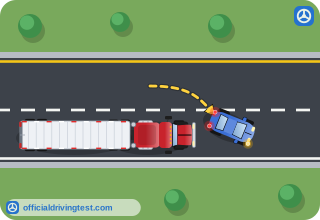
Why should more space be given in front of trucks and buses?
- They require more room and time to stop than cars
- They are required to travel below the speed limit
- They cannot use their brakes on wet roads
- They need to change lanes without signaling
Show answer
Correct answer: They require more room and time to stop than cars
Trucks and buses require more room and time to stop than cars.
Source: Georgia Driver's Manual (2023-2024), page 45
-
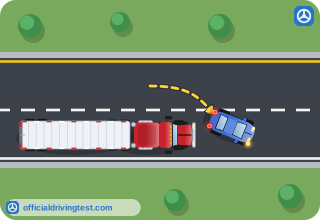
To avoid the Front No-Zone, what should you be able to see before you merge or pull into a lane ahead of a truck or bus?
- The truck's front bumper only, in your side mirror
- The truck driver waving you ahead
- The entire front of the truck or bus in your rear-view mirror
- At least one car length of open road ahead of the truck
Show answer
Correct answer: The entire front of the truck or bus in your rear-view mirror
You should be able to see the entire front of the truck or bus in your rear-view mirror before merging or pulling into that lane.
Source: Georgia Driver's Manual (2023-2024), page 45
-
Under the Georgia TACT Project, whom are law enforcement officers stopping?
- Only commercial drivers who exceed the legal weight limits of their trucks
- Drivers who drive unsafely around commercial motor vehicles, in a car or a truck
- Only car drivers who follow commercial trucks on interstate highways
- Only drivers of commercial vehicles who lack a special license to drive
Show answer
Correct answer: Drivers who drive unsafely around commercial motor vehicles, in a car or a truck
Officers are stopping people who drive unsafe around commercial motor vehicles, whether driving a car or a commercial motor vehicle.
Source: Georgia Driver's Manual (2023-2024), page 45
-
Why is tailgating a commercial motor vehicle dangerous?
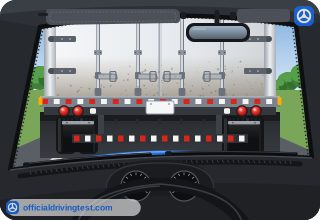
- You cannot see traffic ahead and cannot react if it brakes suddenly
- The driver may become angry and move into your lane to block you
- Your car may be pulled in by the wind created by the truck
- The truck's rear brake lights may be hidden from your view behind it
Show answer
Correct answer: You cannot see traffic ahead and cannot react if it brakes suddenly
Tailgaters in the truck's blind spot behind it cannot see traffic ahead and have no time to react if it brakes suddenly.
Source: Georgia Driver's Manual (2023-2024), page 45
-
According to the Georgia TACT Project tips, what should you allow commercial motor vehicles?
- The left lane at all times
- Plenty of room
- The right of way at intersections
- Extra speed when passing
Show answer
Correct answer: Plenty of room
The tips say to allow commercial motor vehicles plenty of room, especially when entering a highway or merging.
Source: Georgia Driver's Manual (2023-2024), page 45