Georgia: Sharing the road — Part 5 Practice Test
Questions in this part include: “Which of these is listed among Georgia's fines and penalties for the school bus rules?” · “Which areas around a truck or bus does the manual name as No-Zones?”
Independent educational site · not affiliated with any government agency or DMV
Ready? Test yourself
- Instant feedback with an explanation
- Every answer cites its source in the manual
- Your best score is saved on this device
Questions are original and based on the official manual "Georgia Driver's Manual" (2023-2024), Georgia Department of Driver Services (DDS).
All 16 questions in this practice test
Take the test above first, then use this list to study. Tap “Show answer” to see the correct answer and explanation.
Show the questions and answersHide the questions
-
In the Georgia fines and penalties listed with the school bus rules, what happens to a driver under 21 years of age who is convicted?
- The conviction constitutes license suspension
- The conviction adds a required driving course
- The conviction adds a graduated license period
- The conviction raises the insurance requirement
Show answer
Correct answer: The conviction constitutes license suspension
A conviction under 21 years of age constitutes license suspension, according to the listed penalties.
Source: Georgia Driver's Manual (2023-2024), page 44
-
Which of these is listed among Georgia's fines and penalties for the school bus rules?
- Mandatory traffic school
- Mandatory vehicle impoundment
- Mandatory court appearance
- Mandatory community service
Show answer
Correct answer: Mandatory court appearance
The listed penalties include a mandatory court appearance, a fine up to $1000, up to 6 points, and suspension for a conviction under 21.
Source: Georgia Driver's Manual (2023-2024), page 44
-
How does the manual describe drivers of commercial motor vehicles?
- Drivers who need no special license to operate a truck
- Trained, specially licensed driving professionals
- Drivers who are trained only by their own employers
- Drivers who must be at least 25 years old to drive
Show answer
Correct answer: Trained, specially licensed driving professionals
The manual says drivers of commercial motor vehicles are trained, specially licensed driving professionals.
Source: Georgia Driver's Manual (2023-2024), page 44
-
How much do heavy trucks typically weigh?
- 20,000 pounds or more
- 40,000 pounds or more
- 60,000 pounds or more
- 80,000 pounds or more
Show answer
Correct answer: 80,000 pounds or more
The manual says heavy trucks typically weigh 80,000 pounds or more, so drivers should use caution near them.
Source: Georgia Driver's Manual (2023-2024), page 44
-
How do large trucks compare with cars when it comes to turning?
- They turn more sharply than cars
- They need less room but more time
- They require much more room to turn
- They need the same room but more time
Show answer
Correct answer: They require much more room to turn
Large trucks are longer and heavier, more difficult to maneuver, and require much more room to turn.
Source: Georgia Driver's Manual (2023-2024), page 44
-
What are the larger blind spots of large trucks called?
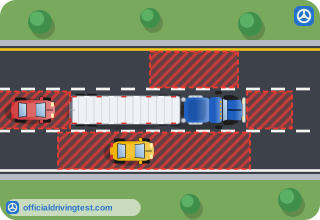
- Dead Zones
- No-Zones
- Stop Zones
- Gap Zones
Show answer
Correct answer: No-Zones
The manual calls the larger blind spots of large trucks "No-Zones."
Source: Georgia Driver's Manual (2023-2024), page 44
-
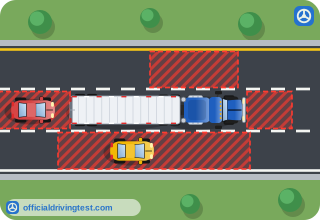
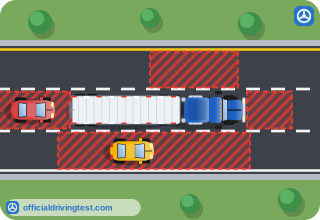
Which areas around a truck or bus does the manual name as No-Zones?
- Side, rear, and top
- Front, top, and bottom
- Left, right, and roof
- Side, rear, and front
Show answer
Correct answer: Side, rear, and front
The blind spots are the Side No-Zone, Rear No-Zone, and Front No-Zone areas.
Source: Georgia Driver's Manual (2023-2024), page 44
-
If you cannot see a truck driver's face in the side-view mirror, what does that mean?
- The driver cannot see you
- The driver can see you only in the mirror on the other side
- You are outside the truck's No-Zone
- The driver must slow down to let you pass
Show answer
Correct answer: The driver cannot see you
If you cannot see the driver's face in the side-view mirror, the driver cannot see you.
Source: Georgia Driver's Manual (2023-2024), page 45
-
Why is the right side No-Zone of a truck or bus particularly dangerous?
- Truck and bus drivers sit farther from the right side mirror
- Truck and bus drivers stop more often on the right
- Truck and bus drivers must make wide right turns
- Trucks and buses drift to the right as they brake
Show answer
Correct answer: Truck and bus drivers must make wide right turns
The right side No-Zone is particularly dangerous because truck and bus drivers must make wide right turns.
Source: Georgia Driver's Manual (2023-2024), page 45
-
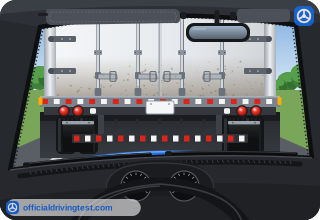
Unlike cars, what do trucks and buses lack that leaves a huge No-Zone directly behind them?
- Rear brake lights
- A rear view mirror
- Rear turn signals
- A rear window
Show answer
Correct answer: A rear view mirror
The manual states that trucks and buses have no rear view mirror, so the driver cannot see your car directly behind.
Source: Georgia Driver's Manual (2023-2024), page 45
-
Why is it critical to keep a safe distance behind a truck or bus?
- The driver may suddenly turn into your lane
- The driver may back up without warning
- The driver may need to use the shoulder
- The driver may slow or stop suddenly
Show answer
Correct answer: The driver may slow or stop suddenly
The manual says it is critical to keep a safe distance behind a truck or bus in case the driver slows or stops suddenly.
Source: Georgia Driver's Manual (2023-2024), page 45
-
Why should more space be given in front of trucks and buses?
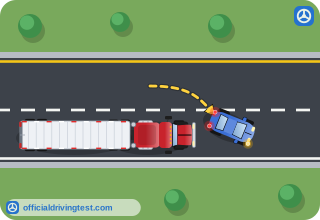
- They require more room and time to stop than cars
- They are required to travel below the speed limit
- They cannot use their brakes on wet roads
- They need to change lanes without signaling
Show answer
Correct answer: They require more room and time to stop than cars
Trucks and buses require more room and time to stop than cars.
Source: Georgia Driver's Manual (2023-2024), page 45
-
To avoid the Front No-Zone, what should you be able to see before you merge or pull into a lane ahead of a truck or bus?
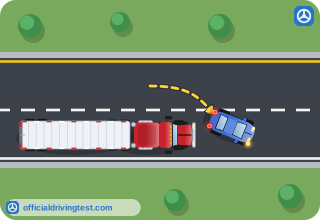
- The truck's front bumper only, in your side mirror
- The truck driver waving you ahead
- The entire front of the truck or bus in your rear-view mirror
- At least one car length of open road ahead of the truck
Show answer
Correct answer: The entire front of the truck or bus in your rear-view mirror
You should be able to see the entire front of the truck or bus in your rear-view mirror before merging or pulling into that lane.
Source: Georgia Driver's Manual (2023-2024), page 45
-
Under the Georgia TACT Project, whom are law enforcement officers stopping?
- Only commercial drivers who exceed the legal weight limits of their trucks
- Drivers who drive unsafely around commercial motor vehicles, in a car or a truck
- Only car drivers who follow commercial trucks on interstate highways
- Only drivers of commercial vehicles who lack a special license to drive
Show answer
Correct answer: Drivers who drive unsafely around commercial motor vehicles, in a car or a truck
Officers are stopping people who drive unsafe around commercial motor vehicles, whether driving a car or a commercial motor vehicle.
Source: Georgia Driver's Manual (2023-2024), page 45
-
Why is tailgating a commercial motor vehicle dangerous?
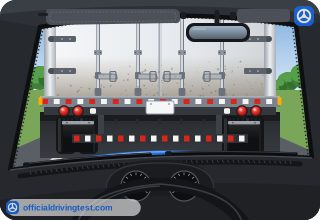
- You cannot see traffic ahead and cannot react if it brakes suddenly
- The driver may become angry and move into your lane to block you
- Your car may be pulled in by the wind created by the truck
- The truck's rear brake lights may be hidden from your view behind it
Show answer
Correct answer: You cannot see traffic ahead and cannot react if it brakes suddenly
Tailgaters in the truck's blind spot behind it cannot see traffic ahead and have no time to react if it brakes suddenly.
Source: Georgia Driver's Manual (2023-2024), page 45
-
According to the Georgia TACT Project tips, what should you allow commercial motor vehicles?
- The left lane at all times
- Plenty of room
- The right of way at intersections
- Extra speed when passing
Show answer
Correct answer: Plenty of room
The tips say to allow commercial motor vehicles plenty of room, especially when entering a highway or merging.
Source: Georgia Driver's Manual (2023-2024), page 45