Georgia: Emergencies and special situations
Hydroplaning, skids, tire blow-outs, breakdowns, crashes, winter weather and deer. Split into 4 shorter tests so you're not stuck in one long quiz.
Independent educational site · not affiliated with any government agency or DMV
Choose a part
Emergencies and special situations — Part 1
Questions in this part include: “What kind of gas is carbon monoxide, which cars produce?”
StartEmergencies and special situations — Part 2
Questions in this part include: “In a standard passenger car, partial hydroplaning can begin at speeds as low as what?”
StartEmergencies and special situations — Part 3
Questions in this part include: “According to the manual, why are most Georgians not experienced in driving in winter weather?”
StartEmergencies and special situations — Part 4
Questions in this part include: “What does Georgia's Good Samaritan Law do?”
StartAll 80 Emergencies and special situations questions with answers
Choose a part above to take a practice test, or study every question and answer here.
Show the questions and answersHide the questions
-
What kind of gas is carbon monoxide, which cars produce?
- A harmless gas that smells of gasoline
- A visible gray gas with a sharp smell
- A deadly gas with no odor and no color
- A light gas that burns the eyes and throat
Show answer
Correct answer: A deadly gas with no odor and no color
The manual describes carbon monoxide as a deadly odorless and colorless gas.
Source: Georgia Driver's Manual (2023-2024), page 39
-
Which of these are symptoms of carbon monoxide poisoning?
- Sudden weariness, yawning, dizziness, and nausea
- Sudden hunger, sneezing, itching, and thirst
- Blurred vision, ringing ears, cough and chills
- Muscle cramps, sweating, fever, and sore throat
Show answer
Correct answer: Sudden weariness, yawning, dizziness, and nausea
The manual lists sudden weariness, yawning, dizziness, and nausea as symptoms.
Source: Georgia Driver's Manual (2023-2024), page 39
-
Which is a simple precaution to avoid carbon monoxide poisoning?
- Warm up the car in a closed garage before you leave
- Run the heater in a parked car with the windows closed
- Drive with a defective muffler only for short trips
- Do not leave the car motor running in a garage
Show answer
Correct answer: Do not leave the car motor running in a garage
One of the listed precautions is not leaving the car motor running in a garage.
Source: Georgia Driver's Manual (2023-2024), page 39
-
While the car is parked, which of these is unsafe because of carbon monoxide?
- Turning the engine off with the window closed
- Leaving the motor running with the window closed
- Leaving the motor off with the doors locked
- Parking in the shade with the engine off
Show answer
Correct answer: Leaving the motor running with the window closed
The manual says not to leave the car motor running and the window closed while the car is parked.
Source: Georgia Driver's Manual (2023-2024), page 39
-
When is it unsafe to operate the heater or air conditioner in a parked car?
- When the windows are closed
- When the windows are open
- When the car is facing uphill
- When the fuel tank is nearly empty
Show answer
Correct answer: When the windows are closed
The manual says not to operate the heater or air conditioner in a parked car with the windows closed.
Source: Georgia Driver's Manual (2023-2024), page 39
-
Driving with which of these can expose you to carbon monoxide?
- A worn windshield wiper and washer system
- A tire with low air pressure
- A defective muffler or exhaust system
- A dim or burned-out brake light
Show answer
Correct answer: A defective muffler or exhaust system
The manual lists driving with a defective muffler or exhaust system among the carbon monoxide hazards.
Source: Georgia Driver's Manual (2023-2024), page 39
-
What should you do for a victim of carbon monoxide poisoning?
- Keep them seated in the car with the windows closed to rest
- Move them to fresh air and contact emergency medical services
- Give them water and let them sleep in the vehicle
- Drive them home first, then call for emergency help
Show answer
Correct answer: Move them to fresh air and contact emergency medical services
The victim should be moved to fresh air and emergency medical services contacted, with artificial respiration if necessary and you are trained.
Source: Georgia Driver's Manual (2023-2024), page 40
-
When is stopping on the roadway shoulder of an expressway permitted?
- To switch drivers
- To stretch
- To retrieve an item from the back of the vehicle
- Only in an emergency
Show answer
Correct answer: Only in an emergency
Stopping on the shoulder is highly dangerous and permitted only in an emergency.
Source: Georgia Driver's Manual (2023-2024), page 41
-
If it is necessary to stop on an expressway, how should you indicate difficulty?
- Walk along the expressway to look for help
- Leave the hood closed and turn off all lights
- Raise the hood and activate your hazard lights
- Flash your high beams and sound the horn
Show answer
Correct answer: Raise the hood and activate your hazard lights
You should raise the hood and activate your hazard lights, and not walk along the expressway in search of help.
Source: Georgia Driver's Manual (2023-2024), page 41
-
In the manual's "Other Highway Emergencies" chart, what can you apply to a fire?
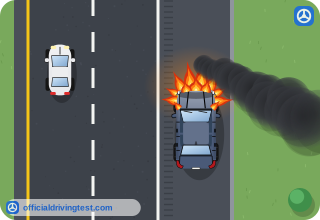
- Engine oil from the dipstick
- Brake fluid from the reservoir
- Antifreeze from the radiator
- Mud, dirt, dust or snow
Show answer
Correct answer: Mud, dirt, dust or snow
For a fire, the chart says to apply mud, dirt, dust or snow.
Source: Georgia Driver's Manual (2023-2024), page 41
-
In the "Other Highway Emergencies" chart, what can you use to carry water to wet apparel when fighting a fire?
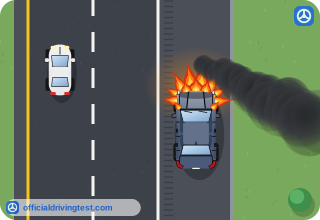
- Your hat
- A hub cap
- A floor mat
- A spare tire cover
Show answer
Correct answer: A hub cap
The chart says to use a hub cap to carry water to wet apparel.
Source: Georgia Driver's Manual (2023-2024), page 41
-
In the "Other Highway Emergencies" chart, what do you use to loosen dirt to throw on a fire?
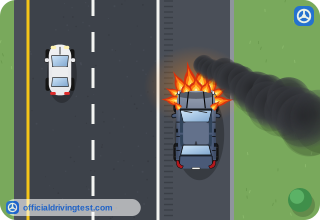
- A tire tool
- A floor mat
- A windshield wiper
- A seat cushion
Show answer
Correct answer: A tire tool
The chart says to loosen dirt with a tire tool to throw on the fire.
Source: Georgia Driver's Manual (2023-2024), page 41
-
If your accelerator is jammed, what does the manual say to shift to?
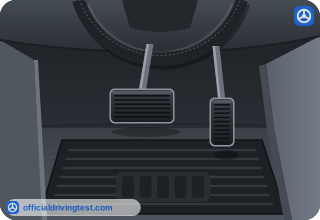
- Park
- Reverse
- Neutral
- Drive
Show answer
Correct answer: Neutral
For a jammed accelerator, the chart lists shifting to neutral.
Source: Georgia Driver's Manual (2023-2024), page 41
-
If your accelerator is jammed, what does the manual say to do with the ignition?
- Turn it to the lock position
- Turn it off, but not to the lock position
- Leave it on and pump the brakes
- Turn it off and remove the key at once
Show answer
Correct answer: Turn it off, but not to the lock position
The chart says to turn off the ignition, but not to the lock position.
Source: Georgia Driver's Manual (2023-2024), page 41
-
If your accelerator is jammed, what does the manual say to do with the pedal?
- Pull the pedal up with your hand
- Press the pedal down harder
- Pump the pedal quickly
- Slap the pedal with your foot
Show answer
Correct answer: Slap the pedal with your foot
The chart lists slapping the pedal with your foot as a step for a jammed accelerator.
Source: Georgia Driver's Manual (2023-2024), page 41
-
If your brakes fail, what does the manual say to shift to?
- Neutral
- Reverse
- A lower gear
- Park
Show answer
Correct answer: A lower gear
For brake failure, the chart says to shift to a lower gear.
Source: Georgia Driver's Manual (2023-2024), page 41
-
If your brakes fail, which of these does the manual list as a way to slow down?
- Rub a tire on the curb
- Slap the pedal with your foot
- Shift to neutral
- Turn off the ignition
Show answer
Correct answer: Rub a tire on the curb
The chart lists rubbing a tire on the curb for brake failure.
Source: Georgia Driver's Manual (2023-2024), page 41
-
After driving through deep water, what should you do with your brakes?
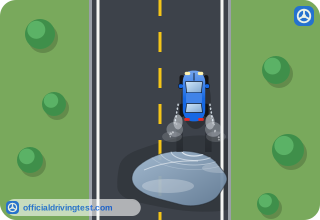
- Apply them hard at once
- Leave them alone until dry
- Pump them at high speed
- Test them lightly
Show answer
Correct answer: Test them lightly
The chart says to test brakes lightly after driving through deep water because they may pull to one side or not hold at all.
Source: Georgia Driver's Manual (2023-2024), page 41
-
How does the manual say to dry wet brakes?
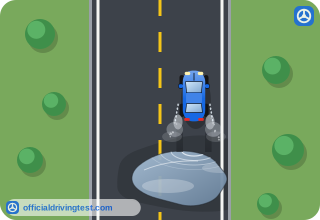
- Drive fast in high gear while pressing the brakes hard
- Drive slowly in low gear while applying the brakes lightly
- Park and wait until the brakes dry on their own
- Drive in neutral while pumping the brakes quickly
Show answer
Correct answer: Drive slowly in low gear while applying the brakes lightly
Wet brakes are dried by driving slowly in low gear while applying the brakes lightly.
Source: Georgia Driver's Manual (2023-2024), page 41
-
Hydroplaning occurs when there is what on a roadway?
- Standing water
- Loose gravel
- Black ice
- Fallen leaves
Show answer
Correct answer: Standing water
The manual says hydroplaning occurs when there is standing water on a roadway.
Source: Georgia Driver's Manual (2023-2024), page 38
-
In a standard passenger car, partial hydroplaning can begin at speeds as low as what?
- 25 mph
- 45 mph
- 35 mph
- 55 mph
Show answer
Correct answer: 35 mph
The manual says partial hydroplaning can begin at speeds as low as 35 mph in a standard passenger car.
Source: Georgia Driver's Manual (2023-2024), page 38
-
At what speed may your tires lose all contact with the road when hydroplaning?
- 45 mph
- 55 mph
- 65 mph
- 75 mph
Show answer
Correct answer: 55 mph
The manual says that at 55 mph the tires may lose all contact with the road.
Source: Georgia Driver's Manual (2023-2024), page 38
-
If your tires lose all contact with the road while hydroplaning, what happens?
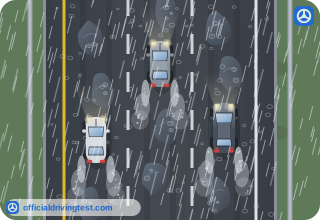
- There is no friction available to brake, accelerate, or steer
- Steering works normally, but braking and acceleration do not
- Braking still works normally, but steering and acceleration do not
- Only the front wheels lose friction, so you can still steer
Show answer
Correct answer: There is no friction available to brake, accelerate, or steer
The manual says that with no contact there is no friction available to brake, accelerate, or steer.
Source: Georgia Driver's Manual (2023-2024), page 38
-
If your vehicle hydroplanes and goes into a skid, what should you do?
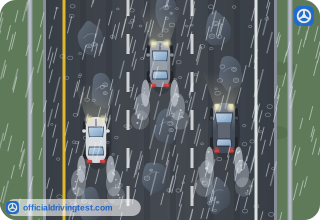
- Brake as hard as possible to regain contact with the road
- Accelerate gently to pull the car out of the water
- Take your foot off the accelerator and let the car slow down
- Steer sharply back and forth to shed the water
Show answer
Correct answer: Take your foot off the accelerator and let the car slow down
The manual says to take your foot off the accelerator, letting the car slow down.
Source: Georgia Driver's Manual (2023-2024), page 38
-
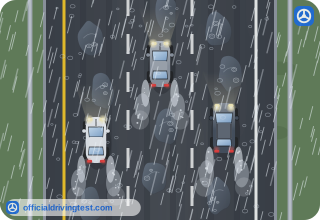
What is the most important way to prevent hydroplaning?
- Keep your tire pressure above the recommended level
- Slow down when there is water on the roadway
- Drive with your hazard lights on when the road is wet
- Drive on the shoulder where the water is shallow
Show answer
Correct answer: Slow down when there is water on the roadway
The manual says that, most importantly, you should slow down when there is water on the roadway.
Source: Georgia Driver's Manual (2023-2024), page 38
-
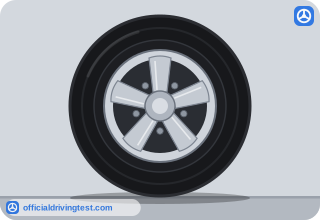
What kind of tires helps prevent hydroplaning?
- Tires inflated well above the recommended pressure
- Tires with worn tread that has been smoothed evenly
- Wide tires with the tread worn down evenly
- Good tires with adequate water-channeling tread
Show answer
Correct answer: Good tires with adequate water-channeling tread
The manual says to maintain good tires with adequate water-channeling tread.
Source: Georgia Driver's Manual (2023-2024), page 38
-
According to the manual, when does a car skid?
- When the engine sends too much power to the wheels
- When the brakes are applied for more than a few seconds
- When its tires lose their grip on the road surface
- When the steering wheel is held in one position
Show answer
Correct answer: When its tires lose their grip on the road surface
The manual says a car skids when its tires lose their grip on the road surface.
Source: Georgia Driver's Manual (2023-2024), page 38
-
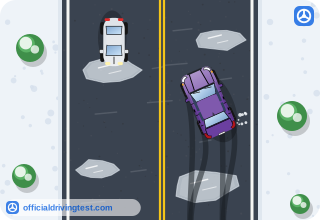
What is lost when a car skids?
- Only the braking ability of the wheels; engine power to them remains
- The engine's power to the wheels and the wheels' braking ability
- Only engine power to the wheels; the brakes continue to work normally
- Nothing, because the wheels are still turning
Show answer
Correct answer: The engine's power to the wheels and the wheels' braking ability
The manual says that when a car skids, both the engine power sent to the wheels and the braking ability of the wheels are lost.
Source: Georgia Driver's Manual (2023-2024), page 38
-
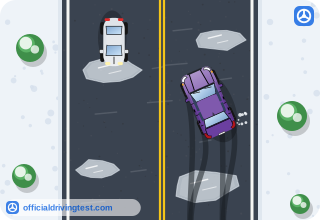
What can cause a skid?
- Easing your foot off the accelerator on a dry, paved road
- Keeping both hands on the wheel at the 9 and 3 o'clock positions
- Checking your mirrors and blind spot before changing lanes
- Applying the brakes too hard or turning the wheel too sharply
Show answer
Correct answer: Applying the brakes too hard or turning the wheel too sharply
The manual says a skid can occur if brakes are applied too hard or the wheel is turned too sharp.
Source: Georgia Driver's Manual (2023-2024), page 38
-
If you start to skid, what should you do with your foot?
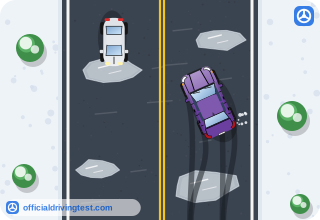
- Ease your foot off of the accelerator
- Press the brake pedal firmly to the floor
- Press the accelerator harder to power out
- Pump the accelerator to regain grip
Show answer
Correct answer: Ease your foot off of the accelerator
The manual says that if you start to skid you should ease your foot off of the accelerator.
Source: Georgia Driver's Manual (2023-2024), page 38
-
If you start to skid, which way should you begin turning the steering wheel?
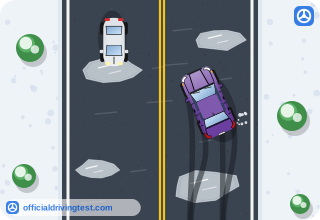
- Away from the direction of the skid
- In the direction of the skid
- Toward the nearest shoulder
- Straight ahead, and hold the wheel still
Show answer
Correct answer: In the direction of the skid
The manual says to begin turning the steering wheel in the direction of the skid.
Source: Georgia Driver's Manual (2023-2024), page 38
-
During a skid, when can you lightly apply the brakes?
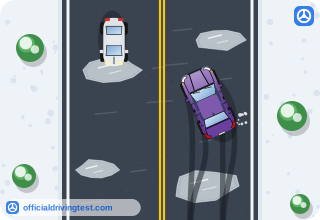
- As soon as the skid begins, before you steer
- Only after the car has come to a complete stop
- As soon as you ease off the accelerator
- Once you have regained control of the vehicle
Show answer
Correct answer: Once you have regained control of the vehicle
The manual says that once you have regained control of the vehicle you can lightly apply brakes and steer in a safe direction.
Source: Georgia Driver's Manual (2023-2024), page 38
-
Why is it difficult to safely maneuver a vehicle once it has left the roadway?
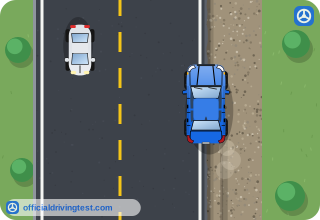
- Uneven terrain and obstacles
- The steering wheel locks up on soft ground
- The brakes stop working off the pavement
- Other drivers are required to stop for you
Show answer
Correct answer: Uneven terrain and obstacles
The manual says uneven terrain and obstacles make it difficult to maneuver safely once the vehicle has left the roadway.
Source: Georgia Driver's Manual (2023-2024), page 39
-
To avoid leaving the roadway, how fast should you drive?
- Slightly above the posted limit to keep up with traffic
- At whatever speed feels comfortable for road conditions
- At or below the speed shown on a regulatory or advisory sign
- At the speed of the fastest vehicle in your lane
Show answer
Correct answer: At or below the speed shown on a regulatory or advisory sign
The manual says to drive at or below the speed indicated on a regulatory sign or an advisory sign indicating potential hazards.
Source: Georgia Driver's Manual (2023-2024), page 39
-
If your vehicle leaves the roadway, what should you do with the accelerator?
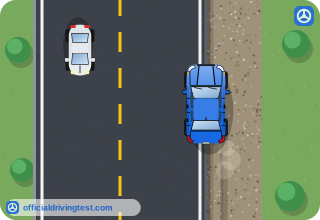
- Press it harder to regain speed
- Take your foot off it
- Pump it gently and repeatedly
- Hold it steady to keep your speed
Show answer
Correct answer: Take your foot off it
The manual says to take your foot off the accelerator if your vehicle leaves the roadway.
Source: Georgia Driver's Manual (2023-2024), page 39
-
If your vehicle leaves the roadway, how should you hold the steering wheel?
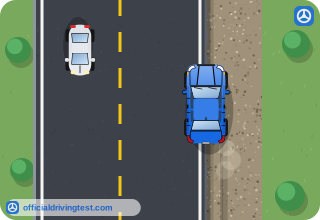
- Hold it loosely with one hand so the wheel can move freely
- Let go briefly so the wheels can straighten themselves
- Turn it fully toward the pavement and hold it there
- Grip it tightly and be prepared to withstand sudden shocks
Show answer
Correct answer: Grip it tightly and be prepared to withstand sudden shocks
The manual says to grip the steering wheel tightly and be prepared to withstand sudden shocks.
Source: Georgia Driver's Manual (2023-2024), page 39
-
If your vehicle leaves the roadway, how should you use the brake pedal?
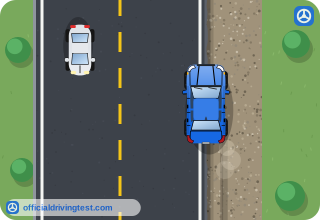
- Suddenly and hard, to stop as quickly as possible
- Not at all until the car stops rolling on its own
- Carefully, not suddenly and hard
- By pumping it rapidly until the car stops
Show answer
Correct answer: Carefully, not suddenly and hard
The manual says not to hit the brake pedal suddenly and hard, and to use your brakes carefully.
Source: Georgia Driver's Manual (2023-2024), page 39
-
If your vehicle leaves the roadway, which of these should you NOT try to do?
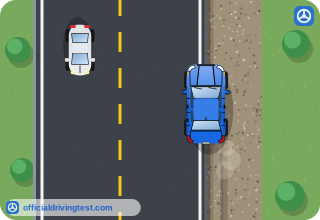
- Take your foot off the accelerator
- Turn back onto the pavement immediately
- Grip the steering wheel tightly
- Check the traffic before returning
Show answer
Correct answer: Turn back onto the pavement immediately
The manual says not to turn back onto the pavement immediately, because overcompensating can cause a skid or a flip.
Source: Georgia Driver's Manual (2023-2024), page 39
-
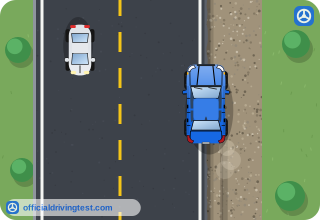
After leaving the roadway, what should you do before you return to it?
- Turn sharply back onto the pavement before other vehicles approach
- Stay on the shoulder until a law enforcement officer directs you back
- Accelerate along the shoulder until you pass the traffic ahead
- Wait until speed has reduced, check traffic, and find a safe place to merge
Show answer
Correct answer: Wait until speed has reduced, check traffic, and find a safe place to merge
The manual says to wait until your speed has reduced, check the traffic, and look for a safe place to return by merging, stopping completely first if necessary.
Source: Georgia Driver's Manual (2023-2024), page 39
-
What is a tire blow-out?
- A tire rupturing and going flat immediately
- A tire slowly losing air over time
- A sudden loss of brake fluid pressure
- A skid caused by hard braking on wet roads
Show answer
Correct answer: A tire rupturing and going flat immediately
The manual says a blow-out occurs when the tire ruptures and goes flat immediately, unlike a slow leak.
Source: Georgia Driver's Manual (2023-2024), page 39
-
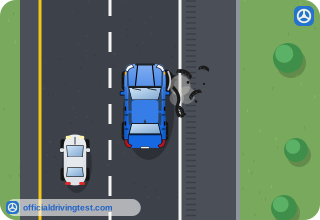
If you experience a sudden tire blow-out, what should you do with the steering wheel and the accelerator?
- Turn the wheel sharply toward the shoulder and brake hard
- Grasp the wheel firmly and take your foot off the accelerator
- Hold the wheel loosely and press the accelerator to stay straight
- Release the wheel and let the car straighten itself
Show answer
Correct answer: Grasp the wheel firmly and take your foot off the accelerator
The manual says to grasp the steering wheel firmly and take your foot off the accelerator so the vehicle rolls to a stop.
Source: Georgia Driver's Manual (2023-2024), page 39
-
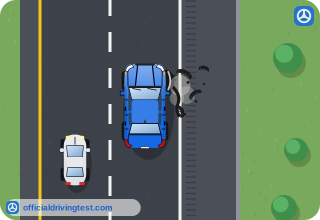
After a sudden tire blow-out, how should you apply the brakes?
- Firmly, to stop as quickly as possible
- Not at all under any circumstances
- By pumping them hard and rapidly
- Lightly, if necessary and safe to do so
Show answer
Correct answer: Lightly, if necessary and safe to do so
The manual says to apply the brakes lightly if necessary and safe to do so.
Source: Georgia Driver's Manual (2023-2024), page 39
-
After a tire blow-out, when should you move to the shoulder of the road?
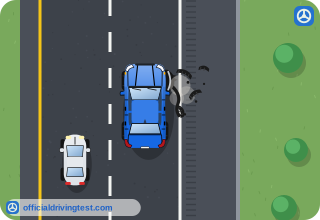
- Not until the car has slowed greatly
- Immediately, before the car slows down
- As soon as you feel the tire rupture
- Only after you have applied the brakes hard
Show answer
Correct answer: Not until the car has slowed greatly
The manual says not to move to the shoulder until the car has slowed greatly.
Source: Georgia Driver's Manual (2023-2024), page 39
-
A tire blow-out causes your car to swerve onto the shoulder. What should you do?
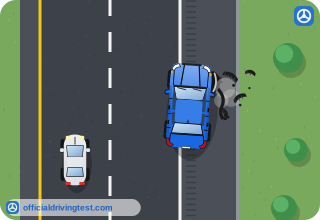
- Steer back onto the pavement right away to avoid the roadside
- Brake hard and turn sharply toward the center of the road
- Let the car coast to a stop without trying to get back on the pavement
- Accelerate along the shoulder until the tire cools down
Show answer
Correct answer: Let the car coast to a stop without trying to get back on the pavement
The manual says not to try to get back on the pavement; let the car coast to a stop.
Source: Georgia Driver's Manual (2023-2024), page 39
-
According to the manual, why are most Georgians not experienced in driving in winter weather?
- Few Georgians own cars with snow tires
- Driver education courses skip winter driving
- Georgia roads are never wet in winter
- The usually mild climate
Show answer
Correct answer: The usually mild climate
The manual says most Georgians are not experienced in winter driving because of the usually mild climate.
Source: Georgia Driver's Manual (2023-2024), page 39
-
When does the manual suggest using chains or snow tires?
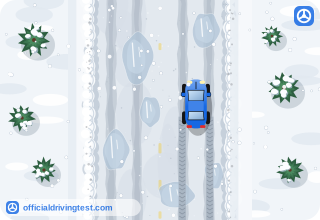
- If road conditions require extra traction
- Whenever the temperature is below freezing
- Any time the road is wet
- Only on roads without a posted speed limit
Show answer
Correct answer: If road conditions require extra traction
The manual says to use chains or snow tires if road conditions require extra traction.
Source: Georgia Driver's Manual (2023-2024), page 39
-
Before installing chains on your vehicle, what should you check?
- Your vehicle's registration and insurance documents for the season
- The weather forecast and road conditions posted online for your route
- The manufacturer's instruction manual for your vehicle, the tires, and the chains
- The tread depth of your tires with a penny
Show answer
Correct answer: The manufacturer's instruction manual for your vehicle, the tires, and the chains
The manual says to check the manufacturer's instruction manual for the vehicle, the tires, and the chains before installing them.
Source: Georgia Driver's Manual (2023-2024), page 39
-
What should you remove from all window surfaces before driving in winter weather?
- Dirt and dust only
- Snow and ice
- Window tint film
- Rain-repellent coatings
Show answer
Correct answer: Snow and ice
The manual says to keep windows clear by removing snow and ice from all window surfaces before driving.
Source: Georgia Driver's Manual (2023-2024), page 39
-
When you first enter the roadway in winter weather and it is safe to do so, what should you do?
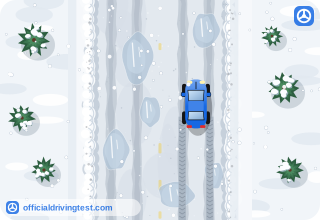
- Get a "feel" for the road by testing your brakes gently
- Accelerate quickly to test how much traction you have
- Brake hard once to see how far the car slides
- Drive in the middle of the road to avoid the ice
Show answer
Correct answer: Get a "feel" for the road by testing your brakes gently
The manual says to get a "feel" for the road and to test your brakes gently.
Source: Georgia Driver's Manual (2023-2024), page 39
-
In winter weather, how should you slow down before an intersection, a turn, or a stop?
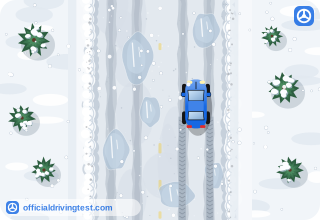
- With one firm application of the brakes
- By shifting to neutral well ahead of time
- Gradually, never applying sudden braking
- By taking your foot off the accelerator at the last moment
Show answer
Correct answer: Gradually, never applying sudden braking
The manual says never to apply sudden braking, but to slow down gradually before an intersection, a turn or a stop.
Source: Georgia Driver's Manual (2023-2024), page 39
-
Which preparation does the manual list among the tips for safe winter driving?
- Drive only at night when the roads are clear
- Learn what to do in a winter emergency
- Leave the engine running in a closed garage
- Follow the vehicle ahead closely for traction
Show answer
Correct answer: Learn what to do in a winter emergency
The manual lists learning what to do in a winter emergency as a tip for safe winter driving.
Source: Georgia Driver's Manual (2023-2024), page 39
-
What does the manual suggest doing before a trip in winter weather?
- Leave at the last minute to avoid waiting
- Take the shortest route regardless of conditions
- Choose unfamiliar back roads to avoid traffic
- Plan your travel and route
Show answer
Correct answer: Plan your travel and route
The manual lists planning your travel and route as a tip for safe winter driving.
Source: Georgia Driver's Manual (2023-2024), page 39
-
What is the first thing you must do if you are involved in a crash?
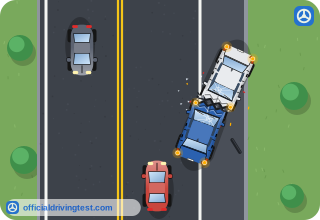
- Move your vehicle to the nearest parking space
- Call your insurance company before anything else
- Leave your name at the scene and continue driving
- Stop immediately in a safe place
Show answer
Correct answer: Stop immediately in a safe place
The manual's first listed step after a crash is to stop immediately in a safe place.
Source: Georgia Driver's Manual (2023-2024), page 50
-
When must you notify the nearest law enforcement agency immediately after a crash?
- If anyone is injured or killed, or property damage exceeds $500.00
- Only if the other driver insists that you call the police
- If property damage exceeds $100.00 or someone is injured
- Only if a vehicle cannot be driven away from the scene
Show answer
Correct answer: If anyone is injured or killed, or property damage exceeds $500.00
You must notify the nearest law enforcement agency immediately if anyone is injured or killed, or if property damage exceeds $500.00.
Source: Georgia Driver's Manual (2023-2024), page 50
-
What must you provide after a crash if a person is injured?
- Payment for their medical bills on the spot
- Only your phone number, then leave the scene
- Reasonable assistance to any person injured
- Nothing, because only police may help injured people
Show answer
Correct answer: Reasonable assistance to any person injured
The manual tells drivers to provide reasonable assistance to any person injured.
Source: Georgia Driver's Manual (2023-2024), page 50
-
How should you warn approaching motorists after a crash?
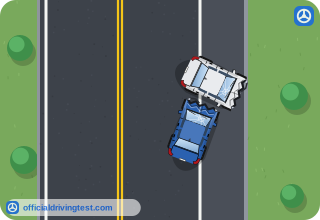
- Stand in the roadway and wave your arms at approaching cars
- Activate hazard lights if possible and use reflective triangles
- Turn off all vehicle lights so other drivers are not confused
- Turn on your high beams and leave them on until police arrive
Show answer
Correct answer: Activate hazard lights if possible and use reflective triangles
You should warn approaching motorists if you can do so safely, using hazard lights and reflective triangles when available.
Source: Georgia Driver's Manual (2023-2024), page 50
-
Which information must you give to anyone else involved in a crash?
- Your name, phone number, insurance policy number, and employer
- Your name, employer, and vehicle identification number (VIN)
- Your name, date of birth, Social Security number, and address
- Your name, address, license plate number, and driver's license number
Show answer
Correct answer: Your name, address, license plate number, and driver's license number
You must give your name, address, license plate number, and driver's license number, and get the same information from the other driver.
Source: Georgia Driver's Manual (2023-2024), page 50
-
If you damage an unattended vehicle in a crash, what must you do?
- Locate the owner, or leave your information where the owner will find it
- Leave only your phone number under the vehicle's windshield wiper
- Leave the scene right away, since no one was injured in the crash
- Wait one hour at the scene and then drive away if unnoticed
Show answer
Correct answer: Locate the owner, or leave your information where the owner will find it
You must locate the owner or leave your name, address, and the name of the owner of the vehicle you were driving in a conspicuous place.
Source: Georgia Driver's Manual (2023-2024), page 50
-
A person involved in a crash says he or she is not injured. What should you do?
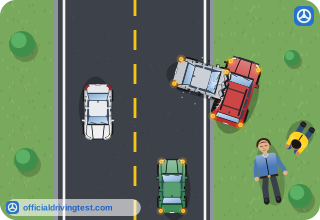
- Take the person's word and allow him or her to drive away
- Move the person to the shoulder of the road right away
- Not assume the person is unhurt, and send for professional help
- Give the person water and wait for the pain to start
Show answer
Correct answer: Not assume the person is unhurt, and send for professional help
The manual warns not to assume a person is not injured simply because that person says so.
Source: Georgia Driver's Manual (2023-2024), page 50
-
When may you move or lift an injured victim of a crash?
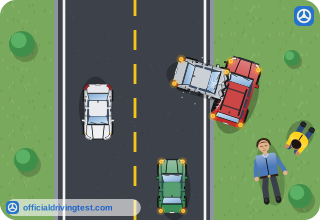
- Whenever the victim asks to be moved
- Only when it is absolutely necessary
- Always, to make the victim more comfortable
- Only after the victim has been given water
Show answer
Correct answer: Only when it is absolutely necessary
Unskilled handling can cause further and more severe injuries, so do not move or lift the victim unless absolutely necessary.
Source: Georgia Driver's Manual (2023-2024), page 50
-
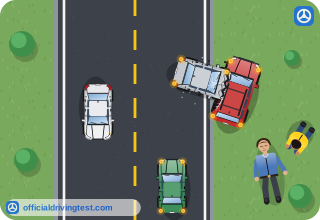
How should serious bleeding be stopped when aiding an injured person?
- With a tight tourniquet placed above the wound right away
- By leaving the wound uncovered so that it can dry out
- By washing the wound with running water until it stops
- With thick, clean cloth pads applied with pressure by hand
Show answer
Correct answer: With thick, clean cloth pads applied with pressure by hand
The manual says to stop serious bleeding with thick cloth pads, as clean as possible, applied with pressure by hand.
Source: Georgia Driver's Manual (2023-2024), page 50
-
What should you do for an injured victim to keep them warm?
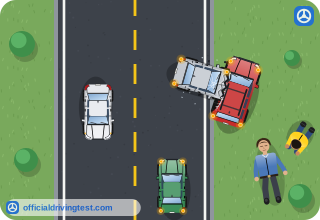
- Cover the victim with blankets or coats if necessary
- Give the victim hot coffee or tea to drink right away
- Move the victim into the back seat of your vehicle
- Have the victim walk around until the shaking stops
Show answer
Correct answer: Cover the victim with blankets or coats if necessary
The manual says to keep the victim warm by covering with blankets or coats if necessary.
Source: Georgia Driver's Manual (2023-2024), page 50
-
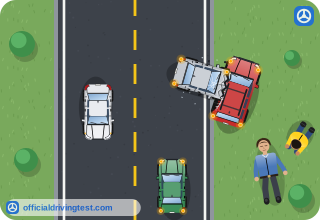
If an injured victim must be moved, what should you try to do?
- Lay the victim flat on the ground and raise the legs up high
- Sit the victim upright against the side of your vehicle
- Get help and keep the victim in the position he or she was found
- Carry the victim alone to the shoulder as quickly as possible
Show answer
Correct answer: Get help and keep the victim in the position he or she was found
If the victim is moved, get help and try to maintain the victim in the position in which he or she was found.
Source: Georgia Driver's Manual (2023-2024), page 50
-
What does Georgia's Good Samaritan Law do?
- It requires every driver to stop at every crash scene they pass
- It holds a person harmless for civil damages for giving emergency care
- It pays the medical bills of anyone who gives emergency care
- It forbids untrained people from giving emergency care at a crash
Show answer
Correct answer: It holds a person harmless for civil damages for giving emergency care
The Good Samaritan Law holds any person harmless for civil damages arising from an act or omission in rendering emergency care.
Source: Georgia Driver's Manual (2023-2024), page 50
-
After a crash on a multilane highway or expressway with no apparent serious injury or death, what is the duty of the drivers involved?
- Leave the vehicles exactly where they stopped until police arrive
- Wait for police in the traffic lane where the crash happened
- Push the vehicles into the nearest open travel lane
- Move the vehicles off the roadway to a safe location like the shoulder
Show answer
Correct answer: Move the vehicles off the roadway to a safe location like the shoulder
The drivers must move their vehicles to a safe location along the shoulder, emergency lane, median, or other safe refuge.
Source: Georgia Driver's Manual (2023-2024), page 50
-
Under what condition should drivers move their vehicles after a crash on a multilane highway?
- Only if the vehicles can be driven normally and no further hazard results
- Only if a police officer is present at the scene of the crash
- Only if neither vehicle has any damage and both look normal
- Only if the other driver agrees in writing before the move
Show answer
Correct answer: Only if the vehicles can be driven normally and no further hazard results
Drivers should move vehicles only if they can be driven normally and successfully and moving them presents no further hazard or harm.
Source: Georgia Driver's Manual (2023-2024), page 50
-
If the persons in a crash cannot move their vehicles, whom may they ask to move them?
- Only a police officer, or a tow truck operator who is called
- Any nearby passenger, even one who has no driver's license
- Any other nearby driver with a valid license of the right class
- Any nearby driver who holds only a learner's permit
Show answer
Correct answer: Any other nearby driver with a valid license of the right class
They may request any other driver in the vicinity with a valid license of the appropriate class to move their vehicles.
Source: Georgia Driver's Manual (2023-2024), page 50
-
What is the legal effect of moving vehicles after a crash as described in the manual?
- They are presumed to be at fault for moving the vehicles
- They are not considered at fault simply because they moved the vehicles
- They lose the ability to file a written report with police
- They can be accused of failing to stop and provide information
Show answer
Correct answer: They are not considered at fault simply because they moved the vehicles
Drivers who move vehicles are not considered at fault simply because of that, and moving does not affect their ability to file a written report.
Source: Georgia Driver's Manual (2023-2024), page 50
-
Automobile crash data from the Georgia Department of Transportation show that deer-automobile crashes account for what share of reported crashes each year?
- About twenty percent
- About ten percent
- More than half
- Less than six percent
Show answer
Correct answer: Less than six percent
Deer-automobile crashes are on the rise but account for less than six percent of reported automobile crashes each year.
Source: Georgia Driver's Manual (2023-2024), page 50
-
What might a deer standing calmly by the road do if it is startled by a car?
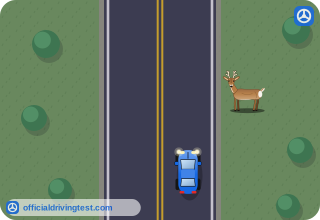
- Bolt toward the road rather than away from it
- Stay perfectly still until the car has passed it by
- Run away from the road and into the nearby woods
- Wait calmly for the car to come to a full stop
Show answer
Correct answer: Bolt toward the road rather than away from it
The manual notes that a deer calmly standing on the roadside may bolt toward the road if startled.
Source: Georgia Driver's Manual (2023-2024), page 50
-
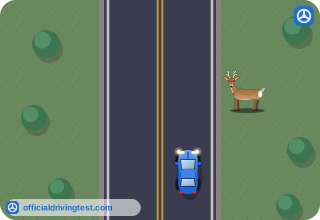
Why should you always slow down when a deer crosses the road in front of you or another car?
- Deer only ever cross the road one at a time and alone
- Deer slow down to match the speed of the vehicle passing by
- Deer usually travel in groups, so another is likely close behind
- Deer are attracted to the sound of fast-moving vehicles
Show answer
Correct answer: Deer usually travel in groups, so another is likely close behind
Deer usually travel in groups and it is likely that another deer is following close behind.
Source: Georgia Driver's Manual (2023-2024), page 50
-
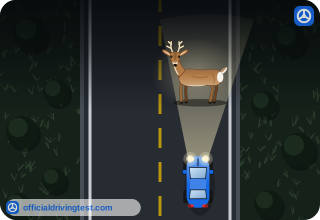
What should a driver do if a deer is spotted on the road or roadside at night?
- Speed up to pass the deer quickly before it can move
- Slow down immediately, blink the headlights and switch to low beam
- Switch to high beam and keep it on to watch the deer
- Turn off the headlights completely to avoid blinding the deer
Show answer
Correct answer: Slow down immediately, blink the headlights and switch to low beam
The driver should slow down, blink the headlights, and switch to low beam so as not to blind the deer.
Source: Georgia Driver's Manual (2023-2024), page 50
-
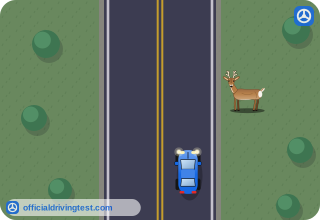
What may help scare a deer from the road?
- A long continuous horn blast
- Turning off the engine and waiting
- Stopping and getting out of the car
- Short horn blasts
Show answer
Correct answer: Short horn blasts
The manual says short horn blasts may help scare the deer from the road.
Source: Georgia Driver's Manual (2023-2024), page 50
-
What should you do if a deer or other animal runs out in front of your car?
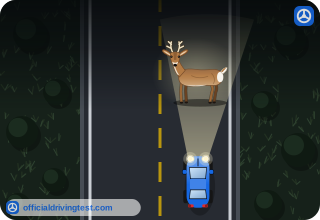
- Slow down as much as possible and never swerve
- Swerve quickly into the next lane to avoid it
- Swerve onto the shoulder to miss the animal
- Speed up to get past the animal quickly
Show answer
Correct answer: Slow down as much as possible and never swerve
Slow down as much as possible to minimize damage; swerving may cause you to strike another vehicle or leave the roadway.
Source: Georgia Driver's Manual (2023-2024), page 50
-
Why should police be alerted after a deer-automobile crash?
- Police must remove the deer from the roadway within one hour
- The law forbids touching the vehicle until the police arrive
- Most insurers require a police accident report before paying claims
- The state pays for the repairs only if there is a police report
Show answer
Correct answer: Most insurers require a police accident report before paying claims
Most insurance companies require an accident report from the police before paying claims for this type of crash.
Source: Georgia Driver's Manual (2023-2024), page 50
-
During which hours are deer usually seen along the roadside?
- Late morning and early afternoon
- Early morning and late evening
- Midday and mid-afternoon only
- Midnight to 3 a.m. only
Show answer
Correct answer: Early morning and late evening
Deer are usually seen along the roadside during the early morning hours and late evening.
Source: Georgia Driver's Manual (2023-2024), page 50
-
During which months are deer most active because of the peak breeding season?
- June, July and August
- January, February and March
- April, May and June
- October, November and December
Show answer
Correct answer: October, November and December
Deer are most active in the fall months of October, November and December during the peak breeding season.
Source: Georgia Driver's Manual (2023-2024), page 50
-
Why are late February and early March critical months for deer-car crashes?
- Deer gather along road shoulders to feed on new green food
- Deer migrate across roads to reach their summer range
- Deer are driven onto roads by flooding of their forest homes
- Deer are at the peak of their yearly breeding season
Show answer
Correct answer: Deer gather along road shoulders to feed on new green food
During this period deer concentrate along road shoulders to feed on new green food available following winter.
Source: Georgia Driver's Manual (2023-2024), page 50
-
When are deer often spotted at midday?
- During the winter months
- During the fall months only
- During the summer months
- During the early spring only
Show answer
Correct answer: During the summer months
The manual says deer are often spotted at midday during summer months.
Source: Georgia Driver's Manual (2023-2024), page 50
-
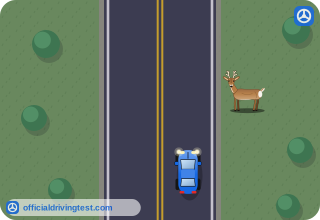
What should drivers do in areas with known deer populations?
- Drive only in the left lane of the road to stay away
- Constantly scan the road and shoulders for deer
- Drive with the high beams on at all times to see
- Stay close behind the vehicle ahead of you
Show answer
Correct answer: Constantly scan the road and shoulders for deer
In areas with known deer populations, drivers should constantly scan the road and shoulders for deer movements and sightings.
Source: Georgia Driver's Manual (2023-2024), page 50