Georgia: Emergencies and special situations — Part 2 Practice Test
Questions in this part include: “In a standard passenger car, partial hydroplaning can begin at speeds as low as what?” · “According to the manual, when does a car skid?”
Independent educational site · not affiliated with any government agency or DMV
Ready? Test yourself
- Instant feedback with an explanation
- Every answer cites its source in the manual
- Your best score is saved on this device
Questions are original and based on the official manual "Georgia Driver's Manual" (2023-2024), Georgia Department of Driver Services (DDS).
All 20 questions in this practice test
Take the test above first, then use this list to study. Tap “Show answer” to see the correct answer and explanation.
Show the questions and answersHide the questions
-
In a standard passenger car, partial hydroplaning can begin at speeds as low as what?
- 25 mph
- 45 mph
- 35 mph
- 55 mph
Show answer
Correct answer: 35 mph
The manual says partial hydroplaning can begin at speeds as low as 35 mph in a standard passenger car.
Source: Georgia Driver's Manual (2023-2024), page 38
-
At what speed may your tires lose all contact with the road when hydroplaning?
- 45 mph
- 55 mph
- 65 mph
- 75 mph
Show answer
Correct answer: 55 mph
The manual says that at 55 mph the tires may lose all contact with the road.
Source: Georgia Driver's Manual (2023-2024), page 38
-
If your tires lose all contact with the road while hydroplaning, what happens?
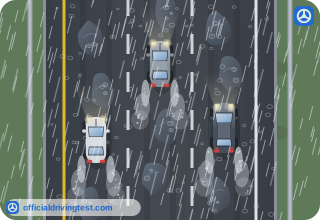
- There is no friction available to brake, accelerate, or steer
- Steering works normally, but braking and acceleration do not
- Braking still works normally, but steering and acceleration do not
- Only the front wheels lose friction, so you can still steer
Show answer
Correct answer: There is no friction available to brake, accelerate, or steer
The manual says that with no contact there is no friction available to brake, accelerate, or steer.
Source: Georgia Driver's Manual (2023-2024), page 38
-
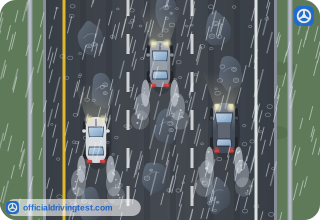
If your vehicle hydroplanes and goes into a skid, what should you do?
- Brake as hard as possible to regain contact with the road
- Accelerate gently to pull the car out of the water
- Take your foot off the accelerator and let the car slow down
- Steer sharply back and forth to shed the water
Show answer
Correct answer: Take your foot off the accelerator and let the car slow down
The manual says to take your foot off the accelerator, letting the car slow down.
Source: Georgia Driver's Manual (2023-2024), page 38
-
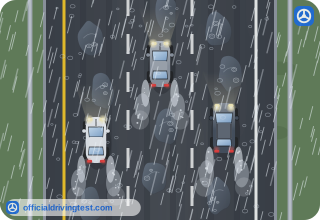
What is the most important way to prevent hydroplaning?
- Keep your tire pressure above the recommended level
- Slow down when there is water on the roadway
- Drive with your hazard lights on when the road is wet
- Drive on the shoulder where the water is shallow
Show answer
Correct answer: Slow down when there is water on the roadway
The manual says that, most importantly, you should slow down when there is water on the roadway.
Source: Georgia Driver's Manual (2023-2024), page 38
-
What kind of tires helps prevent hydroplaning?
- Tires inflated well above the recommended pressure
- Tires with worn tread that has been smoothed evenly
- Wide tires with the tread worn down evenly
- Good tires with adequate water-channeling tread
Show answer
Correct answer: Good tires with adequate water-channeling tread
The manual says to maintain good tires with adequate water-channeling tread.
Source: Georgia Driver's Manual (2023-2024), page 38
-
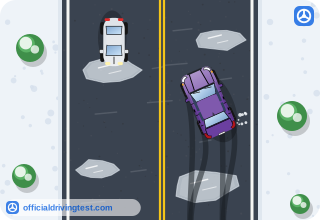
According to the manual, when does a car skid?
- When the engine sends too much power to the wheels
- When the brakes are applied for more than a few seconds
- When its tires lose their grip on the road surface
- When the steering wheel is held in one position
Show answer
Correct answer: When its tires lose their grip on the road surface
The manual says a car skids when its tires lose their grip on the road surface.
Source: Georgia Driver's Manual (2023-2024), page 38
-
What is lost when a car skids?
- Only the braking ability of the wheels; engine power to them remains
- The engine's power to the wheels and the wheels' braking ability
- Only engine power to the wheels; the brakes continue to work normally
- Nothing, because the wheels are still turning
Show answer
Correct answer: The engine's power to the wheels and the wheels' braking ability
The manual says that when a car skids, both the engine power sent to the wheels and the braking ability of the wheels are lost.
Source: Georgia Driver's Manual (2023-2024), page 38
-
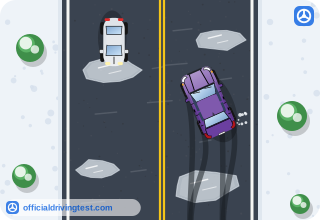
What can cause a skid?
- Easing your foot off the accelerator on a dry, paved road
- Keeping both hands on the wheel at the 9 and 3 o'clock positions
- Checking your mirrors and blind spot before changing lanes
- Applying the brakes too hard or turning the wheel too sharply
Show answer
Correct answer: Applying the brakes too hard or turning the wheel too sharply
The manual says a skid can occur if brakes are applied too hard or the wheel is turned too sharp.
Source: Georgia Driver's Manual (2023-2024), page 38
-
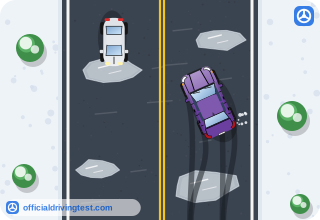
If you start to skid, what should you do with your foot?
- Ease your foot off of the accelerator
- Press the brake pedal firmly to the floor
- Press the accelerator harder to power out
- Pump the accelerator to regain grip
Show answer
Correct answer: Ease your foot off of the accelerator
The manual says that if you start to skid you should ease your foot off of the accelerator.
Source: Georgia Driver's Manual (2023-2024), page 38
-
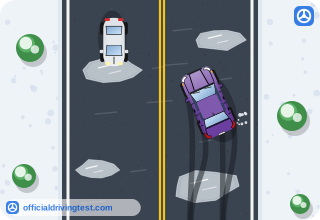
If you start to skid, which way should you begin turning the steering wheel?
- Away from the direction of the skid
- In the direction of the skid
- Toward the nearest shoulder
- Straight ahead, and hold the wheel still
Show answer
Correct answer: In the direction of the skid
The manual says to begin turning the steering wheel in the direction of the skid.
Source: Georgia Driver's Manual (2023-2024), page 38
-
During a skid, when can you lightly apply the brakes?
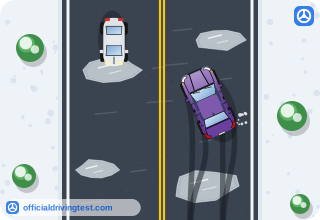
- As soon as the skid begins, before you steer
- Only after the car has come to a complete stop
- As soon as you ease off the accelerator
- Once you have regained control of the vehicle
Show answer
Correct answer: Once you have regained control of the vehicle
The manual says that once you have regained control of the vehicle you can lightly apply brakes and steer in a safe direction.
Source: Georgia Driver's Manual (2023-2024), page 38
-
Why is it difficult to safely maneuver a vehicle once it has left the roadway?
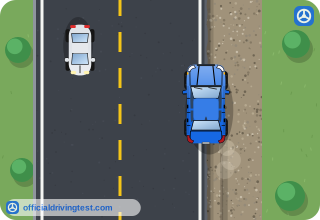
- Uneven terrain and obstacles
- The steering wheel locks up on soft ground
- The brakes stop working off the pavement
- Other drivers are required to stop for you
Show answer
Correct answer: Uneven terrain and obstacles
The manual says uneven terrain and obstacles make it difficult to maneuver safely once the vehicle has left the roadway.
Source: Georgia Driver's Manual (2023-2024), page 39
-
To avoid leaving the roadway, how fast should you drive?
- Slightly above the posted limit to keep up with traffic
- At whatever speed feels comfortable for road conditions
- At or below the speed shown on a regulatory or advisory sign
- At the speed of the fastest vehicle in your lane
Show answer
Correct answer: At or below the speed shown on a regulatory or advisory sign
The manual says to drive at or below the speed indicated on a regulatory sign or an advisory sign indicating potential hazards.
Source: Georgia Driver's Manual (2023-2024), page 39
-
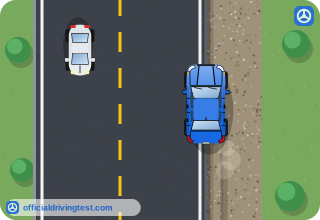
If your vehicle leaves the roadway, what should you do with the accelerator?
- Press it harder to regain speed
- Take your foot off it
- Pump it gently and repeatedly
- Hold it steady to keep your speed
Show answer
Correct answer: Take your foot off it
The manual says to take your foot off the accelerator if your vehicle leaves the roadway.
Source: Georgia Driver's Manual (2023-2024), page 39
-
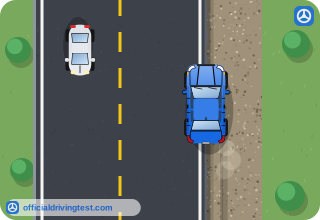
If your vehicle leaves the roadway, how should you hold the steering wheel?
- Hold it loosely with one hand so the wheel can move freely
- Let go briefly so the wheels can straighten themselves
- Turn it fully toward the pavement and hold it there
- Grip it tightly and be prepared to withstand sudden shocks
Show answer
Correct answer: Grip it tightly and be prepared to withstand sudden shocks
The manual says to grip the steering wheel tightly and be prepared to withstand sudden shocks.
Source: Georgia Driver's Manual (2023-2024), page 39
-
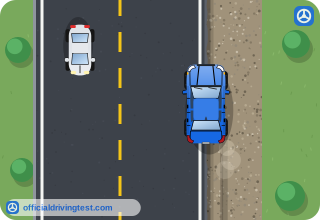
If your vehicle leaves the roadway, how should you use the brake pedal?
- Suddenly and hard, to stop as quickly as possible
- Not at all until the car stops rolling on its own
- Carefully, not suddenly and hard
- By pumping it rapidly until the car stops
Show answer
Correct answer: Carefully, not suddenly and hard
The manual says not to hit the brake pedal suddenly and hard, and to use your brakes carefully.
Source: Georgia Driver's Manual (2023-2024), page 39
-
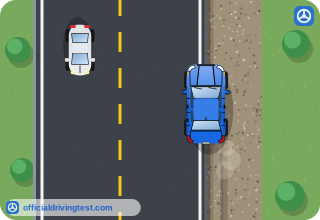
If your vehicle leaves the roadway, which of these should you NOT try to do?
- Take your foot off the accelerator
- Turn back onto the pavement immediately
- Grip the steering wheel tightly
- Check the traffic before returning
Show answer
Correct answer: Turn back onto the pavement immediately
The manual says not to turn back onto the pavement immediately, because overcompensating can cause a skid or a flip.
Source: Georgia Driver's Manual (2023-2024), page 39
-
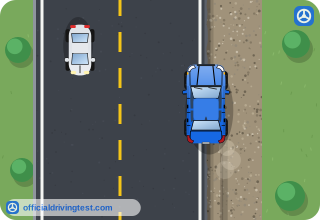
After leaving the roadway, what should you do before you return to it?
- Turn sharply back onto the pavement before other vehicles approach
- Stay on the shoulder until a law enforcement officer directs you back
- Accelerate along the shoulder until you pass the traffic ahead
- Wait until speed has reduced, check traffic, and find a safe place to merge
Show answer
Correct answer: Wait until speed has reduced, check traffic, and find a safe place to merge
The manual says to wait until your speed has reduced, check the traffic, and look for a safe place to return by merging, stopping completely first if necessary.
Source: Georgia Driver's Manual (2023-2024), page 39
-
What is a tire blow-out?
- A tire rupturing and going flat immediately
- A tire slowly losing air over time
- A sudden loss of brake fluid pressure
- A skid caused by hard braking on wet roads
Show answer
Correct answer: A tire rupturing and going flat immediately
The manual says a blow-out occurs when the tire ruptures and goes flat immediately, unlike a slow leak.
Source: Georgia Driver's Manual (2023-2024), page 39