Georgia: Emergencies and special situations — Part 1 Practice Test
Questions in this part include: “What kind of gas is carbon monoxide, which cars produce?” · “Driving with which of these can expose you to carbon monoxide?”
Independent educational site · not affiliated with any government agency or DMV
Ready? Test yourself
- Instant feedback with an explanation
- Every answer cites its source in the manual
- Your best score is saved on this device
Questions are original and based on the official manual "Georgia Driver's Manual" (2023-2024), Georgia Department of Driver Services (DDS).
All 20 questions in this practice test
Take the test above first, then use this list to study. Tap “Show answer” to see the correct answer and explanation.
Show the questions and answersHide the questions
-
What kind of gas is carbon monoxide, which cars produce?
- A harmless gas that smells of gasoline
- A visible gray gas with a sharp smell
- A deadly gas with no odor and no color
- A light gas that burns the eyes and throat
Show answer
Correct answer: A deadly gas with no odor and no color
The manual describes carbon monoxide as a deadly odorless and colorless gas.
Source: Georgia Driver's Manual (2023-2024), page 39
-
Which of these are symptoms of carbon monoxide poisoning?
- Sudden weariness, yawning, dizziness, and nausea
- Sudden hunger, sneezing, itching, and thirst
- Blurred vision, ringing ears, cough and chills
- Muscle cramps, sweating, fever, and sore throat
Show answer
Correct answer: Sudden weariness, yawning, dizziness, and nausea
The manual lists sudden weariness, yawning, dizziness, and nausea as symptoms.
Source: Georgia Driver's Manual (2023-2024), page 39
-
Which is a simple precaution to avoid carbon monoxide poisoning?
- Warm up the car in a closed garage before you leave
- Run the heater in a parked car with the windows closed
- Drive with a defective muffler only for short trips
- Do not leave the car motor running in a garage
Show answer
Correct answer: Do not leave the car motor running in a garage
One of the listed precautions is not leaving the car motor running in a garage.
Source: Georgia Driver's Manual (2023-2024), page 39
-
While the car is parked, which of these is unsafe because of carbon monoxide?
- Turning the engine off with the window closed
- Leaving the motor running with the window closed
- Leaving the motor off with the doors locked
- Parking in the shade with the engine off
Show answer
Correct answer: Leaving the motor running with the window closed
The manual says not to leave the car motor running and the window closed while the car is parked.
Source: Georgia Driver's Manual (2023-2024), page 39
-
When is it unsafe to operate the heater or air conditioner in a parked car?
- When the windows are closed
- When the windows are open
- When the car is facing uphill
- When the fuel tank is nearly empty
Show answer
Correct answer: When the windows are closed
The manual says not to operate the heater or air conditioner in a parked car with the windows closed.
Source: Georgia Driver's Manual (2023-2024), page 39
-
Driving with which of these can expose you to carbon monoxide?
- A worn windshield wiper and washer system
- A tire with low air pressure
- A defective muffler or exhaust system
- A dim or burned-out brake light
Show answer
Correct answer: A defective muffler or exhaust system
The manual lists driving with a defective muffler or exhaust system among the carbon monoxide hazards.
Source: Georgia Driver's Manual (2023-2024), page 39
-
What should you do for a victim of carbon monoxide poisoning?
- Keep them seated in the car with the windows closed to rest
- Move them to fresh air and contact emergency medical services
- Give them water and let them sleep in the vehicle
- Drive them home first, then call for emergency help
Show answer
Correct answer: Move them to fresh air and contact emergency medical services
The victim should be moved to fresh air and emergency medical services contacted, with artificial respiration if necessary and you are trained.
Source: Georgia Driver's Manual (2023-2024), page 40
-
When is stopping on the roadway shoulder of an expressway permitted?
- To switch drivers
- To stretch
- To retrieve an item from the back of the vehicle
- Only in an emergency
Show answer
Correct answer: Only in an emergency
Stopping on the shoulder is highly dangerous and permitted only in an emergency.
Source: Georgia Driver's Manual (2023-2024), page 41
-
If it is necessary to stop on an expressway, how should you indicate difficulty?
- Walk along the expressway to look for help
- Leave the hood closed and turn off all lights
- Raise the hood and activate your hazard lights
- Flash your high beams and sound the horn
Show answer
Correct answer: Raise the hood and activate your hazard lights
You should raise the hood and activate your hazard lights, and not walk along the expressway in search of help.
Source: Georgia Driver's Manual (2023-2024), page 41
-
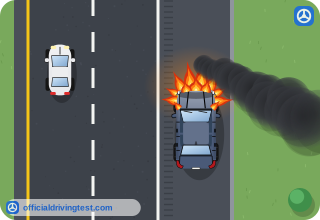
In the manual's "Other Highway Emergencies" chart, what can you apply to a fire?
- Engine oil from the dipstick
- Brake fluid from the reservoir
- Antifreeze from the radiator
- Mud, dirt, dust or snow
Show answer
Correct answer: Mud, dirt, dust or snow
For a fire, the chart says to apply mud, dirt, dust or snow.
Source: Georgia Driver's Manual (2023-2024), page 41
-
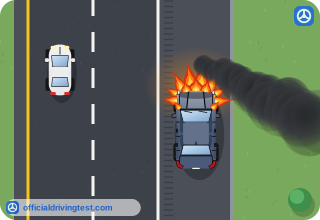
In the "Other Highway Emergencies" chart, what can you use to carry water to wet apparel when fighting a fire?
- Your hat
- A hub cap
- A floor mat
- A spare tire cover
Show answer
Correct answer: A hub cap
The chart says to use a hub cap to carry water to wet apparel.
Source: Georgia Driver's Manual (2023-2024), page 41
-
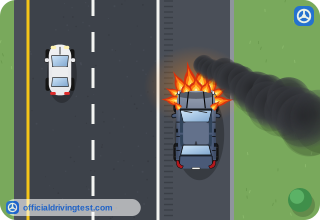
In the "Other Highway Emergencies" chart, what do you use to loosen dirt to throw on a fire?
- A tire tool
- A floor mat
- A windshield wiper
- A seat cushion
Show answer
Correct answer: A tire tool
The chart says to loosen dirt with a tire tool to throw on the fire.
Source: Georgia Driver's Manual (2023-2024), page 41
-
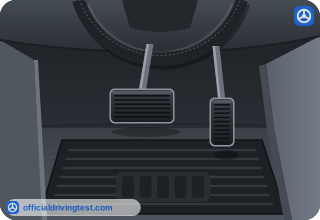
If your accelerator is jammed, what does the manual say to shift to?
- Park
- Reverse
- Neutral
- Drive
Show answer
Correct answer: Neutral
For a jammed accelerator, the chart lists shifting to neutral.
Source: Georgia Driver's Manual (2023-2024), page 41
-
If your accelerator is jammed, what does the manual say to do with the ignition?
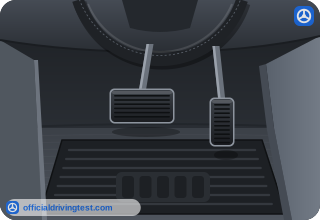
- Turn it to the lock position
- Turn it off, but not to the lock position
- Leave it on and pump the brakes
- Turn it off and remove the key at once
Show answer
Correct answer: Turn it off, but not to the lock position
The chart says to turn off the ignition, but not to the lock position.
Source: Georgia Driver's Manual (2023-2024), page 41
-
If your accelerator is jammed, what does the manual say to do with the pedal?
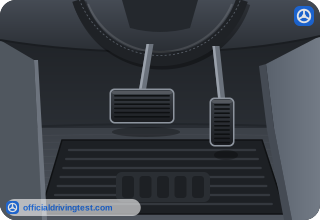
- Pull the pedal up with your hand
- Press the pedal down harder
- Pump the pedal quickly
- Slap the pedal with your foot
Show answer
Correct answer: Slap the pedal with your foot
The chart lists slapping the pedal with your foot as a step for a jammed accelerator.
Source: Georgia Driver's Manual (2023-2024), page 41
-
If your brakes fail, what does the manual say to shift to?
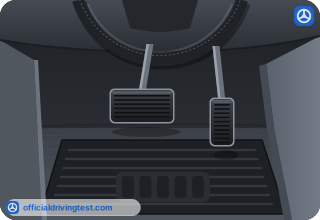
- Neutral
- Reverse
- A lower gear
- Park
Show answer
Correct answer: A lower gear
For brake failure, the chart says to shift to a lower gear.
Source: Georgia Driver's Manual (2023-2024), page 41
-
If your brakes fail, which of these does the manual list as a way to slow down?
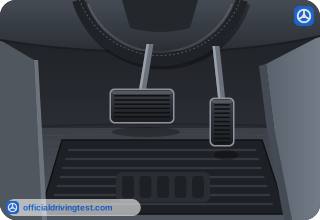
- Rub a tire on the curb
- Slap the pedal with your foot
- Shift to neutral
- Turn off the ignition
Show answer
Correct answer: Rub a tire on the curb
The chart lists rubbing a tire on the curb for brake failure.
Source: Georgia Driver's Manual (2023-2024), page 41
-
After driving through deep water, what should you do with your brakes?
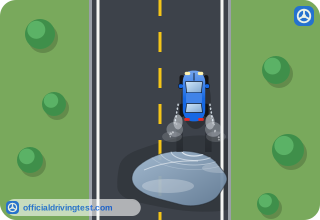
- Apply them hard at once
- Leave them alone until dry
- Pump them at high speed
- Test them lightly
Show answer
Correct answer: Test them lightly
The chart says to test brakes lightly after driving through deep water because they may pull to one side or not hold at all.
Source: Georgia Driver's Manual (2023-2024), page 41
-
How does the manual say to dry wet brakes?
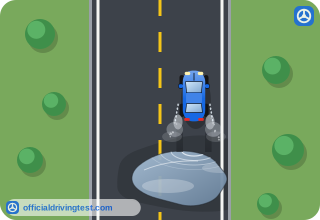
- Drive fast in high gear while pressing the brakes hard
- Drive slowly in low gear while applying the brakes lightly
- Park and wait until the brakes dry on their own
- Drive in neutral while pumping the brakes quickly
Show answer
Correct answer: Drive slowly in low gear while applying the brakes lightly
Wet brakes are dried by driving slowly in low gear while applying the brakes lightly.
Source: Georgia Driver's Manual (2023-2024), page 41
-
Hydroplaning occurs when there is what on a roadway?
- Standing water
- Loose gravel
- Black ice
- Fallen leaves
Show answer
Correct answer: Standing water
The manual says hydroplaning occurs when there is standing water on a roadway.
Source: Georgia Driver's Manual (2023-2024), page 38