Pavement markings in Florida
The Florida Driver License Handbook shows or names everything on this page: 15 in all, on pages 43–46, 69.
Independent educational site · not affiliated with any government agency or DMV
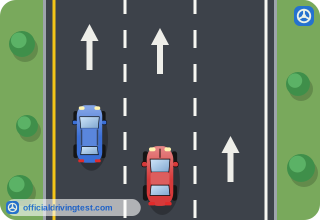
Edge lines and broken white lane line
Single solid white line. Marks the right edge of the roadway.
Manual page 43
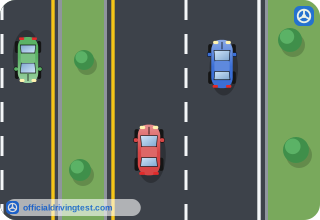
Solid yellow left edge line
Single solid yellow line. Marks the left edge of the roadway on divided highways and one-way streets.
Manual page 43
Broken white line
Single broken white line. You may cross this line to change lanes when it is safe to do so.
Manual page 43
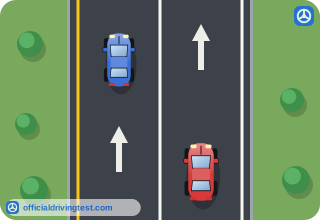
Solid white line
Single solid white line. You may travel in the same direction on both sides of this line, but do not cross the line unless you must do so to avoid a hazard. Also used to discourage lane changes near intersections.
Manual page 43
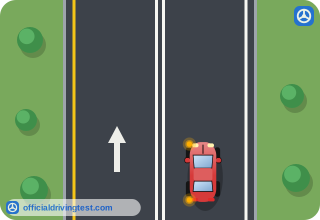
Double solid white lines
Double solid white lines. Crossing a double solid line/changing lanes is not allowed.
Manual page 43
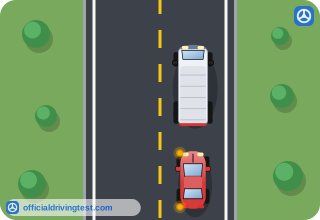
Broken yellow line
Single broken yellow line. Stay to the right of the line. You may cross this line to pass a car ahead of you only when it is safe to do so.
Manual page 43
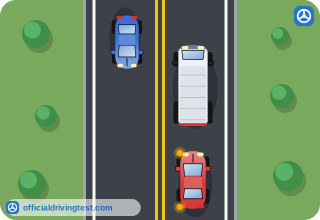
Double solid yellow lines
Double solid yellow lines. Vehicles moving in either direction must not pass/cross these lines. (May turn left or pass a bicyclist when it is safe to do so).
Manual page 44
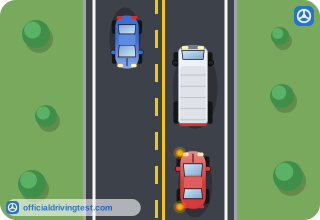
Double yellow: solid on your side, broken on far side
Double yellow lines–solid on right ("your side" of line), broken on left. Passing is not allowed in this lane. (May turn left or pass a bicyclist when it is safe to do so).
Manual page 44
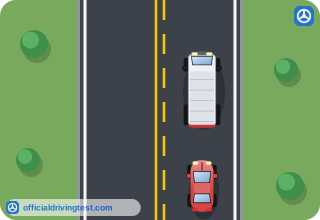
Double yellow: broken on your side, solid on far side
Double yellow lines–broken on right ("your side" of line), solid on left. Passing is permitted in this lane when safe to do so.
Manual page 44
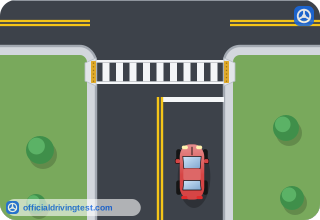
White stop line and crosswalk
Stop lines show where you must stop for a stop sign or red light. You must stop your vehicle before any part of it crosses the line before the crosswalk.
Manual page 45
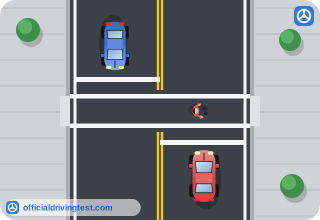
Marked crosswalk
Marked with solid white lines and sometimes filled with white diagonal or perpendicular lines. Shows where pedestrians should cross. Motorists must always yield the right-of-way to pedestrians in a crosswalk.
Manual page 45
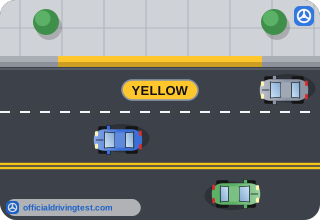
Yellow painted curb
Curbs are often marked yellow to indicate no parking zones near fire hydrants or intersections.
Manual page 46
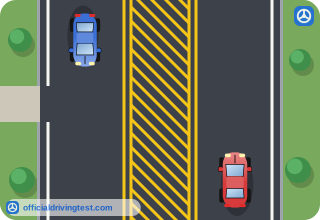
Diagonal stripe markings
Yellow or white diagonal stripes mark fixed obstructions (medians, no parking zones, etc.).
Manual page 46
Fire lane or safety zone marking
It's illegal to park in or drive through areas with pavement markings indicating fire lanes or safety zones.
Manual page 46
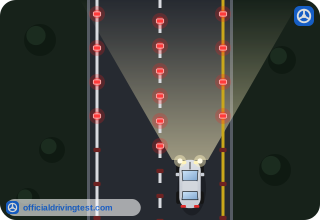
Red reflectors on lane lines
Red reflectors on lane lines always mean you are facing traffic the wrong way and could have a head-on collision. If you see red reflectors facing you on the lane lines, you are on the wrong side of the road. ... If you see red reflectors on the edge lines of the road, you are going the wrong way on an entrance or exit ramp.
Manual page 69