Florida: Pavement markings Practice Test
Yellow and white lane lines, yield lines, and what each one allows.
Independent educational site · not affiliated with any government agency or DMV
Ready? Test yourself
Answer to start, or tap Start below:
What is the purpose of pavement markings, such as lines, symbols, and words painted on roadways?
- Instant feedback with an explanation
- Every answer cites its source in the manual
- Your best score is saved on this device
- Keyboard: press 1 to 4 to answer and Enter for the next question
Questions are original and based on the official manual "Florida Driver License Handbook" (Revised August 2023), Florida Department of Highway Safety and Motor Vehicles (FLHSMV).
Did you know?
- Florida's handbook has a dedicated "Move Over Law" — drivers must slow down and, when possible, move over a lane for any stopped law enforcement, emergency, sanitation, utility, or tow/wrecker vehicle with its lights flashing.
More background reading from the manual →
All 30 questions in this practice test
Take the test above first, then use this list to study. Tap “Show answer” to see the correct answer and explanation.
Show the questions and answersHide the questions
-
What is the purpose of pavement markings, such as lines, symbols, and words painted on roadways?
- To show the speed limit in construction zones
- To help direct drivers and control traffic flow
- To mark areas of historical significance
- To indicate the location of gas stations and restaurants
Show answer
Correct answer: To help direct drivers and control traffic flow
Pavement markings—lines, symbols, and words painted on the road—are used to help direct drivers and control the flow of traffic.
Source: Florida Driver License Handbook (Revised August 2023), page 43
-
Unless you are turning, exiting a highway, or changing lanes, you should always stay between the lines marking your lane. When may a driver safely and briefly drive to the left of center of the roadway?
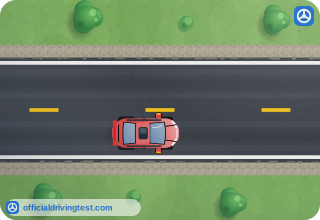
- To pass any vehicle traveling at the speed limit
- To reach a reversible lane more quickly
- To overtake a bicycle, electric bicycle, or pedestrian
- Whenever traffic is heavy
Show answer
Correct answer: To overtake a bicycle, electric bicycle, or pedestrian
Drivers may safely and briefly drive to the left of center of the roadway only to overtake a bicycle, other non-motorized vehicle, an electric bicycle, or a pedestrian.
Source: Florida Driver License Handbook (Revised August 2023), page 43
-
What does a single solid white line along the side of the road mark?
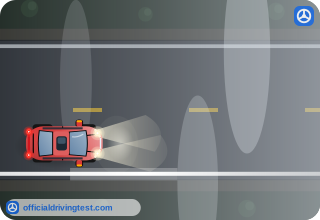
- A lane where passing is always permitted
- The right edge of the roadway
- The left edge of the roadway on divided highways
- The boundary of a shared-use bicycle lane
Show answer
Correct answer: The right edge of the roadway
A single solid white line along the side of the road marks the right edge of the roadway.
Source: Florida Driver License Handbook (Revised August 2023), page 43
-
What does a single solid yellow line mark?
- The left edge of divided highways and one-way streets
- A lane reserved only for passing slower vehicles
- The boundary of a marked crosswalk
- The right edge of the roadway
Show answer
Correct answer: The left edge of divided highways and one-way streets
A single solid yellow line marks the left edge of the roadway on divided highways and one-way streets.
Source: Florida Driver License Handbook (Revised August 2023), page 43
-
What do white lane lines indicate?
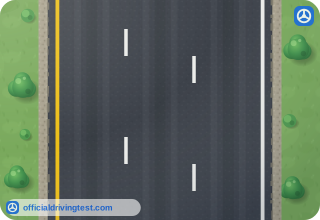
- They mark reversible lanes only
- They mark the edge of a bicycle lane only
- They separate lanes of traffic moving in the same direction
- They separate lanes of traffic moving in opposite directions
Show answer
Correct answer: They separate lanes of traffic moving in the same direction
White lane lines separate lanes of traffic moving in the same direction.
Source: Florida Driver License Handbook (Revised August 2023), page 43
-
What does a single broken white line between lanes mean?
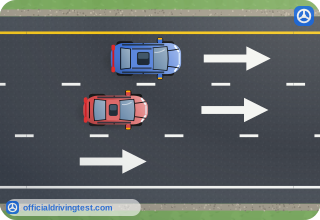
- You may cross this line to change lanes when it is safe to do so
- Crossing this line is never allowed
- Passing is permitted only in the lane to the left of this line
- You must stay to the right of this line at all times
Show answer
Correct answer: You may cross this line to change lanes when it is safe to do so
A single broken white line means you may cross it to change lanes when it is safe to do so.
Source: Florida Driver License Handbook (Revised August 2023), page 43
-
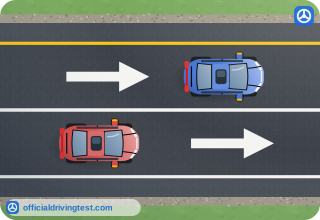
A single solid white line separating lanes moving in the same direction means you may travel on both sides of the line, but you should not cross it unless...
- You are within 500 feet of a service station
- A construction sign tells you to
- You are approaching a reversible lane
- You must do so to avoid a hazard
Show answer
Correct answer: You must do so to avoid a hazard
You may travel on both sides of a single solid white line, but should not cross it unless you must do so to avoid a hazard; it is also used to discourage lane changes near intersections.
Source: Florida Driver License Handbook (Revised August 2023), page 43
-
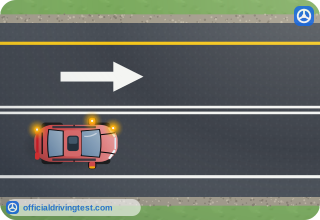
What do double solid white lines mean?
- You may cross to pass when it is safe
- You may cross only to make a left turn
- You may not cross them or change lanes
- They mark a shared-use bicycle lane
Show answer
Correct answer: You may not cross them or change lanes
Crossing a double solid white line or changing lanes across it is not allowed.
Source: Florida Driver License Handbook (Revised August 2023), page 43
-
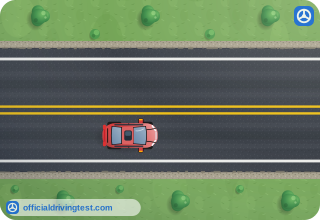
What do yellow lane lines indicate?
- They indicate a fire lane
- They mark the edge of the roadway only
- They separate lanes of traffic moving in opposite directions
- They separate lanes of traffic moving in the same direction
Show answer
Correct answer: They separate lanes of traffic moving in opposite directions
Yellow lane lines separate lanes of traffic moving in opposite directions.
Source: Florida Driver License Handbook (Revised August 2023), page 43
-
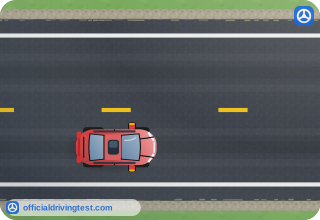
A single broken yellow line means you should stay to the right of the line. When may you cross it?
- Crossing it is never allowed
- Anytime you want to change lanes
- Only during rush hour
- To pass a car ahead when it is safe
Show answer
Correct answer: To pass a car ahead when it is safe
With a single broken yellow line, stay to the right of the line; you may cross it to pass a car ahead of you only when it is safe to do so.
Source: Florida Driver License Handbook (Revised August 2023), page 43
-
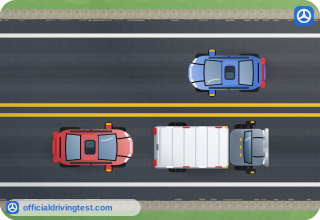
What do double solid yellow lines mean?
- They mark a reversible lane
- You may cross them freely to change lanes at any time of day
- Do not cross them, except to turn left or pass a bicyclist when safe
- Passing is allowed in one direction only
Show answer
Correct answer: Do not cross them, except to turn left or pass a bicyclist when safe
Vehicles moving in either direction must not pass or cross double solid yellow lines, though a driver may still turn left or pass a bicyclist when it is safe to do so.
Source: Florida Driver License Handbook (Revised August 2023), page 44
-
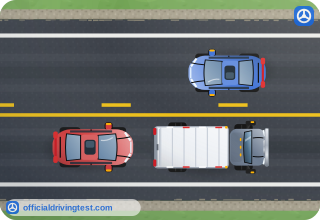
If double yellow lines have a solid line on your side and a broken line on the far side, what does this mean?
- Passing is permitted in your lane when it is safe
- The lane ahead is closed to all traffic
- You must come to a complete stop
- Passing is not allowed in your lane
Show answer
Correct answer: Passing is not allowed in your lane
When the double yellow line is solid on the right ('your side') and broken on the left, passing is not allowed in your lane (you may still turn left or pass a bicyclist when it is safe to do so).
Source: Florida Driver License Handbook (Revised August 2023), page 44
-
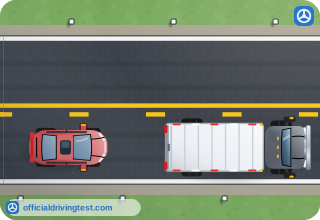
If double yellow lines are broken on your side and solid on the far side, what does this mean?
- The lane is reserved for bicycles only
- Passing is not allowed in your lane
- Passing is permitted in your lane when safe
- You must turn left ahead
Show answer
Correct answer: Passing is permitted in your lane when safe
When the double yellow line is broken on your side and solid on the left, passing is permitted in your lane when it is safe to do so.
Source: Florida Driver License Handbook (Revised August 2023), page 44
-
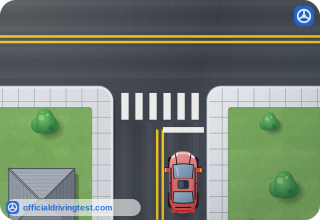
What are white stop lines used for?
- To show where pedestrians should cross the road
- To show where to stop for a stop sign or red light
- To mark the edge of the roadway
- To mark a reversible lane
Show answer
Correct answer: To show where to stop for a stop sign or red light
Stop lines show where you must stop for a stop sign or red light; you must stop your vehicle before any part of it crosses the line before the crosswalk.
Source: Florida Driver License Handbook (Revised August 2023), page 45
-
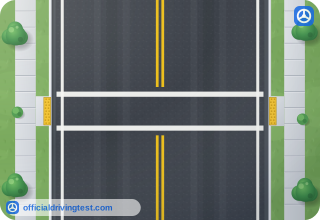
Marked crosswalks are shown with solid white lines and are sometimes filled with white diagonal or perpendicular lines. What must motorists always do?
- Stop only if a pedestrian signals with their hand
- Yield only during school hours
- Yield only when a crossing guard is present
- Yield the right-of-way to pedestrians in the crosswalk
Show answer
Correct answer: Yield the right-of-way to pedestrians in the crosswalk
Marked crosswalks are shown with solid white lines, sometimes filled with diagonal or perpendicular lines; motorists must always yield the right-of-way to pedestrians in a crosswalk.
Source: Florida Driver License Handbook (Revised August 2023), page 45
-
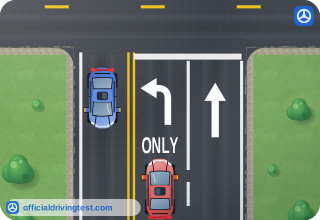
If a lane is marked with a curved arrow and the word 'ONLY', what must you do?
- You may go straight or turn, as you choose
- Stop and wait for a signal
- Turn in the direction of the arrow
- Use the lane only for passing
Show answer
Correct answer: Turn in the direction of the arrow
A lane marked with a curved arrow and the word 'ONLY' means you must turn in the direction of the arrow.
Source: Florida Driver License Handbook (Revised August 2023), page 45
-
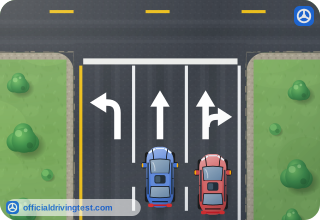
If a lane is marked with both a curved arrow and a straight arrow, what does this mean?
- You must go straight only
- You must turn in the direction of the arrow
- The lane may be used for passing only
- You may either turn or go straight
Show answer
Correct answer: You may either turn or go straight
A lane marked with both a curved and a straight arrow means you may either turn or go straight.
Source: Florida Driver License Handbook (Revised August 2023), page 45
-
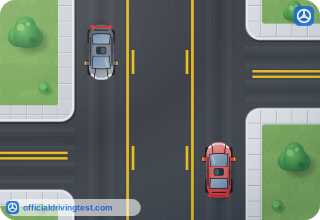
On a two-way roadway with a center lane, how may drivers from either direction use the center lane?
- For right turns only
- For left turns, but not for passing
- As a reversible high-occupancy lane
- For passing only
Show answer
Correct answer: For left turns, but not for passing
On a two-way roadway with a center lane, drivers from either direction may use the center lane for left turns, but must not use it for passing.
Source: Florida Driver License Handbook (Revised August 2023), page 45
-
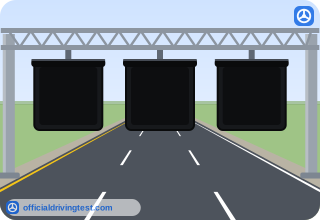
What are reversible lanes?
- Lanes reserved exclusively for bicycles
- Lanes marked only with double solid yellow lines
- Lanes that are permanently closed during rush hour
- Lanes whose direction is normally reversed at set times
Show answer
Correct answer: Lanes whose direction is normally reversed at set times
Some highways have reversible lanes to help handle rush-hour traffic; the direction of traffic is normally reversed at set times each day, and these lanes are marked with special pavement markings, lane signals, and signs.
Source: Florida Driver License Handbook (Revised August 2023), page 45
-
How is an exclusive bike lane marked?
- It is marked only with 'sharrows'
- Broken yellow lines separate it from motor vehicle lanes
- Solid white lines separate it from motor vehicle travel lanes
- It has no pavement markings at all
Show answer
Correct answer: Solid white lines separate it from motor vehicle travel lanes
An exclusive bike lane is separated from motor vehicle travel lanes by solid white lines, and is often marked with bike lane signs and symbols.
Source: Florida Driver License Handbook (Revised August 2023), page 45
-
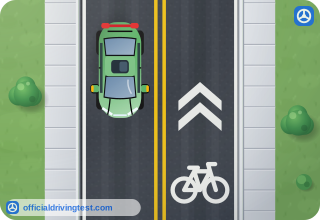
What is the purpose of 'sharrow' markings in a shared-use lane?
- To mark an exclusive bike lane separated by solid white lines
- To mark a fire lane
- To alert motorists that bicyclists may use the entire lane
- To indicate a reversible lane
Show answer
Correct answer: To alert motorists that bicyclists may use the entire lane
A shared-use lane is marked with 'sharrows,' which alert motorists that bicyclists may use the entire lane, indicate to bicyclists where to ride, and discourage bicycling in the wrong direction.
Source: Florida Driver License Handbook (Revised August 2023), page 45
-
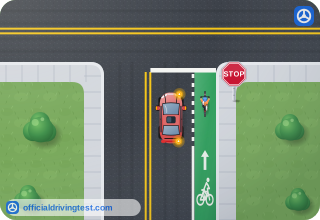
When may a motorized vehicle cross over a bicycle lane?
- Only when turning at an intersection with no bicyclists present
- Never, under any circumstances
- Only during rush hour
- At any time, as long as the driver signals and slows down
Show answer
Correct answer: Only when turning at an intersection with no bicyclists present
Motorized vehicles are not allowed to drive in bike lanes; they may cross over them when turning at intersections, but only when no bicyclists are present in the bike lane.
Source: Florida Driver License Handbook (Revised August 2023), page 45
-
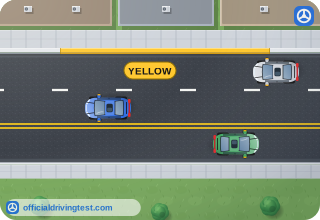
What does a yellow-marked curb usually indicate?
- A crosswalk for pedestrians
- A reversible lane
- A no parking zone
- A designated bicycle lane
Show answer
Correct answer: A no parking zone
Curbs are often marked yellow to indicate no parking zones near fire hydrants or intersections.
Source: Florida Driver License Handbook (Revised August 2023), page 46
-
What do yellow or white diagonal stripes on the pavement indicate?
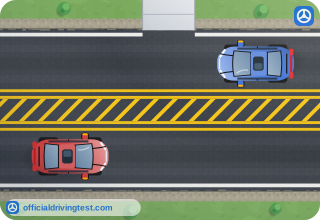
- A center turn lane
- A shared-use bicycle lane
- A reversible traffic lane
- Medians and no parking zones
Show answer
Correct answer: Medians and no parking zones
Yellow or white diagonal stripes mark fixed obstructions, such as medians and no parking zones.
Source: Florida Driver License Handbook (Revised August 2023), page 46
-
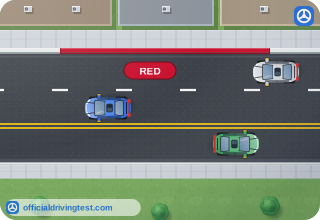
What does the law say about areas with pavement markings indicating fire lanes or safety zones?
- They are reserved exclusively for buses
- It is illegal to park in or drive through these areas
- Driving through is allowed, but parking is not
- Parking is allowed for up to 15 minutes
Show answer
Correct answer: It is illegal to park in or drive through these areas
It's illegal to park in or drive through areas with pavement markings indicating fire lanes or safety zones.
Source: Florida Driver License Handbook (Revised August 2023), page 46
-
On a two-lane highway, which lane must you always drive in, unless overtaking and passing?
- The center of the road, straddling both lanes
- Either lane, whichever has less traffic
- The left lane
- The right lane
Show answer
Correct answer: The right lane
On a two-lane highway you must always drive in the right lane unless you are overtaking and passing (where permitted).
Source: Florida Driver License Handbook (Revised August 2023), page 68
-
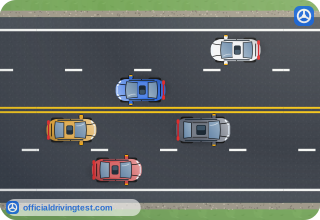
If a road has four or more lanes with two-way traffic, which lanes should you drive in, except when overtaking and passing?
- Any lane, chosen at random
- The center lane only
- The right lanes
- The left lanes
Show answer
Correct answer: The right lanes
If the road has four or more lanes with two-way traffic, drive in the right lanes except when overtaking and passing.
Source: Florida Driver License Handbook (Revised August 2023), page 69
-
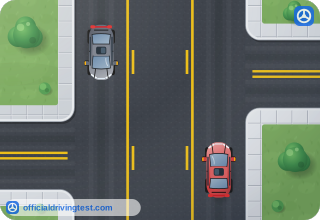
What is the center lane of a three-lane or five-lane highway used for?
- Only for parking
- Only for turning left
- Only for turning right
- Only for emergency vehicles
Show answer
Correct answer: Only for turning left
The center lane of a three-lane or five-lane highway is used only for turning left.
Source: Florida Driver License Handbook (Revised August 2023), page 69
-
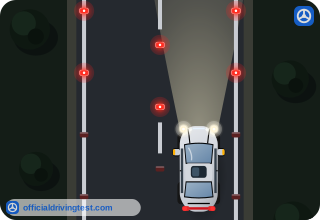
If you see red reflectors facing you on the lane lines, what does this mean, and what should you do?
- You are approaching a toll plaza; slow down and prepare to pay the toll
- You are on the wrong side of the road; turn around or get into the proper lane
- The road ahead is closed for construction; take the next exit ramp
- There is a school zone ahead; reduce speed to 20 MPH
Show answer
Correct answer: You are on the wrong side of the road; turn around or get into the proper lane
Red reflectors on lane lines always mean you are facing traffic the wrong way and could have a head-on collision. If you see red reflectors facing you on the lane lines, you are on the wrong side of the road. Turn around or get into the proper lane immediately.
Source: Florida Driver License Handbook (Revised August 2023), page 69
-
If you see red reflectors on the edge lines of the road, what does this mean, and what should you do?
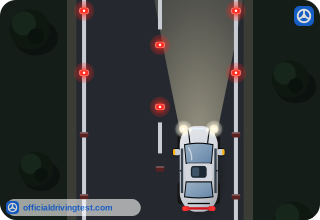
- You are going the wrong way on a ramp; pull over and turn around when safe
- A wildlife crossing is ahead; slow down and watch for animals
- You may park along the edge of the road with your hazard lights on
- The shoulder is closed for maintenance work; stay in your lane
Show answer
Correct answer: You are going the wrong way on a ramp; pull over and turn around when safe
If you see red reflectors on the edge lines of the road, you are going the wrong way on an entrance or exit ramp. Pull over immediately! Turn around when it is safe to do so.
Source: Florida Driver License Handbook (Revised August 2023), page 69