Florida: Right of way & turning Practice Test
Who goes first at intersections, and the rules for turning safely.
Independent educational site · not affiliated with any government agency or DMV
Ready? Test yourself
Answer to start, or tap Start below:
What is an open intersection?
- Instant feedback with an explanation
- Every answer cites its source in the manual
- Your best score is saved on this device
- Keyboard: press 1 to 4 to answer and Enter for the next question
Questions are original and based on the official manual "Florida Driver License Handbook" (Revised August 2023), Florida Department of Highway Safety and Motor Vehicles (FLHSMV).
All 22 questions in this practice test
Take the test above first, then use this list to study. Tap “Show answer” to see the correct answer and explanation.
Show the questions and answersHide the questions
-
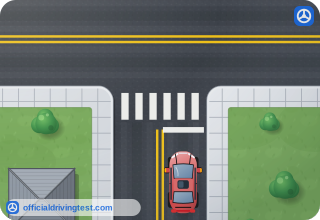
At an intersection marked with a stop line, after coming to a complete stop, who must you yield the right-of-way to?
- No one; you may proceed immediately after a complete stop
- Only vehicles turning left
- Only vehicles with their headlights on
- Traffic already in the intersection, and pedestrians and bicyclists
Show answer
Correct answer: Traffic already in the intersection, and pedestrians and bicyclists
After a complete stop, you must yield the right-of-way to traffic already in the intersection and to pedestrians and bicyclists, moving forward only when the road is clear.
Source: Florida Driver License Handbook (Revised August 2023), page 62
-
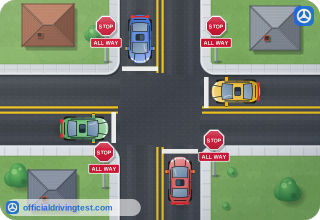
When vehicles have stopped at the stop lines of an intersection, in what order do they proceed?
- The largest vehicle always goes first
- In the order they arrived; the first to arrive should go first
- Vehicles turning right always go before vehicles going straight
- The vehicle honking its horn goes first
Show answer
Correct answer: In the order they arrived; the first to arrive should go first
Vehicles proceed through the intersection in the order they arrived; the first vehicle to reach the intersection should move forward first.
Source: Florida Driver License Handbook (Revised August 2023), page 62
-
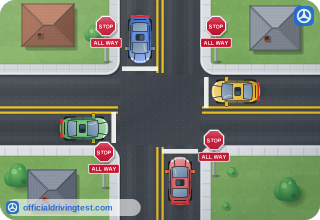
If vehicles arrive at an intersection at approximately the same time, who must each driver yield to?
- Whoever honks first
- The drivers on their right
- No one; all vehicles may proceed simultaneously
- The drivers on their left
Show answer
Correct answer: The drivers on their right
If vehicles arrive at approximately the same time, each driver must yield to the drivers on their right.
Source: Florida Driver License Handbook (Revised August 2023), page 62
-
At a two-way stop, who has the right-of-way?
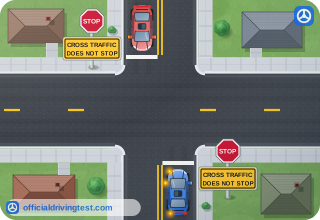
- The vehicle going straight has the right-of-way over the turning vehicle
- Whichever vehicle is larger
- The turning vehicle has the right-of-way over the vehicle going straight
- Whichever vehicle arrives second
Show answer
Correct answer: The vehicle going straight has the right-of-way over the turning vehicle
At a two-way stop, the turning vehicle yields to the vehicle going straight.
Source: Florida Driver License Handbook (Revised August 2023), page 62
-
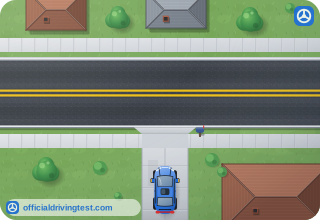
When entering a road from a driveway, alley, or roadside, who must you yield to?
- Only oncoming traffic, not pedestrians
- Only pedestrians, not other vehicles
- Vehicles already on the main road, plus pedestrians and bicyclists
- No one, since you have the right-of-way when entering from a driveway
Show answer
Correct answer: Vehicles already on the main road, plus pedestrians and bicyclists
Drivers entering a road from a driveway, alley, or roadside must yield to vehicles already on the main road, as well as to pedestrians and bicyclists on the sidewalk or in bike lanes.
Source: Florida Driver License Handbook (Revised August 2023), page 62
-
What is an open intersection?
- One found only inside a roundabout
- One with a traffic signal on every corner
- One that is closed to all traffic
- One without traffic control signs or signals
Show answer
Correct answer: One without traffic control signs or signals
An open intersection is one without traffic control signs or signals.
Source: Florida Driver License Handbook (Revised August 2023), page 62
-
At an open intersection, you must yield the right-of-way if you enter or cross a state highway from what type of road?
- A secondary road
- A one-way street only
- A limited access highway
- Another state highway of equal size
Show answer
Correct answer: A secondary road
At an open intersection, you must yield the right-of-way if you enter or cross a state highway from a secondary road, or if you enter a paved road from an unpaved road.
Source: Florida Driver License Handbook (Revised August 2023), page 62
-
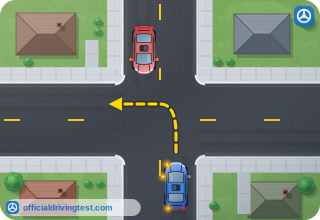
At an open intersection, if you plan to make a left turn and a vehicle is approaching from the opposite direction, what must you do?
- Speed up to complete the turn before the vehicle arrives
- Flash your headlights and proceed with the turn
- Yield the right-of-way to the approaching vehicle
- Sound your horn and proceed with the turn
Show answer
Correct answer: Yield the right-of-way to the approaching vehicle
At an open intersection, you must yield the right-of-way if you plan to make a left turn and a vehicle is approaching from the opposite direction.
Source: Florida Driver License Handbook (Revised August 2023), page 62
-
What is a roundabout, and which direction does traffic travel in it?
- A straight intersection used only for U-turns
- A circular intersection with no traffic signal; traffic travels counter-clockwise
- A rectangular intersection controlled by a traffic signal
- A circular intersection with a traffic signal, where traffic travels clockwise
Show answer
Correct answer: A circular intersection with no traffic signal; traffic travels counter-clockwise
A roundabout is a circular intersection with no traffic signal. Roundabouts travel in a one-way, counter-clockwise direction.
Source: Florida Driver License Handbook (Revised August 2023), page 63
-
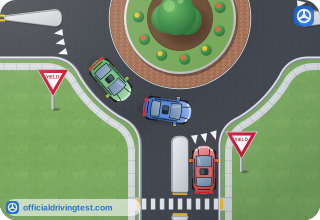
When entering a roundabout, when must you yield, and when may you enter without yielding?
- Traffic already in the roundabout must always yield to entering vehicles
- You never need to yield when entering a roundabout
- Yield to traffic already in the roundabout; if there is none, enter without yielding
- You must always yield, even if the roundabout is completely empty
Show answer
Correct answer: Yield to traffic already in the roundabout; if there is none, enter without yielding
Drivers entering the roundabout must yield to traffic already in the roundabout. If there is no traffic, you may enter without yielding.
Source: Florida Driver License Handbook (Revised August 2023), page 63
-
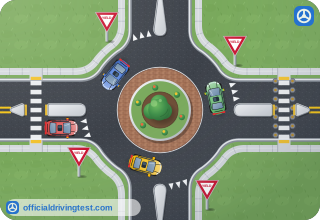
Which of the following is a correct rule for driving inside a roundabout?
- You may stop in the roundabout at any time to let pedestrians cross
- You are not required to signal before exiting a roundabout
- Do not change lanes or stop in the roundabout, and signal before exiting
- Changing lanes inside the roundabout is encouraged to find the fastest path
Show answer
Correct answer: Do not change lanes or stop in the roundabout, and signal before exiting
Do not change lanes in the roundabout, do not stop in a roundabout, and signal before exiting the roundabout.
Source: Florida Driver License Handbook (Revised August 2023), page 63
-
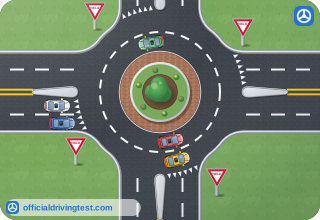
In a multi-lane roundabout, which lane should you use to go straight or turn left, or to make a U-turn?
- The left lane
- Either lane, chosen at random
- The shoulder
- The right lane
Show answer
Correct answer: The left lane
In a multi-lane roundabout, to go straight or left, and to make a U-turn, use the left lane. To go straight or right, use the right lane.
Source: Florida Driver License Handbook (Revised August 2023), page 63
-
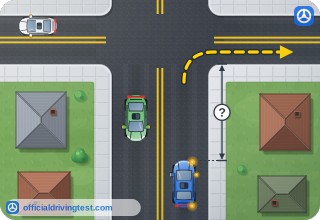
How far before making your turn must you give a turn signal?
- Signaling is only required after completing the turn
- At least 10 feet before making your turn
- At least 500 feet before making your turn
- At least 100 feet before making your turn
Show answer
Correct answer: At least 100 feet before making your turn
You must give a turn signal at least 100 feet BEFORE making your turn.
Source: Florida Driver License Handbook (Revised August 2023), page 69
-
Is it legal to use your directional signals to tell drivers behind you that they can pass?
- Yes, but only on limited access highways
- Yes, it is a common and legal courtesy
- Yes, but only at night
- No, it is against the law
Show answer
Correct answer: No, it is against the law
It's against the law to use your directional signals to tell drivers behind you that they can pass.
Source: Florida Driver License Handbook (Revised August 2023), page 69
-
If using hand signals instead of directional signals, from which side of the vehicle must they be given, and how does a bicyclist signal a right turn?
- Hand signals are never allowed in Florida
- Through the rear window only; a bicyclist points the left arm down
- From the left side; a bicyclist may hold the right arm out horizontally
- From the right side only; a bicyclist points the right arm down
Show answer
Correct answer: From the left side; a bicyclist may hold the right arm out horizontally
Hand signals must be given from the left side of the vehicle. A bicyclist may extend their right hand and arm horizontally from the right side of the bicycle for a right turn.
Source: Florida Driver License Handbook (Revised August 2023), page 69
-
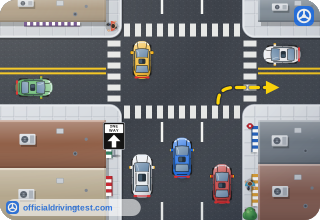
What are the first steps to turning a corner correctly?
- Turn off your turn signal before entering the intersection
- Slow down, get in the correct lane, and signal at least 100 feet ahead
- Speed up to clear the intersection quickly
- Move into the far-left lane regardless of your turn direction
Show answer
Correct answer: Slow down, get in the correct lane, and signal at least 100 feet ahead
Slow down to a safe turning speed, move into the correct lane as you near the intersection, and activate your turn signal at least 100 feet before making your turn, allowing time for drivers around you to see your signal before you move.
Source: Florida Driver License Handbook (Revised August 2023), page 69
-
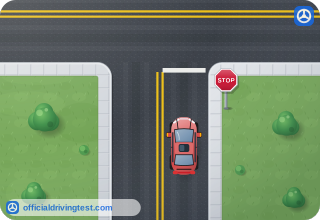
While turning, who must you yield to when crossing a bike lane or crosswalk?
- Only vehicles behind you
- No one, since you have already signaled your turn
- Bicyclists and pedestrians who may be crossing your path
- Only other vehicles turning the same direction
Show answer
Correct answer: Bicyclists and pedestrians who may be crossing your path
Yield to bicyclists when crossing a bike lane and to pedestrians who may be crossing your path.
Source: Florida Driver License Handbook (Revised August 2023), page 70
-
When finishing a turn, into which lane should you turn right, and what lane options are available for a left turn?
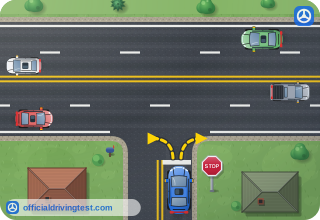
- Turn right into the right lane; a left turn may be completed in any lane lawfully available or safe
- It does not matter which lane you finish a turn in
- Both right and left turns must always finish in the center lane
- Turn right into the far-left lane; a left turn must always be completed in the right lane
Show answer
Correct answer: Turn right into the right lane; a left turn may be completed in any lane lawfully available or safe
Finish your turn in the proper lane. Turn right into the right lane of the roadway entered. A left turn may be completed in any lane lawfully available -- or safe -- for the desired direction of travel.
Source: Florida Driver License Handbook (Revised August 2023), page 70
-
If you reach an intersection where you wish to turn and are not in the proper lane, what should you do?
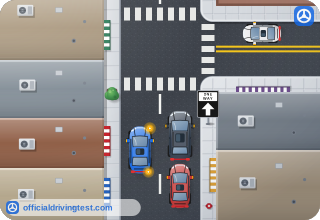
- Stop and reverse back until you can get into the correct lane
- Drive to the next intersection and turn from the proper lane
- Cut across multiple lanes quickly to make the turn
- Stop in the intersection and wait for a gap
Show answer
Correct answer: Drive to the next intersection and turn from the proper lane
Never make last minute turns. If you reach an intersection where you wish to turn and are not in the proper lane, drive to the next intersection and then make the turn from the proper lane.
Source: Florida Driver License Handbook (Revised August 2023), page 70
-
When should you use a three-point turn instead of a U-turn?
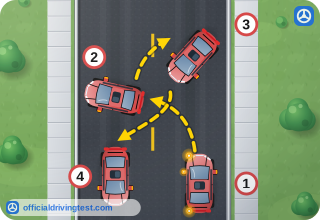
- Whenever you want to save time, no matter how wide the road may be
- Only when other vehicles are present to warn
- Only if the road is too narrow for a U-turn and you can't go around the block
- Only on limited access highways when you have missed your exit
Show answer
Correct answer: Only if the road is too narrow for a U-turn and you can't go around the block
Sometimes you will need to turn around in a very small space. Use a three-point turn only if the road is too narrow for a U-turn and you can't go around the block.
Source: Florida Driver License Handbook (Revised August 2023), page 70
-
What is the correct sequence of steps for making a three-point turn?
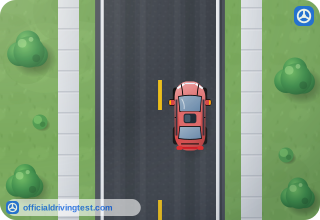
- Turn the wheel sharply right first and drive straight into oncoming traffic
- Move right, signal left, turn sharply left to the curb, back to the right curb, then drive forward
- Stay in drive the entire time and make a wide sweeping circle
- Shift to reverse first, back up at high speed, then shift to drive without stopping
Show answer
Correct answer: Move right, signal left, turn sharply left to the curb, back to the right curb, then drive forward
To make a three-point turn: move as far right as possible, check traffic, and signal a left turn, turning the wheel sharply left and moving forward slowly, then stop at the curb; shift to reverse, turn your wheels sharply to the right, check traffic, and back your vehicle to the right curb; then shift the vehicle into drive and pull forward carefully.
Source: Florida Driver License Handbook (Revised August 2023), page 70
-
Where should you never make a three-point turn or a U-turn?
- On a quiet residential street with no signs
- On a curve, on a hill, or on the highway
- In an empty parking lot
- In a cul-de-sac
Show answer
Correct answer: On a curve, on a hill, or on the highway
Never make a three-point turn or a U-turn on a curve, a hill, the highway, or where there is a sign that prohibits U-turns.
Source: Florida Driver License Handbook (Revised August 2023), page 70