Florida: Railroad crossings Practice Test
Safety rules for crossing train tracks.
Independent educational site · not affiliated with any government agency or DMV
Ready? Test yourself
Answer to start, or tap Start below:
What is the Advance Warning Sign at a railroad crossing?
- Instant feedback with an explanation
- Every answer cites its source in the manual
- Your best score is saved on this device
- Keyboard: press 1 to 4 to answer and Enter for the next question
Questions are original and based on the official manual "Florida Driver License Handbook" (Revised August 2023), Florida Department of Highway Safety and Motor Vehicles (FLHSMV).
Did you know?
- Florida's handbook has a dedicated "Move Over Law" — drivers must slow down and, when possible, move over a lane for any stopped law enforcement, emergency, sanitation, utility, or tow/wrecker vehicle with its lights flashing.
More background reading from the manual →
All 12 questions in this practice test
Take the test above first, then use this list to study. Tap “Show answer” to see the correct answer and explanation.
Show the questions and answersHide the questions
-
When approaching a highway-railroad crossing, you should slow down, be ready to stop, and avoid stopping on the tracks or within how many feet of the crossing?
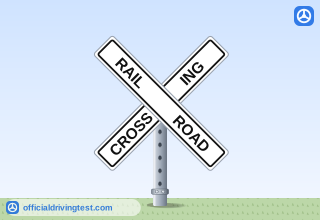
- 15 feet
- 10 feet
- 50 feet
- 30 feet
Show answer
Correct answer: 15 feet
When approaching a highway-railroad crossing, slow down and be ready to stop; do not stop on the tracks or within 15 feet of the crossing.
Source: Florida Driver License Handbook (Revised August 2023), page 56
-
A driver, bicyclist, or pedestrian approaching a railroad crossing must stop if which of the following is true?
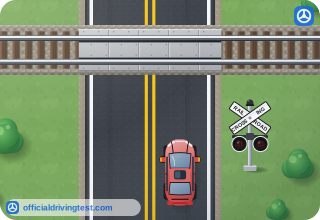
- Only if the crossing gate is fully lowered across your lane of the road, and at no other time.
- If devices flash, the gate is lowered, a flagger warns of an approaching train, or one is clearly visible.
- Only during daylight hours, when visibility along the tracks is good.
- Only if a train is sounding its horn continuously as it approaches.
Show answer
Correct answer: If devices flash, the gate is lowered, a flagger warns of an approaching train, or one is clearly visible.
Anyone approaching a railroad crossing must stop if warning devices are flashing, the gate is lowered, a flagger is warning of a train, or a train is clearly visible.
Source: Florida Driver License Handbook (Revised August 2023), page 56
-
What is the Advance Warning Sign at a railroad crossing?
- Usually the first sign you see when approaching a highway-railroad crossing.
- A sign indicating the number of tracks at the crossing.
- A sign with flashing red lights and bells requiring an immediate stop.
- A yield-shaped sign telling you to yield the right-of-way to trains.
Show answer
Correct answer: Usually the first sign you see when approaching a highway-railroad crossing.
The Advance Warning Sign is usually the first sign you see when approaching a highway-railroad crossing.
Source: Florida Driver License Handbook (Revised August 2023), page 56
-
What does the Crossbuck Sign at a railroad crossing mean?
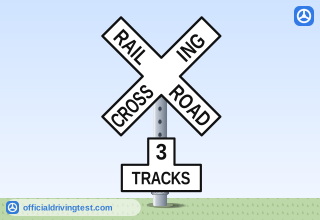
- It is a yield sign; you must yield the right-of-way to trains.
- It is the first warning sign you see before reaching the crossing.
- It means trains must yield the right-of-way to traffic on the road.
- It marks the danger zone where vehicles must not stop.
Show answer
Correct answer: It is a yield sign; you must yield the right-of-way to trains.
The Crossbuck Sign is a yield sign; you must yield the right-of-way to trains, and a sign below it shows the number of tracks if there is more than one.
Source: Florida Driver License Handbook (Revised August 2023), page 56
-
What should you do when the flashing red lights at a railroad crossbuck begin to flash?
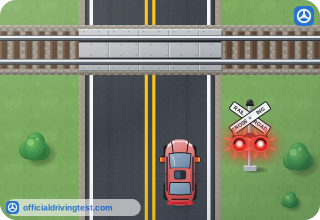
- Stop immediately — a train is approaching.
- Proceed with caution if no train is visible.
- Slow down and prepare to yield to trains.
- Continue driving because the gate has not yet lowered.
Show answer
Correct answer: Stop immediately — a train is approaching.
When the flashing red lights at a crossbuck begin to flash, stop immediately because a train is approaching.
Source: Florida Driver License Handbook (Revised August 2023), page 56
-
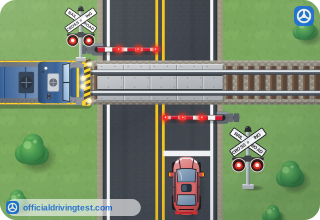
Which of the following is true about railroad crossing gates?
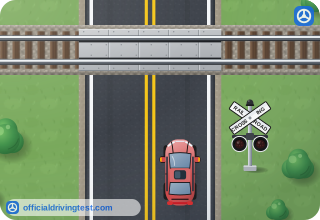
- Gates use only white lights, not red lights.
- It is legal to drive under a gate while it is being raised.
- You may drive around a lowered gate if no train is visible.
- Stop before the gate lowers, and never drive around or under it.
Show answer
Correct answer: Stop before the gate lowers, and never drive around or under it.
Many crossings have gates with flashing red lights and bells; stop when the lights flash and before the gate lowers. It is against the law to drive around or under a gate, whether it is down or being opened or closed.
Source: Florida Driver License Handbook (Revised August 2023), page 56
-
Where may pavement markings for a railroad crossing be painted?
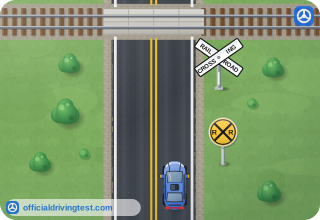
- Only on the shoulder of the road, never in the travel lanes.
- Directly on top of the Crossbuck Sign.
- Only on the far side of the tracks.
- On the paved approach to the crossing, before the stop line.
Show answer
Correct answer: On the paved approach to the crossing, before the stop line.
Pavement markings may be painted on the paved approach to a railroad crossing, before the stop line.
Source: Florida Driver License Handbook (Revised August 2023), page 56
-
What is a Dynamic Envelope at a railroad crossing?
- White X-shaped markings that show the danger zone where you should not stop.
- A yellow warning sign posted on the roadside well before the crossing.
- The flashing red lights and bells mounted on the Crossbuck Sign.
- A metal fence that keeps vehicles off the tracks when a train passes.
Show answer
Correct answer: White X-shaped markings that show the danger zone where you should not stop.
The Dynamic Envelope is made up of white roadway markings shaped like connecting X's marking the danger zone; any object inside it could be struck when a train passes.
Source: Florida Driver License Handbook (Revised August 2023), page 56
-
Why should you be prepared to stop when following a bus or truck near a railroad crossing?
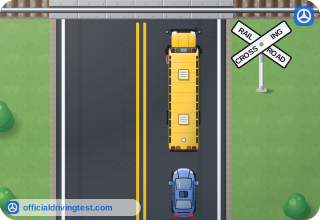
- Buses and trucks always have the right-of-way over trains.
- Gates automatically lower whenever a bus or truck approaches the tracks.
- Buses and trucks are exempt from stopping at railroad crossings.
- Many of them must stop even when the gates are up and lights are not flashing.
Show answer
Correct answer: Many of them must stop even when the gates are up and lights are not flashing.
Many buses and trucks are required to stop at railroad crossings even when gates are up and lights are not flashing, so be prepared to stop if you are following them.
Source: Florida Driver License Handbook (Revised August 2023), page 57
-
If a railroad crossing has more than one track, what should you do before crossing?
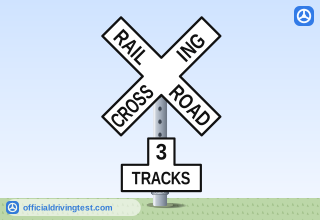
- Only check the track closest to your vehicle.
- Wait for a flagger even if no warning devices are active.
- Cross as soon as the nearest track is clear.
- Make sure all tracks are clear before crossing.
Show answer
Correct answer: Make sure all tracks are clear before crossing.
If there is more than one track, make sure all tracks are clear before crossing.
Source: Florida Driver License Handbook (Revised August 2023), page 57
-
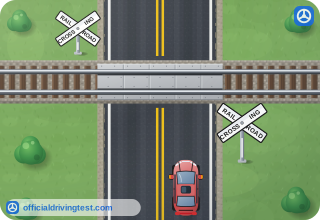
In heavy traffic, what should you confirm before crossing railroad tracks?
- That the gate has fully opened.
- That all tracks have flashing lights activated.
- That the flagger has left the area.
- That there is room for your vehicle on the other side.
Show answer
Correct answer: That there is room for your vehicle on the other side.
In heavy traffic, make sure there is room for your vehicle on the other side of the track before crossing.
Source: Florida Driver License Handbook (Revised August 2023), page 57
-
Why should you never try to "beat the train" at a crossing?
- Trains can stop within 15 feet once the engineer sees a vehicle.
- Trains travel slower than they appear, so there is usually enough time.
- Trains always stop automatically for approaching vehicles.
- Trains often travel faster than they appear and cannot stop quickly.
Show answer
Correct answer: Trains often travel faster than they appear and cannot stop quickly.
Trains often travel faster than they appear and cannot stop quickly; don't try to beat the train, because the train always wins.
Source: Florida Driver License Handbook (Revised August 2023), page 57