Florida: Freeway driving Practice Test
Merging, exiting, passing, and highway driving rules.
Independent educational site · not affiliated with any government agency or DMV
Ready? Test yourself
Answer to start, or tap Start below:
When leaving a limited access highway, from which lane are most exits taken, and what should you activate?
- Instant feedback with an explanation
- Every answer cites its source in the manual
- Your best score is saved on this device
- Keyboard: press 1 to 4 to answer and Enter for the next question
Questions are original and based on the official manual "Florida Driver License Handbook" (Revised August 2023), Florida Department of Highway Safety and Motor Vehicles (FLHSMV).
All 13 questions in this practice test
Take the test above first, then use this list to study. Tap “Show answer” to see the correct answer and explanation.
Show the questions and answersHide the questions
-
When entering a limited access highway, what should you do on the entrance ramp?
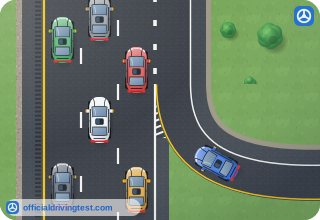
- Begin checking for an opening in traffic and signal your intent to merge
- Turn on your hazard lights and drive slowly on the shoulder
- Reverse back onto the surface street if traffic looks heavy
- Come to a complete stop and wait for a police officer to wave you on
Show answer
Correct answer: Begin checking for an opening in traffic and signal your intent to merge
On the entrance ramp, begin checking for an opening in traffic and signal your intent to merge onto the highway.
Source: Florida Driver License Handbook (Revised August 2023), page 63
-
What should you do to your speed as the entrance ramp straightens into the acceleration lane?
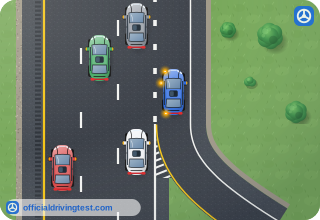
- Turn on your hazard lights and maintain a constant slow speed
- Decrease your speed to 10 MPH
- Come to a complete stop
- Increase your speed
Show answer
Correct answer: Increase your speed
Increase your speed as the ramp straightens into the acceleration lane, then adjust your speed to safely merge into traffic when you reach the end of the acceleration lane.
Source: Florida Driver License Handbook (Revised August 2023), page 63
-
When merging onto a limited access highway, who has the right-of-way, and when may you stop in the acceleration lane?
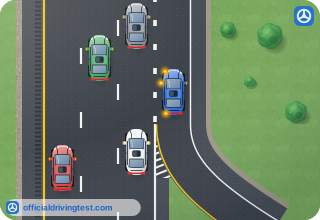
- Traffic on the highway has the right-of-way; stop only if there is no space to enter safely
- You always have the right-of-way when merging, so highway traffic must yield to you
- Neither driver has the right-of-way; it is decided by whoever flashes their lights first
- You may stop in the acceleration lane whenever you like to check your phone
Show answer
Correct answer: Traffic on the highway has the right-of-way; stop only if there is no space to enter safely
Merge into traffic when you can do so safely; you must yield the right-of-way to traffic on the highway. Do not stop in the acceleration lane unless traffic is too heavy and there is no space for you to enter safely.
Source: Florida Driver License Handbook (Revised August 2023), page 63
-
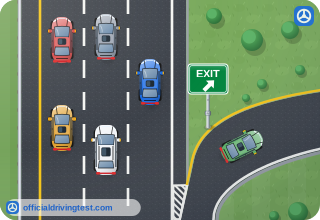
When leaving a limited access highway, from which lane are most exits taken, and what should you activate?
- Exits can be from any lane; no signal is required
- Most exits are from the right lane; activate your turn signal
- Most exits are from the left lane; activate your headlights
- Most exits are from the center lane; activate your hazard lights
Show answer
Correct answer: Most exits are from the right lane; activate your turn signal
When leaving a limited access highway, get into the exit lane -- most exits are from the right lane -- and activate your turn signal to show your intention to exit.
Source: Florida Driver License Handbook (Revised August 2023), page 64
-
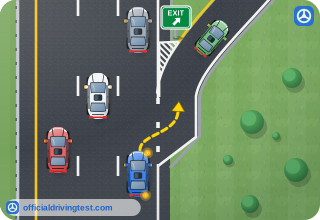
What should you do in the deceleration lane when leaving a limited access highway?
- Turn off your headlights
- Accelerate to highway speed before reaching the exit ramp
- Slow down and check the posted safe speed for the exit ramp
- Change lanes back onto the highway
Show answer
Correct answer: Slow down and check the posted safe speed for the exit ramp
Slow down in the deceleration lane and check the posted safe speed for the exit ramp.
Source: Florida Driver License Handbook (Revised August 2023), page 64
-
If you pass the exit you intended to take on a limited access highway, what should you do?
- Cross the median to reach the exit
- Stop immediately on the highway and back up to the exit
- Make a sharp last-minute turn into the exit lane
- Go to the next exit; never make a last-minute turn into an exit
Show answer
Correct answer: Go to the next exit; never make a last-minute turn into an exit
Don't make last-minute turns into an exit. If you pass your exit, you must go to the next one.
Source: Florida Driver License Handbook (Revised August 2023), page 64
-
According to the handbook, what do highway exits match in Florida, so you can plan ahead?
- The number of toll booths
- The speed limit posted on the highway
- The mile markers on the highway
- The number of lanes on the highway
Show answer
Correct answer: The mile markers on the highway
Plan ahead and know your exits. In Florida, exits match the mile markers on the highway.
Source: Florida Driver License Handbook (Revised August 2023), page 64
-
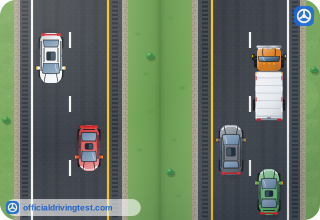
On a limited access highway, in which lane should you drive, and on which side should you pass?
- Drive in any lane and pass on either side
- Drive in the center lane at all times
- Drive in the right lane and pass on the left
- Drive in the left lane and pass on the right
Show answer
Correct answer: Drive in the right lane and pass on the left
Drive in the right lane and pass on the left. While in the right lane, watch for cars entering the highway and adjust your speed or move over so they can enter safely.
Source: Florida Driver License Handbook (Revised August 2023), page 64
-
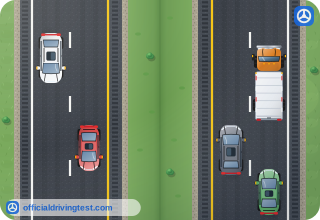
According to the handbook, what should you never do involving the median of a limited access highway?
- Never plant vegetation on the median
- Never allow the median to be visible from your mirrors
- Never look at the median while driving
- Never drive across or park on the median
Show answer
Correct answer: Never drive across or park on the median
Never drive across or park on the median.
Source: Florida Driver License Handbook (Revised August 2023), page 64
-
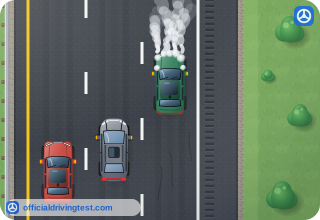
If your vehicle breaks down on a limited access highway, what must you do, and within how many hours?
- Leave it on the shoulder indefinitely until help arrives
- Leave it exactly where it stopped, even on the pavement
- Move it completely off the pavement, no more than six hours
- Move it to the median and leave it there
Show answer
Correct answer: Move it completely off the pavement, no more than six hours
Never stop on the pavement, shoulder, or connecting ramp except in an emergency. If your vehicle breaks down, you must move it completely off the pavement, no more than six hours.
Source: Florida Driver License Handbook (Revised August 2023), page 64
-
What does the handbook say is the greatest danger on limited access highways?
- Vehicles running out of fuel
- Flat tires from potholes
- Drivers using their turn signals too often
- Rear-end collisions from following too closely
Show answer
Correct answer: Rear-end collisions from following too closely
Don't follow too closely. Rear-end collisions are the greatest danger on limited access highways.
Source: Florida Driver License Handbook (Revised August 2023), page 65
-
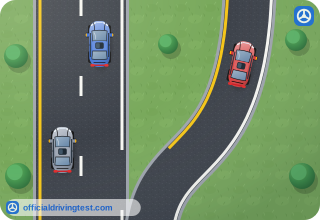
You should never back up on an entrance or exit ramp, except in what situation?
- Whenever traffic behind you is moving slowly and you missed your exit
- If another driver behind you flashes headlights or signals you to back up
- If you see a WRONG WAY or DO NOT ENTER sign, or red reflectors on lane lines
- If you are running late for an appointment and the ramp looks clear
Show answer
Correct answer: If you see a WRONG WAY or DO NOT ENTER sign, or red reflectors on lane lines
Never back up on an entrance ramp or exit ramp. The ONLY exception to this is if you see a WRONG WAY or DO NOT ENTER sign or red reflectors on lane lines; you must back up or turn around.
Source: Florida Driver License Handbook (Revised August 2023), page 65
-
Who may use High Occupancy Vehicle (HOV) lanes, and what do hybrid or low emission vehicles (LEV) require to use them?
- Only motorcycles; hybrid and low emission vehicles may never use them
- Vehicles with two or more occupants, or LEVs with a decal and Form 83027
- Any single-occupant vehicle, and LEVs need no decal or form at all
- Only commercial trucks; LEVs need just a toll transponder
Show answer
Correct answer: Vehicles with two or more occupants, or LEVs with a decal and Form 83027
Some highways reserve the left lane for vehicles with two or more occupants or hybrid/low emission vehicles (LEV). LEVs require a decal and completion of FLHSMV Form 83027.
Source: Florida Driver License Handbook (Revised August 2023), page 69