Washington, D.C.: Road signs — Part 1 Practice Test
Questions in this part include: “What must you be able to do with highway signs?” · “What background colors do advisory speed signs have?”
Independent educational site · not affiliated with any government agency or DMV
Ready? Test yourself
Answer to start, or tap Start below:
What must you be able to do with highway signs?
- Instant feedback with an explanation
- Every answer cites its source in the manual
- Your best score is saved on this device
- Keyboard: press 1 to 4 to answer and Enter for the next question
Questions are original and based on the official manual "District of Columbia Driver Manual" (Updated January 2024), District of Columbia Department of Motor Vehicles (DC DMV).
All 20 questions in this practice test
Take the test above first, then use this list to study. Tap “Show answer” to see the correct answer and explanation.
Show the questions and answersHide the questions
-
What must you be able to do with highway signs?
- Recognize only the regulatory ones
- Read and explain all of them
- Describe only the local signs
- Memorize the number of each sign
Show answer
Correct answer: Read and explain all of them
The manual says you must be able to read and explain all highway signs.
Source: District of Columbia Driver Manual (Updated January 2024), page 20
-
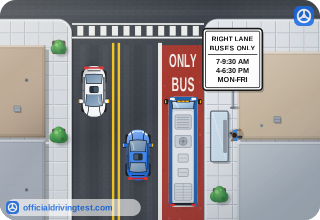
A sign beside a lane reads “RIGHT LANE, BUSES ONLY” followed by a range of hours and days. What do the days and times on a bus lane sign tell you?
- How long a bus may wait in the lane
- Where the next bus stop is
- How many buses may use the lane at once
- When the bus lane is in effect
Show answer
Correct answer: When the bus lane is in effect
Posted signage shows the days and times the Bus Lane is in effect, because some lanes are managed for specific periods of the day.
Source: District of Columbia Driver Manual (Updated January 2024), page 39
-
What colors does a speed limit sign have?
- Black letters and numerals on a yellow rectangular background
- Black letters and numerals on a white rectangular background
- Black letters and numerals on an orange rectangular background
- White letters on a green rectangular background
Show answer
Correct answer: Black letters and numerals on a white rectangular background
Speed limit signs are black letters and numerals on a white rectangle and give the legal limit.
Source: District of Columbia Driver Manual (Updated January 2024), page 46
-
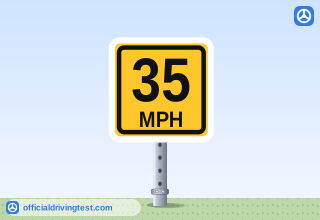
What background colors do advisory speed signs have?
- White or green
- Green or blue
- Red or white
- Yellow or orange
Show answer
Correct answer: Yellow or orange
Advisory speed signs have black letters on a yellow or orange background.
Source: District of Columbia Driver Manual (Updated January 2024), page 46
-
Advisory speed signs are often shown under what other kind of sign?
- A warning sign
- A guide sign
- A stop sign
- A parking sign
Show answer
Correct answer: A warning sign
Advisory speed signs are often placed under a warning sign.
Source: District of Columbia Driver Manual (Updated January 2024), page 46
-
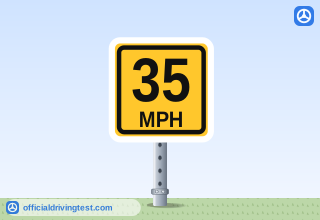
Why are advisory speed signs posted along portions of highways?
- To set the legal minimum speed on that part of the highway
- To warn you that conditions may often make it unsafe to drive faster
- To mark the start of a school zone or work zone
- To tell drivers the speed limit that police enforce at all times
Show answer
Correct answer: To warn you that conditions may often make it unsafe to drive faster
Advisory speed signs warn that conditions may often make driving faster unsafe.
Source: District of Columbia Driver Manual (Updated January 2024), page 46
-
What do regulatory signs tell drivers?
- The speed limit and other laws and regulations
- Where food, fuel and lodging can be found
- Which numbered route the road carries
- What recreational areas are nearby
Show answer
Correct answer: The speed limit and other laws and regulations
Regulatory signs state the speed limit and other laws and regulations that drivers must follow.
Source: District of Columbia Driver Manual (Updated January 2024), page 50
-
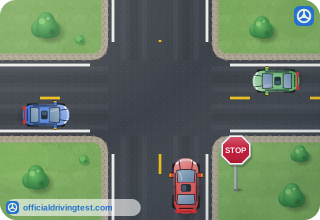
At a stop sign with no stop line and no crosswalk, where must you stop?
- Before the posted stop sign
- Halfway into the intersection
- In the center of the intersection
- Wherever you can see cross traffic best
Show answer
Correct answer: Before the posted stop sign
If there is neither a stop line nor a crosswalk, you stop before the posted stop sign.
Source: District of Columbia Driver Manual (Updated January 2024), page 53
-
Before proceeding from a stop sign, to whom must you yield the right-of-way in the crosswalk?
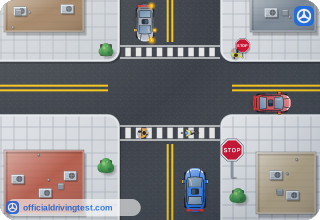
- Pedestrians, but not bicyclists who are in it
- Any pedestrian or bicyclist in the crosswalk
- Only school crossing guards who are on duty
- Only vehicles that are making left turns there
Show answer
Correct answer: Any pedestrian or bicyclist in the crosswalk
You must yield to any pedestrian or bicyclist who may be in the crosswalk before you proceed.
Source: District of Columbia Driver Manual (Updated January 2024), page 53
-
After you stop at a stop sign and make sure the crosswalk is clear, what should you do?
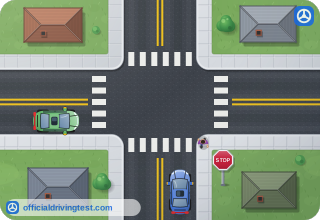
- Accelerate quickly through the intersection to clear it
- Wait for a vehicle to wave you on through the intersection
- Honk your horn before you enter the intersection ahead
- Cautiously proceed and make sure the roadway is clear of vehicles
Show answer
Correct answer: Cautiously proceed and make sure the roadway is clear of vehicles
After the crosswalk is clear, you still cautiously proceed to check that the roadway is clear of vehicles.
Source: District of Columbia Driver Manual (Updated January 2024), page 53
-
As you approach a yield sign, in what order should you look?
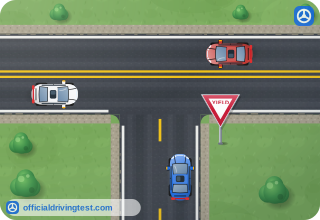
- Left, right, and then back to the left
- Right, left, and then back to the right
- Left only
- Right only, then straight ahead
Show answer
Correct answer: Left, right, and then back to the left
At a yield sign you slow down and look left, right, and then back to the left.
Source: District of Columbia Driver Manual (Updated January 2024), page 53
-
At a yield sign, to whom must you yield the right-of-way?
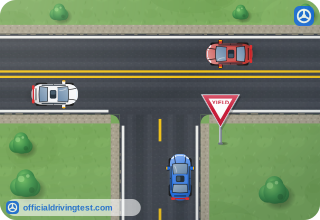
- Vehicles on your right only
- Vehicles that are larger than yours
- Any pedestrian, bicyclist, or vehicle
- Pedestrians only
Show answer
Correct answer: Any pedestrian, bicyclist, or vehicle
You must yield to any pedestrian, bicyclist, or vehicle and proceed when you can do so safely.
Source: District of Columbia Driver Manual (Updated January 2024), page 53
-
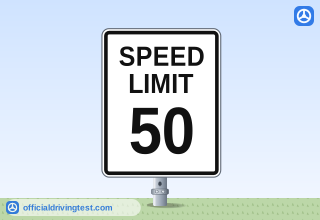
What does a white sign reading SPEED LIMIT 50 tell you?
- The minimum speed required on that stretch of roadway
- The recommended speed for a curve that is ahead of you
- The maximum speed limit for that stretch of roadway
- The speed limit that applies only during the night
Show answer
Correct answer: The maximum speed limit for that stretch of roadway
A speed limit sign gives the maximum speed limit for that stretch of roadway.
Source: District of Columbia Driver Manual (Updated January 2024), page 53
-
Where are overhead lane use signs used?
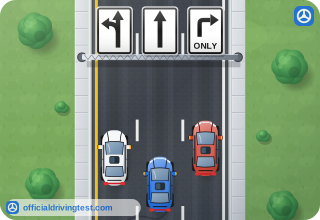
- Where turns are required or unusual turns are allowed from certain lanes
- Where parking is limited to certain hours of the day
- Where the road narrows down to a single lane for all vehicles
- Where trucks and buses must keep to the right lane only
Show answer
Correct answer: Where turns are required or unusual turns are allowed from certain lanes
Overhead lane use signs show required turns, or unconventional turns permitted, from specific lanes at an intersection.
Source: District of Columbia Driver Manual (Updated January 2024), page 53
-
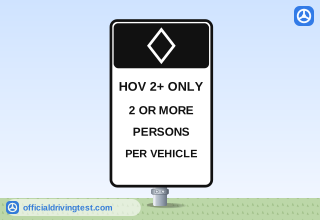
What does a sign with a diamond symbol and the words HOV 2+ ONLY mean?
- The lane is reserved for motorcycles only, with no other vehicles
- The lane is for vehicles carrying commercial loads and freight
- The lane is for emergency vehicles that are answering a call
- The lane is reserved for buses and vehicles with the minimum occupants shown
Show answer
Correct answer: The lane is reserved for buses and vehicles with the minimum occupants shown
A high occupancy vehicle sign reserves the lane for buses and vehicles carrying at least the number of occupants shown.
Source: District of Columbia Driver Manual (Updated January 2024), page 53
-
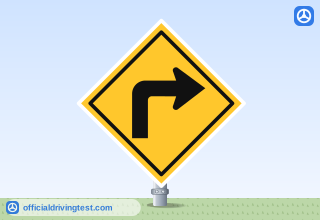
A yellow diamond sign shows an arrow with a sharp right-angle bend to the right. What does it warn of?
- A gentle curve to the right ahead
- A sharp turn to the right ahead
- A right-turn-only lane ahead
- A side road entering from the right
Show answer
Correct answer: A sharp turn to the right ahead
The sharp right turn sign warns that the road ahead has a sharp turn to the right.
Source: District of Columbia Driver Manual (Updated January 2024), page 53
-
A yellow diamond sign shows an arrow that curves gently to the right. What does it warn of?
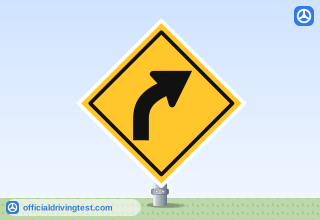
- A curve to the right ahead
- A sharp turn to the right ahead
- A right-turn-only lane ahead
- A road that ends ahead
Show answer
Correct answer: A curve to the right ahead
The right curve sign warns that there is a curve to the right ahead.
Source: District of Columbia Driver Manual (Updated January 2024), page 53
-
A yellow diamond sign shows a zigzag arrow bending sharply right and then left. What does it warn of?
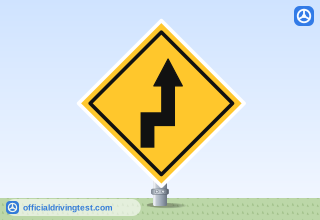
- The road ahead turns sharply left, then right
- A winding road with many curves
- The road ahead turns sharply right, then left
- A divided highway begins
Show answer
Correct answer: The road ahead turns sharply right, then left
The sharp right and left turns sign warns that the road turns sharply right, then left.
Source: District of Columbia Driver Manual (Updated January 2024), page 53
-
What should you do when you see a warning sign?
- Stop completely and wait for a traffic officer to wave you on
- Slow down and watch for other signs and signals
- Speed up to leave the hazard behind you quickly
- Ignore it unless other traffic is present around you
Show answer
Correct answer: Slow down and watch for other signs and signals
Warning signs call for slowing down and watching for other signs and signals that may follow.
Source: District of Columbia Driver Manual (Updated January 2024), page 53
-
A yellow diamond sign shows a red octagon with a black arrow above it. What should you do?
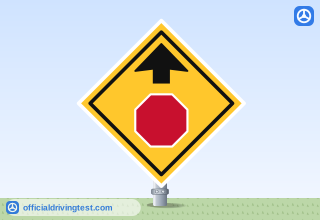
- Stop immediately at the place where you are now
- Yield to cross traffic only, without stopping
- Prepare to turn right at the next road you come to
- Slow down and be ready to stop at the sign ahead
Show answer
Correct answer: Slow down and be ready to stop at the sign ahead
A stop sign ahead sign warns you to slow down and be ready to stop at the stop sign ahead.
Source: District of Columbia Driver Manual (Updated January 2024), page 53