Washington, D.C.: Parking and stopping
Parallel parking, parking on a hill, and the places and distances where you may not stop or park in the District. Split into 2 shorter tests so you're not stuck in one long quiz.
Independent educational site · not affiliated with any government agency or DMV
Choose a part
Parking and stopping — Part 1
Questions in this part include: “What is the penalty for a vehicle parked, stopped or standing on a streetcar guideway or beside a streetcar platform?”
Parking and stopping — Part 2
Questions in this part include: “Where must you not stop, stand, or park if doing so would obstruct traffic?”
Questions are original and based on the official manual "District of Columbia Driver Manual" (Updated January 2024), District of Columbia Department of Motor Vehicles (DC DMV).
All 41 Parking and stopping questions with answers
Choose a part above to take a practice test, or study every question and answer here.
Show the questions and answersHide the questions
1Part 121 questions
-
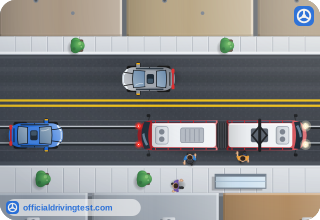
What does District law prohibit on or within a streetcar guideway or adjacent to a streetcar platform?
- Passing a streetcar with a signal on
- Driving at a slow speed
- Parking, stopping or standing a vehicle
- Making a U-turn
Show answer
Correct answer: Parking, stopping or standing a vehicle
A vehicle in violation is subject to a fine and removal or impounding.
Source: District of Columbia Driver Manual (Updated January 2024), page 40
-
What is the penalty for a vehicle parked, stopped or standing on a streetcar guideway or beside a streetcar platform?
- It receives a warning only
- It is subject to a fine and removal or impounding
- It is subject to a fine and a license suspension
- It is moved to the next platform
Show answer
Correct answer: It is subject to a fine and removal or impounding
The manual says such a vehicle shall be subject to fine and removal or impounding.
Source: District of Columbia Driver Manual (Updated January 2024), page 40
-
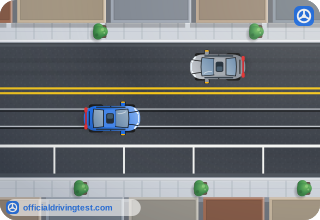
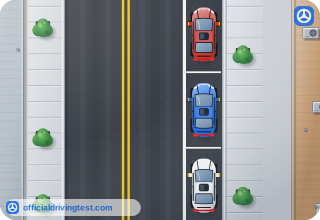
When parking along a streetcar route, where should you park your vehicle?
- On the tracks
- Beside the platform edge
- In the guideway
- Within the solid white line
Show answer
Correct answer: Within the solid white line
The manual says to park within the solid white line and not on the tracks.
Source: District of Columbia Driver Manual (Updated January 2024), page 40
-
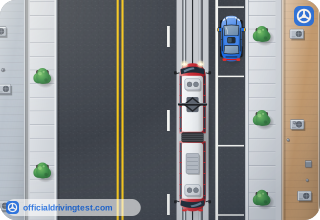
What should you check for when you operate your vehicle doors along a streetcar route?
- Approaching streetcars
- Passing taxis and delivery vans
- Passing buses
- A parking meter
Show answer
Correct answer: Approaching streetcars
A streetcar could be coming as you open a door.
Source: District of Columbia Driver Manual (Updated January 2024), page 40
-
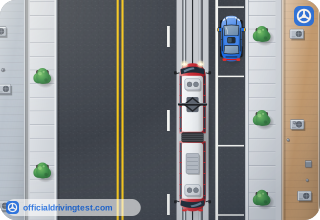
What does the manual say about double parking along a streetcar route?
- It is allowed for loading
- It is allowed for 5 minutes
- It is illegal
- It is allowed after dark
Show answer
Correct answer: It is illegal
Double parking is illegal along a streetcar route.
Source: District of Columbia Driver Manual (Updated January 2024), page 40
-
When parking your vehicle on a street, what must you do?
- Stop the engine, leave the key in the ignition, and set the parking brake
- Leave the engine idling, lock the doors, and set the parking brake
- Stop the engine, remove the key, and release the parking brake
- Stop the engine, lock the ignition, remove the key, and set the parking brake
Show answer
Correct answer: Stop the engine, lock the ignition, remove the key, and set the parking brake
On a street you must stop the engine, lock the ignition, remove the key, and set the parking brake.
Source: District of Columbia Driver Manual (Updated January 2024), page 43
-
Who should never be left inside a vehicle unattended?
- Children, seniors, and pets
- Only infants under one year old
- Only pets in hot weather
- Only people who are asleep
Show answer
Correct answer: Children, seniors, and pets
Children, seniors, and pets should never be left alone inside a vehicle.
Source: District of Columbia Driver Manual (Updated January 2024), page 43
-
When parallel parking on a two-way street, how close must you park to the curb?
- Parallel to and within 18 inches of the curb
- Parallel to and within 24 inches of the curb
- Parallel to and within 12 inches of the curb
- Parallel to and within 36 inches of the curb
Show answer
Correct answer: Parallel to and within 12 inches of the curb
On a two-way street you must park parallel to the curb and within 12 inches of it.
Source: District of Columbia Driver Manual (Updated January 2024), page 43
-
While you parallel park and the driver following you stops, where should that driver stop?
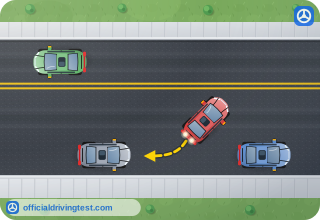
- Directly behind your bumper
- Several lengths behind you
- Beside your vehicle
- One foot behind you
Show answer
Correct answer: Several lengths behind you
A following driver who stops should stay several lengths behind the parking vehicle.
Source: District of Columbia Driver Manual (Updated January 2024), page 43
-
While you look for a parallel parking space, the vehicle behind you is following too closely. What should you do?
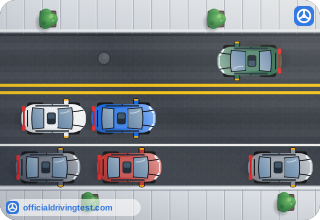
- Stop suddenly so the driver learns to keep a distance
- Stop at once and wave the driver to go around you
- Park in the first gap, even if it is too small for your vehicle
- Do not stop suddenly; continue driving and find another space
Show answer
Correct answer: Do not stop suddenly; continue driving and find another space
Stopping suddenly could cause a rear-end collision, so you keep driving and find another space.
Source: District of Columbia Driver Manual (Updated January 2024), page 43
-
When you start to parallel park, how far from the vehicle parked in front should you be when you line up directly parallel to it?
- 2-5 feet
- 6-8 feet
- 10-12 feet
- 12 inches
Show answer
Correct answer: 2-5 feet
You line up directly parallel to the parked vehicle in front, 2-5 feet away.
Source: District of Columbia Driver Manual (Updated January 2024), page 43
-
As you back up slowly to parallel park, what kind of turn do you start to make?
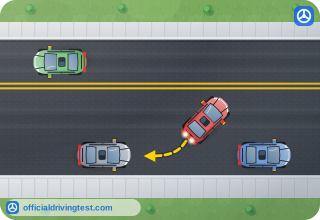
- A U-turn
- A turnabout
- An “S” turn
- A Y-turn
Show answer
Correct answer: An “S” turn
You release the brake, back up slowly, and begin an S-shaped turn.
Source: District of Columbia Driver Manual (Updated January 2024), page 43
-
While you turn to back into a parallel parking space, what should you repeatedly do?
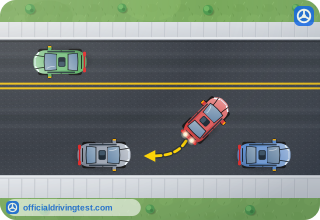
- Look only in the rear-view mirror until the vehicle is in the space
- Glance both forward and backward to check the space around the vehicle
- Look only over your right shoulder
- Look only at the curb
Show answer
Correct answer: Glance both forward and backward to check the space around the vehicle
You glance forward and backward repeatedly to check the space around the vehicle while turning.
Source: District of Columbia Driver Manual (Updated January 2024), page 43
-
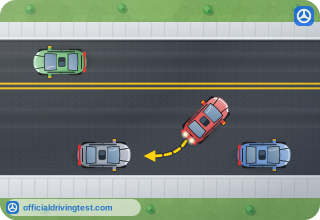
When do you start turning in the other direction to straighten out while parallel parking?
- As soon as you shift into reverse
- When the front bumper passes the parked car ahead
- After the vehicle touches the curb
- Once the rear of the vehicle is mostly in the space
Show answer
Correct answer: Once the rear of the vehicle is mostly in the space
You start turning the other way to straighten out once the rear of the vehicle is mostly in the space.
Source: District of Columbia Driver Manual (Updated January 2024), page 43
-
After parallel parking, you find the wheels are not within 12 inches of the curb. What should you do?
- Pull out and try again
- Leave the vehicle where it is
- Open the door and check the curb on foot
- Set the parking brake and wait
Show answer
Correct answer: Pull out and try again
If the wheels are not within 12 inches of the curb, you pull out and try again.
Source: District of Columbia Driver Manual (Updated January 2024), page 43
-
What should you always check for before you open your door after parking?
- The parking meter
- The curb height only
- Passing vehicles and cyclists
- Pedestrians on the far sidewalk
Show answer
Correct answer: Passing vehicles and cyclists
Before opening your door you must always check for passing vehicles and cyclists.
Source: District of Columbia Driver Manual (Updated January 2024), page 43
-
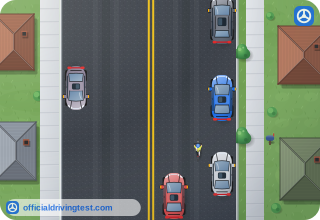
When moving a vehicle from a parked position on a street, what must you do?
- Sound your horn, then pull into the street ahead of approaching traffic
- Signal, yield the right-of-way, and pull into the street when it is safe
- Pull into the street first and signal once you are in the traffic lane
- Signal only if another vehicle is close, then pull out at once
Show answer
Correct answer: Signal, yield the right-of-way, and pull into the street when it is safe
You signal, yield the right-of-way, and enter the street only when it is safe.
Source: District of Columbia Driver Manual (Updated January 2024), page 43
-
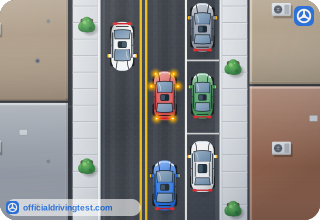
Why is double parking prohibited?
- It prevents other drivers from reading signs
- It damages the road surface
- It makes parking meters harder to use
- It blocks traffic and causes crashes
Show answer
Correct answer: It blocks traffic and causes crashes
Double parking blocks traffic and causes crashes.
Source: District of Columbia Driver Manual (Updated January 2024), page 43
-
If you have a manual transmission and park on a hill, what should you do?
- Leave the vehicle in gear and engage the parking brake
- Leave the vehicle in neutral and engage the parking brake
- Leave the vehicle in neutral and release the parking brake
- Leave the vehicle in gear and release the parking brake
Show answer
Correct answer: Leave the vehicle in gear and engage the parking brake
With a manual transmission you leave the vehicle in gear and engage the parking brake.
Source: District of Columbia Driver Manual (Updated January 2024), page 43
-
When you park downhill next to a curb, which way should you turn your front wheels?
- Away from the curb
- Straight ahead
- Toward the curb
- Toward the center of the road
Show answer
Correct answer: Toward the curb
Parking downhill, the front wheels turn toward the curb to keep the vehicle from rolling into traffic.
Source: District of Columbia Driver Manual (Updated January 2024), page 43
-
When may you park on the paved or traveled part of a highway?
- Only when your vehicle is disabled and cannot be moved
- When you will only be gone for a few minutes
- When you turn on your hazard lights and stay in the vehicle
- When no sign prohibits parking
Show answer
Correct answer: Only when your vehicle is disabled and cannot be moved
You may never park on the paved or traveled part of a highway unless the vehicle is disabled and cannot be moved.
Source: District of Columbia Driver Manual (Updated January 2024), page 44
2Part 220 questions
-
If your vehicle is disabled and cannot be moved from the highway, how should you position it?
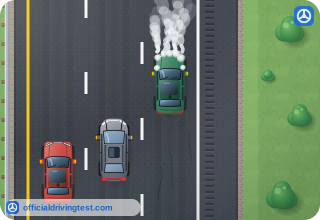
- Pull to the left as far as possible
- Stop in the center of the lane
- Pull to the right as far as possible
- Stop partly on the shoulder and partly in the lane
Show answer
Correct answer: Pull to the right as far as possible
A disabled vehicle that cannot be moved should be pulled to the right as far as possible.
Source: District of Columbia Driver Manual (Updated January 2024), page 44
-
When you park on the shoulder or side of a highway from sunset to sunrise, what must you turn on?
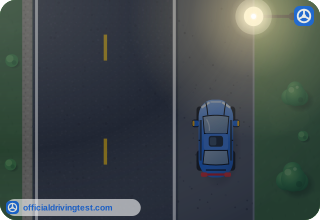
- Your high-beam headlights, with the engine running
- Hazard lights or parking lights, if the vehicle is so equipped
- Your interior dome light and your low-beam headlights
- Only your left turn signal, flashing
Show answer
Correct answer: Hazard lights or parking lights, if the vehicle is so equipped
From sunset to sunrise, a vehicle parked on the shoulder or side of a highway must show hazard lights or parking lights if equipped.
Source: District of Columbia Driver Manual (Updated January 2024), page 44
-
Except to avoid a conflict with other traffic or to follow a police officer or traffic control device, where must you not stop a vehicle?
- Behind the stop line at a red signal
- In a legal parking space with no sign
- At the curb of a street with no signs
- On a sidewalk
Show answer
Correct answer: On a sidewalk
Stopping on a sidewalk is prohibited except to avoid a conflict with traffic or to follow an officer or traffic control device.
Source: District of Columbia Driver Manual (Updated January 2024), page 44
-
Except to avoid a conflict with other traffic or to follow a police officer or traffic control device, which of these is a place where you must not stop a vehicle?
- Within an intersection
- At the curb in front of a house with no signs
- Behind another vehicle waiting in a legal parking space
- Behind the stop line at a stop sign
Show answer
Correct answer: Within an intersection
Stopping within an intersection is prohibited unless needed to avoid a conflict with traffic or to follow an officer or traffic control device.
Source: District of Columbia Driver Manual (Updated January 2024), page 44
-
Except to avoid a conflict with other traffic or to follow a police officer or traffic control device, which marked part of the road is a place where you must not stop a vehicle?
- Behind the crosswalk at a red signal
- At a curb marked with no signs
- On a crosswalk
- Next to a legal parking space
Show answer
Correct answer: On a crosswalk
Stopping on a crosswalk is prohibited unless needed to avoid a conflict with traffic or to follow an officer or traffic control device.
Source: District of Columbia Driver Manual (Updated January 2024), page 44
-
Except to avoid a conflict with other traffic or to follow a police officer or traffic control device, in front of which of these must you not stop a vehicle?
- Beside a clear curb with no signs
- In front of a public driveway
- Behind a stop line at a red signal
- In an unmarked space at a curb
Show answer
Correct answer: In front of a public driveway
You must not stop in front of a public driveway except to avoid a conflict with traffic or to follow an officer or traffic control device.
Source: District of Columbia Driver Manual (Updated January 2024), page 44
-
Unless signs or markings show a different length, within how many feet of the points on the curb opposite the ends of a safety zone must you not stop a vehicle?
- 10 feet
- 20 feet
- 50 feet
- 30 feet
Show answer
Correct answer: 30 feet
You must not stop within 30 feet of the curb points opposite the ends of a safety zone unless signs or markings show another length.
Source: District of Columbia Driver Manual (Updated January 2024), page 44
-
Except to avoid a conflict with other traffic or to follow a police officer or traffic control device, where on a highway must you not stop a vehicle?
- Upon any bridge or other elevated structure, or within a highway tunnel
- Beside a clear curb of an ordinary street where signs allow stopping
- Behind a stopped vehicle at a red signal
- In a legal parking space at the edge of the road
Show answer
Correct answer: Upon any bridge or other elevated structure, or within a highway tunnel
Stopping upon a bridge, other elevated structure, or inside a highway tunnel is prohibited.
Source: District of Columbia Driver Manual (Updated January 2024), page 44
-
Where must you not stop, stand, or park if doing so would obstruct traffic?
- Next to a clear, empty curb with no signs or markings posted
- Alongside a clear curb where parking is allowed by sign
- Alongside or opposite any street excavation or obstruction
- Behind the stop line at a signal that has just turned red
Show answer
Correct answer: Alongside or opposite any street excavation or obstruction
You must not stop, stand, or park alongside or opposite a street excavation or obstruction where doing so would obstruct traffic.
Source: District of Columbia Driver Manual (Updated January 2024), page 44
-
In which direction must you not stop a vehicle?
- With the flow of traffic
- Opposite from the flow of traffic
- Parallel to the curb
- Toward the nearest sidewalk or curb
Show answer
Correct answer: Opposite from the flow of traffic
You must not stop a vehicle in a direction opposite from the flow of traffic.
Source: District of Columbia Driver Manual (Updated January 2024), page 44
-
Within how many feet of a private driveway, public driveway, or alley must you not stand or park a vehicle?
- 10 feet
- 15 feet
- 20 feet
- 5 feet
Show answer
Correct answer: 5 feet
You must not stand or park in front of or within 5 feet of a driveway or alley.
Source: District of Columbia Driver Manual (Updated January 2024), page 44
-
Within how many feet of a fire hydrant must you not stand or park a vehicle?
- 10 feet
- 5 feet
- 15 feet
- 20 feet
Show answer
Correct answer: 10 feet
You must not stand or park within 10 feet of a fire hydrant.
Source: District of Columbia Driver Manual (Updated January 2024), page 44
-
Within how many feet in front of a flashing signal, stop sign, or traffic control signal at the side of a roadway must you not stand or park?
- 5 feet
- 10 feet
- 25 feet
- 50 feet
Show answer
Correct answer: 25 feet
You must not stand or park within 25 feet in front of a flashing signal, stop sign, or traffic control signal at the side of the road.
Source: District of Columbia Driver Manual (Updated January 2024), page 44
-
Within how many feet of the entrance to a fire station driveway must you not stand or park a vehicle?
- 5 feet
- 20 feet
- 10 feet
- 50 feet
Show answer
Correct answer: 20 feet
You must not stand or park within 20 feet of a fire station driveway entrance.
Source: District of Columbia Driver Manual (Updated January 2024), page 45
-
On a curve or the brow of a hill, which road marking means you must not stand or park?
- Broken yellow lines
- Solid white edge lines along the road
- Painted bicycle symbols
- Solid lines indicating a no-passing zone
Show answer
Correct answer: Solid lines indicating a no-passing zone
On a curve or hill brow with solid no-passing lines painted on the road, standing or parking is not allowed.
Source: District of Columbia Driver Manual (Updated January 2024), page 45
-
Standing or parking on the roadway side of a vehicle stopped or parked at the edge or curb of a street is considered what?
- Double parking
- Parallel parking
- Angle parking
- Temporary stopping
Show answer
Correct answer: Double parking
Standing or parking beside a vehicle that is already parked at the curb, on the roadway side, is double parking.
Source: District of Columbia Driver Manual (Updated January 2024), page 45
-
In front of what must you not stand or park a vehicle?
- A mailbox at the side of the road
- A utility pole at the edge of the street
- Any barricade or sign placed to close a street
- A street light pole
Show answer
Correct answer: Any barricade or sign placed to close a street
You must not stand or park in front of a barricade or sign that has been placed to close a street.
Source: District of Columbia Driver Manual (Updated January 2024), page 45
-
Within how many feet of the nearest rail of a railroad crossing is parking prohibited?
- 25 feet
- 50 feet
- 75 feet
- 100 feet
Show answer
Correct answer: 50 feet
You must not park within 50 feet of the nearest rail of a railroad crossing except briefly to load or unload.
Source: District of Columbia Driver Manual (Updated January 2024), page 45
-
Near a railroad crossing, parking is prohibited except temporarily for what purpose?
- Waiting for the crossing gates to be raised again
- Resting briefly while the driver stays in the vehicle
- Waiting for a passenger to finish a short phone call
- Loading or unloading merchandise or passengers
Show answer
Correct answer: Loading or unloading merchandise or passengers
The exception is temporarily loading or unloading merchandise or passengers.
Source: District of Columbia Driver Manual (Updated January 2024), page 45
-
Who may park in a space or zone properly marked as restricted for the use of individuals with disabilities?
- An individual with a disability
- Any licensed driver
- Any driver who turns on hazard lights
- Any driver parking for less than one hour
Show answer
Correct answer: An individual with a disability
You may not park in a space or zone marked for individuals with disabilities unless you are an individual with a disability.
Source: District of Columbia Driver Manual (Updated January 2024), page 45