Washington, D.C.: Emergency vehicles and work zones Practice Test
Yielding to emergency vehicles, work zone signs, flaggers and channeling devices.
Independent educational site · not affiliated with any government agency or DMV
Ready? Test yourself
Answer to start, or tap Start below:
In emergency situations, whose direction must you obey in addition to the orders of police officers?
- Instant feedback with an explanation
- Every answer cites its source in the manual
- Your best score is saved on this device
- Keyboard: press 1 to 4 to answer and Enter for the next question
Questions are original and based on the official manual "District of Columbia Driver Manual" (Updated January 2024), District of Columbia Department of Motor Vehicles (DC DMV).
All 24 questions in this practice test
Take the test above first, then use this list to study. Tap “Show answer” to see the correct answer and explanation.
Show the questions and answersHide the questions
-
In emergency situations, whose direction must you obey in addition to the orders of police officers?
- Firefighters
- Tow truck operators
- Utility workers
- Bus drivers
Show answer
Correct answer: Firefighters
The manual says you must obey police officers and, in emergency situations, the direction of firefighters.
Source: District of Columbia Driver Manual (Updated January 2024), page 20
-
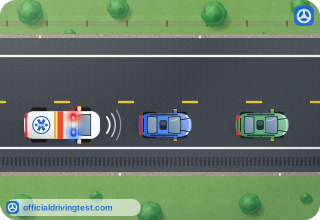
Which signals give an authorized emergency vehicle the right-of-way?
- Only a siren, because a flashing light is not enough
- Only a flashing light
- An audible signal (siren) or a visual signal (flashing light)
- Only a police radio call
Show answer
Correct answer: An audible signal (siren) or a visual signal (flashing light)
Authorized emergency vehicles have the right-of-way when giving a siren or a flashing light.
Source: District of Columbia Driver Manual (Updated January 2024), page 35
-
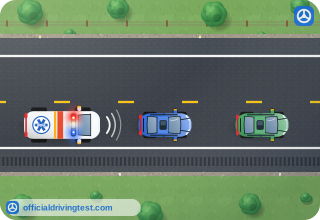
When you hear or see an authorized emergency vehicle approach, what should you immediately do?
- Slow down and keep driving in your lane until it passes
- Drive to the curb and stop, and stay stopped until it has passed
- Stop in the middle of the lane
- Speed up to get out of its way
Show answer
Correct answer: Drive to the curb and stop, and stay stopped until it has passed
The manual says to drive to the curb and remain stopped until the emergency vehicle has passed.
Source: District of Columbia Driver Manual (Updated January 2024), page 35
-
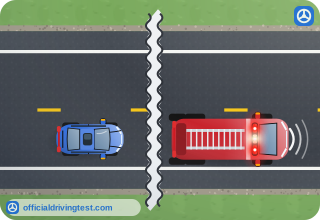
How close may you follow a fire apparatus that is responding to an emergency?
- No closer than 50 feet
- No closer than 200 feet
- No closer than 1,000 feet
- No closer than 500 feet
Show answer
Correct answer: No closer than 500 feet
The manual says not to follow any responding fire apparatus closer than 500 feet.
Source: District of Columbia Driver Manual (Updated January 2024), page 35
-
You approach a block where fire engines or emergency vehicles are stopped. What should you do?
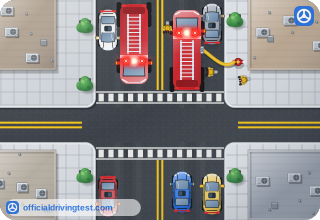
- Not drive into the block, and turn right or left
- Drive through the block slowly in the right lane
- Wait behind them until they move
- Pass them on the left at low speed
Show answer
Correct answer: Not drive into the block, and turn right or left
It is against traffic regulations to drive into the block, so you turn right or left.
Source: District of Columbia Driver Manual (Updated January 2024), page 35
-
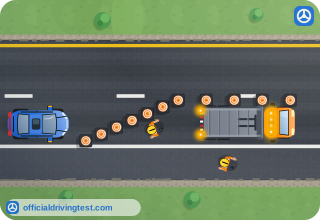
What is a work zone?
- An area of highway reserved for police and emergency vehicles responding to a crash
- An area along a highway where only road construction is taking place
- An area of a highway used only by workers and equipment, closed to all traffic
- An area along a highway where construction, maintenance, or utility work is occurring
Show answer
Correct answer: An area along a highway where construction, maintenance, or utility work is occurring
A work zone is an area along a highway where construction, maintenance, or utility work is occurring.
Source: District of Columbia Driver Manual (Updated January 2024), page 49
-
What color are traffic warning signs in work zones usually?
- Orange
- Yellow
- Red
- Green
Show answer
Correct answer: Orange
Traffic warning signs in work zones are usually orange.
Source: District of Columbia Driver Manual (Updated January 2024), page 49
-
A work zone may be stationary or a mobile operation. Which is an example of a mobile operation?
- A bridge that is being widened by a construction crew
- A permanent detour around a bridge that has been closed
- Pavement striping or patching that moves down the road slowly
- A set of fixed signs warning of a lane closure ahead
Show answer
Correct answer: Pavement striping or patching that moves down the road slowly
Pavement striping or patching that moves slowly down the road is a mobile work zone; widening a bridge is stationary.
Source: District of Columbia Driver Manual (Updated January 2024), page 49
-
Where may stopped traffic be hidden when you approach a work zone?
- Behind an orange sign only
- Around a curve or over a hill
- Under a highway overpass only
- Inside a tunnel only
Show answer
Correct answer: Around a curve or over a hill
Stopped traffic may be hidden around a curve or over a hill, so stay alert.
Source: District of Columbia Driver Manual (Updated January 2024), page 49
-
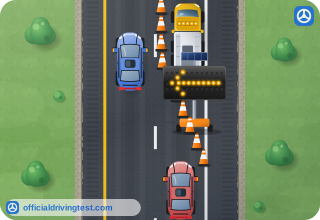
In a work zone, whose directions must you obey?
- Only police officers
- Only the workers operating equipment
- Only the signs, if flaggers disagree
- The police and flaggers
Show answer
Correct answer: The police and flaggers
You must obey the directions of the police and flaggers in a work zone.
Source: District of Columbia Driver Manual (Updated January 2024), page 49
-
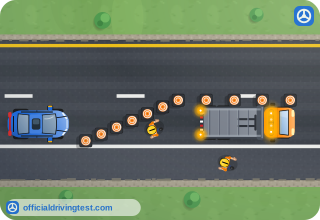
When you see signs indicating lane closures ahead in a work zone, what should you do?
- Prepare to move from the closed lane
- Move into the closed lane to stay with traffic
- Speed up to pass slower vehicles before the lane ends
- Stop and wait for a flagger
Show answer
Correct answer: Prepare to move from the closed lane
Lane closure signs mean you should prepare to move out of the closed lane.
Source: District of Columbia Driver Manual (Updated January 2024), page 49
-
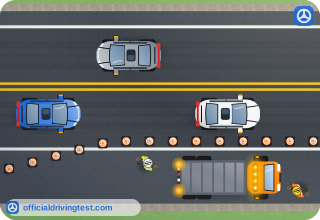
In a work zone, how should you brake?
- Quickly, to show drivers behind you that traffic is slowing
- Only after you reach the first cone or barrier
- Gradually, to give drivers behind you ample time to slow down
- Only when you reach a flagger holding a STOP/SLOW paddle
Show answer
Correct answer: Gradually, to give drivers behind you ample time to slow down
Braking gradually gives drivers behind you ample time to slow down.
Source: District of Columbia Driver Manual (Updated January 2024), page 49
-
What should you not do in a work zone?
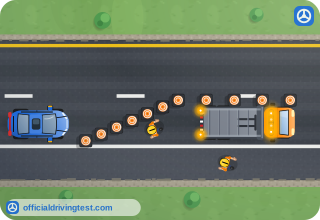
- Keep up with the flow of traffic
- Weave from lane to lane
- Watch for slower speed limits
- Brake gradually
Show answer
Correct answer: Weave from lane to lane
You should not weave from lane to lane in a work zone.
Source: District of Columbia Driver Manual (Updated January 2024), page 49
-
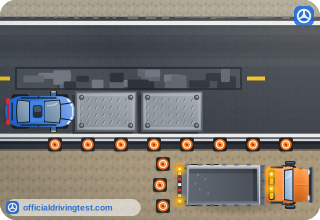
What kind of movements are best in a work zone with rough surfaces, metal plates, uneven pavement between lanes, or drop-offs at the pavement edge?
- Quick, sharp steering movements
- Hard braking
- Sudden lane changes
- Gradual, controlled movements
Show answer
Correct answer: Gradual, controlled movements
Unusual pavement conditions make control harder, so gradual, controlled movements are best.
Source: District of Columbia Driver Manual (Updated January 2024), page 49
-
What should you maintain in a work zone?
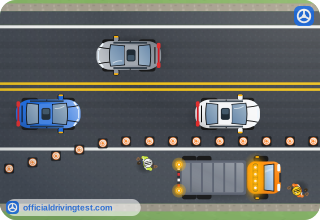
- A reasonable speed and spacing between vehicles
- The same speed limit as outside the work zone
- A close following distance to keep traffic moving
- The speed of the fastest vehicles around you
Show answer
Correct answer: A reasonable speed and spacing between vehicles
You may have nowhere to go if you drive too fast or follow too closely when the vehicle ahead slows or stops.
Source: District of Columbia Driver Manual (Updated January 2024), page 49
-
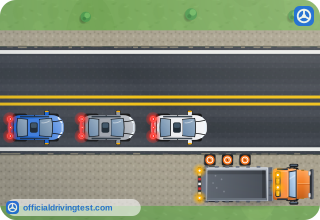
Traffic in a work zone usually must be stopped when what occurs?
- A highway has more than two lanes in each direction
- Drivers have been traveling through the zone for more than ten minutes
- Traffic from opposite directions must take turns using a single lane
- Orange signs are posted along the shoulder
Show answer
Correct answer: Traffic from opposite directions must take turns using a single lane
Work zone traffic is usually stopped when opposing traffic must take turns on one lane, workers or equipment must enter the lane, or the work is dangerous to passing vehicles.
Source: District of Columbia Driver Manual (Updated January 2024), page 49
-
When traffic in a work zone must be stopped, what is used most often to stop, slow, and direct it?
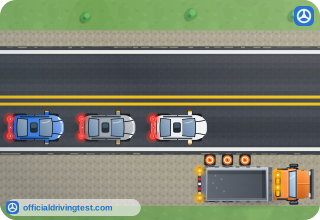
- Changeable message signs placed alone along the road
- Trained and certified flaggers with STOP/SLOW paddles
- Drivers taking turns without any direction
- Police officers stationed at every work zone
Show answer
Correct answer: Trained and certified flaggers with STOP/SLOW paddles
Trained and certified flaggers with STOP/SLOW paddles are most often used in work zones.
Source: District of Columbia Driver Manual (Updated January 2024), page 49
-
What may happen to speed limits in work areas?
- They are suspended until the work ends
- They are raised for passenger cars
- They may be reduced
- They apply only to trucks
Show answer
Correct answer: They may be reduced
Speed limits may be reduced in work areas, so watch the posted limit.
Source: District of Columbia Driver Manual (Updated January 2024), page 50
-
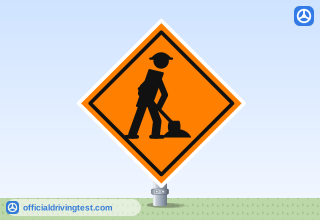
What are most signs used in highway and street work areas like?
- Red and octagonal
- Orange and diamond shaped
- Green and rectangular
- Blue and round
Show answer
Correct answer: Orange and diamond shaped
Work-area warning signs are mostly orange and diamond shaped.
Source: District of Columbia Driver Manual (Updated January 2024), page 50
-
What are warning signs in and near work zones used to do?
- Tell drivers where they may park near the work area
- Show the legal speed limit for the whole city
- Direct drivers to nearby food and fuel services
- Alert drivers to unusual or potentially hazardous conditions
Show answer
Correct answer: Alert drivers to unusual or potentially hazardous conditions
Work-zone warning signs alert drivers to unusual or potentially hazardous conditions in or near the zone.
Source: District of Columbia Driver Manual (Updated January 2024), page 50
-
Which devices are the most commonly used to guide drivers safely through work areas?
- Flares, flags, and rope
- Reflectors, tape, and chains
- Speed bumps, posts, and gates
- Barricades, cones, and drums
Show answer
Correct answer: Barricades, cones, and drums
Barricades, cones, and drums are the channeling devices most commonly used in work areas.
Source: District of Columbia Driver Manual (Updated January 2024), page 50
-
What may channeling devices in work areas be equipped with at night?
- Sirens that sound when a car is near
- Warning lights for improved visibility
- Flashing red arrows on every cone
- A speed limit display
Show answer
Correct answer: Warning lights for improved visibility
At night, channeling devices may carry warning lights so drivers can see them better.
Source: District of Columbia Driver Manual (Updated January 2024), page 50
-
Which electronic signs can display a variety of messages about road conditions, traffic problems and special events?
- Arrow panels
- Overhead lane use signs
- Changeable message signs
- Slow moving vehicle signs
Show answer
Correct answer: Changeable message signs
Changeable message signs are electronic signs that show varied messages and are often used in work zones.
Source: District of Columbia Driver Manual (Updated January 2024), page 50
-
What do arrow panels tell drivers?
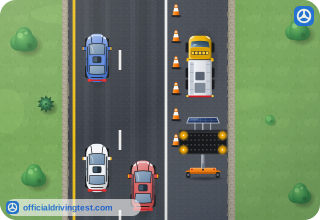
- Where they need to move into another lane
- Where the work zone ends exactly
- How many lanes the road has beyond the work
- Which lanes may be used for passing
Show answer
Correct answer: Where they need to move into another lane
Arrow panels give advance warning and directional information about moving into another lane to the right or left.
Source: District of Columbia Driver Manual (Updated January 2024), page 50