Delaware: Right-of-way and turning — Part 2 Practice Test
Questions in this part include: “What is a Diverging Diamond Intersection (DDI) based on?” · “What can happen to a shared center lane in some areas during rush hours?”
Independent educational site · not affiliated with any government agency or DMV
Ready? Test yourself
- Instant feedback with an explanation
- Every answer cites its source in the manual
- Your best score is saved on this device
Questions are original and based on the official manual "Delaware Driver Manual" (July 2026), Delaware Division of Motor Vehicles (DMV).
All 19 questions in this practice test
Take the test above first, then use this list to study. Tap “Show answer” to see the correct answer and explanation.
Show the questions and answersHide the questions
-
What does the design of a roundabout reduce the need for?
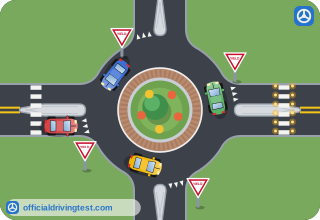
- Traffic signals at every entry to the intersection
- Pedestrian crosswalks at the exits of the roundabout
- Direct left turns, a major reason for intersection crashes
- Right turns, which are a major reason for crashes
Show answer
Correct answer: Direct left turns, a major reason for intersection crashes
The manual says the design reduces the need for direct left turns, a major reason for intersection crashes.
Source: Delaware Driver Manual (July 2026), page 86 · Open this page in the manual (Manual page 86)
-
Which approach lane should you be in if you intend to turn right at a roundabout?
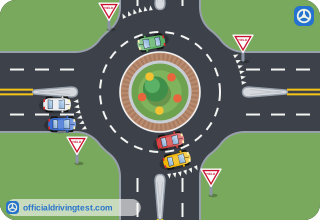
- The left approach lane
- The right approach lane
- Any approach lane
- The center approach lane
Show answer
Correct answer: The right approach lane
The manual says to be in the right approach lane if you intend to turn right.
Source: Delaware Driver Manual (July 2026), page 86 · Open this page in the manual (Manual page 86)
-
Which approach lane should you be in if you intend to make a left turn or a U-turn at a roundabout?
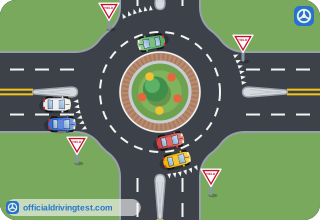
- The right approach lane
- Any approach lane
- Whichever approach lane has less traffic
- The left approach lane
Show answer
Correct answer: The left approach lane
The manual says to be in the left approach lane if you intend on making a left or U-turn.
Source: Delaware Driver Manual (July 2026), page 86 · Open this page in the manual (Manual page 86)
-
Which approach lane may you use at a roundabout if you are proceeding straight?
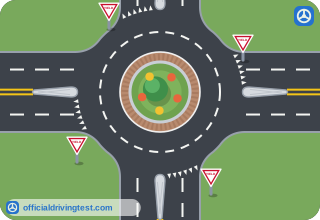
- Any approach lane
- Only the right approach lane
- Only the left approach lane
- Only the lane closest to the central island
Show answer
Correct answer: Any approach lane
The manual says any approach lane is okay if you are proceeding straight.
Source: Delaware Driver Manual (July 2026), page 86 · Open this page in the manual (Manual page 86)
-
When approaching a roundabout, which side of the splitter island should you stay on?
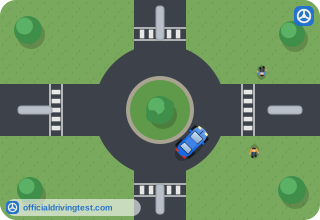
- The left
- Either side, whichever is clearer
- The right
- The side closest to the crosswalk
Show answer
Correct answer: The right
The manual says to stay to the right of the splitter island when approaching the roundabout.
Source: Delaware Driver Manual (July 2026), page 86 · Open this page in the manual (Manual page 86)
-
To what speed should you slow down when approaching a roundabout?

- 20-25 mph
- 10-15 mph
- 30-35 mph
- 5-10 mph
Show answer
Correct answer: 10-15 mph
The manual says to slow down to 10-15 mph upon approaching the roundabout.
Source: Delaware Driver Manual (July 2026), page 86 · Open this page in the manual (Manual page 86)
-
What should you do about bicyclists when approaching a roundabout?
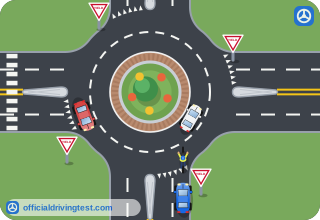
- Pass them quickly before you reach the roundabout entry
- Honk to warn them to stay on the sidewalk
- Stop and wait for them to clear the roundabout
- Watch for them and let them merge into the entry lane
Show answer
Correct answer: Watch for them and let them merge into the entry lane
The manual says to watch for bicyclists and allow them to merge into the entry lane.
Source: Delaware Driver Manual (July 2026), page 86 · Open this page in the manual (Manual page 86)
-
What should you do about pedestrians when entering a roundabout?
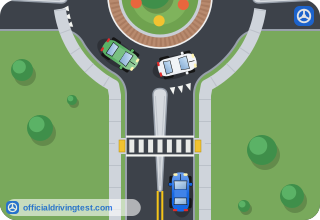
- Watch for and yield to pedestrians in the crosswalk
- Sound your horn so pedestrians clear the crosswalk
- Pass pedestrians quickly before the crosswalk
- Expect pedestrians to wait until you have passed
Show answer
Correct answer: Watch for and yield to pedestrians in the crosswalk
The manual says to watch for and yield to pedestrians in the crosswalk.
Source: Delaware Driver Manual (July 2026), page 86 · Open this page in the manual (Manual page 86)
-
Which vehicles must you yield to when entering a roundabout?
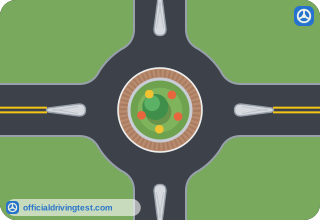
- Traffic waiting behind you to enter
- Traffic stopped at the next entry
- Traffic already in the roundabout
- No one, since entering traffic has the right-of-way
Show answer
Correct answer: Traffic already in the roundabout
The manual says to yield to traffic already in the roundabout.
Source: Delaware Driver Manual (July 2026), page 86 · Open this page in the manual (Manual page 86)
-
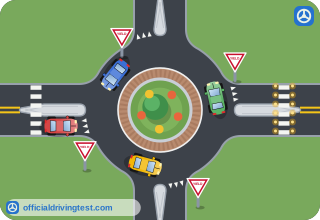
Once you are in a roundabout, when should you stop?
- At every exit to check for pedestrians
- Only to avoid a collision
- Whenever entering traffic is waiting
- Before passing each crosswalk
Show answer
Correct answer: Only to avoid a collision
The manual says that once in the roundabout you do not stop except to avoid a collision, and you have the right-of-way over entering traffic.
Source: Delaware Driver Manual (July 2026), page 86 · Open this page in the manual (Manual page 86)
-
In a roundabout, who has the right-of-way, a vehicle already in the roundabout or a vehicle entering it?
- The vehicle entering the roundabout
- Whichever vehicle is traveling faster
- The vehicle that arrived at its entry first
- The vehicle already in the roundabout
Show answer
Correct answer: The vehicle already in the roundabout
The manual says that once you are in the roundabout you have the right-of-way over entering traffic.
Source: Delaware Driver Manual (July 2026), page 86 · Open this page in the manual (Manual page 86)
-
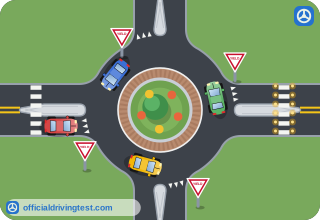
What does the manual say about passing other vehicles inside a roundabout?
- Do not pass other vehicles
- Pass only on the left side
- Pass only slow bicyclists
- Pass only after sounding the horn
Show answer
Correct answer: Do not pass other vehicles
The manual says to maintain a slow speed and not pass other vehicles in the roundabout.
Source: Delaware Driver Manual (July 2026), page 86 · Open this page in the manual (Manual page 86)
-
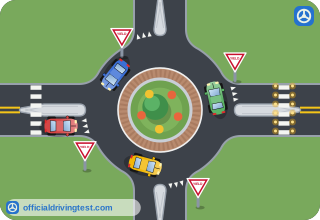
As you exit a roundabout, what should you watch for and yield to?
- Vehicles entering at the next entry
- Vehicles stopped on the central island
- Pedestrians and bicyclists
- Trucks backing out of the exit lane
Show answer
Correct answer: Pedestrians and bicyclists
The manual says to watch for and yield to pedestrians and bicyclists as you exit.
Source: Delaware Driver Manual (July 2026), page 86 · Open this page in the manual (Manual page 86)
-
What is a Diverging Diamond Intersection (DDI) based on?
- A traditional traffic circle with a central island
- A standard diamond interchange with a shift in traffic
- A cloverleaf interchange with four loop ramps
- A four-way stop intersection with an added center lane
Show answer
Correct answer: A standard diamond interchange with a shift in traffic
The manual says a DDI is based on a standard diamond interchange with a shift in traffic within the interchange.
Source: Delaware Driver Manual (July 2026), page 86 · Open this page in the manual (Manual page 86)
-
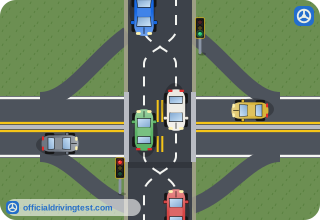
What is the Diverging Diamond Intersection (DDI) designed to accommodate safely and efficiently?
- High volume right turn movements
- Slow-moving farm vehicles
- Large numbers of pedestrians crossing at once
- High volume left turn movements
Show answer
Correct answer: High volume left turn movements
The manual says the DDI shifts traffic to safely and efficiently accommodate high volume left turn movements.
Source: Delaware Driver Manual (July 2026), page 86 · Open this page in the manual (Manual page 86)
-
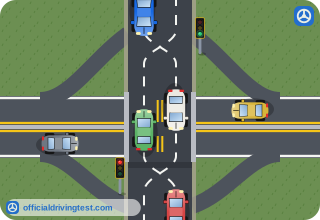
What happens within a Diverging Diamond Intersection (DDI) interchange that allows left turns without crossing oncoming traffic or stopping?
- Traffic briefly drives on the left side of the road
- Traffic is stopped by a stop sign at every ramp
- Left turns are made from the right-hand lane
- Traffic drives in a circle around a central island
Show answer
Correct answer: Traffic briefly drives on the left side of the road
The manual says traffic briefly drives on the left side of the road within the interchange so left turns occur without crossing oncoming traffic.
Source: Delaware Driver Manual (July 2026), page 86 · Open this page in the manual (Manual page 86)
-
What are the advantages of a Diverging Diamond Intersection (DDI)?
- Fewer exits, reducing speeds, and lower noise from traffic
- More traffic signals, reducing delays, and smaller crossing distances
- Fewer conflict points and greater capacity for vehicles
- Wider lanes, reducing lane changes, and shorter ramps
Show answer
Correct answer: Fewer conflict points and greater capacity for vehicles
The manual says a DDI has fewer conflict points and greater capacity for vehicles at the interchange.
Source: Delaware Driver Manual (July 2026), page 86 · Open this page in the manual (Manual page 86)
-
For what are shared center lanes reserved?
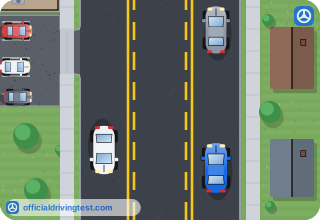
- Left turns, used by vehicles in both directions
- Passing slower vehicles in both directions
- Emergency vehicles traveling in either direction
- Left turns for one direction of traffic only
Show answer
Correct answer: Left turns, used by vehicles in both directions
The manual says shared center lanes are reserved for left turns (or permitted U-turns) and can be used by vehicles traveling in both directions.
Source: Delaware Driver Manual (July 2026), page 87 · Open this page in the manual (Manual page 87)
-
What can happen to a shared center lane in some areas during rush hours?
- It is closed to all traffic
- It becomes a reversible lane
- It becomes a passing lane
- It is reserved for buses only
Show answer
Correct answer: It becomes a reversible lane
The manual states that in some areas the shared center lane becomes a reversible lane during rush hours.
Source: Delaware Driver Manual (July 2026), page 87 · Open this page in the manual (Manual page 87)