Connecticut: Road signs
Regulatory, warning, work-area, guide and route signs shown in the Connecticut Driver's Manual. Split into 4 shorter tests so you're not stuck in one long quiz.
Independent educational site · not affiliated with any government agency or DMV
Choose a part
Road signs — Part 1
Questions in this part include: “What kind of information do regulatory signs give you?”
StartRoad signs — Part 2
Questions in this part include: “What are passing areas based on?”
StartRoad signs — Part 3
Questions in this part include: “Where is an Advisory Speed plaque usually installed?”
StartRoad signs — Part 4
Questions in this part include: “What is the purpose of guide signs?”
StartAll 73 Road signs questions with answers
Choose a part above to take a practice test, or study every question and answer here.
Show the questions and answersHide the questions
-
What kind of information do regulatory signs give you?
- Where food, fuel and other services can be found along the roadway
- Road conditions and dangers that lie ahead
- Rules for traffic direction, lane use, turning, speed and parking
- Which parks and recreation areas are nearby
Show answer
Correct answer: Rules for traffic direction, lane use, turning, speed and parking
Regulatory signs give information about rules for traffic direction, lane use, turning, speed, parking and other special situations.
Source: Connecticut Driver's Manual (Revised March 2023), page 47 · Open this page in the manual (Manual page 47)
-
How many sides does a stop sign have?
- Four
- Eight
- Six
- Ten
Show answer
Correct answer: Eight
A stop sign has eight sides and is red with white letters.
Source: Connecticut Driver's Manual (Revised March 2023), page 47 · Open this page in the manual (Manual page 47)
-
What must you do at a stop sign?
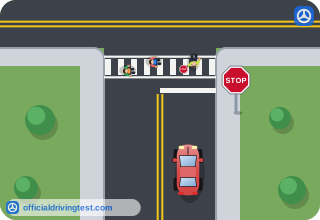
- Slow down and continue through the intersection if no vehicles are in sight
- Stop only if other vehicles are in the intersection or approaching it
- Stop only if pedestrians are crossing the road in front of you at the time
- Come to a full and complete stop at the sign or stop line, if one is present
Show answer
Correct answer: Come to a full and complete stop at the sign or stop line, if one is present
You must come to a full and complete stop at a stop sign or stop line, if one is present.
Source: Connecticut Driver's Manual (Revised March 2023), page 47 · Open this page in the manual (Manual page 47)
-
After stopping at a stop sign, when may you pull forward?
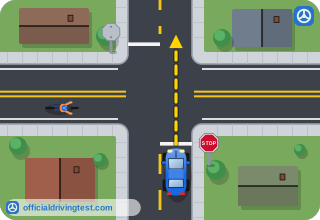
- Only when crossing vehicles and pedestrians have cleared and it is safe
- As soon as the crossing vehicles slow down to let you go ahead
- Whenever you have stopped for at least three full seconds
- As soon as you have looked both ways one time
Show answer
Correct answer: Only when crossing vehicles and pedestrians have cleared and it is safe
You must wait until crossing vehicles and pedestrians have cleared, and may pull forward only when it is safe to do so.
Source: Connecticut Driver's Manual (Revised March 2023), page 47 · Open this page in the manual (Manual page 47)
-
What is the shape of a yield sign?
- An upward pointing triangle
- A diamond
- A downward pointing triangle
- An eight-sided octagon
Show answer
Correct answer: A downward pointing triangle
A yield sign is a downward pointing triangle, red and white with red letters.
Source: Connecticut Driver's Manual (Revised March 2023), page 47 · Open this page in the manual (Manual page 47)
-
What does a red and white downward pointing triangle sign mean?
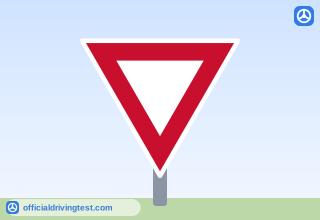
- Come to a full stop and stay stopped until a traffic officer signals you to go
- Slow down and yield the right-of-way to traffic where you are crossing or entering
- You are leaving a divided roadway and will be driving on a two-way highway
- A school zone is ahead and you must slow down and watch for children
Show answer
Correct answer: Slow down and yield the right-of-way to traffic where you are crossing or entering
A yield sign means you must slow down and yield the right-of-way to traffic in the intersection you are crossing or roadway you are entering.
Source: Connecticut Driver's Manual (Revised March 2023), page 47 · Open this page in the manual (Manual page 47)
-
A square sign shows a white horizontal line inside a red ball and the words DO NOT ENTER. What does it mean?
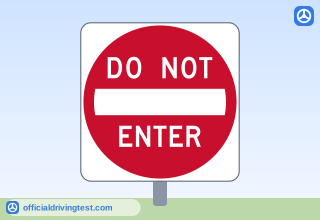
- You may enter only after stopping
- You may enter only if you are turning
- You may enter if no traffic is coming
- You cannot enter
Show answer
Correct answer: You cannot enter
A square sign with a white horizontal line inside a red ball means you cannot enter.
Source: Connecticut Driver's Manual (Revised March 2023), page 47 · Open this page in the manual (Manual page 47)
-
Where will you see a DO NOT ENTER sign?
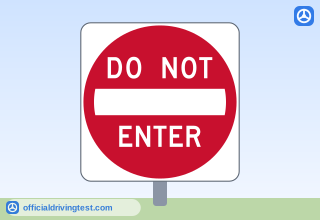
- Exit ramps entered the wrong way, divided-roadway crossovers and one-way streets
- At the beginning of every no passing zone and at railroad crossings
- Only at the far end of a one-way street, never at ramps or crossovers
- At entrances to parks, recreation areas and service plazas
Show answer
Correct answer: Exit ramps entered the wrong way, divided-roadway crossovers and one-way streets
The DO NOT ENTER sign is posted at roadway openings you should not enter, such as exit ramps, crossovers on divided roadways and one-way streets.
Source: Connecticut Driver's Manual (Revised March 2023), page 47 · Open this page in the manual (Manual page 47)
-
What should you do if you drive up to a WRONG WAY sign?
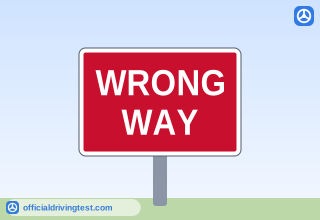
- Slow down and proceed with care
- Stop and wait for traffic to clear
- Do not drive past it and turn around
- Continue if no vehicles are coming
Show answer
Correct answer: Do not drive past it and turn around
The WRONG WAY sign identifies a one-way street, an expressway ramp or the wrong direction or side of a divided highway; do not drive past it.
Source: Connecticut Driver's Manual (Revised March 2023), page 47 · Open this page in the manual (Manual page 47)
-
A square sign shows a circle with a slash over a U-shaped arrow. What does it mean?
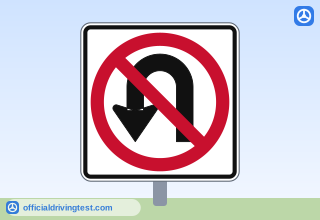
- U-turns are required
- U-turns are prohibited
- U-turns are allowed only from the left lane
- U-turns are allowed after you stop
Show answer
Correct answer: U-turns are prohibited
This is the No U-Turn sign, which means U-turns are prohibited.
Source: Connecticut Driver's Manual (Revised March 2023), page 48 · Open this page in the manual (Manual page 48)
-
Where might you see a NO U-TURN sign on a divided highway or expressway?
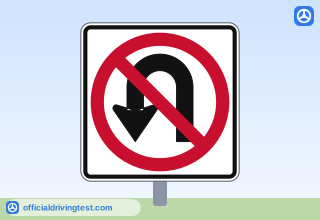
- At every exit ramp where drivers leave the divided highway
- Only at the entrance to a rest area or service plaza
- At the start of every no passing zone on the highway
- Where an opening in the divided highway leads to the other side
Show answer
Correct answer: Where an opening in the divided highway leads to the other side
The manual mentions NO U-TURN signs posted on divided highways or expressways where an opening leads to the other side.
Source: Connecticut Driver's Manual (Revised March 2023), page 48 · Open this page in the manual (Manual page 48)
-
A sign shows a circle with a slash over a right-turn arrow. What does it indicate?
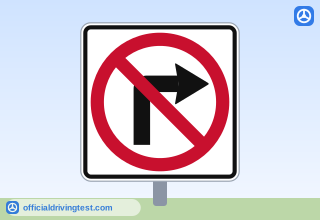
- The movement shown is prohibited from that lane or approach
- The movement shown is required from that lane or approach
- The movement shown is allowed only for buses and trucks
- The right lane ends ahead and traffic must merge left
Show answer
Correct answer: The movement shown is prohibited from that lane or approach
Movement prohibition signs indicate movements that are prohibited from a lane or approach.
Source: Connecticut Driver's Manual (Revised March 2023), page 48 · Open this page in the manual (Manual page 48)
-
Where can movement prohibition signs be located?
- Only on the right side of the road, never over a lane
- Only painted on the pavement of the lane, as arrows
- On the side of the road or hanging over the lane of travel
- Only on the left side of a divided highway median
Show answer
Correct answer: On the side of the road or hanging over the lane of travel
These signs can be on the side of the road or hanging over the lane, and arrows are sometimes painted on the road as a supplement.
Source: Connecticut Driver's Manual (Revised March 2023), page 48 · Open this page in the manual (Manual page 48)
-
What are ONE WAY signs used on?
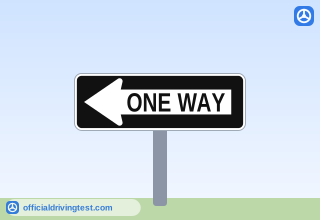
- Two-way streets with a center turn lane
- One-way streets or driveways
- Ramps leading to rest areas only
- Divided highways with a wide median
Show answer
Correct answer: One-way streets or driveways
ONE WAY signs are used on one-way streets or driveways.
Source: Connecticut Driver's Manual (Revised March 2023), page 48 · Open this page in the manual (Manual page 48)
-
Which way must you go when you see a ONE WAY sign?
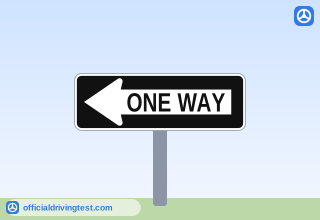
- In either direction if the street is empty
- Against the arrow when turning left
- In the direction of the arrow or straight ahead
- Only in the direction of the arrow
Show answer
Correct answer: Only in the direction of the arrow
You must always go only in the direction of the arrow on a ONE WAY sign.
Source: Connecticut Driver's Manual (Revised March 2023), page 48 · Open this page in the manual (Manual page 48)
-
What does a lane use control sign indicate?
- The permitted movement from a lane
- The maximum speed in a lane
- Where passing is not permitted
- Which lane is reserved for parking
Show answer
Correct answer: The permitted movement from a lane
The lane use control sign indicates the permitted movement from a lane.
Source: Connecticut Driver's Manual (Revised March 2023), page 48 · Open this page in the manual (Manual page 48)
-
What does a Keep Right sign tell you?
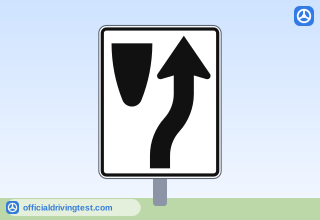
- That you may pass on the right when the road is wide enough to do so
- That the right lane ends ahead and you must merge into the left lane
- Where to drive near traffic islands, medians or other obstructions in the roadway
- That the right lane is reserved for slower vehicles and for turning traffic
Show answer
Correct answer: Where to drive near traffic islands, medians or other obstructions in the roadway
The Keep Right sign tells you where to drive when approaching obstructions in the middle of the roadway.
Source: Connecticut Driver's Manual (Revised March 2023), page 48 · Open this page in the manual (Manual page 48)
-
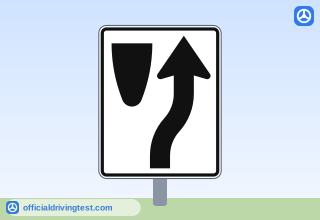
On a Keep Right sign, which side of the obstruction must you drive on?
- The side with the lighter traffic
- The side indicated by the arrow
- Whichever side is clear
- The left side when turning
Show answer
Correct answer: The side indicated by the arrow
You must drive to the side indicated by the arrow.
Source: Connecticut Driver's Manual (Revised March 2023), page 48 · Open this page in the manual (Manual page 48)
-
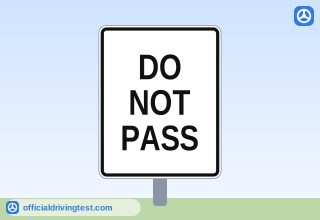
What do no passing signs tell you?
- Where passing is required
- Where passing may be done at any speed
- Where other vehicles will pass you
- Where passing is not permitted
Show answer
Correct answer: Where passing is not permitted
No passing signs tell you where passing is not permitted.
Source: Connecticut Driver's Manual (Revised March 2023), page 48 · Open this page in the manual (Manual page 48)
-
What are passing areas based on?
- How far you can see ahead
- The posted speed limit
- The number of vehicles behind you
- The width of the shoulder
Show answer
Correct answer: How far you can see ahead
Passing areas are based on how far you can see ahead.
Source: Connecticut Driver's Manual (Revised March 2023), page 48 · Open this page in the manual (Manual page 48)
-
Which of these do no passing zones take into account as unseen hazards?
- Weather forecasts and the time of day or night
- Parked cars and bicycle lanes
- Hills and curves, intersections and driveways
- School bus routes and bridges
Show answer
Correct answer: Hills and curves, intersections and driveways
No passing signs consider unseen hazards such as hills and curves, intersections, driveways and other places where a vehicle may enter the roadway.
Source: Connecticut Driver's Manual (Revised March 2023), page 48 · Open this page in the manual (Manual page 48)
-
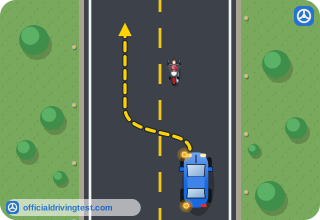
Where passing is permitted, when may you pass?
- Whenever the sign allows it
- Only if it is safe
- Whenever the car ahead is slower
- Only during daylight hours
Show answer
Correct answer: Only if it is safe
Where it is permitted to pass, you may do so only if it is safe, being aware of road conditions and other vehicles.
Source: Connecticut Driver's Manual (Revised March 2023), page 48 · Open this page in the manual (Manual page 48)
-
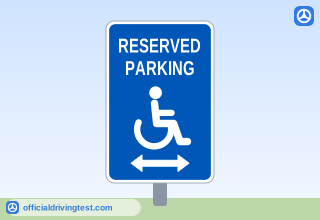
Who may use parking spaces marked with the Reserved Parking sign showing a wheelchair symbol?
- Any driver who stays for a short time
- Drivers who carry passengers
- Drivers of delivery vehicles only
- Individuals with disabled parking privileges
Show answer
Correct answer: Individuals with disabled parking privileges
Parking spaces marked with the disabled parking sign are reserved for individuals with disabled parking privileges.
Source: Connecticut Driver's Manual (Revised March 2023), page 48 · Open this page in the manual (Manual page 48)
-
What does a Speed Limit sign indicate?
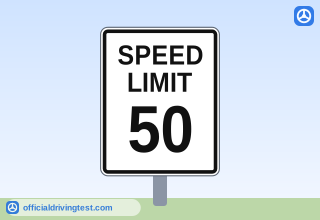
- The maximum speed that should be driven on the roadway
- The minimum speed required to stay on the roadway
- The advisory speed for a curve
- The average speed of traffic
Show answer
Correct answer: The maximum speed that should be driven on the roadway
The Speed Limit sign indicates the maximum speed that should be driven on the roadway.
Source: Connecticut Driver's Manual (Revised March 2023), page 48 · Open this page in the manual (Manual page 48)
-
What are the usual color and shape of warning signs?
- White with red lettering or symbols, and most are square
- Green with white lettering or symbols, and most are rectangular
- Yellow with black lettering or symbols, and most are diamond-shaped
- Red with white lettering or symbols, and most are triangular
Show answer
Correct answer: Yellow with black lettering or symbols, and most are diamond-shaped
Warning signs are usually yellow with black lettering or symbols, and most are diamond-shaped.
Source: Connecticut Driver's Manual (Revised March 2023), page 49 · Open this page in the manual (Manual page 49)
-
What do warning signs tell you to do?
- Stop immediately at the sign
- Slow down and be prepared to stop if necessary
- Speed up to clear the hazard as quickly as you can
- Pull over and wait for instructions
Show answer
Correct answer: Slow down and be prepared to stop if necessary
Warning signs warn you to slow down and be prepared to stop if necessary, because a special situation or hazard is ahead.
Source: Connecticut Driver's Manual (Revised March 2023), page 49 · Open this page in the manual (Manual page 49)
-
A diamond warning sign shows a traffic light with three circles stacked vertically. What does it mean?
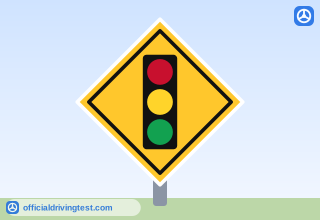
- A railroad crossing signal is ahead; stop and look both ways
- A pedestrian signal is ahead; wait for the walk signal
- The signal ahead is broken; treat the corner as a stop
- Traffic signals are ahead; slow down and prepare to stop
Show answer
Correct answer: Traffic signals are ahead; slow down and prepare to stop
The Signal Ahead sign means traffic signals are ahead; slow down and prepare to stop.
Source: Connecticut Driver's Manual (Revised March 2023), page 49 · Open this page in the manual (Manual page 49)
-
A diamond warning sign shows an arrow pointing up above a stop-sign shape. What does it mean?
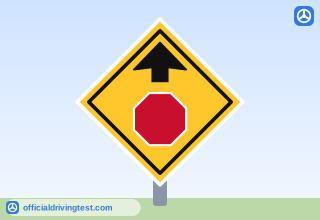
- A stop sign is ahead; slow down and prepare to stop
- A traffic signal is ahead; watch for the color change
- You must stop here and then turn right or left
- A divided highway ends ahead and traffic merges
Show answer
Correct answer: A stop sign is ahead; slow down and prepare to stop
The Stop Ahead sign means a stop sign is ahead; slow down and prepare to stop.
Source: Connecticut Driver's Manual (Revised March 2023), page 49 · Open this page in the manual (Manual page 49)
-
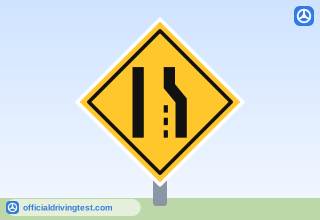
What does the Reduction in Lanes sign warn you of on multi-lane highways?
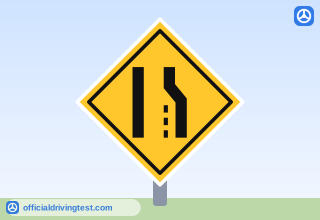
- More traffic lanes in the direction you are traveling
- A lane reserved for buses and carpool vehicles only
- Fewer traffic lanes in the direction you are traveling
- A divided highway turning into a two-way highway
Show answer
Correct answer: Fewer traffic lanes in the direction you are traveling
The Reduction in Lanes sign is used on multi-lane highways to warn of fewer lanes in your direction of travel.
Source: Connecticut Driver's Manual (Revised March 2023), page 49 · Open this page in the manual (Manual page 49)
-
What should you be prepared to do when you see the Reduction in Lanes sign?
- Pass the slower vehicles ahead before the lanes narrow
- Change lanes or allow other vehicles to merge into your lane
- Stop and wait for the lane to clear
- Move onto the shoulder to continue
Show answer
Correct answer: Change lanes or allow other vehicles to merge into your lane
Be prepared to change lanes or to allow other vehicles to merge into your lane.
Source: Connecticut Driver's Manual (Revised March 2023), page 49 · Open this page in the manual (Manual page 49)
-
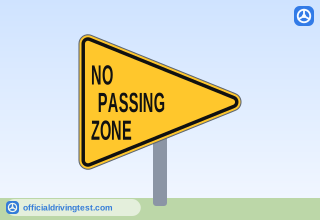
What does a sign reading NO PASSING ZONE mark?
- The end of a no passing zone
- A zone where only trucks may pass
- A zone where passing is allowed on the right
- The beginning of a no passing zone
Show answer
Correct answer: The beginning of a no passing zone
This sign marks the beginning of a no passing zone; you may not pass cars ahead of you in your lane.
Source: Connecticut Driver's Manual (Revised March 2023), page 49 · Open this page in the manual (Manual page 49)
-
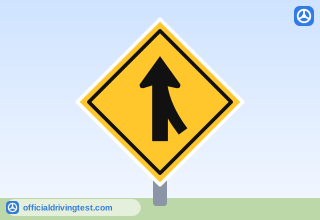
A yellow diamond sign shows an upward arrow with a shorter line joining it from the right. What does it mean?
- Two lanes of traffic are about to become one
- One lane is about to split into two
- The road ahead is a two-way road
- The lane on your left is for passing only
Show answer
Correct answer: Two lanes of traffic are about to become one
The Merge sign means two lanes of traffic are about to become one.
Source: Connecticut Driver's Manual (Revised March 2023), page 49 · Open this page in the manual (Manual page 49)
-
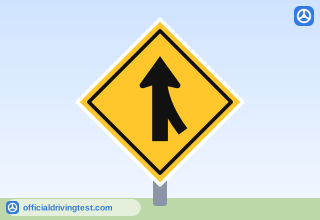
Who is responsible for merging smoothly where the Merge sign is posted?
- Only the driver in the left lane
- Only the driver in the right lane
- Drivers in both lanes
- Only the driver who arrives first
Show answer
Correct answer: Drivers in both lanes
Drivers in both lanes are responsible for merging smoothly.
Source: Connecticut Driver's Manual (Revised March 2023), page 49 · Open this page in the manual (Manual page 49)
-
What should you do when you see a Pedestrian Crossing sign?
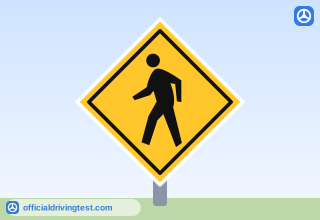
- Sound your horn to warn them and keep driving at your speed
- Watch for people crossing and be prepared to slow down and stop
- Speed up to clear the crossing before people step out
- Stop only if someone is in the crosswalk
Show answer
Correct answer: Watch for people crossing and be prepared to slow down and stop
The Pedestrian Crossing sign means watch for people crossing your path and be prepared to slow down and stop.
Source: Connecticut Driver's Manual (Revised March 2023), page 49 · Open this page in the manual (Manual page 49)
-
What should you do when you see the School Zone sign, showing two children walking?
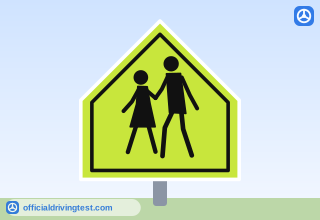
- Slow down, watch for children and obey any crossing guards
- Maintain your speed and sound your horn to warn children
- Stop and wait until the children are gone
- Slow down only when children are visible
Show answer
Correct answer: Slow down, watch for children and obey any crossing guards
The School Zone sign means to slow down, watch out for children crossing or playing, be ready to stop and obey crossing guards.
Source: Connecticut Driver's Manual (Revised March 2023), page 49 · Open this page in the manual (Manual page 49)
-
What is a Rectangular Rapid Flashing Beacon (RRFB) designed to do?
- Warn drivers that a railroad crossing is coming up ahead of them
- Show drivers the advisory speed for a curve in the roadway
- Allow pedestrians to safely cross streets with high volumes of traffic
- Tell drivers that a school bus ahead is stopping to load children
Show answer
Correct answer: Allow pedestrians to safely cross streets with high volumes of traffic
The RRFB is designed to let pedestrians safely cross streets with high volumes of traffic at unsignalized intersections or mid-block crossings.
Source: Connecticut Driver's Manual (Revised March 2023), page 49 · Open this page in the manual (Manual page 49)
-
A Slippery when Wet sign is posted. What should you do on the wet pavement ahead?
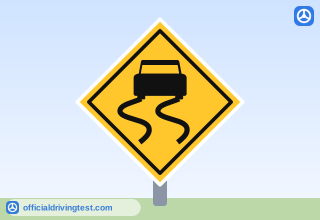
- Keep your speed and brake firmly when you reach curves
- Reduce your speed and increase the distance to the car ahead
- Reduce your speed and change direction often to keep control
- Keep your speed and follow closely to see the road
Show answer
Correct answer: Reduce your speed and increase the distance to the car ahead
On wet pavement, reduce speed, do not brake hard or change direction suddenly, and increase the distance to the car ahead.
Source: Connecticut Driver's Manual (Revised March 2023), page 49 · Open this page in the manual (Manual page 49)
-
Where are the actions listed for the Slippery when Wet sign needed?
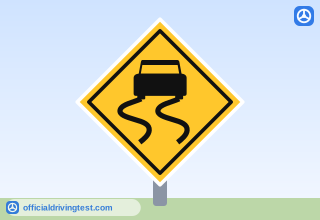
- Only on the roads where the sign is posted, not elsewhere
- Only on highways and expressways, not on local streets
- Only when the rain is heavy enough to flood the road
- On all wet roads, and especially where the sign is posted
Show answer
Correct answer: On all wet roads, and especially where the sign is posted
These actions are needed on all wet roads and especially on roads where the sign is posted.
Source: Connecticut Driver's Manual (Revised March 2023), page 49 · Open this page in the manual (Manual page 49)
-
What does the Two-Way Road Way sign tell you?
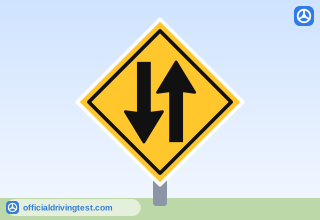
- You are leaving a divided roadway for a two-way highway
- You are entering a divided roadway with two lanes each way
- You must keep right when you reach the end of a median
- Two lanes of traffic are about to become one
Show answer
Correct answer: You are leaving a divided roadway for a two-way highway
This sign tells you that you are leaving a divided roadway and will be driving on a two-way highway.
Source: Connecticut Driver's Manual (Revised March 2023), page 49 · Open this page in the manual (Manual page 49)
-
Where is an Advisory Speed plaque usually installed?
- Above a speed limit sign
- On the pavement of the lane
- Below another warning sign
- Beside every stop sign
Show answer
Correct answer: Below another warning sign
An Advisory Speed plaque is usually installed below another warning sign and indicates the advisory speed for a condition.
Source: Connecticut Driver's Manual (Revised March 2023), page 49 · Open this page in the manual (Manual page 49)
-
What does an Advisory Speed plaque, such as one reading 35 MPH, indicate?
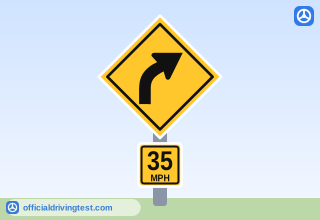
- The maximum legal speed on the road
- The advisory speed for a condition
- The minimum speed on the road
- The speed limit in a school zone
Show answer
Correct answer: The advisory speed for a condition
The Advisory Speed plaque is used to indicate the advisory speed for a condition.
Source: Connecticut Driver's Manual (Revised March 2023), page 49 · Open this page in the manual (Manual page 49)
-
A diamond-shaped sign shows a wedge-shaped divider with an arrow on each side. What does it tell you?
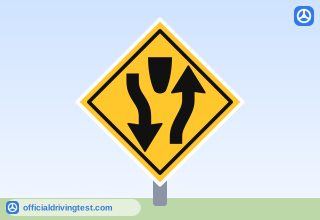
- The highway ahead is split into two roadways by a divider
- The road ahead narrows from two lanes down to a single lane
- Traffic from a side road may enter the highway ahead
- The two roadways ahead come together and become one road
Show answer
Correct answer: The highway ahead is split into two roadways by a divider
The Divided Highway Begins sign warns that the highway ahead is split into two roadways by a median or divider.
Source: Connecticut Driver's Manual (Revised March 2023), page 50 · Open this page in the manual (Manual page 50)
-
At a Divided Highway Begins sign, which way should you keep?
- Left
- Either side, as you prefer
- Right
- In the center of the road
Show answer
Correct answer: Right
The manual says each roadway is one-way and tells you to keep right.
Source: Connecticut Driver's Manual (Revised March 2023), page 50 · Open this page in the manual (Manual page 50)
-
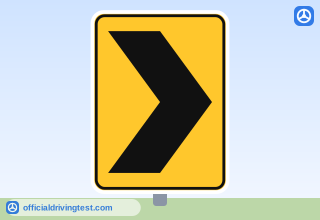
A Change in Direction sign warns you of a change in direction or what else?
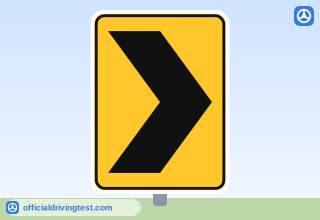
- A school zone ahead
- A narrowing of the road
- A railroad crossing ahead
- A lowered speed limit
Show answer
Correct answer: A narrowing of the road
The sign warns of a change in direction or narrowing of the road.
Source: Connecticut Driver's Manual (Revised March 2023), page 50 · Open this page in the manual (Manual page 50)
-
Where may you find several Change in Direction signs, each showing a large black arrow?
- Only on the inside of a curve at the entrance to a highway
- Beside school zones and busy pedestrian crosswalks in town
- Only at the point where a divided highway begins and ends
- On the outside of a sharp curve or on approaches to a narrow bridge
Show answer
Correct answer: On the outside of a sharp curve or on approaches to a narrow bridge
The manual says several of these signs may stand on the outside of a sharp curve or on approaches to a narrow bridge.
Source: Connecticut Driver's Manual (Revised March 2023), page 50 · Open this page in the manual (Manual page 50)
-
How many signs does the manual show to warn you of intersections ahead?
- Four
- Two
- Three
- Six
Show answer
Correct answer: Four
The manual says four signs warn you of intersections ahead.
Source: Connecticut Driver's Manual (Revised March 2023), page 50 · Open this page in the manual (Manual page 50)
-
What may be posted along with a sign warning of an intersection ahead?
- A sign showing the toll for the road
- A sign listing the next five exits
- A sign naming the intersecting road
- A sign showing the road’s age
Show answer
Correct answer: A sign naming the intersecting road
The manual says a sign naming the intersecting road may also be posted.
Source: Connecticut Driver's Manual (Revised March 2023), page 50 · Open this page in the manual (Manual page 50)
-
Intersections Ahead signs warn you of intersections where what may happen?
- Trains may cross the road and drivers must stop and wait
- Traffic may exist or a right or left turn may be required
- Road work may block the lane and traffic may be diverted
- Animals may cross the road at any time of day or night
Show answer
Correct answer: Traffic may exist or a right or left turn may be required
The manual says these signs warn of intersections ahead where traffic may exist or a right or left turn may be required.
Source: Connecticut Driver's Manual (Revised March 2023), page 50 · Open this page in the manual (Manual page 50)
-
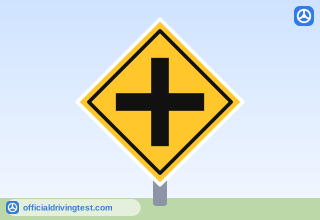
A diamond-shaped sign shows a plus symbol, with one road crossing another. Which intersection sign is it?
- Side Road
- “T” Intersection
- “Y” Intersection
- Crossroad
Show answer
Correct answer: Crossroad
The manual shows the plus-shaped symbol as the Crossroad sign.
Source: Connecticut Driver's Manual (Revised March 2023), page 50 · Open this page in the manual (Manual page 50)
-
A diamond-shaped sign shows a vertical bar with a short stub joining it from one side. Which intersection sign is it?
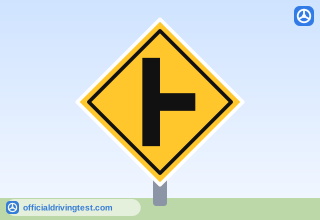
- Side Road
- Crossroad
- “T” Intersection
- “Y” Intersection
Show answer
Correct answer: Side Road
The manual labels this picture, a main road with one short road joining it, as the Side Road sign.
Source: Connecticut Driver's Manual (Revised March 2023), page 50 · Open this page in the manual (Manual page 50)
-
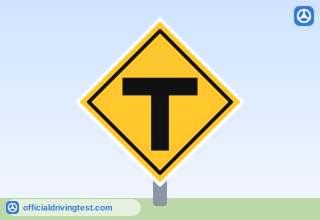
A diamond-shaped sign shows a horizontal bar with one bar joining it from below at the center. Which intersection sign is it?
- Crossroad
- Side Road
- “T” Intersection
- “Y” Intersection
Show answer
Correct answer: “T” Intersection
The manual labels this picture as the “T” Intersection sign.
Source: Connecticut Driver's Manual (Revised March 2023), page 50 · Open this page in the manual (Manual page 50)
-
A diamond-shaped sign shows one road that splits into two branches at the top. Which intersection sign is it?
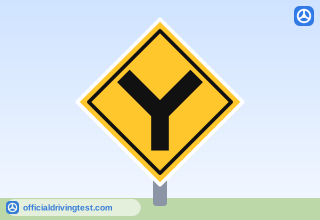
- Crossroad
- “Y” Intersection
- Side Road
- “T” Intersection
Show answer
Correct answer: “Y” Intersection
The manual labels this picture as the “Y” Intersection sign.
Source: Connecticut Driver's Manual (Revised March 2023), page 50 · Open this page in the manual (Manual page 50)
-
On signs posted before turns and curves, what tells you what to expect?
- The color of the border
- The number of the route
- The size of the sign
- The shape of the arrow
Show answer
Correct answer: The shape of the arrow
The manual says the shape of the arrow tells you what to expect.
Source: Connecticut Driver's Manual (Revised March 2023), page 50 · Open this page in the manual (Manual page 50)
-
What may be posted below the arrow on a sign before a turn or curve?
- A small sign showing the maximum safe speed
- A small sign showing the next exit
- A small sign showing the distance to the next town
- A small sign showing the minimum speed
Show answer
Correct answer: A small sign showing the maximum safe speed
The manual says a small sign showing the maximum safe speed may also be posted below the arrow.
Source: Connecticut Driver's Manual (Revised March 2023), page 50 · Open this page in the manual (Manual page 50)
-
A diamond-shaped sign shows a single arrow bending smoothly to the right. Which sign is it?
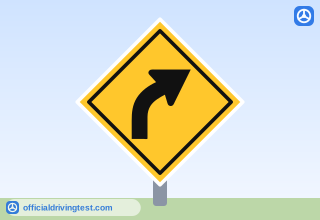
- Winding Road Ahead
- Change in Direction
- Road Curves to Right
- Divided Highway Begins
Show answer
Correct answer: Road Curves to Right
The manual labels this picture, one arrow curving to the right, as Road Curves to Right.
Source: Connecticut Driver's Manual (Revised March 2023), page 50 · Open this page in the manual (Manual page 50)
-
A diamond-shaped sign shows an arrow with a sharp right-angle bend toward the right. Which sign is it?
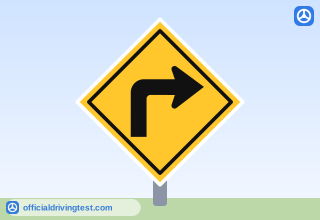
- Winding Road Ahead
- Right Turn Ahead
- Side Road
- Divided Highway Begins
Show answer
Correct answer: Right Turn Ahead
The manual labels this picture, an arrow with a right-angle bend, as Right Turn Ahead.
Source: Connecticut Driver's Manual (Revised March 2023), page 50 · Open this page in the manual (Manual page 50)
-
A diamond-shaped sign shows one arrow that twists back and forth several times. Which sign is it?
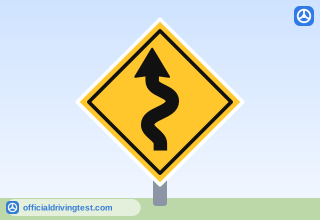
- Right Turn Ahead
- Road Curves to Right
- Detour
- Winding Road Ahead
Show answer
Correct answer: Winding Road Ahead
The manual labels this picture, a snaking arrow, as Winding Road Ahead.
Source: Connecticut Driver's Manual (Revised March 2023), page 50 · Open this page in the manual (Manual page 50)
-
What is the purpose of guide signs?
- To direct a motorist to certain places
- To stop traffic at intersections
- To mark where passing is not allowed
- To warn of hazards on the road
Show answer
Correct answer: To direct a motorist to certain places
The manual says guide signs direct a motorist to certain places and tell you where you are and how to get where you want to go.
Source: Connecticut Driver's Manual (Revised March 2023), page 50 · Open this page in the manual (Manual page 50)
-
Which shape are most guide signs?
- Octagonal
- Triangular
- Rectangular
- Diamond-shaped
Show answer
Correct answer: Rectangular
The manual says most guide signs are rectangular.
Source: Connecticut Driver's Manual (Revised March 2023), page 50 · Open this page in the manual (Manual page 50)
-
What do the shape and color of a route number sign indicate?
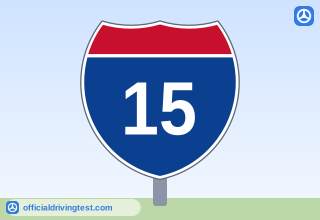
- The maximum speed limit on that roadway at all times
- The type of roadway, such as interstate, state or county road
- The number of lanes found on that roadway at all times
- The distance to the next exit on that roadway ahead
Show answer
Correct answer: The type of roadway, such as interstate, state or county road
The manual says the shape and color of a route number sign indicate the type of roadway.
Source: Connecticut Driver's Manual (Revised March 2023), page 50 · Open this page in the manual (Manual page 50)
-
When planning a trip, what does the manual say to use to determine your route?
- A mileposts list
- The message boards
- A list of exit numbers
- A road map
Show answer
Correct answer: A road map
The manual says to use a road map to determine your route when planning a trip.
Source: Connecticut Driver's Manual (Revised March 2023), page 50 · Open this page in the manual (Manual page 50)
-
During a trip, what should you follow to keep from getting lost?
- The route signs
- The message boards
- The work area signs
- The vehicles ahead of you
Show answer
Correct answer: The route signs
The manual says that during the trip you should follow the route signs to keep from getting lost.
Source: Connecticut Driver's Manual (Revised March 2023), page 50 · Open this page in the manual (Manual page 50)
-
Which of these do service signs show the locations of?
- Rest areas, gas stations, campgrounds or hospitals
- State lines, city limits and county borders
- Detours, flag persons and work zone speed limits
- Streams, elevations and other geographical items
Show answer
Correct answer: Rest areas, gas stations, campgrounds or hospitals
The manual says service signs show the locations of services such as rest areas, gas stations, campgrounds or hospitals.
Source: Connecticut Driver's Manual (Revised March 2023), page 51 · Open this page in the manual (Manual page 51)
-
Which of these do Destination and Distance signs direct you to?
- Hospitals and gas stations
- Bike routes and parking areas
- Rest areas and campgrounds
- Streams and landmarks
Show answer
Correct answer: Bike routes and parking areas
The manual says these signs direct you to bike routes, parking areas, mileposts and specific exits.
Source: Connecticut Driver's Manual (Revised March 2023), page 51 · Open this page in the manual (Manual page 51)
-
How often are mileposts placed along the freeway?
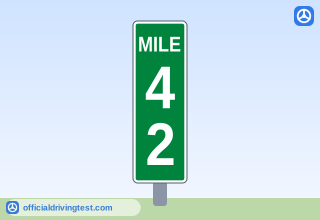
- Every half mile
- Every two miles
- Every five miles
- Every mile
Show answer
Correct answer: Every mile
The manual says mileposts are placed every mile along the freeway from one end of the state to the other.
Source: Connecticut Driver's Manual (Revised March 2023), page 51 · Open this page in the manual (Manual page 51)
-
Where does zero usually start on the freeway mileposts?
- At the south and west borders of the state
- At the north and east borders of the state
- At the state capital
- At the center of the state
Show answer
Correct answer: At the south and west borders of the state
The manual says zero usually starts at the south and west borders of the state.
Source: Connecticut Driver's Manual (Revised March 2023), page 51 · Open this page in the manual (Manual page 51)
-
What can mileposts be used to determine?
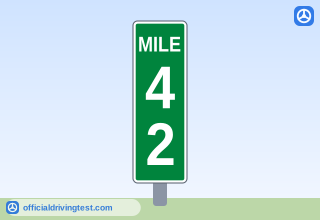
- The speed limit on the road ahead of you
- The number of lanes on the road ahead
- The distance to exits, cities or state lines
- The location of rest areas and gas stations only
Show answer
Correct answer: The distance to exits, cities or state lines
The manual says mileposts can be used to determine the distance to exits, cities or state lines.
Source: Connecticut Driver's Manual (Revised March 2023), page 51 · Open this page in the manual (Manual page 51)
-
How can you compute how far you are from the exit you want to use?
- By counting the green signs you pass along the way
- By using the milepost number and the exit number
- By reading the route number sign at each interchange
- By checking the message boards along the highway
Show answer
Correct answer: By using the milepost number and the exit number
The manual says you can use the milepost number and the exit number to compute your distance from the exit.
Source: Connecticut Driver's Manual (Revised March 2023), page 51 · Open this page in the manual (Manual page 51)
-
Which signs show state lines, city limits and other boundaries?
- Service signs
- Work area signs
- Parks and Recreation signs
- Information signs
Show answer
Correct answer: Information signs
The manual says information signs include items such as state lines, city limits and other boundaries.
Source: Connecticut Driver's Manual (Revised March 2023), page 51 · Open this page in the manual (Manual page 51)
-
Which of these may you find on information signs?
- Names of streams, elevations and landmarks
- Detours and slow moving construction equipment
- Rest areas, gas stations and hospitals
- Railroad crossings and flag persons ahead
Show answer
Correct answer: Names of streams, elevations and landmarks
The manual says information signs may also show names of streams, elevations, landmarks and other items of geographical interest.
Source: Connecticut Driver's Manual (Revised March 2023), page 51 · Open this page in the manual (Manual page 51)
-
A rectangular sign with the word DETOUR and an arrow is used at the beginning of what?
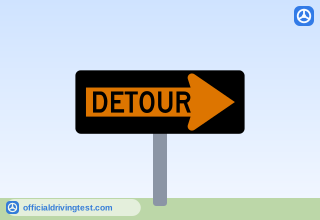
- A road that has been repaved and reopened to traffic
- An alternate route established because a road has been closed
- A lane reserved for slow vehicles and heavy trucks only
- A road that is open only to local traffic and residents
Show answer
Correct answer: An alternate route established because a road has been closed
The manual says the Detour sign is used at the beginning of an alternate route established because a road has been closed.
Source: Connecticut Driver's Manual (Revised March 2023), page 51 · Open this page in the manual (Manual page 51)
-
What should you do about directions posted on message boards along the highway?
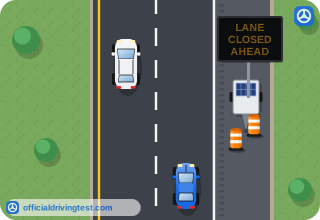
- Always obey them
- Obey them only if no police are nearby
- Obey them only in a work zone
- Treat them as suggestions
Show answer
Correct answer: Always obey them
The manual says to always obey any directions posted on message boards.
Source: Connecticut Driver's Manual (Revised March 2023), page 52 · Open this page in the manual (Manual page 52)
-
Which of these may portable or permanent message boards provide information about?
- Fuel prices and the menus at nearby rest areas
- Local sports schedules and community events
- Traffic, road, weather or other hazardous conditions
- Court dates and fine amounts for traffic tickets
Show answer
Correct answer: Traffic, road, weather or other hazardous conditions
The manual says message boards may provide information about traffic, road, weather or other hazardous conditions.
Source: Connecticut Driver's Manual (Revised March 2023), page 52 · Open this page in the manual (Manual page 52)