Connecticut: Road signs — Part 2 Practice Test
Questions in this part include: “What are passing areas based on?” · “What are the usual color and shape of warning signs?”
Independent educational site · not affiliated with any government agency or DMV
Ready? Test yourself
- Instant feedback with an explanation
- Every answer cites its source in the manual
- Your best score is saved on this device
Questions are original and based on the official manual "Connecticut Driver's Manual" (Revised March 2023), Connecticut Department of Motor Vehicles (DMV).
All 18 questions in this practice test
Take the test above first, then use this list to study. Tap “Show answer” to see the correct answer and explanation.
Show the questions and answersHide the questions
-
What are passing areas based on?
- How far you can see ahead
- The posted speed limit
- The number of vehicles behind you
- The width of the shoulder
Show answer
Correct answer: How far you can see ahead
Passing areas are based on how far you can see ahead.
Source: Connecticut Driver's Manual (Revised March 2023), page 48 · Open this page in the manual (Manual page 48)
-
Which of these do no passing zones take into account as unseen hazards?
- Weather forecasts and the time of day or night
- Parked cars and bicycle lanes
- Hills and curves, intersections and driveways
- School bus routes and bridges
Show answer
Correct answer: Hills and curves, intersections and driveways
No passing signs consider unseen hazards such as hills and curves, intersections, driveways and other places where a vehicle may enter the roadway.
Source: Connecticut Driver's Manual (Revised March 2023), page 48 · Open this page in the manual (Manual page 48)
-
Where passing is permitted, when may you pass?
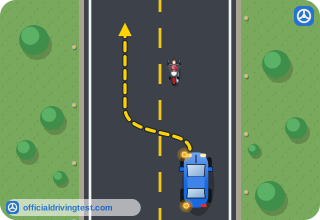
- Whenever the sign allows it
- Only if it is safe
- Whenever the car ahead is slower
- Only during daylight hours
Show answer
Correct answer: Only if it is safe
Where it is permitted to pass, you may do so only if it is safe, being aware of road conditions and other vehicles.
Source: Connecticut Driver's Manual (Revised March 2023), page 48 · Open this page in the manual (Manual page 48)
-
Who may use parking spaces marked with the Reserved Parking sign showing a wheelchair symbol?
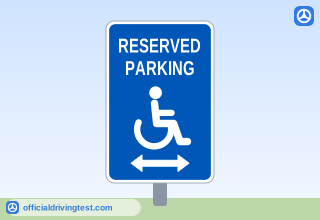
- Any driver who stays for a short time
- Drivers who carry passengers
- Drivers of delivery vehicles only
- Individuals with disabled parking privileges
Show answer
Correct answer: Individuals with disabled parking privileges
Parking spaces marked with the disabled parking sign are reserved for individuals with disabled parking privileges.
Source: Connecticut Driver's Manual (Revised March 2023), page 48 · Open this page in the manual (Manual page 48)
-
What does a Speed Limit sign indicate?
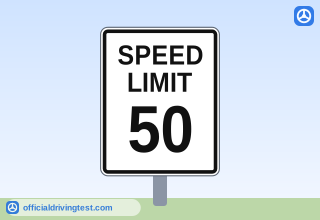
- The maximum speed that should be driven on the roadway
- The minimum speed required to stay on the roadway
- The advisory speed for a curve
- The average speed of traffic
Show answer
Correct answer: The maximum speed that should be driven on the roadway
The Speed Limit sign indicates the maximum speed that should be driven on the roadway.
Source: Connecticut Driver's Manual (Revised March 2023), page 48 · Open this page in the manual (Manual page 48)
-
What are the usual color and shape of warning signs?
- White with red lettering or symbols, and most are square
- Green with white lettering or symbols, and most are rectangular
- Yellow with black lettering or symbols, and most are diamond-shaped
- Red with white lettering or symbols, and most are triangular
Show answer
Correct answer: Yellow with black lettering or symbols, and most are diamond-shaped
Warning signs are usually yellow with black lettering or symbols, and most are diamond-shaped.
Source: Connecticut Driver's Manual (Revised March 2023), page 49 · Open this page in the manual (Manual page 49)
-
What do warning signs tell you to do?
- Stop immediately at the sign
- Slow down and be prepared to stop if necessary
- Speed up to clear the hazard as quickly as you can
- Pull over and wait for instructions
Show answer
Correct answer: Slow down and be prepared to stop if necessary
Warning signs warn you to slow down and be prepared to stop if necessary, because a special situation or hazard is ahead.
Source: Connecticut Driver's Manual (Revised March 2023), page 49 · Open this page in the manual (Manual page 49)
-
A diamond warning sign shows a traffic light with three circles stacked vertically. What does it mean?
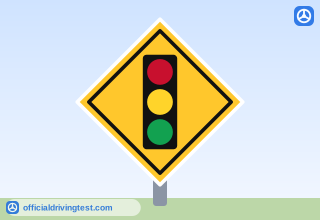
- A railroad crossing signal is ahead; stop and look both ways
- A pedestrian signal is ahead; wait for the walk signal
- The signal ahead is broken; treat the corner as a stop
- Traffic signals are ahead; slow down and prepare to stop
Show answer
Correct answer: Traffic signals are ahead; slow down and prepare to stop
The Signal Ahead sign means traffic signals are ahead; slow down and prepare to stop.
Source: Connecticut Driver's Manual (Revised March 2023), page 49 · Open this page in the manual (Manual page 49)
-
A diamond warning sign shows an arrow pointing up above a stop-sign shape. What does it mean?
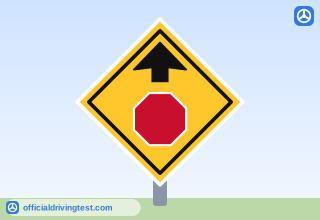
- A stop sign is ahead; slow down and prepare to stop
- A traffic signal is ahead; watch for the color change
- You must stop here and then turn right or left
- A divided highway ends ahead and traffic merges
Show answer
Correct answer: A stop sign is ahead; slow down and prepare to stop
The Stop Ahead sign means a stop sign is ahead; slow down and prepare to stop.
Source: Connecticut Driver's Manual (Revised March 2023), page 49 · Open this page in the manual (Manual page 49)
-
What does the Reduction in Lanes sign warn you of on multi-lane highways?
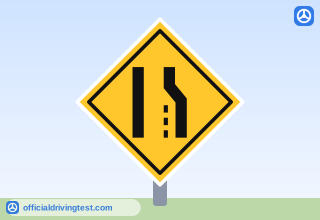
- More traffic lanes in the direction you are traveling
- A lane reserved for buses and carpool vehicles only
- Fewer traffic lanes in the direction you are traveling
- A divided highway turning into a two-way highway
Show answer
Correct answer: Fewer traffic lanes in the direction you are traveling
The Reduction in Lanes sign is used on multi-lane highways to warn of fewer lanes in your direction of travel.
Source: Connecticut Driver's Manual (Revised March 2023), page 49 · Open this page in the manual (Manual page 49)
-
What should you be prepared to do when you see the Reduction in Lanes sign?
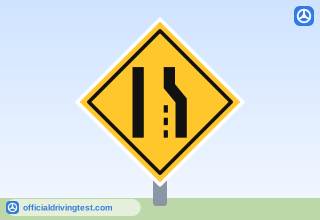
- Pass the slower vehicles ahead before the lanes narrow
- Change lanes or allow other vehicles to merge into your lane
- Stop and wait for the lane to clear
- Move onto the shoulder to continue
Show answer
Correct answer: Change lanes or allow other vehicles to merge into your lane
Be prepared to change lanes or to allow other vehicles to merge into your lane.
Source: Connecticut Driver's Manual (Revised March 2023), page 49 · Open this page in the manual (Manual page 49)
-
What does a sign reading NO PASSING ZONE mark?
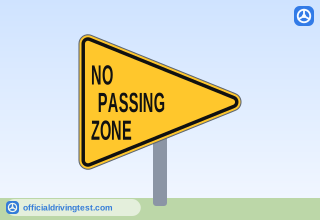
- The end of a no passing zone
- A zone where only trucks may pass
- A zone where passing is allowed on the right
- The beginning of a no passing zone
Show answer
Correct answer: The beginning of a no passing zone
This sign marks the beginning of a no passing zone; you may not pass cars ahead of you in your lane.
Source: Connecticut Driver's Manual (Revised March 2023), page 49 · Open this page in the manual (Manual page 49)
-
A yellow diamond sign shows an upward arrow with a shorter line joining it from the right. What does it mean?
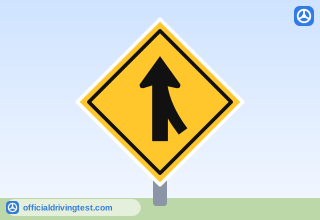
- Two lanes of traffic are about to become one
- One lane is about to split into two
- The road ahead is a two-way road
- The lane on your left is for passing only
Show answer
Correct answer: Two lanes of traffic are about to become one
The Merge sign means two lanes of traffic are about to become one.
Source: Connecticut Driver's Manual (Revised March 2023), page 49 · Open this page in the manual (Manual page 49)
-
Who is responsible for merging smoothly where the Merge sign is posted?
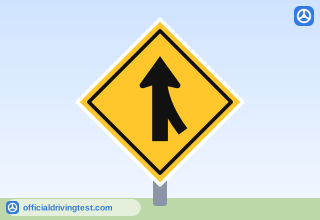
- Only the driver in the left lane
- Only the driver in the right lane
- Drivers in both lanes
- Only the driver who arrives first
Show answer
Correct answer: Drivers in both lanes
Drivers in both lanes are responsible for merging smoothly.
Source: Connecticut Driver's Manual (Revised March 2023), page 49 · Open this page in the manual (Manual page 49)
-
What should you do when you see a Pedestrian Crossing sign?
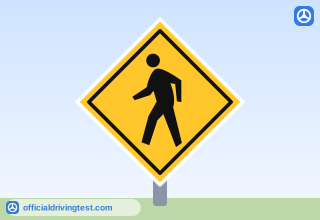
- Sound your horn to warn them and keep driving at your speed
- Watch for people crossing and be prepared to slow down and stop
- Speed up to clear the crossing before people step out
- Stop only if someone is in the crosswalk
Show answer
Correct answer: Watch for people crossing and be prepared to slow down and stop
The Pedestrian Crossing sign means watch for people crossing your path and be prepared to slow down and stop.
Source: Connecticut Driver's Manual (Revised March 2023), page 49 · Open this page in the manual (Manual page 49)
-
What should you do when you see the School Zone sign, showing two children walking?
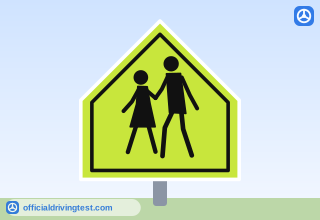
- Slow down, watch for children and obey any crossing guards
- Maintain your speed and sound your horn to warn children
- Stop and wait until the children are gone
- Slow down only when children are visible
Show answer
Correct answer: Slow down, watch for children and obey any crossing guards
The School Zone sign means to slow down, watch out for children crossing or playing, be ready to stop and obey crossing guards.
Source: Connecticut Driver's Manual (Revised March 2023), page 49 · Open this page in the manual (Manual page 49)
-
What is a Rectangular Rapid Flashing Beacon (RRFB) designed to do?
- Warn drivers that a railroad crossing is coming up ahead of them
- Show drivers the advisory speed for a curve in the roadway
- Allow pedestrians to safely cross streets with high volumes of traffic
- Tell drivers that a school bus ahead is stopping to load children
Show answer
Correct answer: Allow pedestrians to safely cross streets with high volumes of traffic
The RRFB is designed to let pedestrians safely cross streets with high volumes of traffic at unsignalized intersections or mid-block crossings.
Source: Connecticut Driver's Manual (Revised March 2023), page 49 · Open this page in the manual (Manual page 49)
-
A Slippery when Wet sign is posted. What should you do on the wet pavement ahead?
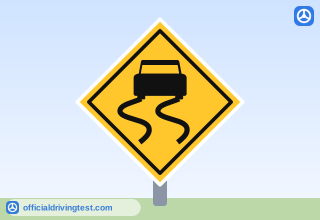
- Keep your speed and brake firmly when you reach curves
- Reduce your speed and increase the distance to the car ahead
- Reduce your speed and change direction often to keep control
- Keep your speed and follow closely to see the road
Show answer
Correct answer: Reduce your speed and increase the distance to the car ahead
On wet pavement, reduce speed, do not brake hard or change direction suddenly, and increase the distance to the car ahead.
Source: Connecticut Driver's Manual (Revised March 2023), page 49 · Open this page in the manual (Manual page 49)