Connecticut: Road signs — Part 1 Practice Test
Questions in this part include: “What kind of information do regulatory signs give you?” · “What is the shape of a yield sign?”
Independent educational site · not affiliated with any government agency or DMV
Ready? Test yourself
- Instant feedback with an explanation
- Every answer cites its source in the manual
- Your best score is saved on this device
Questions are original and based on the official manual "Connecticut Driver's Manual" (Revised March 2023), Connecticut Department of Motor Vehicles (DMV).
All 19 questions in this practice test
Take the test above first, then use this list to study. Tap “Show answer” to see the correct answer and explanation.
Show the questions and answersHide the questions
-
What kind of information do regulatory signs give you?
- Where food, fuel and other services can be found along the roadway
- Road conditions and dangers that lie ahead
- Rules for traffic direction, lane use, turning, speed and parking
- Which parks and recreation areas are nearby
Show answer
Correct answer: Rules for traffic direction, lane use, turning, speed and parking
Regulatory signs give information about rules for traffic direction, lane use, turning, speed, parking and other special situations.
Source: Connecticut Driver's Manual (Revised March 2023), page 47 · Open this page in the manual (Manual page 47)
-
How many sides does a stop sign have?
- Four
- Eight
- Six
- Ten
Show answer
Correct answer: Eight
A stop sign has eight sides and is red with white letters.
Source: Connecticut Driver's Manual (Revised March 2023), page 47 · Open this page in the manual (Manual page 47)
-
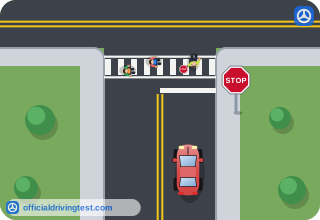
What must you do at a stop sign?
- Slow down and continue through the intersection if no vehicles are in sight
- Stop only if other vehicles are in the intersection or approaching it
- Stop only if pedestrians are crossing the road in front of you at the time
- Come to a full and complete stop at the sign or stop line, if one is present
Show answer
Correct answer: Come to a full and complete stop at the sign or stop line, if one is present
You must come to a full and complete stop at a stop sign or stop line, if one is present.
Source: Connecticut Driver's Manual (Revised March 2023), page 47 · Open this page in the manual (Manual page 47)
-
After stopping at a stop sign, when may you pull forward?
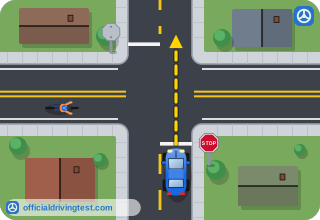
- Only when crossing vehicles and pedestrians have cleared and it is safe
- As soon as the crossing vehicles slow down to let you go ahead
- Whenever you have stopped for at least three full seconds
- As soon as you have looked both ways one time
Show answer
Correct answer: Only when crossing vehicles and pedestrians have cleared and it is safe
You must wait until crossing vehicles and pedestrians have cleared, and may pull forward only when it is safe to do so.
Source: Connecticut Driver's Manual (Revised March 2023), page 47 · Open this page in the manual (Manual page 47)
-
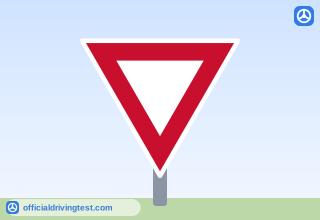
What is the shape of a yield sign?
- An upward pointing triangle
- A diamond
- A downward pointing triangle
- An eight-sided octagon
Show answer
Correct answer: A downward pointing triangle
A yield sign is a downward pointing triangle, red and white with red letters.
Source: Connecticut Driver's Manual (Revised March 2023), page 47 · Open this page in the manual (Manual page 47)
-
What does a red and white downward pointing triangle sign mean?
- Come to a full stop and stay stopped until a traffic officer signals you to go
- Slow down and yield the right-of-way to traffic where you are crossing or entering
- You are leaving a divided roadway and will be driving on a two-way highway
- A school zone is ahead and you must slow down and watch for children
Show answer
Correct answer: Slow down and yield the right-of-way to traffic where you are crossing or entering
A yield sign means you must slow down and yield the right-of-way to traffic in the intersection you are crossing or roadway you are entering.
Source: Connecticut Driver's Manual (Revised March 2023), page 47 · Open this page in the manual (Manual page 47)
-
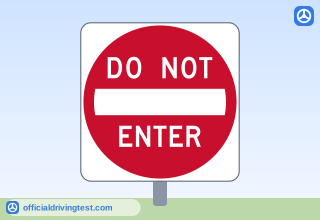
A square sign shows a white horizontal line inside a red ball and the words DO NOT ENTER. What does it mean?
- You may enter only after stopping
- You may enter only if you are turning
- You may enter if no traffic is coming
- You cannot enter
Show answer
Correct answer: You cannot enter
A square sign with a white horizontal line inside a red ball means you cannot enter.
Source: Connecticut Driver's Manual (Revised March 2023), page 47 · Open this page in the manual (Manual page 47)
-
Where will you see a DO NOT ENTER sign?
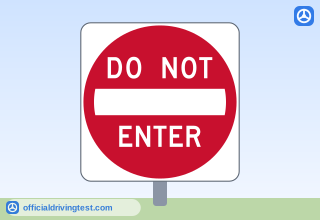
- Exit ramps entered the wrong way, divided-roadway crossovers and one-way streets
- At the beginning of every no passing zone and at railroad crossings
- Only at the far end of a one-way street, never at ramps or crossovers
- At entrances to parks, recreation areas and service plazas
Show answer
Correct answer: Exit ramps entered the wrong way, divided-roadway crossovers and one-way streets
The DO NOT ENTER sign is posted at roadway openings you should not enter, such as exit ramps, crossovers on divided roadways and one-way streets.
Source: Connecticut Driver's Manual (Revised March 2023), page 47 · Open this page in the manual (Manual page 47)
-
What should you do if you drive up to a WRONG WAY sign?
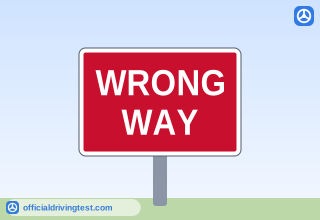
- Slow down and proceed with care
- Stop and wait for traffic to clear
- Do not drive past it and turn around
- Continue if no vehicles are coming
Show answer
Correct answer: Do not drive past it and turn around
The WRONG WAY sign identifies a one-way street, an expressway ramp or the wrong direction or side of a divided highway; do not drive past it.
Source: Connecticut Driver's Manual (Revised March 2023), page 47 · Open this page in the manual (Manual page 47)
-
A square sign shows a circle with a slash over a U-shaped arrow. What does it mean?
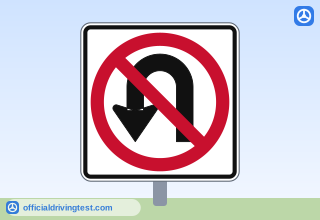
- U-turns are required
- U-turns are prohibited
- U-turns are allowed only from the left lane
- U-turns are allowed after you stop
Show answer
Correct answer: U-turns are prohibited
This is the No U-Turn sign, which means U-turns are prohibited.
Source: Connecticut Driver's Manual (Revised March 2023), page 48 · Open this page in the manual (Manual page 48)
-
Where might you see a NO U-TURN sign on a divided highway or expressway?
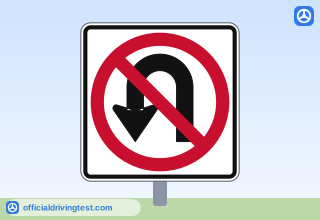
- At every exit ramp where drivers leave the divided highway
- Only at the entrance to a rest area or service plaza
- At the start of every no passing zone on the highway
- Where an opening in the divided highway leads to the other side
Show answer
Correct answer: Where an opening in the divided highway leads to the other side
The manual mentions NO U-TURN signs posted on divided highways or expressways where an opening leads to the other side.
Source: Connecticut Driver's Manual (Revised March 2023), page 48 · Open this page in the manual (Manual page 48)
-
A sign shows a circle with a slash over a right-turn arrow. What does it indicate?
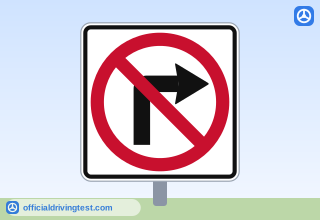
- The movement shown is prohibited from that lane or approach
- The movement shown is required from that lane or approach
- The movement shown is allowed only for buses and trucks
- The right lane ends ahead and traffic must merge left
Show answer
Correct answer: The movement shown is prohibited from that lane or approach
Movement prohibition signs indicate movements that are prohibited from a lane or approach.
Source: Connecticut Driver's Manual (Revised March 2023), page 48 · Open this page in the manual (Manual page 48)
-
Where can movement prohibition signs be located?
- Only on the right side of the road, never over a lane
- Only painted on the pavement of the lane, as arrows
- On the side of the road or hanging over the lane of travel
- Only on the left side of a divided highway median
Show answer
Correct answer: On the side of the road or hanging over the lane of travel
These signs can be on the side of the road or hanging over the lane, and arrows are sometimes painted on the road as a supplement.
Source: Connecticut Driver's Manual (Revised March 2023), page 48 · Open this page in the manual (Manual page 48)
-
What are ONE WAY signs used on?
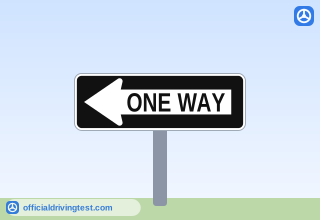
- Two-way streets with a center turn lane
- One-way streets or driveways
- Ramps leading to rest areas only
- Divided highways with a wide median
Show answer
Correct answer: One-way streets or driveways
ONE WAY signs are used on one-way streets or driveways.
Source: Connecticut Driver's Manual (Revised March 2023), page 48 · Open this page in the manual (Manual page 48)
-
Which way must you go when you see a ONE WAY sign?
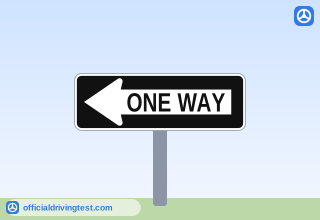
- In either direction if the street is empty
- Against the arrow when turning left
- In the direction of the arrow or straight ahead
- Only in the direction of the arrow
Show answer
Correct answer: Only in the direction of the arrow
You must always go only in the direction of the arrow on a ONE WAY sign.
Source: Connecticut Driver's Manual (Revised March 2023), page 48 · Open this page in the manual (Manual page 48)
-
What does a lane use control sign indicate?
- The permitted movement from a lane
- The maximum speed in a lane
- Where passing is not permitted
- Which lane is reserved for parking
Show answer
Correct answer: The permitted movement from a lane
The lane use control sign indicates the permitted movement from a lane.
Source: Connecticut Driver's Manual (Revised March 2023), page 48 · Open this page in the manual (Manual page 48)
-
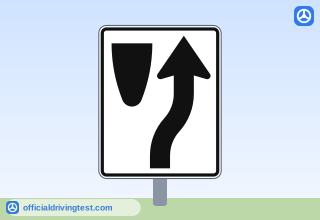
What does a Keep Right sign tell you?
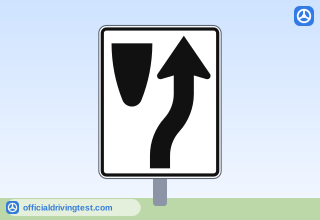
- That you may pass on the right when the road is wide enough to do so
- That the right lane ends ahead and you must merge into the left lane
- Where to drive near traffic islands, medians or other obstructions in the roadway
- That the right lane is reserved for slower vehicles and for turning traffic
Show answer
Correct answer: Where to drive near traffic islands, medians or other obstructions in the roadway
The Keep Right sign tells you where to drive when approaching obstructions in the middle of the roadway.
Source: Connecticut Driver's Manual (Revised March 2023), page 48 · Open this page in the manual (Manual page 48)
-
On a Keep Right sign, which side of the obstruction must you drive on?
- The side with the lighter traffic
- The side indicated by the arrow
- Whichever side is clear
- The left side when turning
Show answer
Correct answer: The side indicated by the arrow
You must drive to the side indicated by the arrow.
Source: Connecticut Driver's Manual (Revised March 2023), page 48 · Open this page in the manual (Manual page 48)
-
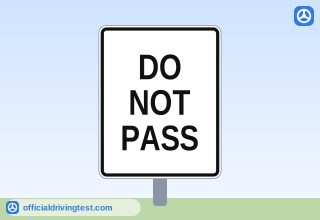
What do no passing signs tell you?
- Where passing is required
- Where passing may be done at any speed
- Where other vehicles will pass you
- Where passing is not permitted
Show answer
Correct answer: Where passing is not permitted
No passing signs tell you where passing is not permitted.
Source: Connecticut Driver's Manual (Revised March 2023), page 48 · Open this page in the manual (Manual page 48)