Passenger: On the road with passengers — Part 2
Questions in this part include: “A railroad crossing has a traffic signal that is showing green. What must the bus driver do?” · “What two items should a mass transit driver make sure work properly during the after-trip inspection?”
Independent educational site · not affiliated with any government agency or DMV
Ready? Test yourself
Answer to start, or tap Start below:
At which kind of railroad crossing is a bus not required to stop, though it must slow down and look?
- Instant feedback with an explanation
- Every answer cites its source in the manual
- Your best score is saved on this device
- Keyboard: press 1 to 3 to answer and Enter for the next question
Questions are written in our own words from the CDL manual; they are not the real test's questions. With your state chosen, every answer gives its page in your state's CDL manual. Without a state, answers cite the CDL manual, national model as printed by New Jersey (July 2017).
All 19 questions in this practice test
Take the test above first, then use this list to study. Tap “Show answer” to see the correct answer and explanation.
Show the questions and answersHide the questions
-
A railroad crossing has a traffic signal that is showing green. What must the bus driver do?
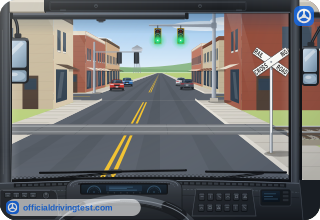
- Slow down and check, no stop is required
- Come to a full stop, then go on
- Keep the same speed, since the signal is green
Show answer
Correct answer: Slow down and check, no stop is required
With a green signal the driver does not need to stop, but must still slow down and look for other vehicles.
Source: CDL manual, national model as printed by New Jersey, Section 4 (July 2017)
-
At which kind of railroad crossing is a bus not required to stop, though it must slow down and look?
- One marked exempt or abandoned
- One with a single track
- One in a town with fewer riders aboard
Show answer
Correct answer: One marked exempt or abandoned
Crossings marked as exempt or abandoned do not call for a stop, but the driver still slows down and checks for vehicles.
Source: CDL manual, national model as printed by New Jersey, Section 4 (July 2017)
-
A drawbridge has no signal light and no attendant. What is the minimum distance from the draw at which the bus must stop?
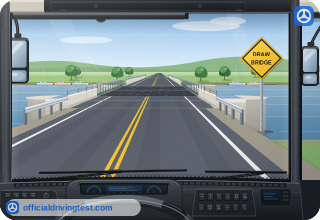
- 15 feet
- 25 feet
- 50 feet
Show answer
Correct answer: 50 feet
At such a drawbridge the bus stops at least 50 feet before the movable part of the bridge.
Source: CDL manual, national model as printed by New Jersey, Section 4 (July 2017)
-
After stopping at a drawbridge with no signal or attendant, what must the driver confirm before going across?
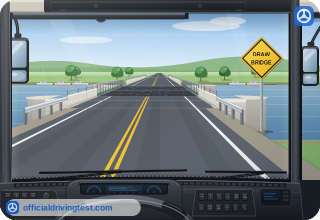
- That the bridge is free of other buses
- That the horn is working properly
- That the draw is fully closed
Show answer
Correct answer: That the draw is fully closed
The driver must see that the movable section is completely closed before driving onto it.
Source: CDL manual, national model as printed by New Jersey, Section 4 (July 2017)
-
When does a bus driver not have to stop at a drawbridge, but still slow down and make sure it is safe?
- When no other vehicles are in sight on the road
- When an attendant controls traffic whenever it opens
- When the bridge is more than a mile long
Show answer
Correct answer: When an attendant controls traffic whenever it opens
A bridge with an attendant or traffic officer controlling traffic, or a green light, does not need a stop, only a slow and careful approach.
Source: CDL manual, national model as printed by New Jersey, Section 4 (July 2017)
-
When should a bus driver inspect the bus after the trip?
- At the end of every shift
- Once at the end of each week
- Only when a defect was noticed
Show answer
Correct answer: At the end of every shift
An after-trip inspection is done each shift, so problems are found before the bus is used again.
Source: CDL manual, national model as printed by New Jersey, Section 4 (July 2017)
-
A driver works for an interstate carrier. What must be filled out for each bus driven?
- A written inspection report
- A list of the riders carried
- A record of the fuel bought
Show answer
Correct answer: A written inspection report
Interstate carriers require a written inspection report for every bus the driver operates.
Source: CDL manual, national model as printed by New Jersey, Section 4 (July 2017)
-
Which defects must an interstate driver's inspection report list?
- Any that could affect safety or cause a breakdown
- Only those that need a mechanic at once
- Only those that riders have complained about
Show answer
Correct answer: Any that could affect safety or cause a breakdown
The report names each bus and lists every defect that could harm safety or lead to a breakdown.
Source: CDL manual, national model as printed by New Jersey, Section 4 (July 2017)
-
What should the inspection report show when the driver finds nothing wrong with the bus?
- Nothing, because it is left blank
- A statement that no defects were found
- A request for the mechanic to look it over anyway
Show answer
Correct answer: A statement that no defects were found
The report should clearly state that there are no defects, rather than being left empty.
Source: CDL manual, national model as printed by New Jersey, Section 4 (July 2017)
-
Why should a driver report rider damage to seats or emergency exits at the end of the shift?
- So repairs can be made before the bus runs again
- So the damaged rider can be found
- So the next driver can skip the inspection
Show answer
Correct answer: So repairs can be made before the bus runs again
Reporting the damage promptly gives mechanics time to fix it before the bus goes back on the road.
Source: CDL manual, national model as printed by New Jersey, Section 4 (July 2017)
-
What two items should a mass transit driver make sure work properly during the after-trip inspection?
- Rider signals and brake-door interlocks
- The radio and the heater controls
- The fare machine and the destination sign
Show answer
Correct answer: Rider signals and brake-door interlocks
Mass transit buses have rider signals and brake-door interlocks that must be checked at the end of the shift.
Source: CDL manual, national model as printed by New Jersey, Section 4 (July 2017)
-
A bus needs fuel. When is it acceptable to fuel it with riders on board?
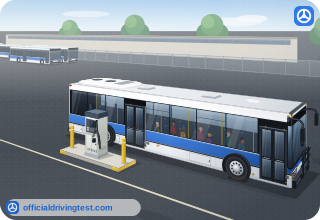
- Whenever the riders agree to it
- Only when it is absolutely necessary
- Any time the engine has been shut off
Show answer
Correct answer: Only when it is absolutely necessary
Fueling with riders aboard is to be avoided and is done only when there is no other choice.
Source: CDL manual, national model as printed by New Jersey, Section 4 (July 2017)
-
Where must a driver never refuel a bus that has riders aboard?
- On a busy street corner
- Beside a low curb
- Inside a closed building
Show answer
Correct answer: Inside a closed building
Refueling inside an enclosed building with riders on the bus is never allowed.
Source: CDL manual, national model as printed by New Jersey, Section 4 (July 2017)
-
What is a bus driver not supposed to do while the bus is moving?
- Check the mirrors
- Chat with riders
- Watch the interior
Show answer
Correct answer: Chat with riders
Conversations and other distractions take the driver's attention off the road, so they are prohibited while driving.
Source: CDL manual, national model as printed by New Jersey, Section 4 (July 2017)
-
A bus breaks down with riders aboard. When may it be towed or pushed with them still inside?
- Whenever the riders are all seated
- Only when leaving the bus would be unsafe
- Whenever the tow truck driver agrees
Show answer
Correct answer: Only when leaving the bus would be unsafe
Riders should leave a disabled bus before it is moved, unless getting off would put them in danger.
Source: CDL manual, national model as printed by New Jersey, Section 4 (July 2017)
-
If a disabled bus must be moved with riders on board, how far should it be towed or pushed?
- To the nearest safe place to let riders off
- To the next scheduled stop on the route
- To the garage where it is serviced
Show answer
Correct answer: To the nearest safe place to let riders off
The move is kept as short as possible, ending at the closest safe place where riders can get off.
Source: CDL manual, national model as printed by New Jersey, Section 4 (July 2017)
-
On a transit coach with a brake-door interlock, what happens when the rear door opens?
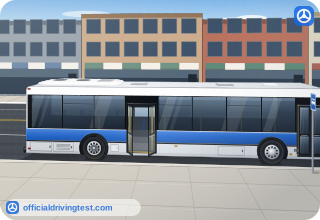
- The brakes are applied and the throttle stays at idle
- The parking brake is set and the engine shuts off
- The brakes stay free and the throttle is locked open
Show answer
Correct answer: The brakes are applied and the throttle stays at idle
With the rear door open, the interlock holds the bus with the brakes and keeps the throttle at idle.
Source: CDL manual, national model as printed by New Jersey, Section 4 (July 2017)
-
When does a brake-door interlock let go of the brakes and throttle?
- When the driver sets the parking brake
- When the rear door is closed
- When the front door is opened
Show answer
Correct answer: When the rear door is closed
The system releases as soon as the rear door is shut.
Source: CDL manual, national model as printed by New Jersey, Section 4 (July 2017)
-
How should a driver treat the brake-door interlock when leaving the bus parked?
- Still set the parking brake, never rely on the interlock
- Rely on the interlock instead of the parking brake
- Leave the rear door open to keep the brakes applied
Show answer
Correct answer: Still set the parking brake, never rely on the interlock
The interlock is an added safety feature only and is never a replacement for the parking brake.
Source: CDL manual, national model as printed by New Jersey, Section 4 (July 2017)