Passenger: On the road with passengers — Part 1
Questions in this part include: “On a charter trip, when is the best time to tell riders about the carrier's comfort and safety rules?” · “When should a bus pull away from a stop into moving traffic?”
Independent educational site · not affiliated with any government agency or DMV
Ready? Test yourself
Answer to start, or tap Start below:
On a charter trip, when is the best time to tell riders about the carrier's comfort and safety rules?
- Instant feedback with an explanation
- Every answer cites its source in the manual
- Your best score is saved on this device
- Keyboard: press 1 to 3 to answer and Enter for the next question
Questions are written in our own words from the CDL manual; they are not the real test's questions. With your state chosen, every answer gives its page in your state's CDL manual. Without a state, answers cite the CDL manual, national model as printed by New Jersey (July 2017).
All 19 questions in this practice test
Take the test above first, then use this list to study. Tap “Show answer” to see the correct answer and explanation.
Show the questions and answersHide the questions
-
On a charter trip, when is the best time to tell riders about the carrier's comfort and safety rules?
- When a rider first breaks a rule
- Right when the trip begins
- At the first rest stop on the route
Show answer
Correct answer: Right when the trip begins
Telling riders the rules at the beginning helps prevent trouble later in the trip.
Source: CDL manual, national model as printed by New Jersey, Section 4 (July 2017)
-
Besides the road around the bus, what else should a bus driver keep watching while driving?
- The inside of the bus and its riders
- Only the mirrors on the right side
- The fare box and the ticket machine
Show answer
Correct answer: The inside of the bus and its riders
A driver must also look over the inside of the bus, so rule breakers or riders with arms and heads out of windows are noticed early.
Source: CDL manual, national model as printed by New Jersey, Section 4 (July 2017)
-
While driving, what may a driver have to remind riders about?
- Paying the fare again at each stop
- Rules, and keeping arms and heads inside
- Moving to the back at every stop
Show answer
Correct answer: Rules, and keeping arms and heads inside
Riders who lean out of windows can be hurt, so the driver calls out the rule when it is broken.
Source: CDL manual, national model as printed by New Jersey, Section 4 (July 2017)
-
What should a driver tell riders as they get ready to leave the bus?
- To leave by the rear door only
- To stay seated until the doors open fully
- To watch where they step
Show answer
Correct answer: To watch where they step
Riders can stumble while getting off, so the driver reminds them to be careful with each step.
Source: CDL manual, national model as printed by New Jersey, Section 4 (July 2017)
-
Riders have just boarded and are still walking in the aisle. What should the driver do before moving the bus?
- Pull out slowly while they walk
- Let them find a seat or hold on first
- Honk once so they know to hurry
Show answer
Correct answer: Let them find a seat or hold on first
Riders can stumble when the bus starts, so the driver waits until they are seated or steady.
Source: CDL manual, national model as printed by New Jersey, Section 4 (July 2017)
-
Why should a bus driver start and stop as smoothly as possible?
- To save fuel on city routes
- To keep riders from being hurt
- To keep the brake lining cool
Show answer
Correct answer: To keep riders from being hurt
Sudden starts and stops can throw riders off balance, so smooth driving protects them from injury.
Source: CDL manual, national model as printed by New Jersey, Section 4 (July 2017)
-
A rider is drunk and causing problems. Where should the driver let this person off?
- At once, at the nearest spot where the bus can pull over
- On a quiet side road, away from the other riders
- At a safe place, such as the next stop or a lit area with people
Show answer
Correct answer: At a safe place, such as the next stop or a lit area with people
The driver is responsible for the safety of the disruptive rider too, so the rider must not be left in an unsafe place.
Source: CDL manual, national model as printed by New Jersey, Section 4 (July 2017)
-
A bus approaches an intersection where a stop sign controls the cross traffic. What should the driver do?
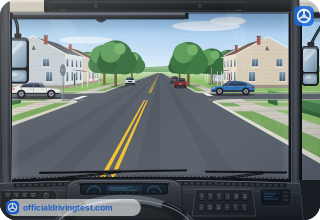
- Stay careful, since crashes are common there
- Keep normal speed, the cross traffic must stop
- Rely on the stop sign to hold the cross traffic
Show answer
Correct answer: Stay careful, since crashes are common there
Bus crashes often happen at intersections, so caution is needed even when the other traffic has a stop sign.
Source: CDL manual, national model as printed by New Jersey, Section 4 (July 2017)
-
What should a driver watch for around a bus stop to avoid scraping off the mirrors?
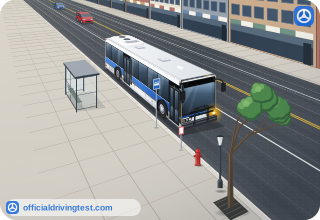
- Low road signs on the left
- Fire hydrants near the curb
- Poles and tree limbs
Show answer
Correct answer: Poles and tree limbs
The bus needs more clearance than a car, and objects such as poles and tree limbs by the stop can hit the mirrors.
Source: CDL manual, national model as printed by New Jersey, Section 4 (July 2017)
-
When should a bus pull away from a stop into moving traffic?
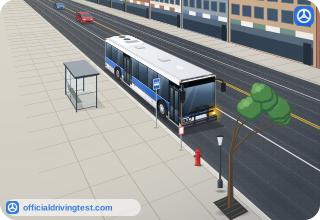
- As soon as the turn signal has been switched on
- When the closest vehicle looks like it is slowing
- After a gap big enough for the bus has opened
Show answer
Correct answer: After a gap big enough for the bus has opened
The driver needs to know how much room the bus needs to speed up and merge, and leaves only when that gap is there.
Source: CDL manual, national model as printed by New Jersey, Section 4 (July 2017)
-
A bus driver signals to leave a stop and merge into traffic. What must the driver not take for granted?
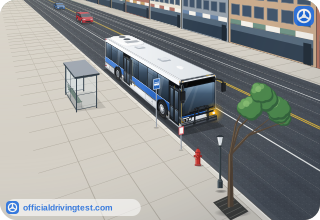
- That the bus will reach traffic speed in time
- That other drivers will brake to make room
- That the bus stop sign is visible to traffic
Show answer
Correct answer: That other drivers will brake to make room
Other drivers may not slow down for a signaling bus, so the driver must find a real gap in traffic.
Source: CDL manual, national model as printed by New Jersey, Section 4 (July 2017)
-
What is behind the deadly bus crashes that happen on curves?
- Tires worn on the inside edge of the tread
- Too much speed, often on a slippery road
- A load placed too far toward the rear
Show answer
Correct answer: Too much speed, often on a slippery road
Going too fast for the curve is the cause, and it is most dangerous when rain or snow makes the road slippery.
Source: CDL manual, national model as printed by New Jersey, Section 4 (July 2017)
-
On a banked curve with a posted speed limit, what is true for many buses, even in good weather?
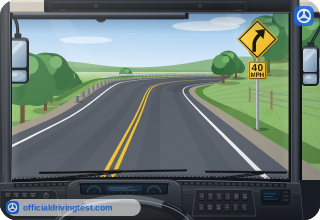
- The posted speed is always safe for a bus
- The posted speed may be too fast for the bus
- The bus may drive ten miles over the posted speed
Show answer
Correct answer: The posted speed may be too fast for the bus
The posted speed is set with cars in mind, and a tall, heavy bus can need a lower speed to stay safe.
Source: CDL manual, national model as printed by New Jersey, Section 4 (July 2017)
-
A bus takes a curve too fast. What can happen when the road has good grip?
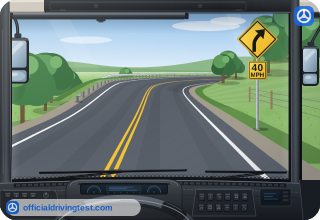
- The bus can roll over
- The bus can slide off the curve
- The bus can stall in the curve
Show answer
Correct answer: The bus can roll over
Too much speed on a grippy road can tip the bus over, while too much speed on a slippery road can make it slide off.
Source: CDL manual, national model as printed by New Jersey, Section 4 (July 2017)
-
On a banked curve, the body of the bus leans toward the outside of the turn. What does this tell the driver?
- The speed is too high
- The tires are low on air
- The load is evenly spread
Show answer
Correct answer: The speed is too high
Leaning outward in a banked curve is a warning that the bus is going too fast for the curve.
Source: CDL manual, national model as printed by New Jersey, Section 4 (July 2017)
-
How far before a railroad crossing must a bus stop when a stop is required?
- Between 15 and 50 feet
- Between 5 and 10 feet
- Between 60 and 100 feet
Show answer
Correct answer: Between 15 and 50 feet
The bus must stop in a zone starting 15 feet and ending 50 feet before the tracks.
Source: CDL manual, national model as printed by New Jersey, Section 4 (July 2017)
-
At a railroad crossing stop, when should a bus driver open the forward door?
- When it helps to see or hear a train
- Every time, to let fresh air in
- Only after the train has passed
Show answer
Correct answer: When it helps to see or hear a train
Opening the door can help the driver see or hear a train coming, so it is done when it makes that easier.
Source: CDL manual, national model as printed by New Jersey, Section 4 (July 2017)
-
A train has just passed the crossing where the bus is stopped. What must the driver do before crossing?
- Cross at once, since the danger has gone
- Wait for the gates to lift, then cross without looking
- Check that no train is coming on another track
Show answer
Correct answer: Check that no train is coming on another track
Another train may be coming from the other direction on a different track, so the driver checks before crossing.
Source: CDL manual, national model as printed by New Jersey, Section 4 (July 2017)
-
A bus with a manual transmission is on a railroad crossing. What must the driver avoid?
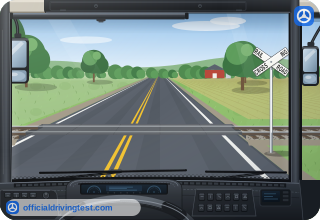
- Driving over the tracks slowly
- Shifting gears on the tracks
- Looking both ways while crossing
Show answer
Correct answer: Shifting gears on the tracks
A driver of a bus with a manual transmission must never change gears while the bus is on the tracks.
Source: CDL manual, national model as printed by New Jersey, Section 4 (July 2017)