General Knowledge: Managing space — Part 2
Questions in this part include: “You must travel near other vehicles. How can you be sure the other driver can see you?” · “What can a drainage channel across a road cause for some vehicles?”
Independent educational site · not affiliated with any government agency or DMV
Ready? Test yourself
Answer to start, or tap Start below:
Strong winds make it hard to stay in your lane. Which vehicles usually have the worst problem?
- Instant feedback with an explanation
- Every answer cites its source in the manual
- Your best score is saved on this device
- Keyboard: press 1 to 3 to answer and Enter for the next question
Questions are written in our own words from the CDL manual; they are not the real test's questions. With your state chosen, every answer gives its page in your state's CDL manual. Without a state, answers cite the CDL manual, national model as printed by New Jersey (July 2017).
All 22 questions in this practice test
Take the test above first, then use this list to study. Tap “Show answer” to see the correct answer and explanation.
Show the questions and answersHide the questions
-
You must travel near other vehicles. How can you be sure the other driver can see you?
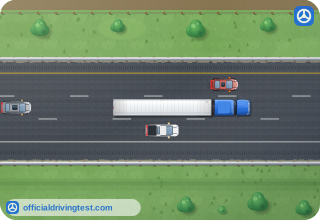
- Stay alongside and flash your headlights
- Sound your horn as you pass
- Drop back or pull forward
Show answer
Correct answer: Drop back or pull forward
Dropping back or pulling forward takes you out of the other driver's blind spot, so you can be sure you are seen.
Source: CDL manual, national model as printed by New Jersey, Sections 1 to 3 (July 2017)
-
Strong winds make it hard to stay in your lane. Which vehicles usually have the worst problem?
- Lighter vehicles
- Heavily loaded vehicles
- Vehicles that are very long
Show answer
Correct answer: Lighter vehicles
Wind affects lighter vehicles more, and it is often worst when coming out of tunnels.
Source: CDL manual, national model as printed by New Jersey, Sections 1 to 3 (July 2017)
-
Where can strong winds be especially bad for keeping your vehicle in its lane?
- Going down a long grade
- Driving through a work zone
- Coming out of tunnels
Show answer
Correct answer: Coming out of tunnels
Strong winds are especially bad coming out of tunnels; avoid driving alongside other vehicles when you can.
Source: CDL manual, national model as printed by New Jersey, Sections 1 to 3 (July 2017)
-
Why should you not assume the height posted at a bridge is correct?
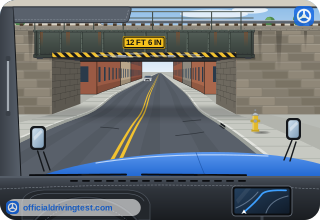
- Posted heights are measured to the top of the bridge
- Heights change with the weight of traffic on the bridge
- Re-paving or packed snow may have lowered the clearance
Show answer
Correct answer: Re-paving or packed snow may have lowered the clearance
The road surface may be higher than when the sign was put up, so the real clearance can be less than posted.
Source: CDL manual, national model as printed by New Jersey, Sections 1 to 3 (July 2017)
-
Your loaded cargo van fit under a bridge. Can you be sure it will fit when it is empty?
- Yes, an empty van sits lower than a loaded one
- No, a van without cargo stands taller than when loaded
- Yes, as long as you drive more slowly
Show answer
Correct answer: No, a van without cargo stands taller than when loaded
Cargo weight changes the van's height, so without a load it stands taller.
Source: CDL manual, national model as printed by New Jersey, Sections 1 to 3 (July 2017)
-
As you approach an overhead object whose clearance you doubt, how should you drive?
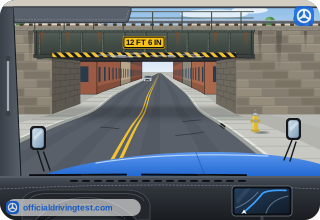
- Go slowly
- Speed up so you spend less time under it
- At normal speed, watching the clearance
Show answer
Correct answer: Go slowly
When you are unsure of the clearance, slow down before reaching the object.
Source: CDL manual, national model as printed by New Jersey, Sections 1 to 3 (July 2017)
-
You are not sure you can pass under a low bridge. What should you do?
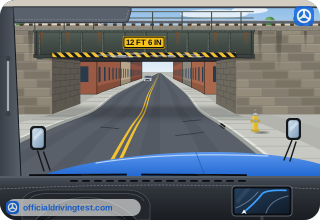
- Speed up to clear it quickly
- Drive under it at normal speed and watch closely
- Take another route
Show answer
Correct answer: Take another route
If you doubt the clearance, go slowly, and if you are still not sure, choose another route.
Source: CDL manual, national model as printed by New Jersey, Sections 1 to 3 (July 2017)
-
What is true about warning signs at low bridges and underpasses?
- Every low bridge has a warning posted
- Often there is a sign, but not always
- Warnings are posted only on bridges over highways
Show answer
Correct answer: Often there is a sign, but not always
Many low bridges and underpasses have warnings, but some do not, so you cannot count on a sign.
Source: CDL manual, national model as printed by New Jersey, Sections 1 to 3 (July 2017)
-
A tilting road makes it hard to clear signs, trees or bridge supports at the road edge. What should you do?
- Move somewhat nearer the middle of the road
- Move onto the shoulder for more room
- Drive along the right edge to line up better
Show answer
Correct answer: Move somewhat nearer the middle of the road
The road's tilt can swing your vehicle toward objects at the edge, so shift toward the middle of the road.
Source: CDL manual, national model as printed by New Jersey, Sections 1 to 3 (July 2017)
-
How do you check for overhead objects before backing into an area?
- Look in your mirrors as you start to back
- Get out and look for overhanging objects
- Sound your horn and back slowly
Show answer
Correct answer: Get out and look for overhanging objects
Overhead objects such as branches and wires are easy to miss while backing, so get out and check first.
Source: CDL manual, national model as printed by New Jersey, Sections 1 to 3 (July 2017)
-
When is the space under a vehicle especially small?
- When the vehicle is empty
- When the vehicle is heavily loaded
- When the vehicle is on a downgrade
Show answer
Correct answer: When the vehicle is heavily loaded
A heavy load lowers the vehicle, which can make it get hung up on dirt roads or in unpaved yards.
Source: CDL manual, national model as printed by New Jersey, Sections 1 to 3 (July 2017)
-
What can a drainage channel across a road cause for some vehicles?
- The ends of the vehicle may drag
- The load may shift toward the front
- The steering wheel may pull to one side
Show answer
Correct answer: The ends of the vehicle may drag
A dip across the road can make the front or back of some vehicles scrape, so take it with care.
Source: CDL manual, national model as printed by New Jersey, Sections 1 to 3 (July 2017)
-
Which vehicles are most likely to have trouble crossing railroad tracks because of the space below?
- Trailers with low underneath clearance
- Buses with an empty passenger area
- Short trucks with high ground clearance
Show answer
Correct answer: Trailers with low underneath clearance
A trailer with low underneath clearance can get hung up halfway across the tracks.
Source: CDL manual, national model as printed by New Jersey, Sections 1 to 3 (July 2017)
-
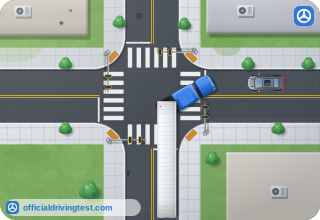
How should you make a right turn to give everyone more time to avoid problems?
- Quickly, to clear the intersection
- At the speed of traffic
- Slowly
Show answer
Correct answer: Slowly
Turning slowly gives you and other road users more time to react.
Source: CDL manual, national model as printed by New Jersey, Sections 1 to 3 (July 2017)
-
You must turn wide to finish a right turn. Why should the back end of your vehicle stay near the curb?
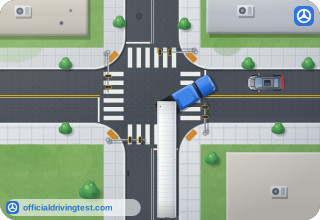
- It blocks other drivers from going by on your right
- It keeps the rear wheels from running off the road
- It lets you see the curb in your right mirror
Show answer
Correct answer: It blocks other drivers from going by on your right
With the rear near the curb, there is no gap on your right for another driver to use.
Source: CDL manual, national model as printed by New Jersey, Sections 1 to 3 (July 2017)
-
Why should you not swing wide to the left as you start a right turn?
- A driver behind may think you are turning left
- The trailer would off-track and climb over the curb
- Oncoming drivers would not be able to see your signal
Show answer
Correct answer: A driver behind may think you are turning left
That driver may try to pass on the right, and you may crash into that vehicle as you finish the turn.
Source: CDL manual, national model as printed by New Jersey, Sections 1 to 3 (July 2017)
-
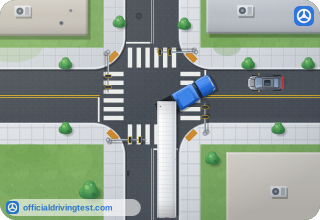
During a turn you must cross into the oncoming lane and a vehicle approaches. What should you not do?
- Give it room to go by or stop
- Back up to make room for it
- Watch for vehicles coming toward you
Show answer
Correct answer: Back up to make room for it
Backing up could put you into someone behind you, so give oncoming drivers room to pass or stop instead.
Source: CDL manual, national model as printed by New Jersey, Sections 1 to 3 (July 2017)
-
When should a large vehicle begin a left turn?
- As soon as the front bumper enters the intersection
- After reaching the center of the intersection
- Just before the crosswalk on the far side
Show answer
Correct answer: After reaching the center of the intersection
Turning too soon can make the left side of the vehicle hit another vehicle because of off-tracking.
Source: CDL manual, national model as printed by New Jersey, Sections 1 to 3 (July 2017)
-
You are making a left turn and there are two left-turn lanes. Which lane should a large vehicle use?
- The lane with less traffic
- The left-hand turning lane
- The right-hand turning lane
Show answer
Correct answer: The right-hand turning lane
Starting in the inside lane may force you to swing right, and drivers on your left can be seen more easily.
Source: CDL manual, national model as printed by New Jersey, Sections 1 to 3 (July 2017)
-
Why does a big truck need a bigger opening in traffic than a car does when it pulls in?
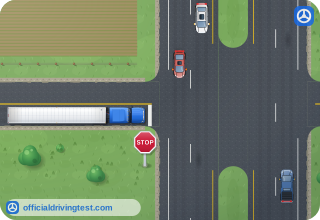
- It accelerates slowly and needs more space
- Other drivers cannot judge its speed
- It must stop fully before every entry
Show answer
Correct answer: It accelerates slowly and needs more space
Slow acceleration and the room a large vehicle takes mean it needs a bigger gap in traffic.
Source: CDL manual, national model as printed by New Jersey, Sections 1 to 3 (July 2017)
-
How does a heavy load change the room you need to enter or cross traffic?
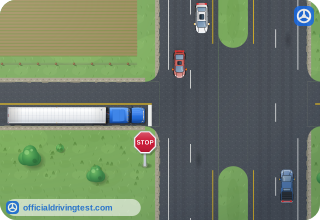
- You need more room
- You need less room because of the extra momentum
- You need the same room as when empty
Show answer
Correct answer: You need more room
Acceleration changes with the load, so a heavily loaded vehicle needs more room.
Source: CDL manual, national model as printed by New Jersey, Sections 1 to 3 (July 2017)
-
What must you be sure of before you start across a road?
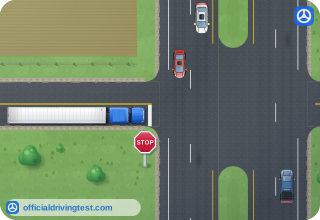
- That you can finish crossing before traffic arrives
- That traffic has slowed to let you in
- That the road is wide enough to stop halfway
Show answer
Correct answer: That you can finish crossing before traffic arrives
Never start across unless there is time to clear the road completely before traffic arrives.
Source: CDL manual, national model as printed by New Jersey, Sections 1 to 3 (July 2017)
-
Only in Arizona's manual
A road has two lanes that both turn right. Which lane should a large truck driver use?
- The lane nearest the center of the road
- Either lane, whichever has less traffic
- The outermost lane, nearest the curb
Show answer
Correct answer: The outermost lane, nearest the curb
Using the lane nearest the curb keeps other vehicles from ending up beside the truck's right side, where the blind spots are large.
Source: CDL manual, national model as printed by New Jersey, Sections 1 to 3 (July 2017)