General Knowledge: Alcohol, drugs and hazardous materials rules — Part 2
Questions in this part include: “What makes a product a hazardous material?” · “Can one identification number appear for more than one chemical?”
Independent educational site · not affiliated with any government agency or DMV
Ready? Test yourself
Answer to start, or tap Start below:
What makes a product a hazardous material?
- Instant feedback with an explanation
- Every answer cites its source in the manual
- Your best score is saved on this device
- Keyboard: press 1 to 3 to answer and Enter for the next question
Questions are written in our own words from the CDL manual; they are not the real test's questions. With your state chosen, every answer gives its page in your state's CDL manual. Without a state, answers cite the CDL manual, national model as printed by New Jersey (July 2017).
All 23 questions in this practice test
Take the test above first, then use this list to study. Tap “Show answer” to see the correct answer and explanation.
Show the questions and answersHide the questions
-
What makes a product a hazardous material?
- It can endanger health, safety and property
- It can harm property but not people
- It is regulated only when in a bulk tank
Show answer
Correct answer: It can endanger health, safety and property
Hazardous materials are products that endanger health, safety and property while being transported.
Source: CDL manual, national model as printed by New Jersey, Sections 1 to 3 (July 2017)
-
Which is one of the aims of the hazardous materials rules?
- To keep the cost of shipping low
- To limit hauling to daytime hours only
- To communicate the risk of the product
Show answer
Correct answer: To communicate the risk of the product
The rules aim to contain the product, communicate the risk, and make sure drivers and equipment are safe.
Source: CDL manual, national model as printed by New Jersey, Sections 1 to 3 (July 2017)
-
What do the containment rules tell drivers to do with bulk tanks?
- Load, transport and unload them correctly
- Test them for leaks each month
- Keep them filled below the halfway mark
Show answer
Correct answer: Load, transport and unload them correctly
Containment rules direct shippers to package safely and direct drivers in loading, hauling and unloading bulk tanks.
Source: CDL manual, national model as printed by New Jersey, Sections 1 to 3 (July 2017)
-
What does a shipper use to warn dockworkers and drivers about a product's risk?
- A radio message and a loading ticket
- A driver's log and a round warning sticker
- A shipping paper and diamond hazard labels
Show answer
Correct answer: A shipping paper and diamond hazard labels
Dockworkers and drivers learn the danger from the paperwork the shipper provides and from the diamond labels on the load.
Source: CDL manual, national model as printed by New Jersey, Sections 1 to 3 (July 2017)
-
How must a driver handle the shipping papers for hazardous materials among other papers?
- Mark them or keep them on top of the others
- Put them at the bottom of the stack
- Keep them in a sealed envelope in the cargo area
Show answer
Correct answer: Mark them or keep them on top of the others
Hazmat papers must be identified or kept on top so that rescuers can find them fast after a crash.
Source: CDL manual, national model as printed by New Jersey, Sections 1 to 3 (July 2017)
-
While driving, where may hazardous materials shipping papers be kept?
- In a locked box behind the seat
- In a pouch on the driver's door
- In the sleeper berth
Show answer
Correct answer: In a pouch on the driver's door
On the road, the papers can sit in a door pouch beside the driver, or anywhere in plain sight that the driver can reach.
Source: CDL manual, national model as printed by New Jersey, Sections 1 to 3 (July 2017)
-
Where should shipping papers be kept when the driver is out of the vehicle?
- On the driver's seat
- Locked in the glove box
- Under the cargo tie-downs
Show answer
Correct answer: On the driver's seat
When the driver leaves the vehicle, the shipping papers stay on the driver's seat so they can be found quickly.
Source: CDL manual, national model as printed by New Jersey, Sections 1 to 3 (July 2017)
-
On which parts of a vehicle must the identical placards be placed?
- Both sides and the roof only
- Front, rear and both sides
- Front and rear bumpers only
Show answer
Correct answer: Front, rear and both sides
A placarded vehicle needs at least four identical placards, one on the front, one on the rear and one on each side.
Source: CDL manual, national model as printed by New Jersey, Sections 1 to 3 (July 2017)
-
How is a hazardous materials placard shaped and set on the vehicle?
- A square turned upright on a point
- A circle with a bar across the middle
- A triangle with one point at the top
Show answer
Correct answer: A square turned upright on a point
A placard is a square set on one of its points, so it looks like a diamond.
Source: CDL manual, national model as printed by New Jersey, Sections 1 to 3 (July 2017)
-
Where do cargo tanks show the identification number of their contents?
- Only on the shipping papers
- On placards or orange panels
- On a white label beside the valves
Show answer
Correct answer: On placards or orange panels
Cargo tanks and other bulk packaging show the number on placards or on orange panels.
Source: CDL manual, national model as printed by New Jersey, Sections 1 to 3 (July 2017)
-
What is a hazardous materials identification number?
- A two-digit code for the cargo's weight
- A four-digit code for the hazardous material
- A six-digit code for the driver's endorsement
Show answer
Correct answer: A four-digit code for the hazardous material
First responders use the four-digit identification number to identify a hazardous material.
Source: CDL manual, national model as printed by New Jersey, Sections 1 to 3 (July 2017)
-
Can one identification number appear for more than one chemical?
- Yes, one number may cover several
- No, each chemical has its own number
- Yes, but only inside a bulk tank
Show answer
Correct answer: Yes, one number may cover several
A single identification number may identify more than one chemical on the shipping papers.
Source: CDL manual, national model as printed by New Jersey, Sections 1 to 3 (July 2017)
-
Which letters come before a hazardous materials identification number?
- NA or UN
- HM or HZ
- US or DT
Show answer
Correct answer: NA or UN
An identification number is written with the letters NA or UN in front of it.
Source: CDL manual, national model as printed by New Jersey, Sections 1 to 3 (July 2017)
-
Which book lists chemicals together with their identification numbers?
- The driver's trip log book
- The Emergency Response Guidebook
- The vehicle inspection report
Show answer
Correct answer: The Emergency Response Guidebook
Each chemical and its identification number appear in the ERG, the Emergency Response Guidebook from the US DOT.
Source: CDL manual, national model as printed by New Jersey, Sections 1 to 3 (July 2017)
-
A vehicle carries hazardous materials but needs no placards. Can a driver without a hazmat endorsement drive it?
- Yes, since no placards are required
- No, the endorsement is always required
- Yes, if the trip is under 100 miles
Show answer
Correct answer: Yes, since no placards are required
The endorsement is needed only when the vehicle requires placards. Without a placard requirement, it is not needed.
Source: CDL manual, national model as printed by New Jersey, Sections 1 to 3 (July 2017)
-
What must a driver pass to get the hazardous materials endorsement?
- A road skills test with a loaded tank
- A medical exam given by the shipper
- A written test on hazmat rules
Show answer
Correct answer: A written test on hazmat rules
The hazmat endorsement requires a written test on the hazardous materials material in Section 9.
Source: CDL manual, national model as printed by New Jersey, Sections 1 to 3 (July 2017)
-
A tank endorsement is needed for tanks with an aggregate capacity of how much?
- 500 gallons or more
- 2,000 gallons or more
- 1,000 gallons or more
Show answer
Correct answer: 1,000 gallons or more
A tank endorsement applies to tanks with each tank rated over 119 gallons and a combined capacity of 1,000 gallons or more.
Source: CDL manual, national model as printed by New Jersey, Sections 1 to 3 (July 2017)
-
Must the liquid in a large tank be hazardous for the tank endorsement to be required?
- Yes, only hazardous liquids count
- No, any liquid or gas counts
- Yes, but only if it is flammable
Show answer
Correct answer: No, any liquid or gas counts
The tank endorsement depends on the tank's size, not on the cargo being hazardous.
Source: CDL manual, national model as printed by New Jersey, Sections 1 to 3 (July 2017)
-
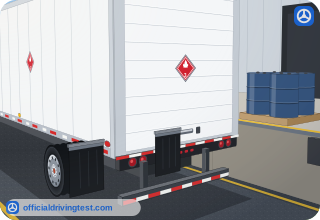
Whom should a driver ask when unsure whether the vehicle needs placards?
- The employer
- The dockworker
- The nearest police officer
Show answer
Correct answer: The employer
A driver who is not sure about the placard requirement should ask the employer.
Source: CDL manual, national model as printed by New Jersey, Sections 1 to 3 (July 2017)
-
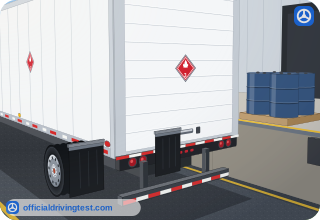
What is it to drive a vehicle that needs placards without the hazmat endorsement?
- A crime
- A minor warning only
- Allowed with a written permit
Show answer
Correct answer: A crime
Driving a vehicle that needs placards without the endorsement is a crime. The driver is cited and cannot continue.
Source: CDL manual, national model as printed by New Jersey, Sections 1 to 3 (July 2017)
-
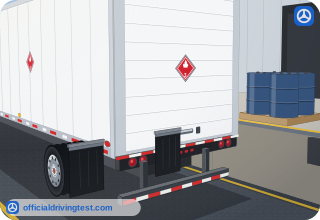
What happens to a driver stopped in a placarded vehicle without the endorsement?
- A citation and no further driving of the truck
- A warning and a fifty-mile limit
- A fine only, then the trip may continue
Show answer
Correct answer: A citation and no further driving of the truck
The driver is cited and may not drive the truck any further.
Source: CDL manual, national model as printed by New Jersey, Sections 1 to 3 (July 2017)
-
Why is failing to placard a vehicle that needs it dangerous after an accident?
- Rescuers will not know about the hazardous cargo
- The vehicle cannot be towed
- The cargo insurance becomes void at once
Show answer
Correct answer: Rescuers will not know about the hazardous cargo
Without placards, emergency workers cannot know the vehicle carries hazardous cargo, which puts everyone at risk.
Source: CDL manual, national model as printed by New Jersey, Sections 1 to 3 (July 2017)
-
A driver must load several types of products and is unsure they can go together. What should be done?
- Load them and check again at delivery
- Separate them by about one foot of space
- Ask the employer and read the regulations
Show answer
Correct answer: Ask the employer and read the regulations
Before loading different products together, the driver must know it is safe, and if unsure must ask the employer and consult the regulations.
Source: CDL manual, national model as printed by New Jersey, Sections 1 to 3 (July 2017)