Doubles and Triples: Pulling double and triple trailers
Rollover and the crack-the-whip effect, inspecting completely, looking far ahead, managing space, adverse conditions, parking, and antilock brakes on converter dollies.
Independent educational site · not affiliated with any government agency or DMV
Ready? Test yourself
Answer to start, or tap Start below:
Which two dangers do smooth driving help you avoid in a double or triple rig?
- Instant feedback with an explanation
- Every answer cites its source in the manual
- Your best score is saved on this device
- Keyboard: press 1 to 3 to answer and Enter for the next question
Questions are written in our own words from the CDL manual; they are not the real test's questions. With your state chosen, every answer gives its page in your state's CDL manual. Without a state, answers cite the CDL manual, national model as printed by New Jersey (July 2017).
All 17 questions in this practice test
Take the test above first, then use this list to study. Tap “Show answer” to see the correct answer and explanation.
Show the questions and answersHide the questions
-
How does the stability of a double or triple rig compare with other commercial vehicles?
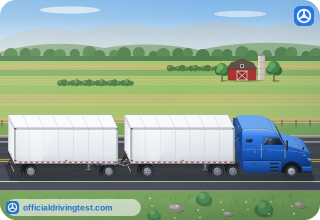
- It is just as stable as a single trailer rig
- It is more stable because it has more axles
- It is less stable than other commercial vehicles
Show answer
Correct answer: It is less stable than other commercial vehicles
Rigs with two or three trailers are less stable than other commercial vehicles, and more problems can happen with them, so extra care is needed.
Source: CDL manual, national model as printed by New Jersey, Section 7 (July 2017)
-
How should you take a curve or a ramp to keep your trailers from rolling over?

- Brake hard just before the curve
- Steer gently and go slowly
- Steer sharply and keep your speed up
Show answer
Correct answer: Steer gently and go slowly
Gentle steering and low speed on corners, ramps and curves help keep the trailers upright.
Source: CDL manual, national model as printed by New Jersey, Section 7 (July 2017)
-
You can take a curve safely at a certain speed in a straight truck. What does that tell you about taking it with doubles or triples?

- The same speed is safe for any rig with more trailers
- You may go faster because the extra weight holds the road
- That speed may be too fast for the longer rig
Show answer
Correct answer: That speed may be too fast for the longer rig
Taking a bend at a pace that suits a straight truck or one trailer can be too fast for two or three trailers.
Source: CDL manual, national model as printed by New Jersey, Section 7 (July 2017)
-
Which effect makes a rig with two or three trailers tip over more easily than other combinations?
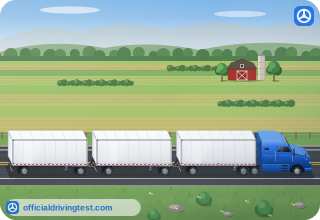
- The dead axle drag effect
- The crack-the-whip effect
- The spring brake lock-up effect
Show answer
Correct answer: The crack-the-whip effect
Because of the crack-the-whip effect, a rig with two or three trailers tips over more readily than other combinations.
Source: CDL manual, national model as printed by New Jersey, Section 7 (July 2017)
-
In a rig with several trailers, which trailer is the most likely to tip over?
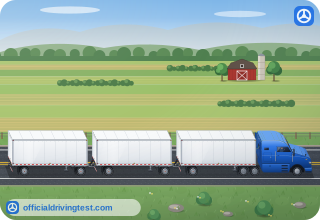
- The first trailer behind the tractor
- The trailer at the very back
- The trailer in the middle of the rig
Show answer
Correct answer: The trailer at the very back
The last trailer in the combination is the one most likely to turn over, so steer gently.
Source: CDL manual, national model as printed by New Jersey, Section 7 (July 2017)
-
What is the reason for inspecting a double or triple rig especially carefully?
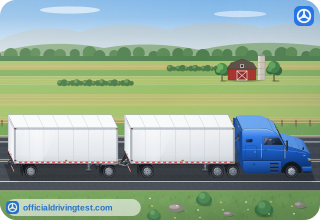
- Inspection rules for them are stricter than for a single trailer
- Trailers in a set are usually older than a single trailer
- Two or three trailers mean more critical parts to check
Show answer
Correct answer: Two or three trailers mean more critical parts to check
Each added trailer brings more important parts, and the driver must check all of them.
Source: CDL manual, national model as printed by New Jersey, Section 7 (July 2017)
-
Which two dangers do smooth driving help you avoid in a double or triple rig?
- Brake fade and tire blowout
- Hydroplaning and engine overheating
- Rollover and jackknife
Show answer
Correct answer: Rollover and jackknife
Sudden moves can tip the trailers over or fold the rig, so these rigs must be driven very smoothly.
Source: CDL manual, national model as printed by New Jersey, Section 7 (July 2017)
-
Why should a driver of doubles or triples look far down the road?
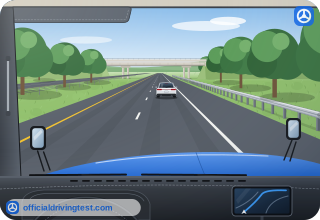
- To read signs from a longer distance
- To slow down or change lanes gradually
- To pass slower traffic before it brakes
Show answer
Correct answer: To slow down or change lanes gradually
Seeing early lets you slow or move over smoothly, which avoids rollover and jackknife.
Source: CDL manual, national model as printed by New Jersey, Section 7 (July 2017)
-
Besides being longer, why do doubles and triples need more space on the road?
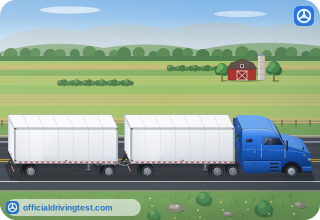
- They must keep a wider lane than other trucks
- They cannot use the left lane on a highway
- They cannot be turned or stopped suddenly
Show answer
Correct answer: They cannot be turned or stopped suddenly
These rigs cannot make abrupt turns or quick stops, so the driver must leave extra room.
Source: CDL manual, national model as printed by New Jersey, Section 7 (July 2017)
-
How should your following distance behind other vehicles be set when you pull doubles or triples?
- Longer than for other commercial vehicles
- The same as for a single trailer rig
- Shorter, because the rig is heavy and steady
Show answer
Correct answer: Longer than for other commercial vehicles
Because the rig cannot stop suddenly, you must keep a bigger gap behind the vehicle ahead.
Source: CDL manual, national model as printed by New Jersey, Section 7 (July 2017)
-
What must you be sure of before you enter or cross a stream of traffic in a double or triple rig?
- That the traffic ahead is moving slowly
- That the other drivers see your turn signal
- That the gaps are large enough for the whole rig
Show answer
Correct answer: That the gaps are large enough for the whole rig
A long rig needs a big opening to get through, so you must be certain the gap is large enough.
Source: CDL manual, national model as printed by New Jersey, Section 7 (July 2017)
-
What must you be certain of before you change lanes with a long rig of several trailers?
- That the vehicle ahead is at least four seconds away
- That your turn signal has been on for ten seconds
- That the road is clear at both sides of the rig
Show answer
Correct answer: That the road is clear at both sides of the rig
Doubles and triples take up more space and cannot turn suddenly, so be certain the sides are clear before the lane change.
Source: CDL manual, national model as printed by New Jersey, Section 7 (July 2017)
-
Why is there a greater chance of skids and lost traction with double or triple bottoms in bad conditions?

- The drive axles carry too little weight to hold the road
- The tires on trailers are made of harder rubber
- Many dead axles must be pulled by the same drive axles
Show answer
Correct answer: Many dead axles must be pulled by the same drive axles
The drive axles pull a longer rig with more dead axles than other drivers have, so traction is lost more easily on slick roads or hills.
Source: CDL manual, national model as printed by New Jersey, Section 7 (July 2017)
-
When parking a doubles or triples rig, what kind of spot should you avoid?
- A spot you cannot pull straight through
- A spot you can only leave by turning right
- A spot with a curb on one side
Show answer
Correct answer: A spot you cannot pull straight through
Pick a spot you can drive straight out of, and know how the lot is laid out, so you never face a long and difficult escape.
Source: CDL manual, national model as printed by New Jersey, Section 7 (July 2017)
-
Why should a doubles or triples driver pay attention to how a parking lot is laid out?
- To find the spot closest to the fuel island
- To check where speed limit signs are posted
- To avoid a slow, awkward way out
Show answer
Correct answer: To avoid a slow, awkward way out
Knowing how the lot is arranged helps you avoid a long and difficult way out.
Source: CDL manual, national model as printed by New Jersey, Section 7 (July 2017)
-
Which converter dollies must have antilock brakes?
- Those built on or after January 1, 1990
- Those that pull a trailer with more than two axles
- Those built on or after March 1, 1998
Show answer
Correct answer: Those built on or after March 1, 1998
Antilock brakes are required on dollies manufactured from March 1, 1998 onward.
Source: CDL manual, national model as printed by New Jersey, Section 7 (July 2017)
-
How can you tell that a converter dolly has antilock brakes?
- A yellow lamp shows on its left side
- A red lamp shows on its right side
- A green lamp shows on its tow bar
Show answer
Correct answer: A yellow lamp shows on its left side
A dolly with antilock brakes has a yellow lamp on its left side.
Source: CDL manual, national model as printed by New Jersey, Section 7 (July 2017)