California: Financial responsibility & insurance Practice Test
Insurance minimums, what to do after a collision, and vehicle registration.
Independent educational site · not affiliated with any government agency or DMV
Ready? Test yourself
- Instant feedback with an explanation
- Every answer cites its source in the manual
- Your best score is saved on this device
- Keyboard: press 1 to 4 to answer and Enter for the next question
Questions are original and based on the official manual "California Driver Handbook" (2025), California DMV.
All 18 questions in this practice test
Take the test above first, then use this list to study. Tap “Show answer” to see the correct answer and explanation.
Show the questions and answersHide the questions
-
When must you have proof of financial responsibility (insurance) with you?
- Only when you travel out of state
- Only after you have been in a collision
- Whenever you drive, including when you take a drive test
- Only when a police officer asks for it in writing
Show answer
Correct answer: Whenever you drive, including when you take a drive test
Proof of insurance must be with you every time you drive and for your drive test, and you must show it to other drivers after a collision.
Source: California Driver Handbook (2025), page 76 · Open this page in the manual (Manual page 76)
-
What is the minimum coverage your insurance must provide for a single death or injury?
- $15,000
- $30,000
- $60,000
- $5,000
Show answer
Correct answer: $30,000
California requires at least $30,000 of coverage for a single death or injury.
Source: California Driver Handbook (2025), page 76 · Open this page in the manual (Manual page 76)
-
What minimum amount must your policy cover when more than one person is killed or injured?
- $30,000
- $45,000
- $100,000
- $60,000
Show answer
Correct answer: $60,000
The minimum rises to $60,000 when a collision kills or injures more than one person.
Source: California Driver Handbook (2025), page 76 · Open this page in the manual (Manual page 76)
-
What is the minimum property damage coverage required in California?
- $5,000
- $15,000
- $25,000
- $1,000
Show answer
Correct answer: $15,000
Policies must cover at least $15,000 in property damage.
Source: California Driver Handbook (2025), page 76 · Open this page in the manual (Manual page 76)
-
Who carries the financial responsibility for a licensed driver who is 16 years old?
- The teen driver alone
- The driving school that trained them
- Their parents or guardians
- DMV, through a state fund
Show answer
Correct answer: Their parents or guardians
Parents or guardians are financially responsible for drivers under 18 and pay for damages from a collision. At 18 the driver takes on that responsibility.
Source: California Driver Handbook (2025), page 76 · Open this page in the manual (Manual page 76)
-
You are in a collision without proper insurance coverage. What is the longest your driving privilege can be suspended?
- Up to four years, no matter who was at fault
- Up to one year, only if you caused it
- Up to 90 days
- There is no suspension, only a fine
Show answer
Correct answer: Up to four years, no matter who was at fault
Being uninsured in a collision can cost up to four years of driving, and fault does not matter.
Source: California Driver Handbook (2025), page 76 · Open this page in the manual (Manual page 76)
-
A driver's privilege is suspended for up to four years after a collision without proper insurance. How can the driver get a license back early?
- By paying the other driver's repair bill in full, with proof of payment
- By retaking and passing both the knowledge and drive tests
- By providing an SR 22/SR 1P certificate and maintaining it for three years
- It is not possible; the whole suspension must be served
Show answer
Correct answer: By providing an SR 22/SR 1P certificate and maintaining it for three years
The suspension can last up to four years. Providing a California Insurance Proof Certificate (SR 22/SR 1P) and maintaining it for three years lets you get your license back during the last three years of the suspension.
Source: California Driver Handbook (2025), page 76 · Open this page in the manual (Manual page 76)
-
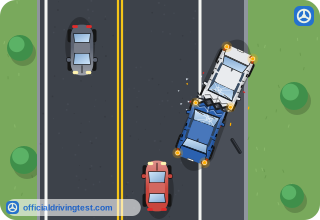
You are involved in a collision. What is the first thing the law requires of you?
- Photograph the damage before doing anything else
- Stop; leaving the scene is a hit-and-run with severe penalties
- Call your insurance agent and wait there for instructions
- Drive to the nearest police station
Show answer
Correct answer: Stop; leaving the scene is a hit-and-run with severe penalties
You must stop. Driving away from a collision is a hit-and-run, and conviction carries severe punishment.
Source: California Driver Handbook (2025), page 77 · Open this page in the manual (Manual page 77)
-
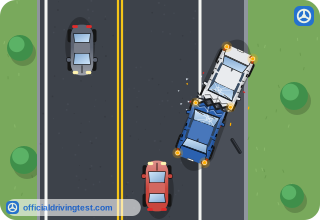
What must you show the other driver and any responding officer after a collision?
- Only your driver's license and your phone number
- Your license, registration card, insurance information, and address
- Your license, the vehicle's title, and your employer's address
- Nothing until your insurance company's agent arrives at the scene
Show answer
Correct answer: Your license, registration card, insurance information, and address
Everyone involved is entitled to see your license, registration card, insurance information, and current address.
Source: California Driver Handbook (2025), page 77 · Open this page in the manual (Manual page 77)
-
Someone is injured in a collision you were part of. How soon must a report reach law enforcement?
- Within 24 hours of the collision
- Within 10 days
- Within 72 hours
- Only if the injuries need hospital care
Show answer
Correct answer: Within 24 hours of the collision
If anyone is injured or killed, a report must go to law enforcement within 24 hours. Your insurance agent, broker, or legal representative may file it for you.
Source: California Driver Handbook (2025), page 77 · Open this page in the manual (Manual page 77)
-
Your car rolls into a parked vehicle and you cannot find the owner. What should you do?
- Drive away, since no one saw the contact and the damage is small
- Wait exactly one hour for the owner, then leave without a note
- Attach a note with your name, phone number, and address, then report it
- Report it only to your insurer, and leave no note on the car
Show answer
Correct answer: Attach a note with your name, phone number, and address, then report it
When the owner cannot be found, fasten a note with your name, phone number, and address to the vehicle or property and report the collision to law enforcement.
Source: California Driver Handbook (2025), page 77 · Open this page in the manual (Manual page 77)
-
You strike and injure an animal with your vehicle. What is the right response?
- Carry the injured animal off the road to the roadside yourself
- Call the nearest humane society or law enforcement; do not move the animal
- Drive on, as animals are not covered by collision rules
- Put the animal in your car and take it to a veterinarian yourself
Show answer
Correct answer: Call the nearest humane society or law enforcement; do not move the animal
Call the nearest humane society or law enforcement. Do not try to move an injured animal yourself.
Source: California Driver Handbook (2025), page 77 · Open this page in the manual (Manual page 77)
-
Which collision must be reported to DMV within 10 days?
- Any collision at all, even one with no damage and no injuries
- Only collisions where someone died, not ones with injuries
- One with over $1,000 in damage, or where anyone was hurt or killed
- Only collisions on a public highway, never on private property
Show answer
Correct answer: One with over $1,000 in damage, or where anyone was hurt or killed
A DMV report is due within 10 days when damage tops $1,000 or anyone is injured or killed, even if the injury is minor.
Source: California Driver Handbook (2025), page 78 · Open this page in the manual (Manual page 78)
-
Who is responsible for filing the SR 1 collision report with DMV?
- The driver who caused the collision only
- The responding law enforcement officer
- The insurance company, automatically
- Each driver involved, at fault or not
Show answer
Correct answer: Each driver involved, at fault or not
Every driver must file an SR 1 regardless of fault, including collisions on private property. Law enforcement will not file it for you, and failing to file leads to suspension.
Source: California Driver Handbook (2025), page 78 · Open this page in the manual (Manual page 78)
-
You buy a used car from a private party. How long do you have to transfer the ownership into your name?
- 10 days
- 5 days
- 20 days
- 30 days
Show answer
Correct answer: 10 days
A buyer has 10 days to transfer the vehicle's ownership into their own name.
Source: California Driver Handbook (2025), page 79 · Open this page in the manual (Manual page 79)
-
You sell your vehicle. How quickly must you notify DMV, and how?
- Within 30 days, by visiting a DMV field office in person
- Within five days, with a Notice of Transfer and Release of Liability
- Within 10 days, by mailing the license plates and title to DMV
- No notice is needed; the buyer handles everything
Show answer
Correct answer: Within five days, with a Notice of Transfer and Release of Liability
A seller must notify DMV within five days using the Notice of Transfer and Release of Liability.
Source: California Driver Handbook (2025), page 79 · Open this page in the manual (Manual page 79)
-
You move to California and start a job there, bringing your out-of-state car. How long do you have to register it?
- 60 days
- 10 days
- 20 days
- Until the out-of-state plates expire
Show answer
Correct answer: 20 days
You have 20 days to register the vehicle once you become a California resident or take a job in the state.
Source: California Driver Handbook (2025), page 79 · Open this page in the manual (Manual page 79)
-
What happens if a vehicle does not meet California's vehicle emission control requirements?
- It is registered, but with a higher annual fee
- DMV cannot register it
- It may be driven only outside city limits
- Emission rules apply only to commercial trucks
Show answer
Correct answer: DMV cannot register it
All vehicles registered in California must meet state requirements, including emission controls. DMV cannot register a vehicle that does not qualify.
Source: California Driver Handbook (2025), page 79 · Open this page in the manual (Manual page 79)