California: Emergency vehicles & work zones Practice Test
Yielding to emergency vehicles and slowing down in work zones.
Independent educational site · not affiliated with any government agency or DMV
Ready? Test yourself
- Instant feedback with an explanation
- Every answer cites its source in the manual
- Your best score is saved on this device
- Keyboard: press 1 to 4 to answer and Enter for the next question
Questions are original and based on the official manual "California Driver Handbook" (2025), California DMV.
All 8 questions in this practice test
Take the test above first, then use this list to study. Tap “Show answer” to see the correct answer and explanation.
Show the questions and answersHide the questions
-
Which set of actions describes how you should drive through a highway work zone?
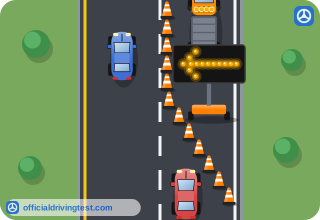
- Keep your usual speed and stay close to the car ahead
- Slow down, leave extra space, and expect sudden stops
- Change lanes often to find the fastest line
- Use the time to answer messages while traffic crawls
Show answer
Correct answer: Slow down, leave extra space, and expect sudden stops
Work zones call for lower speed, more following space, and full attention because traffic can stop without warning.
Source: California Driver Handbook (2025), page 49 · Open this page in the manual (Manual page 49)
-
Cones and drums are guiding traffic through a work zone and a lane ahead is closing. What should you do?
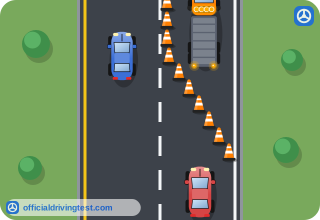
- Drive over the cones to reach the open lane
- Reverse to the previous exit
- Stop and wait for a worker to wave you through
- Merge as soon as it is safe, without crossing them
Show answer
Correct answer: Merge as soon as it is safe, without crossing them
Merge early and safely, staying inside the channel the cones create, and obey any flagger's instructions.
Source: California Driver Handbook (2025), page 49 · Open this page in the manual (Manual page 49)
-
How large can a fine be for a traffic violation committed in a work zone?
- No more than $100
- No more than $250
- $1,000 or more
- Fines do not change inside work zones
Show answer
Correct answer: $1,000 or more
Work zone violations can cost $1,000 or more, far above an ordinary ticket.
Source: California Driver Handbook (2025), page 49 · Open this page in the manual (Manual page 49)
-
In a Safety Enhanced-Double Fine Zone, or in a construction zone with workers present, what happens to traffic fines?
- They are doubled
- They are reduced by half
- They are replaced by a warning
- They stay exactly the same
Show answer
Correct answer: They are doubled
Fines double in designated double fine zones and in highway construction or maintenance areas when workers are present.
Source: California Driver Handbook (2025), page 49 · Open this page in the manual (Manual page 49)
-
The Move Over and Slow Down law applies to which stopped vehicles displaying flashing warning lights?
- Any vehicle parked at the curb
- Delivery trucks stopped at the curb to unload goods
- School buses loading children
- Emergency vehicles, tow trucks, and road work vehicles
Show answer
Correct answer: Emergency vehicles, tow trucks, and road work vehicles
Drivers must move over and slow down for stopped emergency vehicles, tow trucks, and road work vehicles displaying flashing amber or emergency lights.
Source: California Driver Handbook (2025), page 49 · Open this page in the manual (Manual page 49)
-
You come upon a highway construction zone at night. What does the handbook tell you to do?
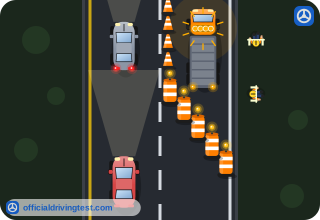
- Reduce your speed through the zone
- Keep your normal speed because crews leave at night
- Turn off your headlights so you do not blind the workers
- Use the shoulder to get past the equipment
Show answer
Correct answer: Reduce your speed through the zone
Highway construction often takes place after dark, so slow down when you drive through a construction zone at night.
Source: California Driver Handbook (2025), page 59 · Open this page in the manual (Manual page 59)
-
How can you recognize a law enforcement traffic break?
- The officer parks across the shoulder with the siren sounding
- The officer turns on emergency lights and slowly weaves across lanes
- Flares are placed in every lane
- A flashing yellow arrow board blocks the freeway entrance
Show answer
Correct answer: The officer turns on emergency lights and slowly weaves across lanes
During a traffic break the officer uses emergency lights and weaves slowly across the lanes to slow or stop traffic, usually to clear a hazard or manage unusual conditions.
Source: California Driver Handbook (2025), page 64 · Open this page in the manual (Manual page 64)
-
What should you do during a traffic break?
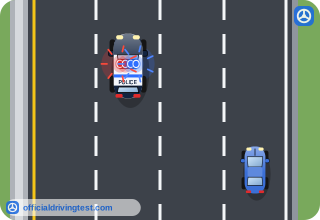
- Brake hard and stop immediately in your lane
- Move to the far right lane and pass the patrol car there
- Turn on your flashers, slow to the officer's speed, and do not pass
- Exit the freeway at the first opportunity
Show answer
Correct answer: Turn on your flashers, slow to the officer's speed, and do not pass
Warn drivers behind you with your flashers, match the officer's speed without braking suddenly, keep a safe distance, and stay behind until the emergency lights are turned off.
Source: California Driver Handbook (2025), page 64 · Open this page in the manual (Manual page 64)