Arkansas: Emergency vehicles and work zones
The Move Over law, work zones, emergency vehicles and what to do when an officer stops you. Split into 3 shorter tests so you're not stuck in one long quiz.
Independent educational site · not affiliated with any government agency or DMV
Choose a part
Emergency vehicles and work zones — Part 1
Questions in this part include: “Where should you NOT stop when pulled over by a law enforcement officer?”
StartEmergency vehicles and work zones — Part 2
Questions in this part include: “Which of these is named as a stopped vehicle with its lights on that you must move over for on a multilane highway?”
StartEmergency vehicles and work zones — Part 3
Questions in this part include: “How does the manual say to prepare for the unexpected before entering a Work Zone?”
StartAll 53 Emergency vehicles and work zones questions with answers
Choose a part above to take a practice test, or study every question and answer here.
Show the questions and answersHide the questions
-
What should you do first when a law enforcement officer signals you to stop?
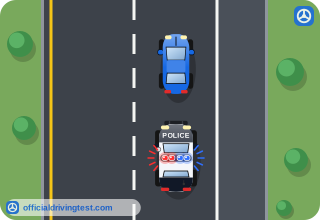
- Stop in your lane and turn on only your hazard lights
- Pull over to the left side of the road and shut off the engine
- Slow down and keep driving until you reach your destination
- Pull over to the right side of the road and activate your turn signal
Show answer
Correct answer: Pull over to the right side of the road and activate your turn signal
You pull over to the right and use your turn signal to show the officer you are seeking a safe place to stop.
Source: Arkansas Driver License Study Guide (Volume 1, Edition 10, October 2026)
-
If you are unsure that the vehicle signaling you to stop belongs to an actual police officer, what should you do?
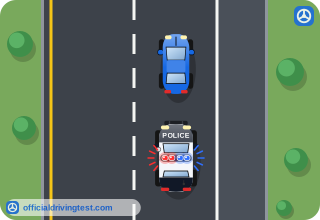
- Turn on your signal, go to a well-lit place, and call 9-1-1
- Keep driving at normal speed until you reach your home or workplace
- Stop right where you are and wait with the engine running
- Pull onto the left shoulder and flash your headlights at the vehicle
Show answer
Correct answer: Turn on your signal, go to a well-lit place, and call 9-1-1
You signal, pull to the nearest well-lit location, dial 9-1-1 and ask for a police officer confirmation.
Source: Arkansas Driver License Study Guide (Volume 1, Edition 10, October 2026)
-
Where should you NOT stop when pulled over by a law enforcement officer?
- In a well-lit location
- Out of the traffic lane
- On a bridge or overpass
- On the right side of the road
Show answer
Correct answer: On a bridge or overpass
The manual says to pull to the closest safest spot out of the traffic lane and not to stop on bridges or overpasses.
Source: Arkansas Driver License Study Guide (Volume 1, Edition 10, October 2026)
-
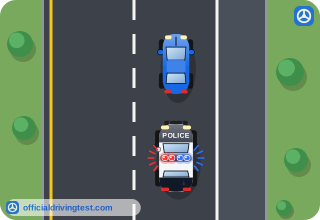
During a traffic stop, what should you do unless the officer instructs you to exit?
- Step out and stand beside the vehicle
- Remain in the vehicle
- Walk back toward the officer’s vehicle
- Wait outside on the shoulder
Show answer
Correct answer: Remain in the vehicle
The manual says to remain in the vehicle unless the officer instructs you to exit.
Source: Arkansas Driver License Study Guide (Volume 1, Edition 10, October 2026)
-
Where does the manual suggest placing your hands so the officer can see them as he or she approaches?
- On the dashboard
- In your lap below the wheel
- Behind your head
- At the top of the steering wheel
Show answer
Correct answer: At the top of the steering wheel
Both hands should be visible, for example at the top of the steering wheel.
Source: Arkansas Driver License Study Guide (Volume 1, Edition 10, October 2026)
-
While looking for your documents during a traffic stop, what should you avoid doing?
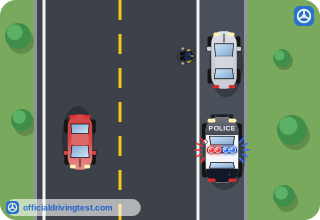
- Making any sudden movements
- Keeping your hands visible
- Turning on the interior lights at night
- Telling the officer where the documents are
Show answer
Correct answer: Making any sudden movements
The manual says not to make any sudden movements while looking for your documents.
Source: Arkansas Driver License Study Guide (Volume 1, Edition 10, October 2026)
-
If you are stopped at night, what should you do so the officer can see you more clearly?
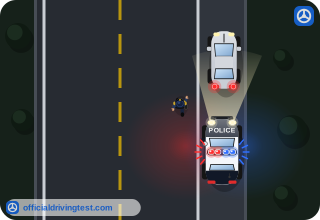
- Turn off all the lights, including the headlights
- Switch on the high beams
- Turn on the interior lights
- Flash your headlights at the officer
Show answer
Correct answer: Turn on the interior lights
At night you turn on the interior lights so the officer can see you more clearly.
Source: Arkansas Driver License Study Guide (Volume 1, Edition 10, October 2026)
-
What should you do with the radio and mobile devices during a traffic stop?
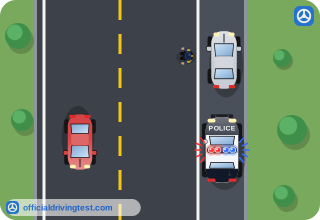
- Lower the radio volume and use the phone hands-free
- Turn off the radio and put down any mobile devices
- Leave the radio on and set the phone on the seat
- Keep the radio on but put the phone away
Show answer
Correct answer: Turn off the radio and put down any mobile devices
You turn off the radio, put down mobile devices and give the officer your full attention.
Source: Arkansas Driver License Study Guide (Volume 1, Edition 10, October 2026)
-
According to the manual, what should an officer do at the start of a traffic stop?
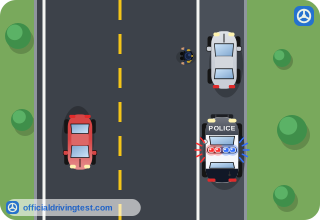
- Ask you to step out of the vehicle and walk to the patrol car
- Take your keys and hold them until the stop is over
- Search the vehicle before explaining the reason for the stop
- Introduce himself or herself and tell you the reason for the stop
Show answer
Correct answer: Introduce himself or herself and tell you the reason for the stop
The officer should give his or her name and agency and tell you the reason for the stop.
Source: Arkansas Driver License Study Guide (Volume 1, Edition 10, October 2026)
-
Before reaching for your documents during a traffic stop, what should you do?
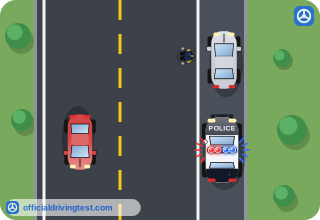
- Reach for them quickly to show that you are cooperating
- Wait for the officer to tell you where to find them
- Tell the officer where they are and ask before reaching
- Step out of the vehicle and get them from the trunk
Show answer
Correct answer: Tell the officer where they are and ask before reaching
You inform the officer where the documents are and ask before reaching to retrieve them.
Source: Arkansas Driver License Study Guide (Volume 1, Edition 10, October 2026)
-
If there is a weapon in the vehicle during a traffic stop, what should you do?
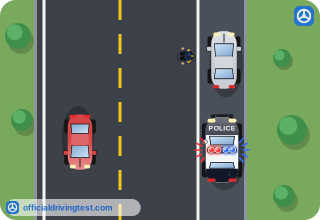
- Say nothing unless the officer asks you about it
- Tell the officer about it and its location; do not reach for it
- Move the weapon to the trunk before the officer arrives
- Hand the weapon to the officer through the window
Show answer
Correct answer: Tell the officer about it and its location; do not reach for it
Inform the officer of the weapon, its type and location, do not reach for it, and follow the officer’s instructions.
Source: Arkansas Driver License Study Guide (Volume 1, Edition 10, October 2026)
-
If you have a concealed carry permit, what should you do during a traffic stop?
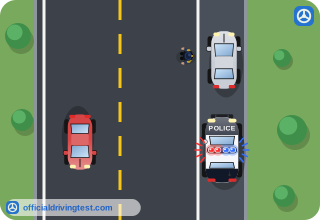
- Keep it hidden unless the officer asks to see the weapon
- Show it only after the stop is over
- Leave it in the glove box
- Present it to the officer with your driver’s license
Show answer
Correct answer: Present it to the officer with your driver’s license
The manual says to present the concealed carry permit to the officer with your driver’s license.
Source: Arkansas Driver License Study Guide (Volume 1, Edition 10, October 2026)
-
Which side of the vehicle may an officer approach during a traffic stop?
- Either side of the vehicle
- Only the driver’s side
- Only the passenger side
- Only the side away from traffic
Show answer
Correct answer: Either side of the vehicle
The officer may approach either side; the manual says not to be alarmed.
Source: Arkansas Driver License Study Guide (Volume 1, Edition 10, October 2026)
-
What should you do if you disagree with the officer’s actions during a traffic stop?
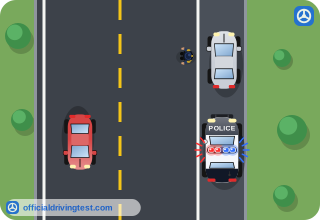
- Argue your case on the side of the road
- Refuse to continue until the officer explains the law
- Be courteous to the officer
- Get out of the vehicle to talk face to face
Show answer
Correct answer: Be courteous to the officer
The manual says to be courteous to the officer even if you disagree with his or her actions.
Source: Arkansas Driver License Study Guide (Volume 1, Edition 10, October 2026)
-
If you observe a traffic stop that does not involve you, what should you do?
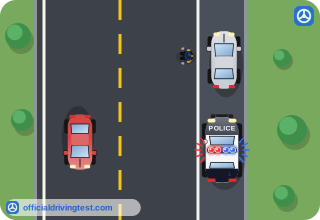
- Stop and offer to help the officer
- Slow down and watch the stop
- Do not approach the officer
- Pull over and wait with the driver
Show answer
Correct answer: Do not approach the officer
The manual says not to approach the officer during a traffic stop that does not involve you.
Source: Arkansas Driver License Study Guide (Volume 1, Edition 10, October 2026)
-
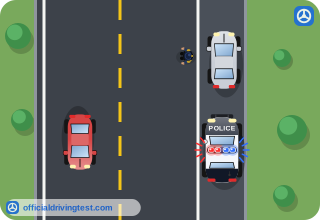
When passing an officer or other authorized vehicle stopped on the side of the road, what does Arkansas law require?
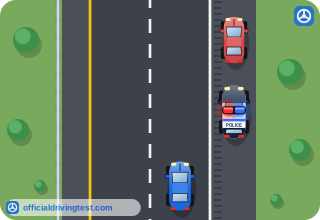
- Stay in your lane and sound your horn as you pass
- Move to the farthest lane or position away from it
- Stop behind the vehicle until it drives away
- Speed up to get past the vehicle quickly
Show answer
Correct answer: Move to the farthest lane or position away from it
Arkansas law requires you to move to the farthest lane or position away from the authorized vehicle.
Source: Arkansas Driver License Study Guide (Volume 1, Edition 10, October 2026)
-
When passing a stopped officer or authorized vehicle, what does the law require if it is unsafe or not possible to change lanes?
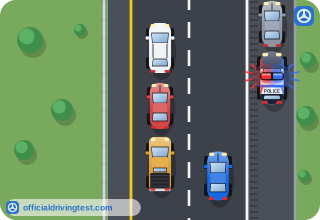
- Come to a complete stop
- Sound your horn
- Keep your speed and use your hazard lights
- Reduce your speed as you pass
Show answer
Correct answer: Reduce your speed as you pass
If you cannot change lanes safely, the law requires you to reduce your speed as you pass.
Source: Arkansas Driver License Study Guide (Volume 1, Edition 10, October 2026)
-
How should you respond to a police car, fire truck or ambulance using a siren or air horn and a red or blue flashing light?
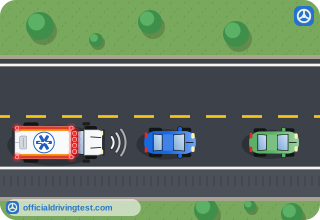
- Pull over to the right edge of the road, or as near to the right as possible
- Stop immediately where you are, even if you are in an intersection
- Pull over to the left edge of the road, or as near to the left as possible
- Move to the center of the road and slow down to a crawl
Show answer
Correct answer: Pull over to the right edge of the road, or as near to the right as possible
Drivers should pull over to the right edge of the road, or as near to the right as possible.
Source: Arkansas Driver License Study Guide (Volume 1, Edition 10, October 2026), page 11 · Open this page in the manual (Manual page 11)
-
If you are in an intersection when an emergency vehicle approaches with its siren on, what should you do?
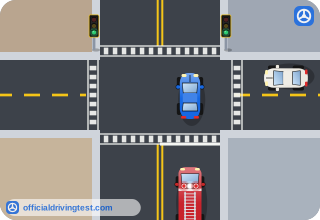
- Stop in the intersection and wait for it to pass
- Back up out of the intersection
- Drive through the intersection before pulling over
- Turn left and stop in the left lane
Show answer
Correct answer: Drive through the intersection before pulling over
The manual says to go ahead and drive through the intersection before pulling over.
Source: Arkansas Driver License Study Guide (Volume 1, Edition 10, October 2026), page 11 · Open this page in the manual (Manual page 11)
-
On a multilane highway, what does Arkansas law require when you approach a stopped law enforcement vehicle with its lights turned on?
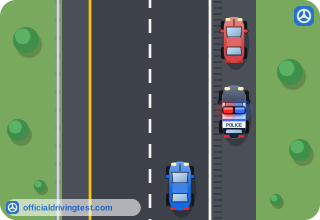
- Stop behind it until its lights are turned off
- Move over, whenever possible, to the farthest lane away from it
- Stay in your lane and sound your horn
- Move to the lane closest to it to let other traffic pass
Show answer
Correct answer: Move over, whenever possible, to the farthest lane away from it
Arkansas law requires any vehicle on a multilane highway to move over, whenever possible, to the farthest lane away from a stopped law enforcement vehicle with its lights on.
Source: Arkansas Driver License Study Guide (Volume 1, Edition 10, October 2026), page 11 · Open this page in the manual (Manual page 11)
-
For how long can the court suspend the driver's license of a driver found guilty of violating the law about moving over for a stopped law enforcement vehicle?
- Up to thirty days
- Up to ninety days
- Up to one year
- Up to six months
Show answer
Correct answer: Up to six months
The court may order community service or suspend the person's driver's license up to six months.
Source: Arkansas Driver License Study Guide (Volume 1, Edition 10, October 2026), page 11 · Open this page in the manual (Manual page 11)
-
When an emergency vehicle is stopped on the side of the road and you cannot change lanes, what should you do?
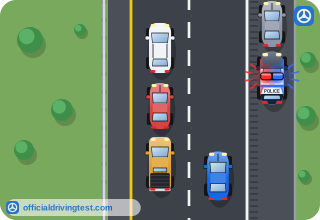
- Slow down
- Stop and wait until it leaves
- Speed up to pass quickly
- Sound your horn as you pass
Show answer
Correct answer: Slow down
The page says to move to the next lane, or slow down if changing lanes is not possible.
Source: Arkansas Driver License Study Guide (Volume 1, Edition 10, October 2026), page 15 · Open this page in the manual (Manual page 15)
-
Which of these is named as a stopped vehicle with its lights on that you must move over for on a multilane highway?
- A mail delivery truck
- A taxi
- An Arkansas DOT vehicle
- A pizza delivery car
Show answer
Correct answer: An Arkansas DOT vehicle
The law names an enforcement vehicle, an Arkansas DOT vehicle, a utility vehicle or a towing vehicle.
Source: Arkansas Driver License Study Guide (Volume 1, Edition 10, October 2026), page 15 · Open this page in the manual (Manual page 15)
-
Which two driver behaviors does the manual say can be especially problematic in Work Zones?
- Speeding and distracted driving
- Tailgating and improper passing
- Drowsy driving and impaired driving
- Illegal turns and failing to signal
Show answer
Correct answer: Speeding and distracted driving
The manual names speeding and distracted driving as the two behaviors that are especially problematic in Work Zones.
Source: Arkansas Driver License Study Guide (Volume 1, Edition 10, October 2026), page 17 · Open this page in the manual (Manual page 17)
-
What generally identifies a standard Work Zone for highway construction?
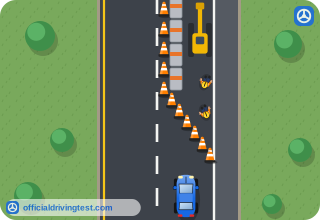
- A crew working for a short time and moving along the road with periodic stops
- A construction site that may exist in one location for months or years
- A work area that is open only during the night shift each week
- A work area marked only by signs on the back of a work vehicle
Show answer
Correct answer: A construction site that may exist in one location for months or years
A standard Work Zone generally identifies a construction site that may exist in one location for months or years.
Source: Arkansas Driver License Study Guide (Volume 1, Edition 10, October 2026), page 17 · Open this page in the manual (Manual page 17)
-
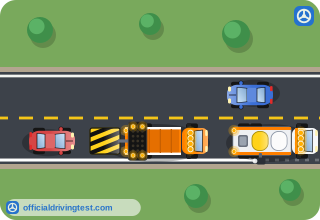
How does the manual describe a Mobile Work Zone?
- A construction site that stays in one location for months or years
- Any Work Zone where the speed limit has been reduced for safety
- A work area that exists only on Interstate highways at night
- Work done for a short time, often moving slowly with periodic stops
Show answer
Correct answer: Work done for a short time, often moving slowly with periodic stops
A Mobile Work Zone exists where work is performed for a short period of time and often travels at slow speeds with periodic stops.
Source: Arkansas Driver License Study Guide (Volume 1, Edition 10, October 2026), page 17 · Open this page in the manual (Manual page 17)
-
Which of these is an example of a Mobile Work Zone?
- A contractor building a new interchange over several months
- A crew widening a highway over a two-year project
- A maintenance crew painting stripes on the roadway
- A company rebuilding a bridge for most of a year
Show answer
Correct answer: A maintenance crew painting stripes on the roadway
The manual says a highway maintenance crew painting stripes, removing debris or patching potholes is a Mobile Work Zone.
Source: Arkansas Driver License Study Guide (Volume 1, Edition 10, October 2026), page 17 · Open this page in the manual (Manual page 17)
-
Flashing green lights are seen on a roadway construction or maintenance vehicle. What do they indicate, and what should drivers do?
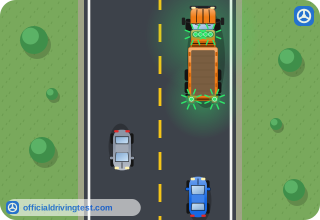
- An active Work Zone, so drivers should use caution and slow down
- A vehicle that may pass through red lights without stopping
- The end of the Work Zone, so drivers may resume normal speed
- A police vehicle that is making a traffic stop ahead
Show answer
Correct answer: An active Work Zone, so drivers should use caution and slow down
The manual says flashing green lights indicate an active Work Zone, standard or mobile, and drivers should exercise caution and slow down.
Source: Arkansas Driver License Study Guide (Volume 1, Edition 10, October 2026), page 18 · Open this page in the manual (Manual page 18)
-
What is a flagger?
- A crew member who inspects the vehicles passing through the work area
- A person with a sign or flag who controls traffic in a work area
- A police officer who writes citations to speeding drivers
- A worker who checks the weather before the crew begins its shift
Show answer
Correct answer: A person with a sign or flag who controls traffic in a work area
In work areas, traffic may be controlled by a person with a sign or flag, known as a flagger.
Source: Arkansas Driver License Study Guide (Volume 1, Edition 10, October 2026), page 18 · Open this page in the manual (Manual page 18)
-
In Arkansas, fines for all moving traffic violations in a highway work zone are doubled under which conditions?
- Only when a police officer is parked inside the work zone
- Only when the work zone speed limit has been reduced at night
- Only when workers are present and warning signs are posted in advance
- Only when the violation is speeding and a flagger is present
Show answer
Correct answer: Only when workers are present and warning signs are posted in advance
The manual says fines double if workers are present and warning signs are present in advance of the work zone.
Source: Arkansas Driver License Study Guide (Volume 1, Edition 10, October 2026), page 18 · Open this page in the manual (Manual page 18)
-
A driver receives a citation for a moving traffic violation in a Work Zone where workers are present. What will the driver pay?
- Double the fine
- Triple the fine
- The normal fine only
- The normal fine plus a mandatory license suspension
Show answer
Correct answer: Double the fine
The manual says a driver cited for any moving traffic violation in a Work Zone will pay double the fine.
Source: Arkansas Driver License Study Guide (Volume 1, Edition 10, October 2026), page 19 · Open this page in the manual (Manual page 19)
-
Depending on the violation, doubled fines in a Work Zone can be as high as what amount?
- $5,000
- $1,000
- $2,500
- $10,000
Show answer
Correct answer: $5,000
The manual says that doubled fines can be as high as $5,000, depending on the traffic violation.
Source: Arkansas Driver License Study Guide (Volume 1, Edition 10, October 2026), page 19 · Open this page in the manual (Manual page 19)
-
How are fines handled in a Mobile Work Zone compared with a standard Work Zone?
- They are reduced because the Work Zone is moving
- They double only in a standard Work Zone
- They are tripled in a Mobile Work Zone
- They double in both types of Work Zones
Show answer
Correct answer: They double in both types of Work Zones
Mobile Work Zones are treated the same as standard or stationary Work Zones, so fines double in both.
Source: Arkansas Driver License Study Guide (Volume 1, Edition 10, October 2026), page 19 · Open this page in the manual (Manual page 19)
-
Where does the manual say speed enforcement cameras are used in Arkansas Work Zones?
- In all school zones
- In Interstate Work Zones
- In Mobile Work Zones only
- On every two-lane highway
Show answer
Correct answer: In Interstate Work Zones
The manual says speed enforcement cameras are used in Interstate Work Zones in Arkansas.
Source: Arkansas Driver License Study Guide (Volume 1, Edition 10, October 2026), page 19 · Open this page in the manual (Manual page 19)
-
When speed enforcement cameras are used in an Interstate Work Zone, where can the officer be positioned?
- At the end of the Work Zone
- At the start of the Work Zone
- Inside the Work Zone, next to the workers
- At the nearest exit before the Work Zone
Show answer
Correct answer: At the end of the Work Zone
The cameras let an officer be positioned at the end of a Work Zone and pull over violators as they exit, so no officer is needed inside it.
Source: Arkansas Driver License Study Guide (Volume 1, Edition 10, October 2026), page 19 · Open this page in the manual (Manual page 19)
-
What does the manual say to do before leaving for a trip to prepare for Work Zones on your route?
- Look for Work Zones only after you see the first warning sign
- Choose the shortest route even if it has several Work Zones
- Plan to follow a large truck through the Work Zone
- Check your route for Work Zones and consider an alternate route
Show answer
Correct answer: Check your route for Work Zones and consider an alternate route
Before entering a Work Zone, the manual says to plan ahead by checking for Work Zones on your route and considering an alternate route.
Source: Arkansas Driver License Study Guide (Volume 1, Edition 10, October 2026), page 20 · Open this page in the manual (Manual page 20)
-
How does the manual say to prepare for the unexpected before entering a Work Zone?
- Keep your phone in hand to check the route and call ahead
- Turn up the radio so you hear traffic reports
- Put your phone away, turn down the radio, and focus on driving
- Look at the workers instead of the road ahead
Show answer
Correct answer: Put your phone away, turn down the radio, and focus on driving
Minimizing distractions by putting the phone away, turning down the radio and focusing on driving prepares you for the unexpected.
Source: Arkansas Driver License Study Guide (Volume 1, Edition 10, October 2026), page 20 · Open this page in the manual (Manual page 20)
-
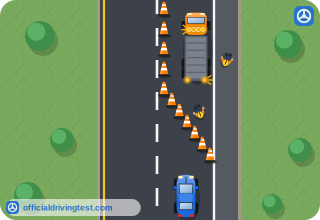
If you see lane closures ahead in a Work Zone, when should you change to the correct lane?
- At the point where the lane ends, so you can see the signs
- Only after you have passed the first flagger in the zone
- As soon as it is safe, ideally a mile or more before the closure
- Within 100 feet of the lane closure, to keep traffic moving
Show answer
Correct answer: As soon as it is safe, ideally a mile or more before the closure
The manual says to merge early, changing lanes as soon as it is safe, ideally a mile or more before the closure.
Source: Arkansas Driver License Study Guide (Volume 1, Edition 10, October 2026), page 20 · Open this page in the manual (Manual page 20)
-
What does the manual say to be prepared for when entering a Work Zone?
- A clear lane with steady, uninterrupted traffic
- Higher speed limits than on the open road
- Signs only at the end of the Work Zone
- Delays and the possibility of sudden stops
Show answer
Correct answer: Delays and the possibility of sudden stops
Under Be Patient, the manual says to be prepared for delays and the possibility of sudden stops.
Source: Arkansas Driver License Study Guide (Volume 1, Edition 10, October 2026), page 20 · Open this page in the manual (Manual page 20)
-
Why does the manual tell you to keep a safe following distance while in a Work Zone?
- Work Zone speed limits are always higher than normal
- Rear-end collisions are common in Work Zones
- Construction vehicles must be allowed to pass first
- Flaggers are not allowed to stop traffic
Show answer
Correct answer: Rear-end collisions are common in Work Zones
The manual says to keep a safe following distance because rear-end collisions are common in Work Zones.
Source: Arkansas Driver License Study Guide (Volume 1, Edition 10, October 2026), page 20 · Open this page in the manual (Manual page 20)
-
What lights will work vehicles in a Mobile Work Zone have?
- Flashing green, yellow, or white lights
- Flashing red or blue emergency lights
- Steady red lights only
- Steady white lights only
Show answer
Correct answer: Flashing green, yellow, or white lights
The manual says work vehicles in a Mobile Work Zone will have flashing green, yellow, or white lights.
Source: Arkansas Driver License Study Guide (Volume 1, Edition 10, October 2026), page 20 · Open this page in the manual (Manual page 20)
-
The Move Over law is meant to give additional space to which of these groups?
- Only police officers, fire fighters, and ambulance crews
- School bus drivers, crossing guards, and pedestrians
- Bicyclists, motorcyclists, and drivers of farm vehicles
- Emergency, construction, utility and tow truck workers
Show answer
Correct answer: Emergency, construction, utility and tow truck workers
The manual says the purpose is to allow additional space for emergency responders, construction workers, utility workers and tow truck operators.
Source: Arkansas Driver License Study Guide (Volume 1, Edition 10, October 2026), page 21 · Open this page in the manual (Manual page 21)
-
Under the Move Over law, what should you do if able when passing a stationary vehicle?
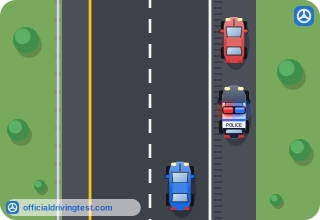
- Change to a lane not immediately adjacent to the vehicle
- Stop behind the vehicle until it leaves
- Stay in your lane and speed up to pass it quickly
- Honk your horn to warn the people working
Show answer
Correct answer: Change to a lane not immediately adjacent to the vehicle
The manual says to move over, if able, into a lane that is not immediately adjacent to the stationary vehicle.
Source: Arkansas Driver License Study Guide (Volume 1, Edition 10, October 2026), page 21 · Open this page in the manual (Manual page 21)
-
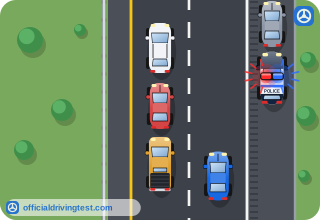
Under the Move Over law, what should you do if moving over is unsafe or impossible?
- Come to a complete stop until the vehicle has left the area
- Slow to a safe speed for conditions or a legally mandated speed
- Keep your speed and flash your headlights
- Stop and wait for a flagger to wave you on
Show answer
Correct answer: Slow to a safe speed for conditions or a legally mandated speed
The manual says to slow down to a safe level for conditions, or a legally mandated speed, if you cannot move over.
Source: Arkansas Driver License Study Guide (Volume 1, Edition 10, October 2026), page 21 · Open this page in the manual (Manual page 21)
-
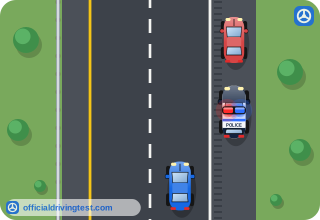
Besides police, fire, and ambulance vehicles, which vehicles with flashing lights does Arkansas's Move Over law also cover?
- Only school buses and mail delivery vehicles
- Funeral procession and taxi vehicles
- ARDOT, utility, construction vehicles and tow trucks
- Any private vehicle with its hazard lights on
Show answer
Correct answer: ARDOT, utility, construction vehicles and tow trucks
The manual says Arkansas expanded the law to ARDOT vehicles, utility vehicles, construction vehicles and tow trucks with flashing lights.
Source: Arkansas Driver License Study Guide (Volume 1, Edition 10, October 2026), page 21 · Open this page in the manual (Manual page 21)
-
According to the manual, violating a Move Over law can result in which consequences?
- A written warning only, with no other penalty applied
- A fine only, with no effect on the driver's license
- Fines, imprisonment, community service, license suspension
- Fines and a mandatory driver education course only
Show answer
Correct answer: Fines, imprisonment, community service, license suspension
The manual lists fines, imprisonment, community service and suspension of a driver's license.
Source: Arkansas Driver License Study Guide (Volume 1, Edition 10, October 2026), page 21 · Open this page in the manual (Manual page 21)
-
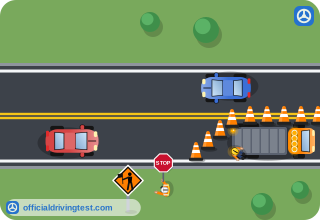
How do a flagger's instructions compare with other traffic signals or devices in a Work Zone?
- Traffic signals come first and the flagger second
- They overrule any other traffic signals or devices
- They apply only when no signs are posted
- They are advice that drivers may choose to follow
Show answer
Correct answer: They overrule any other traffic signals or devices
The manual says a flagger's instructions overrule any other traffic signals or devices.
Source: Arkansas Driver License Study Guide (Volume 1, Edition 10, October 2026), page 22 · Open this page in the manual (Manual page 22)
-
Where should you stop when a flagger tells you to stop?
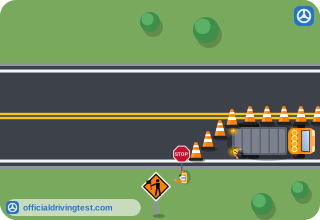
- At the designated spot, or at least a car length away
- As close to the flagger as possible so you can hear
- At least one mile before the flagger
- Just past the flagger, to leave room for others
Show answer
Correct answer: At the designated spot, or at least a car length away
The manual says to stop at the designated location, or at least a car length away from the flagger, and wait for directions to proceed.
Source: Arkansas Driver License Study Guide (Volume 1, Edition 10, October 2026), page 22 · Open this page in the manual (Manual page 22)
-
What legal authority does a flagger have in a Work Zone?
- Flaggers may only advise drivers and cannot direct traffic
- Flaggers may direct traffic only when a police officer is present
- Flaggers may direct traffic only on Interstate highways
- Flaggers are legally authorized to direct traffic in Work Zones
Show answer
Correct answer: Flaggers are legally authorized to direct traffic in Work Zones
The manual says flaggers are legally authorized to direct traffic in Work Zones and manage traffic flow.
Source: Arkansas Driver License Study Guide (Volume 1, Edition 10, October 2026), page 22 · Open this page in the manual (Manual page 22)
-
Which of these do flaggers use to communicate directions to drivers?
- Sirens
- Stop/slow paddles
- Loudspeakers
- Car horns
Show answer
Correct answer: Stop/slow paddles
The manual says flaggers use signals, stop/slow paddles, high visibility flags, and sometimes signs.
Source: Arkansas Driver License Study Guide (Volume 1, Edition 10, October 2026), page 22 · Open this page in the manual (Manual page 22)
-
In a Work Zone with one-way traffic control, what will you experience?
- Traffic held in one direction while the other passes slowly
- Traffic held in both directions at the same time
- Both directions passing at full speed without guidance
- All traffic moved onto the shoulder
Show answer
Correct answer: Traffic held in one direction while the other passes slowly
The manual says traffic is held in one direction while the other is allowed to pass slowly, often guided by a flagger or pilot car.
Source: Arkansas Driver License Study Guide (Volume 1, Edition 10, October 2026), page 22 · Open this page in the manual (Manual page 22)
-
What is the primary role of a flagger?
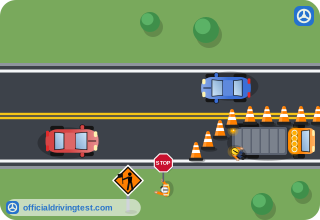
- To enforce speed limits and write citations
- To decide which vehicle types may enter the Work Zone
- To ensure the safety of work crews and the motoring public
- To record information about crashes
Show answer
Correct answer: To ensure the safety of work crews and the motoring public
The manual says flaggers' primary role is to ensure the safety of both the work crews and the motoring public.
Source: Arkansas Driver License Study Guide (Volume 1, Edition 10, October 2026), page 22 · Open this page in the manual (Manual page 22)
-
Why should you leave space when following police vehicles, ambulances and fire trucks?
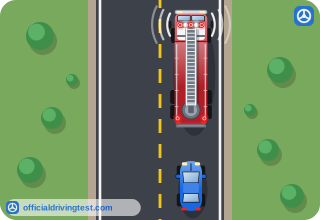
- They are required to stop for you
- They will always drive slowly
- They cannot see vehicles behind them
- They need room to work
Show answer
Correct answer: They need room to work
The manual says police vehicles, ambulances, and fire trucks need room to work.
Source: Arkansas Driver License Study Guide (Volume 1, Edition 10, October 2026), page 59 · Open this page in the manual (Manual page 59)