Arkansas: Emergency vehicles and work zones — Part 3 Practice Test
Questions in this part include: “How does the manual say to prepare for the unexpected before entering a Work Zone?” · “The Move Over law is meant to give additional space to which of these groups?”
Independent educational site · not affiliated with any government agency or DMV
Ready? Test yourself
- Instant feedback with an explanation
- Every answer cites its source in the manual
- Your best score is saved on this device
Questions are original and based on the official manual "Arkansas Driver License Study Guide" (Volume 1, Edition 10, October 2026), Arkansas State Police (ASP).
All 17 questions in this practice test
Take the test above first, then use this list to study. Tap “Show answer” to see the correct answer and explanation.
Show the questions and answersHide the questions
-
How does the manual say to prepare for the unexpected before entering a Work Zone?
- Keep your phone in hand to check the route and call ahead
- Turn up the radio so you hear traffic reports
- Put your phone away, turn down the radio, and focus on driving
- Look at the workers instead of the road ahead
Show answer
Correct answer: Put your phone away, turn down the radio, and focus on driving
Minimizing distractions by putting the phone away, turning down the radio and focusing on driving prepares you for the unexpected.
Source: Arkansas Driver License Study Guide (Volume 1, Edition 10, October 2026), page 20 · Open this page in the manual (Manual page 20)
-
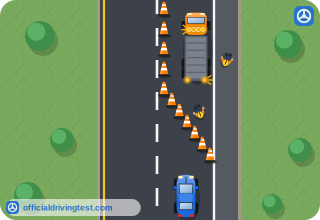
If you see lane closures ahead in a Work Zone, when should you change to the correct lane?
- At the point where the lane ends, so you can see the signs
- Only after you have passed the first flagger in the zone
- As soon as it is safe, ideally a mile or more before the closure
- Within 100 feet of the lane closure, to keep traffic moving
Show answer
Correct answer: As soon as it is safe, ideally a mile or more before the closure
The manual says to merge early, changing lanes as soon as it is safe, ideally a mile or more before the closure.
Source: Arkansas Driver License Study Guide (Volume 1, Edition 10, October 2026), page 20 · Open this page in the manual (Manual page 20)
-
What does the manual say to be prepared for when entering a Work Zone?
- A clear lane with steady, uninterrupted traffic
- Higher speed limits than on the open road
- Signs only at the end of the Work Zone
- Delays and the possibility of sudden stops
Show answer
Correct answer: Delays and the possibility of sudden stops
Under Be Patient, the manual says to be prepared for delays and the possibility of sudden stops.
Source: Arkansas Driver License Study Guide (Volume 1, Edition 10, October 2026), page 20 · Open this page in the manual (Manual page 20)
-
Why does the manual tell you to keep a safe following distance while in a Work Zone?
- Work Zone speed limits are always higher than normal
- Rear-end collisions are common in Work Zones
- Construction vehicles must be allowed to pass first
- Flaggers are not allowed to stop traffic
Show answer
Correct answer: Rear-end collisions are common in Work Zones
The manual says to keep a safe following distance because rear-end collisions are common in Work Zones.
Source: Arkansas Driver License Study Guide (Volume 1, Edition 10, October 2026), page 20 · Open this page in the manual (Manual page 20)
-
What lights will work vehicles in a Mobile Work Zone have?
- Flashing green, yellow, or white lights
- Flashing red or blue emergency lights
- Steady red lights only
- Steady white lights only
Show answer
Correct answer: Flashing green, yellow, or white lights
The manual says work vehicles in a Mobile Work Zone will have flashing green, yellow, or white lights.
Source: Arkansas Driver License Study Guide (Volume 1, Edition 10, October 2026), page 20 · Open this page in the manual (Manual page 20)
-
The Move Over law is meant to give additional space to which of these groups?
- Only police officers, fire fighters, and ambulance crews
- School bus drivers, crossing guards, and pedestrians
- Bicyclists, motorcyclists, and drivers of farm vehicles
- Emergency, construction, utility and tow truck workers
Show answer
Correct answer: Emergency, construction, utility and tow truck workers
The manual says the purpose is to allow additional space for emergency responders, construction workers, utility workers and tow truck operators.
Source: Arkansas Driver License Study Guide (Volume 1, Edition 10, October 2026), page 21 · Open this page in the manual (Manual page 21)
-
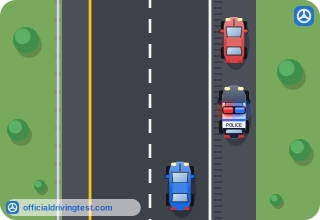
Under the Move Over law, what should you do if able when passing a stationary vehicle?
- Change to a lane not immediately adjacent to the vehicle
- Stop behind the vehicle until it leaves
- Stay in your lane and speed up to pass it quickly
- Honk your horn to warn the people working
Show answer
Correct answer: Change to a lane not immediately adjacent to the vehicle
The manual says to move over, if able, into a lane that is not immediately adjacent to the stationary vehicle.
Source: Arkansas Driver License Study Guide (Volume 1, Edition 10, October 2026), page 21 · Open this page in the manual (Manual page 21)
-
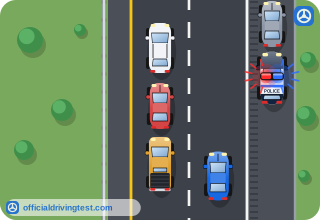
Under the Move Over law, what should you do if moving over is unsafe or impossible?
- Come to a complete stop until the vehicle has left the area
- Slow to a safe speed for conditions or a legally mandated speed
- Keep your speed and flash your headlights
- Stop and wait for a flagger to wave you on
Show answer
Correct answer: Slow to a safe speed for conditions or a legally mandated speed
The manual says to slow down to a safe level for conditions, or a legally mandated speed, if you cannot move over.
Source: Arkansas Driver License Study Guide (Volume 1, Edition 10, October 2026), page 21 · Open this page in the manual (Manual page 21)
-
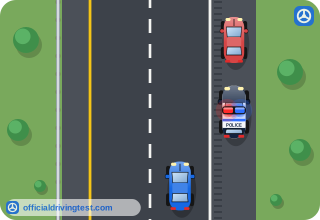
Besides police, fire, and ambulance vehicles, which vehicles with flashing lights does Arkansas's Move Over law also cover?
- Only school buses and mail delivery vehicles
- Funeral procession and taxi vehicles
- ARDOT, utility, construction vehicles and tow trucks
- Any private vehicle with its hazard lights on
Show answer
Correct answer: ARDOT, utility, construction vehicles and tow trucks
The manual says Arkansas expanded the law to ARDOT vehicles, utility vehicles, construction vehicles and tow trucks with flashing lights.
Source: Arkansas Driver License Study Guide (Volume 1, Edition 10, October 2026), page 21 · Open this page in the manual (Manual page 21)
-
According to the manual, violating a Move Over law can result in which consequences?
- A written warning only, with no other penalty applied
- A fine only, with no effect on the driver's license
- Fines, imprisonment, community service, license suspension
- Fines and a mandatory driver education course only
Show answer
Correct answer: Fines, imprisonment, community service, license suspension
The manual lists fines, imprisonment, community service and suspension of a driver's license.
Source: Arkansas Driver License Study Guide (Volume 1, Edition 10, October 2026), page 21 · Open this page in the manual (Manual page 21)
-
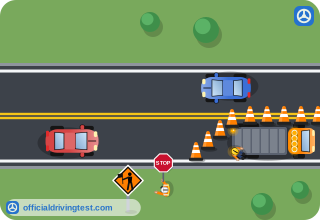
How do a flagger's instructions compare with other traffic signals or devices in a Work Zone?
- Traffic signals come first and the flagger second
- They overrule any other traffic signals or devices
- They apply only when no signs are posted
- They are advice that drivers may choose to follow
Show answer
Correct answer: They overrule any other traffic signals or devices
The manual says a flagger's instructions overrule any other traffic signals or devices.
Source: Arkansas Driver License Study Guide (Volume 1, Edition 10, October 2026), page 22 · Open this page in the manual (Manual page 22)
-
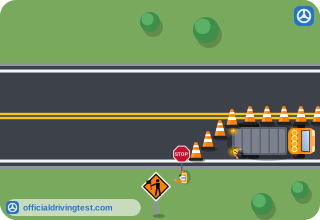
Where should you stop when a flagger tells you to stop?
- At the designated spot, or at least a car length away
- As close to the flagger as possible so you can hear
- At least one mile before the flagger
- Just past the flagger, to leave room for others
Show answer
Correct answer: At the designated spot, or at least a car length away
The manual says to stop at the designated location, or at least a car length away from the flagger, and wait for directions to proceed.
Source: Arkansas Driver License Study Guide (Volume 1, Edition 10, October 2026), page 22 · Open this page in the manual (Manual page 22)
-
What legal authority does a flagger have in a Work Zone?
- Flaggers may only advise drivers and cannot direct traffic
- Flaggers may direct traffic only when a police officer is present
- Flaggers may direct traffic only on Interstate highways
- Flaggers are legally authorized to direct traffic in Work Zones
Show answer
Correct answer: Flaggers are legally authorized to direct traffic in Work Zones
The manual says flaggers are legally authorized to direct traffic in Work Zones and manage traffic flow.
Source: Arkansas Driver License Study Guide (Volume 1, Edition 10, October 2026), page 22 · Open this page in the manual (Manual page 22)
-
Which of these do flaggers use to communicate directions to drivers?
- Sirens
- Stop/slow paddles
- Loudspeakers
- Car horns
Show answer
Correct answer: Stop/slow paddles
The manual says flaggers use signals, stop/slow paddles, high visibility flags, and sometimes signs.
Source: Arkansas Driver License Study Guide (Volume 1, Edition 10, October 2026), page 22 · Open this page in the manual (Manual page 22)
-
In a Work Zone with one-way traffic control, what will you experience?
- Traffic held in one direction while the other passes slowly
- Traffic held in both directions at the same time
- Both directions passing at full speed without guidance
- All traffic moved onto the shoulder
Show answer
Correct answer: Traffic held in one direction while the other passes slowly
The manual says traffic is held in one direction while the other is allowed to pass slowly, often guided by a flagger or pilot car.
Source: Arkansas Driver License Study Guide (Volume 1, Edition 10, October 2026), page 22 · Open this page in the manual (Manual page 22)
-
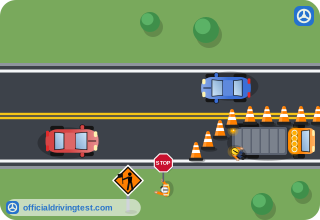
What is the primary role of a flagger?
- To enforce speed limits and write citations
- To decide which vehicle types may enter the Work Zone
- To ensure the safety of work crews and the motoring public
- To record information about crashes
Show answer
Correct answer: To ensure the safety of work crews and the motoring public
The manual says flaggers' primary role is to ensure the safety of both the work crews and the motoring public.
Source: Arkansas Driver License Study Guide (Volume 1, Edition 10, October 2026), page 22 · Open this page in the manual (Manual page 22)
-
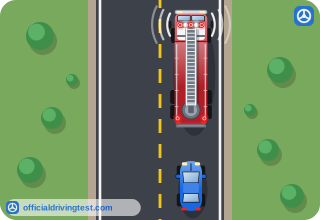
Why should you leave space when following police vehicles, ambulances and fire trucks?
- They are required to stop for you
- They will always drive slowly
- They cannot see vehicles behind them
- They need room to work
Show answer
Correct answer: They need room to work
The manual says police vehicles, ambulances, and fire trucks need room to work.
Source: Arkansas Driver License Study Guide (Volume 1, Edition 10, October 2026), page 59 · Open this page in the manual (Manual page 59)