Arkansas: Emergency vehicles and work zones — Part 1 Practice Test
Questions in this part include: “Where should you NOT stop when pulled over by a law enforcement officer?” · “Which side of the vehicle may an officer approach during a traffic stop?”
Independent educational site · not affiliated with any government agency or DMV
Ready? Test yourself
- Instant feedback with an explanation
- Every answer cites its source in the manual
- Your best score is saved on this device
Questions are original and based on the official manual "Arkansas Driver License Study Guide" (Volume 1, Edition 10, October 2026), Arkansas State Police (ASP).
All 18 questions in this practice test
Take the test above first, then use this list to study. Tap “Show answer” to see the correct answer and explanation.
Show the questions and answersHide the questions
-
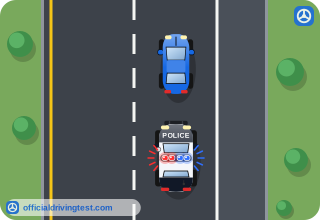
What should you do first when a law enforcement officer signals you to stop?
- Stop in your lane and turn on only your hazard lights
- Pull over to the left side of the road and shut off the engine
- Slow down and keep driving until you reach your destination
- Pull over to the right side of the road and activate your turn signal
Show answer
Correct answer: Pull over to the right side of the road and activate your turn signal
You pull over to the right and use your turn signal to show the officer you are seeking a safe place to stop.
Source: Arkansas Driver License Study Guide (Volume 1, Edition 10, October 2026)
-
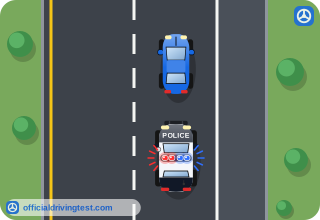
If you are unsure that the vehicle signaling you to stop belongs to an actual police officer, what should you do?
- Turn on your signal, go to a well-lit place, and call 9-1-1
- Keep driving at normal speed until you reach your home or workplace
- Stop right where you are and wait with the engine running
- Pull onto the left shoulder and flash your headlights at the vehicle
Show answer
Correct answer: Turn on your signal, go to a well-lit place, and call 9-1-1
You signal, pull to the nearest well-lit location, dial 9-1-1 and ask for a police officer confirmation.
Source: Arkansas Driver License Study Guide (Volume 1, Edition 10, October 2026)
-
Where should you NOT stop when pulled over by a law enforcement officer?
- In a well-lit location
- Out of the traffic lane
- On a bridge or overpass
- On the right side of the road
Show answer
Correct answer: On a bridge or overpass
The manual says to pull to the closest safest spot out of the traffic lane and not to stop on bridges or overpasses.
Source: Arkansas Driver License Study Guide (Volume 1, Edition 10, October 2026)
-
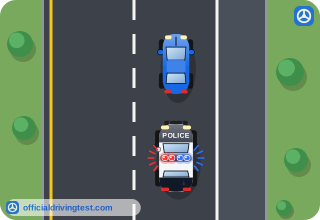
During a traffic stop, what should you do unless the officer instructs you to exit?
- Step out and stand beside the vehicle
- Remain in the vehicle
- Walk back toward the officer’s vehicle
- Wait outside on the shoulder
Show answer
Correct answer: Remain in the vehicle
The manual says to remain in the vehicle unless the officer instructs you to exit.
Source: Arkansas Driver License Study Guide (Volume 1, Edition 10, October 2026)
-
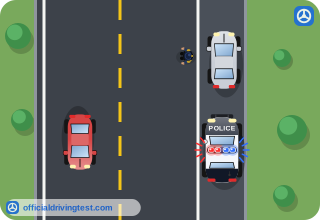
Where does the manual suggest placing your hands so the officer can see them as he or she approaches?
- On the dashboard
- In your lap below the wheel
- Behind your head
- At the top of the steering wheel
Show answer
Correct answer: At the top of the steering wheel
Both hands should be visible, for example at the top of the steering wheel.
Source: Arkansas Driver License Study Guide (Volume 1, Edition 10, October 2026)
-
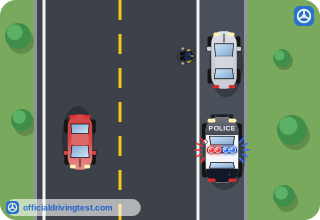
While looking for your documents during a traffic stop, what should you avoid doing?
- Making any sudden movements
- Keeping your hands visible
- Turning on the interior lights at night
- Telling the officer where the documents are
Show answer
Correct answer: Making any sudden movements
The manual says not to make any sudden movements while looking for your documents.
Source: Arkansas Driver License Study Guide (Volume 1, Edition 10, October 2026)
-
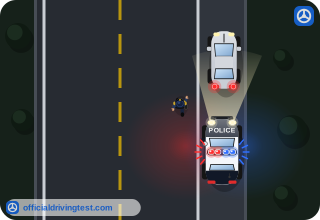
If you are stopped at night, what should you do so the officer can see you more clearly?
- Turn off all the lights, including the headlights
- Switch on the high beams
- Turn on the interior lights
- Flash your headlights at the officer
Show answer
Correct answer: Turn on the interior lights
At night you turn on the interior lights so the officer can see you more clearly.
Source: Arkansas Driver License Study Guide (Volume 1, Edition 10, October 2026)
-
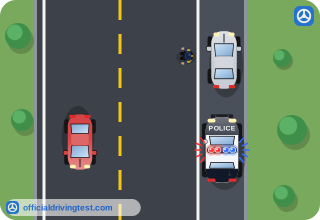
What should you do with the radio and mobile devices during a traffic stop?
- Lower the radio volume and use the phone hands-free
- Turn off the radio and put down any mobile devices
- Leave the radio on and set the phone on the seat
- Keep the radio on but put the phone away
Show answer
Correct answer: Turn off the radio and put down any mobile devices
You turn off the radio, put down mobile devices and give the officer your full attention.
Source: Arkansas Driver License Study Guide (Volume 1, Edition 10, October 2026)
-
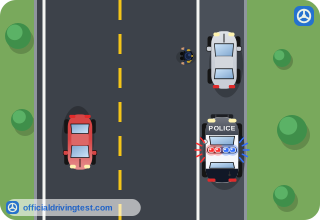
According to the manual, what should an officer do at the start of a traffic stop?
- Ask you to step out of the vehicle and walk to the patrol car
- Take your keys and hold them until the stop is over
- Search the vehicle before explaining the reason for the stop
- Introduce himself or herself and tell you the reason for the stop
Show answer
Correct answer: Introduce himself or herself and tell you the reason for the stop
The officer should give his or her name and agency and tell you the reason for the stop.
Source: Arkansas Driver License Study Guide (Volume 1, Edition 10, October 2026)
-
Before reaching for your documents during a traffic stop, what should you do?
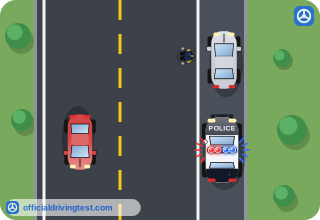
- Reach for them quickly to show that you are cooperating
- Wait for the officer to tell you where to find them
- Tell the officer where they are and ask before reaching
- Step out of the vehicle and get them from the trunk
Show answer
Correct answer: Tell the officer where they are and ask before reaching
You inform the officer where the documents are and ask before reaching to retrieve them.
Source: Arkansas Driver License Study Guide (Volume 1, Edition 10, October 2026)
-
If there is a weapon in the vehicle during a traffic stop, what should you do?
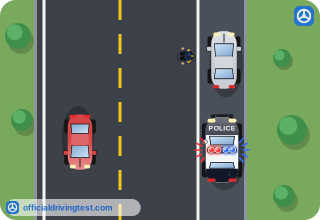
- Say nothing unless the officer asks you about it
- Tell the officer about it and its location; do not reach for it
- Move the weapon to the trunk before the officer arrives
- Hand the weapon to the officer through the window
Show answer
Correct answer: Tell the officer about it and its location; do not reach for it
Inform the officer of the weapon, its type and location, do not reach for it, and follow the officer’s instructions.
Source: Arkansas Driver License Study Guide (Volume 1, Edition 10, October 2026)
-
If you have a concealed carry permit, what should you do during a traffic stop?
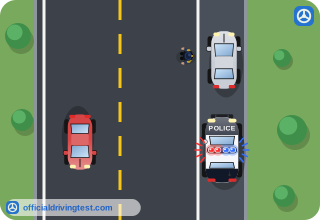
- Keep it hidden unless the officer asks to see the weapon
- Show it only after the stop is over
- Leave it in the glove box
- Present it to the officer with your driver’s license
Show answer
Correct answer: Present it to the officer with your driver’s license
The manual says to present the concealed carry permit to the officer with your driver’s license.
Source: Arkansas Driver License Study Guide (Volume 1, Edition 10, October 2026)
-
Which side of the vehicle may an officer approach during a traffic stop?
- Either side of the vehicle
- Only the driver’s side
- Only the passenger side
- Only the side away from traffic
Show answer
Correct answer: Either side of the vehicle
The officer may approach either side; the manual says not to be alarmed.
Source: Arkansas Driver License Study Guide (Volume 1, Edition 10, October 2026)
-
What should you do if you disagree with the officer’s actions during a traffic stop?
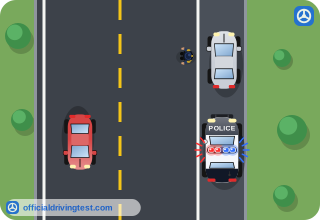
- Argue your case on the side of the road
- Refuse to continue until the officer explains the law
- Be courteous to the officer
- Get out of the vehicle to talk face to face
Show answer
Correct answer: Be courteous to the officer
The manual says to be courteous to the officer even if you disagree with his or her actions.
Source: Arkansas Driver License Study Guide (Volume 1, Edition 10, October 2026)
-
If you observe a traffic stop that does not involve you, what should you do?
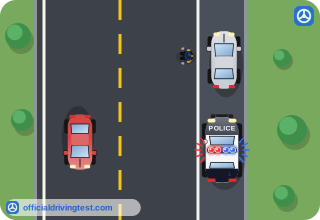
- Stop and offer to help the officer
- Slow down and watch the stop
- Do not approach the officer
- Pull over and wait with the driver
Show answer
Correct answer: Do not approach the officer
The manual says not to approach the officer during a traffic stop that does not involve you.
Source: Arkansas Driver License Study Guide (Volume 1, Edition 10, October 2026)
-
When passing an officer or other authorized vehicle stopped on the side of the road, what does Arkansas law require?
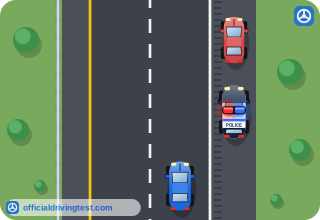
- Stay in your lane and sound your horn as you pass
- Move to the farthest lane or position away from it
- Stop behind the vehicle until it drives away
- Speed up to get past the vehicle quickly
Show answer
Correct answer: Move to the farthest lane or position away from it
Arkansas law requires you to move to the farthest lane or position away from the authorized vehicle.
Source: Arkansas Driver License Study Guide (Volume 1, Edition 10, October 2026)
-
When passing a stopped officer or authorized vehicle, what does the law require if it is unsafe or not possible to change lanes?
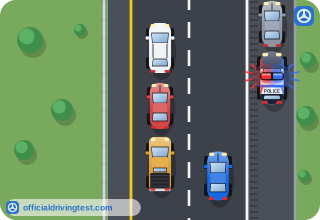
- Come to a complete stop
- Sound your horn
- Keep your speed and use your hazard lights
- Reduce your speed as you pass
Show answer
Correct answer: Reduce your speed as you pass
If you cannot change lanes safely, the law requires you to reduce your speed as you pass.
Source: Arkansas Driver License Study Guide (Volume 1, Edition 10, October 2026)
-
How should you respond to a police car, fire truck or ambulance using a siren or air horn and a red or blue flashing light?
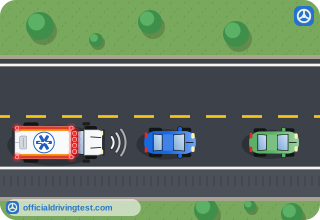
- Pull over to the right edge of the road, or as near to the right as possible
- Stop immediately where you are, even if you are in an intersection
- Pull over to the left edge of the road, or as near to the left as possible
- Move to the center of the road and slow down to a crawl
Show answer
Correct answer: Pull over to the right edge of the road, or as near to the right as possible
Drivers should pull over to the right edge of the road, or as near to the right as possible.
Source: Arkansas Driver License Study Guide (Volume 1, Edition 10, October 2026), page 11 · Open this page in the manual (Manual page 11)