Arizona: Emergency vehicles and work zones
The Move Over law, school buses, work zones and what to do when an officer stops you. Split into 2 shorter tests so you're not stuck in one long quiz.
Independent educational site · not affiliated with any government agency or DMV
Choose a part
Emergency vehicles and work zones — Part 1
Questions in this part include: “Which vehicles does the move-over law cover when they are pulled over with flashing lights?”
StartEmergency vehicles and work zones — Part 2
Questions in this part include: “When do law enforcement officers conduct traffic stops, according to the manual?”
StartAll 45 Emergency vehicles and work zones questions with answers
Choose a part above to take a practice test, or study every question and answer here.
Show the questions and answersHide the questions
-
What should you do when you see an emergency vehicle while you are in a roundabout?
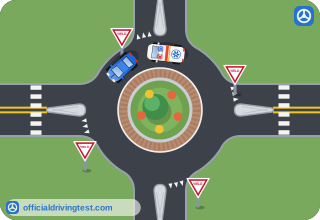
- Stop immediately where you are inside the roundabout and wait for it to pass
- Speed up to leave the roundabout before the emergency vehicle arrives
- Pull over to the left side of the central island and turn off your engine
- Proceed with caution and exit if you can, or pull over to the right
Show answer
Correct answer: Proceed with caution and exit if you can, or pull over to the right
In a roundabout, proceed with caution when you see an emergency vehicle; exit if you can, or pull over to the right.
Source: Arizona Driver License Manual and Customer Service Guide (Revised March 2026), page 28
-
What distance must you maintain behind a fire department vehicle responding to an emergency?
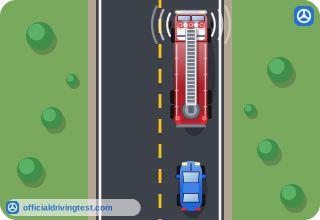
- At least 100 feet
- At least 300 feet
- At least 1,000 feet
- At least 500 feet
Show answer
Correct answer: At least 500 feet
The driver shall maintain a distance of at least 500 feet behind a fire department vehicle responding to an emergency.
Source: Arizona Driver License Manual and Customer Service Guide (Revised March 2026), page 38
-
What distance must you maintain behind a police vehicle responding to an emergency?
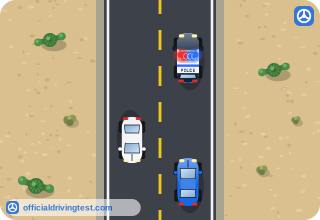
- At least 300 feet
- At least 100 feet
- At least 200 feet
- At least 500 feet
Show answer
Correct answer: At least 300 feet
The driver shall maintain a distance of at least 300 feet behind a police vehicle responding to an emergency.
Source: Arizona Driver License Manual and Customer Service Guide (Revised March 2026), page 38
-
Where must you not drive into or park your vehicle when an emergency vehicle has stopped to respond to an emergency?
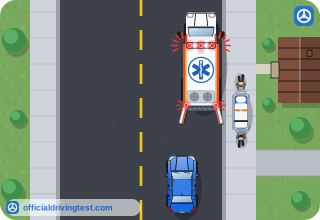
- Within two blocks of the place where the emergency vehicle has stopped
- Within sight of the emergency vehicle that has stopped to respond
- Within the block where the emergency vehicle has stopped
- Within the intersection nearest the stopped emergency vehicle
Show answer
Correct answer: Within the block where the emergency vehicle has stopped
Do not drive into or park your vehicle within the block where the emergency vehicle has stopped to respond to the emergency.
Source: Arizona Driver License Manual and Customer Service Guide (Revised March 2026), page 38
-
What does Arizona's move-over law require when you drive by a vehicle with flashing lights pulled to the side of a road or highway?
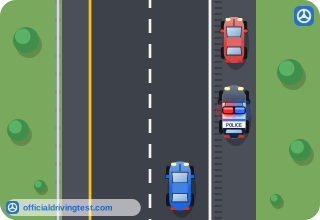
- Move over one lane to create a safe margin of space
- Stop completely until the flashing lights are turned off
- Slow to 15 mph but stay in your lane
- Pass on the left without changing your speed
Show answer
Correct answer: Move over one lane to create a safe margin of space
The move-over law requires motorists to move over one lane to create a safe margin of space when driving by a vehicle with flashing lights at the roadside.
Source: Arizona Driver License Manual and Customer Service Guide (Revised March 2026), page 39
-
Under the move-over law, what must you do if it is not safe or possible to move over?
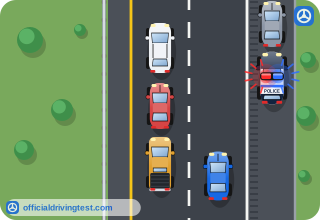
- Stop until the roadside vehicle leaves
- Sound your horn and keep your speed
- Slow down and use caution
- Speed up and pass quickly
Show answer
Correct answer: Slow down and use caution
If it is not safe or possible to move over, motorists must slow down and use caution.
Source: Arizona Driver License Manual and Customer Service Guide (Revised March 2026), page 39
-
Which vehicles does the move-over law cover when they are pulled over with flashing lights?
- Only emergency-response and law-enforcement vehicles
- All of them, including private vehicles
- Only police cars and fire trucks
- Only tow trucks and highway maintenance vehicles
Show answer
Correct answer: All of them, including private vehicles
The law pertains to all vehicles pulled over with flashing lights, including emergency-response and law-enforcement vehicles, tow trucks, highway maintenance vehicles and private vehicles.
Source: Arizona Driver License Manual and Customer Service Guide (Revised March 2026), page 39
-
On which roads does the move-over law apply?
- Only freeways and interstate highways, but not city streets
- Only multiple lane highways outside of cities
- Only rural highways with a paved shoulder
- Freeways, other multiple lane highways, city roads and streets
Show answer
Correct answer: Freeways, other multiple lane highways, city roads and streets
The law applies to all freeways and other multiple lane highways, city roads and streets.
Source: Arizona Driver License Manual and Customer Service Guide (Revised March 2026), page 39
-
Which crash is commonly seen in work zones?
- Head-on collisions at railroad crossings
- Rear-end collisions from drivers going too fast
- Collisions with animals on the roadway
- Side-impact crashes at roundabouts
Show answer
Correct answer: Rear-end collisions from drivers going too fast
Crashes that commonly occur in a work zone are rear end collisions from drivers going too fast, crashes with fixed objects or vehicles hitting people working in the area.
Source: Arizona Driver License Manual and Customer Service Guide (Revised March 2026), page 43
-
What should you expect when driving through a work zone?
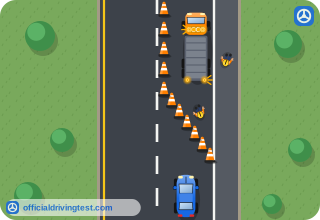
- A smooth road surface throughout the whole work zone
- Workers only on the shoulder, away from lanes
- Warning signs that are always lit at night
- To stop or slow down suddenly for changing conditions
Show answer
Correct answer: To stop or slow down suddenly for changing conditions
Always be on high alert and expect to stop or slow down suddenly for changing or unexpected conditions, including changes to the road surface.
Source: Arizona Driver License Manual and Customer Service Guide (Revised March 2026), page 43
-
Where may workers and construction vehicles be in a work zone?
- Adjacent to the travel lanes, or entering them at any point
- Only behind barriers that keep them away from traffic
- Only in the closed lane of the work zone
- Only at the start of the work zone
Show answer
Correct answer: Adjacent to the travel lanes, or entering them at any point
Workers and construction vehicles may be immediately adjacent to the travel lanes or may enter the travel lanes at any point in the work zone.
Source: Arizona Driver License Manual and Customer Service Guide (Revised March 2026), page 43
-
How may a temporary work area be marked?
- Only with permanent signs placed beside the road
- Only with flashing arrow panels and drums
- With portable signs placed just for that activity
- Only with a flagger and no signs
Show answer
Correct answer: With portable signs placed just for that activity
Temporary work areas set up for just a few hours use portable signs placed just for that activity.
Source: Arizona Driver License Manual and Customer Service Guide (Revised March 2026), page 43
-
What is the basic color of the alerting and controlling devices used in road construction and maintenance areas?
- Red
- Orange
- Yellow
- White
Show answer
Correct answer: Orange
Orange is the basic color for these devices.
Source: Arizona Driver License Manual and Customer Service Guide (Revised March 2026), page 43
-
How must you drive at all construction sites?
- At the normal speed if no workers are visible
- Slowly only when a flagger is present
- At the speed of the vehicle ahead
- Slowly and be especially alert
Show answer
Correct answer: Slowly and be especially alert
You must drive slowly and be especially alert at all construction sites, and always obey the posted speed limit.
Source: Arizona Driver License Manual and Customer Service Guide (Revised March 2026), page 43
-
What are flaggers often used for in road work zones?
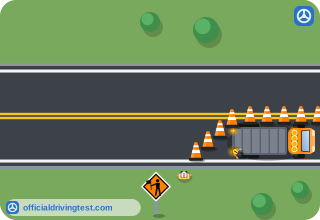
- To collect tolls from drivers entering the work zone
- To stop, slow or guide traffic safely through the area
- To issue citations to drivers who are speeding
- To report crashes in the work zone to police
Show answer
Correct answer: To stop, slow or guide traffic safely through the area
Flaggers are often used in road work zones to stop, slow or guide traffic safely through the area.
Source: Arizona Driver License Manual and Customer Service Guide (Revised March 2026), page 44
-
What do flaggers wear in work zones?
- Yellow-green vests only
- White uniforms
- Red helmets and gloves
- Orange vests or jackets
Show answer
Correct answer: Orange vests or jackets
Flaggers wear orange vests or jackets.
Source: Arizona Driver License Manual and Customer Service Guide (Revised March 2026), page 44
-
What do flaggers use to direct traffic through work zones?
- Red flags or stop/slow panels
- Blue flags or lighted wands
- Whistles and hand signals only
- Green flags or go/stop lights
Show answer
Correct answer: Red flags or stop/slow panels
Flaggers use red flags or stop/slow panels to direct traffic through work zones.
Source: Arizona Driver License Manual and Customer Service Guide (Revised March 2026), page 44
-
What are construction and maintenance signs used for?
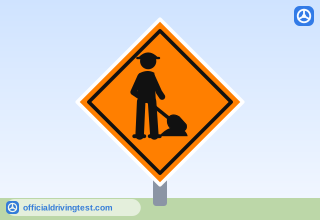
- To mark the end of a work zone and cancel its limits
- To notify drivers of possible danger in or near work areas
- To regulate the speed limit on freeways nearby
- To direct pedestrians across the road safely
Show answer
Correct answer: To notify drivers of possible danger in or near work areas
Construction and maintenance signs are used to notify drivers of possible danger in or near work areas.
Source: Arizona Driver License Manual and Customer Service Guide (Revised March 2026), page 44
-
What do electronic message signs give advance warning of?
- Only speed limit changes and school zones in session
- Only crashes and stalled vehicles ahead
- Only the distance to the next exit
- Construction zones, road closures or weather conditions
Show answer
Correct answer: Construction zones, road closures or weather conditions
Electronic message signs are used on some roadways to give advance warning of construction zones, special traffic directions, road closures or even weather conditions.
Source: Arizona Driver License Manual and Customer Service Guide (Revised March 2026), page 44
-
What is the purpose of cones, drums and barricades?
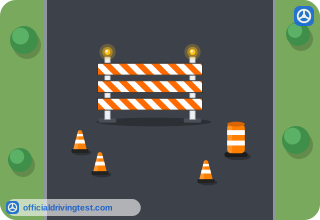
- To alert and guide you safely through the work area
- To mark where the work zone ends for drivers
- To show the speed limit inside the work area
- To block all traffic from entering the road
Show answer
Correct answer: To alert and guide you safely through the work area
Cones, drums and barricades are used to alert you and to guide you safely through the work area.
Source: Arizona Driver License Manual and Customer Service Guide (Revised March 2026), page 44
-
How may cones, drums and barricades be equipped at night?
- With flashing arrow panels
- With reflective flags only
- With warning lights
- With loud warning bells
Show answer
Correct answer: With warning lights
At night, cones, drums and barricades may be equipped with warning lights.
Source: Arizona Driver License Manual and Customer Service Guide (Revised March 2026), page 44
-
When are flashing arrow panels used?
- Only at night
- Both day and night
- Only during daylight hours
- Only when workers are present
Show answer
Correct answer: Both day and night
Flashing arrow panels are used both day and night to give advance warning to drivers.
Source: Arizona Driver License Manual and Customer Service Guide (Revised March 2026), page 44
-
What should you do when you see a flashing arrow panel?
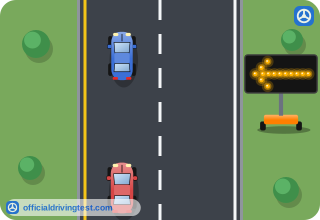
- Speed up and pass the panel before the lane closes
- Stop and wait for the flagger to wave you ahead
- Merge opposite to the direction of the arrow
- Slow down and prepare to merge in the direction of the arrow
Show answer
Correct answer: Slow down and prepare to merge in the direction of the arrow
Slow down and prepare to merge in the direction of the arrow.
Source: Arizona Driver License Manual and Customer Service Guide (Revised March 2026), page 44
-
When do law enforcement officers conduct traffic stops, according to the manual?
- When they have reasonable suspicion of a traffic or criminal violation
- Only when a driver is seen driving faster than the posted limit
- Only when a driver has no license
- Only when a crash has been reported
Show answer
Correct answer: When they have reasonable suspicion of a traffic or criminal violation
The manual says officers conduct stops when they have reasonable suspicion of a traffic or criminal violation.
Source: Arizona Driver License Manual and Customer Service Guide (Revised March 2026), page 72
-
When you see emergency lights behind you, what is important for you and your passengers to do?
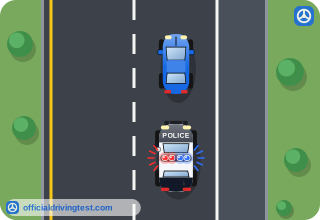
- Speed up to find a safe place to stop
- Get out and walk to the officer
- Stay calm and cooperate
- Ignore the lights until the officer uses a siren
Show answer
Correct answer: Stay calm and cooperate
The manual says it is important to stay calm and cooperate.
Source: Arizona Driver License Manual and Customer Service Guide (Revised March 2026), page 72
-
When you are being pulled over, what should you do with your turn signal and position?
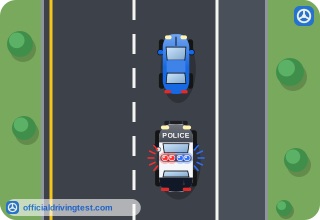
- Signal, then pull off or to the side of the roadway as soon as it is safe
- Stop at once in the travel lane without using any turn signal at all
- Keep driving until you reach your destination
- Turn on your hazard lights and stop in the center of the road
Show answer
Correct answer: Signal, then pull off or to the side of the roadway as soon as it is safe
The manual says to signal and pull off or to the side of the roadway as soon as it is safe.
Source: Arizona Driver License Manual and Customer Service Guide (Revised March 2026), page 72
-
What should you do with the engine and audio devices during a traffic stop?
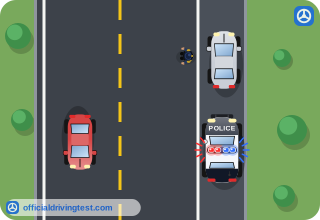
- Leave them on but lower the volume
- Turn off the engine but turn up the radio
- Turn them off
- Turn off the audio devices but keep the engine running
Show answer
Correct answer: Turn them off
The manual says to turn off the engine and any audio devices.
Source: Arizona Driver License Manual and Customer Service Guide (Revised March 2026), page 72
-
During a traffic stop, when should you get out of your vehicle?
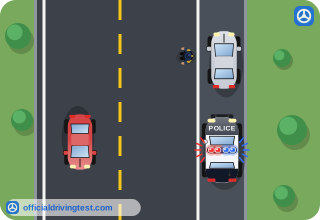
- Right away, to meet the officer at the door
- Only when directed by the officer to exit
- When you see the officer step out of the patrol car
- Whenever you have a question for the officer
Show answer
Correct answer: Only when directed by the officer to exit
The manual says to stay in your vehicle unless directed by the officer to exit.
Source: Arizona Driver License Manual and Customer Service Guide (Revised March 2026), page 73
-
If you are pulled over at night, what should you do to help visibility?
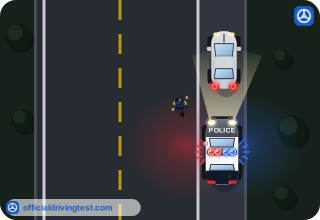
- Turn off all lights, including your headlights
- Flash your high beams at the officer
- Get out and stand beside the car
- Turn on your interior lights
Show answer
Correct answer: Turn on your interior lights
The manual says to turn on your interior lights at night to assist with visibility.
Source: Arizona Driver License Manual and Customer Service Guide (Revised March 2026), page 73
-
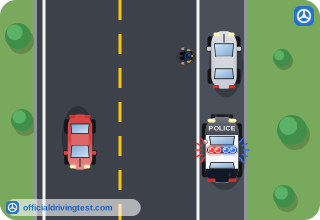
During a traffic stop, where should you keep your hands?
- Out of sight in your pockets or lap
- Under the seat or in the glove box
- Visible, such as on the steering wheel
- Behind your head, fingers locked together
Show answer
Correct answer: Visible, such as on the steering wheel
The manual says to keep your hands on the steering wheel or in a visible location so they are easily observable.
Source: Arizona Driver License Manual and Customer Service Guide (Revised March 2026), page 73
-
During a traffic stop, whose instructions should you follow?
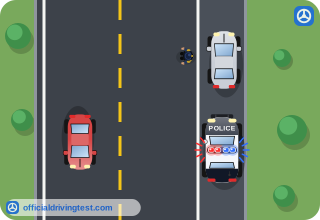
- All instructions the officer gives you or your passengers
- Only the instructions the officer gives you
- Only the instructions your passengers agree with
- Only instructions that are given in writing
Show answer
Correct answer: All instructions the officer gives you or your passengers
The manual says to follow all instructions the officer gives you or your passengers.
Source: Arizona Driver License Manual and Customer Service Guide (Revised March 2026), page 73
-
When the officer approaches your vehicle, what should you do so you and the officer can better communicate?
- Step out and shut the door
- Keep all the windows closed and locked
- Open the door a little
- Lower the corresponding window
Show answer
Correct answer: Lower the corresponding window
The manual says to lower the corresponding window; the officer may approach either side of the vehicle.
Source: Arizona Driver License Manual and Customer Service Guide (Revised March 2026), page 73
-
If you have a weapon in the vehicle during a traffic stop, when should you let the officer know?
- Only if the officer asks to search the vehicle
- Upon first contact
- After the officer has checked your license
- Only when you are asked to exit the vehicle
Show answer
Correct answer: Upon first contact
The manual says to tell the officer about a weapon in the vehicle upon first contact.
Source: Arizona Driver License Manual and Customer Service Guide (Revised March 2026), page 73
-
When should you reach for your driver’s license or vehicle documents during a traffic stop?
- As soon as you stop the vehicle
- After waiting for the officer’s instructions
- As soon as the officer reaches your window
- Before you lower the window
Show answer
Correct answer: After waiting for the officer’s instructions
The manual says to wait for the officer’s instructions before reaching for your license or documents.
Source: Arizona Driver License Manual and Customer Service Guide (Revised March 2026), page 73
-
Which documents will the officer typically ask for during a traffic stop?
- Your birth certificate, passport and Social Security card
- Your vehicle title and loan papers
- Your Social Security card and a utility bill
- Driver’s license, proof of insurance and vehicle registration
Show answer
Correct answer: Driver’s license, proof of insurance and vehicle registration
The manual says the officer will typically ask for your license, proof of insurance and vehicle registration.
Source: Arizona Driver License Manual and Customer Service Guide (Revised March 2026), page 73
-
If the documents the officer asks for are out of your reach, what should you do?
- Tell the officer where they are and wait for acknowledgment before reaching
- Reach for them right away and tell the officer what you are doing after
- Ask a passenger to get out and fetch them
- Step out of the vehicle to get them
Show answer
Correct answer: Tell the officer where they are and wait for acknowledgment before reaching
The manual says to tell the officer where the documents are and wait for acknowledgment before reaching.
Source: Arizona Driver License Manual and Customer Service Guide (Revised March 2026), page 73
-
What may you do if an officer who is not in uniform does not show law enforcement credentials?
- Drive away at once
- Refuse to give any information at all
- Ask to see them
- Call 911 and keep driving
Show answer
Correct answer: Ask to see them
The manual says officers not in uniform should show credentials, and if they do not, you may ask to see them.
Source: Arizona Driver License Manual and Customer Service Guide (Revised March 2026), page 73
-
If an officer asks you to exit the vehicle, what should you do?
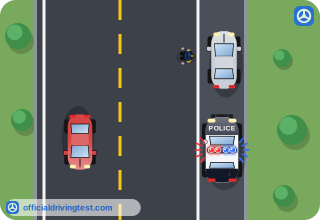
- Keep your hands visible, exit, and stand where the officer directs
- Stay in your seat with the engine running
- Exit with your hands in your pockets and stand at the rear
- Exit and walk toward the patrol car
Show answer
Correct answer: Keep your hands visible, exit, and stand where the officer directs
The manual says to keep your hands visible, exit, and stand in the location the officer directs.
Source: Arizona Driver License Manual and Customer Service Guide (Revised March 2026), page 73
-
Which actions may an officer take during a traffic stop?
- Only issue a warning and let the driver go
- Only issue a traffic ticket
- Issue a warning or ticket, or make an arrest
- Only make an arrest
Show answer
Correct answer: Issue a warning or ticket, or make an arrest
The manual says the officer may take many possible actions, including a warning, a traffic ticket or an arrest.
Source: Arizona Driver License Manual and Customer Service Guide (Revised March 2026), page 73
-
If an officer does not explain the action being taken during a stop, what may you do?
- Drive away without waiting
- Ask the officer to explain
- Argue until the officer explains
- Refuse to speak to the officer again
Show answer
Correct answer: Ask the officer to explain
The manual says the officer will typically explain the action, and if not, you may ask them to do so.
Source: Arizona Driver License Manual and Customer Service Guide (Revised March 2026), page 73
-
If you disagree with an officer’s decision during a traffic stop, what should you do?
- Argue calmly until the officer changes the decision
- Refuse to sign anything and leave
- Drive away and contest the decision by mail
- Not argue; contest it in court through legal channels
Show answer
Correct answer: Not argue; contest it in court through legal channels
The manual says not to prolong the contact by arguing, and to contest the decision in court through established legal channels.
Source: Arizona Driver License Manual and Customer Service Guide (Revised March 2026), page 73
-
What does your acceptance and signature on a traffic ticket mean?
- It is an admission of guilt
- It cancels your right to go to court
- It is not an admission of guilt
- It pays the fine in full
Show answer
Correct answer: It is not an admission of guilt
The manual says that signing a traffic ticket is not an admission of guilt.
Source: Arizona Driver License Manual and Customer Service Guide (Revised March 2026), page 73
-
What may happen if you refuse to sign a traffic ticket?
- You may be arrested
- Your license is cancelled at once
- The ticket is dismissed
- You must pay the fine on the spot
Show answer
Correct answer: You may be arrested
The manual says refusing to sign a traffic ticket may result in your arrest.
Source: Arizona Driver License Manual and Customer Service Guide (Revised March 2026), page 73
-
If you believe an officer acted inappropriately, what may you do?
- Confront the officer at the roadside
- Refuse to sign the ticket until the officer apologizes first
- Follow the patrol car to the station
- Contact the officer’s agency and request to speak to a supervisor
Show answer
Correct answer: Contact the officer’s agency and request to speak to a supervisor
The manual says to call or contact the officer’s agency and ask to speak to a supervisor.
Source: Arizona Driver License Manual and Customer Service Guide (Revised March 2026), page 74
-
When is it best to contact the officer’s agency about the officer’s conduct?
- After a month, when you have calmed down
- As soon as possible after the stop
- Only after your court date
- During the stop, while the officer is still there
Show answer
Correct answer: As soon as possible after the stop
The manual says this is best done as soon as possible after the stop.
Source: Arizona Driver License Manual and Customer Service Guide (Revised March 2026), page 74