Arizona: Emergency vehicles and work zones — Part 1 Practice Test
Questions in this part include: “Which vehicles does the move-over law cover when they are pulled over with flashing lights?” · “How must you drive at all construction sites?”
Independent educational site · not affiliated with any government agency or DMV
Ready? Test yourself
- Instant feedback with an explanation
- Every answer cites its source in the manual
- Your best score is saved on this device
Questions are original and based on the official manual "Arizona Driver License Manual and Customer Service Guide" (Revised March 2026), Arizona Department of Transportation Motor Vehicle Division (ADOT MVD).
All 23 questions in this practice test
Take the test above first, then use this list to study. Tap “Show answer” to see the correct answer and explanation.
Show the questions and answersHide the questions
-
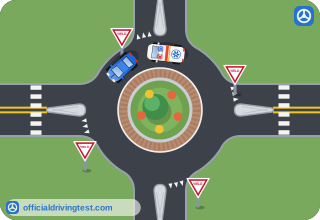
What should you do when you see an emergency vehicle while you are in a roundabout?
- Stop immediately where you are inside the roundabout and wait for it to pass
- Speed up to leave the roundabout before the emergency vehicle arrives
- Pull over to the left side of the central island and turn off your engine
- Proceed with caution and exit if you can, or pull over to the right
Show answer
Correct answer: Proceed with caution and exit if you can, or pull over to the right
In a roundabout, proceed with caution when you see an emergency vehicle; exit if you can, or pull over to the right.
Source: Arizona Driver License Manual and Customer Service Guide (Revised March 2026), page 28
-
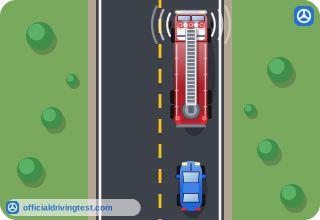
What distance must you maintain behind a fire department vehicle responding to an emergency?
- At least 100 feet
- At least 300 feet
- At least 1,000 feet
- At least 500 feet
Show answer
Correct answer: At least 500 feet
The driver shall maintain a distance of at least 500 feet behind a fire department vehicle responding to an emergency.
Source: Arizona Driver License Manual and Customer Service Guide (Revised March 2026), page 38
-
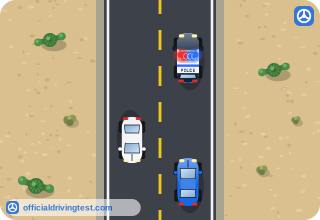
What distance must you maintain behind a police vehicle responding to an emergency?
- At least 300 feet
- At least 100 feet
- At least 200 feet
- At least 500 feet
Show answer
Correct answer: At least 300 feet
The driver shall maintain a distance of at least 300 feet behind a police vehicle responding to an emergency.
Source: Arizona Driver License Manual and Customer Service Guide (Revised March 2026), page 38
-
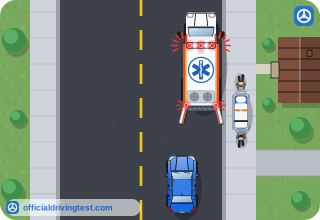
Where must you not drive into or park your vehicle when an emergency vehicle has stopped to respond to an emergency?
- Within two blocks of the place where the emergency vehicle has stopped
- Within sight of the emergency vehicle that has stopped to respond
- Within the block where the emergency vehicle has stopped
- Within the intersection nearest the stopped emergency vehicle
Show answer
Correct answer: Within the block where the emergency vehicle has stopped
Do not drive into or park your vehicle within the block where the emergency vehicle has stopped to respond to the emergency.
Source: Arizona Driver License Manual and Customer Service Guide (Revised March 2026), page 38
-
What does Arizona's move-over law require when you drive by a vehicle with flashing lights pulled to the side of a road or highway?
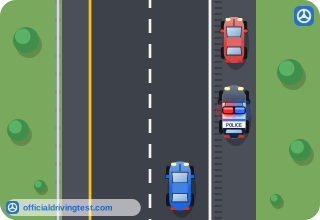
- Move over one lane to create a safe margin of space
- Stop completely until the flashing lights are turned off
- Slow to 15 mph but stay in your lane
- Pass on the left without changing your speed
Show answer
Correct answer: Move over one lane to create a safe margin of space
The move-over law requires motorists to move over one lane to create a safe margin of space when driving by a vehicle with flashing lights at the roadside.
Source: Arizona Driver License Manual and Customer Service Guide (Revised March 2026), page 39
-
Under the move-over law, what must you do if it is not safe or possible to move over?
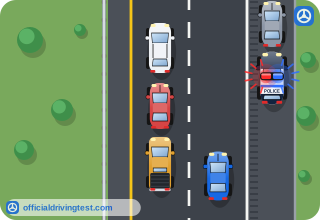
- Stop until the roadside vehicle leaves
- Sound your horn and keep your speed
- Slow down and use caution
- Speed up and pass quickly
Show answer
Correct answer: Slow down and use caution
If it is not safe or possible to move over, motorists must slow down and use caution.
Source: Arizona Driver License Manual and Customer Service Guide (Revised March 2026), page 39
-
Which vehicles does the move-over law cover when they are pulled over with flashing lights?
- Only emergency-response and law-enforcement vehicles
- All of them, including private vehicles
- Only police cars and fire trucks
- Only tow trucks and highway maintenance vehicles
Show answer
Correct answer: All of them, including private vehicles
The law pertains to all vehicles pulled over with flashing lights, including emergency-response and law-enforcement vehicles, tow trucks, highway maintenance vehicles and private vehicles.
Source: Arizona Driver License Manual and Customer Service Guide (Revised March 2026), page 39
-
On which roads does the move-over law apply?
- Only freeways and interstate highways, but not city streets
- Only multiple lane highways outside of cities
- Only rural highways with a paved shoulder
- Freeways, other multiple lane highways, city roads and streets
Show answer
Correct answer: Freeways, other multiple lane highways, city roads and streets
The law applies to all freeways and other multiple lane highways, city roads and streets.
Source: Arizona Driver License Manual and Customer Service Guide (Revised March 2026), page 39
-
Which crash is commonly seen in work zones?
- Head-on collisions at railroad crossings
- Rear-end collisions from drivers going too fast
- Collisions with animals on the roadway
- Side-impact crashes at roundabouts
Show answer
Correct answer: Rear-end collisions from drivers going too fast
Crashes that commonly occur in a work zone are rear end collisions from drivers going too fast, crashes with fixed objects or vehicles hitting people working in the area.
Source: Arizona Driver License Manual and Customer Service Guide (Revised March 2026), page 43
-
What should you expect when driving through a work zone?
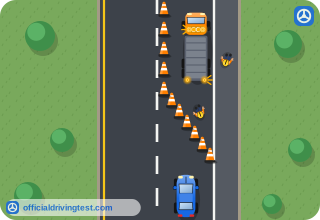
- A smooth road surface throughout the whole work zone
- Workers only on the shoulder, away from lanes
- Warning signs that are always lit at night
- To stop or slow down suddenly for changing conditions
Show answer
Correct answer: To stop or slow down suddenly for changing conditions
Always be on high alert and expect to stop or slow down suddenly for changing or unexpected conditions, including changes to the road surface.
Source: Arizona Driver License Manual and Customer Service Guide (Revised March 2026), page 43
-
Where may workers and construction vehicles be in a work zone?
- Adjacent to the travel lanes, or entering them at any point
- Only behind barriers that keep them away from traffic
- Only in the closed lane of the work zone
- Only at the start of the work zone
Show answer
Correct answer: Adjacent to the travel lanes, or entering them at any point
Workers and construction vehicles may be immediately adjacent to the travel lanes or may enter the travel lanes at any point in the work zone.
Source: Arizona Driver License Manual and Customer Service Guide (Revised March 2026), page 43
-
How may a temporary work area be marked?
- Only with permanent signs placed beside the road
- Only with flashing arrow panels and drums
- With portable signs placed just for that activity
- Only with a flagger and no signs
Show answer
Correct answer: With portable signs placed just for that activity
Temporary work areas set up for just a few hours use portable signs placed just for that activity.
Source: Arizona Driver License Manual and Customer Service Guide (Revised March 2026), page 43
-
What is the basic color of the alerting and controlling devices used in road construction and maintenance areas?
- Red
- Orange
- Yellow
- White
Show answer
Correct answer: Orange
Orange is the basic color for these devices.
Source: Arizona Driver License Manual and Customer Service Guide (Revised March 2026), page 43
-
How must you drive at all construction sites?
- At the normal speed if no workers are visible
- Slowly only when a flagger is present
- At the speed of the vehicle ahead
- Slowly and be especially alert
Show answer
Correct answer: Slowly and be especially alert
You must drive slowly and be especially alert at all construction sites, and always obey the posted speed limit.
Source: Arizona Driver License Manual and Customer Service Guide (Revised March 2026), page 43
-
What are flaggers often used for in road work zones?
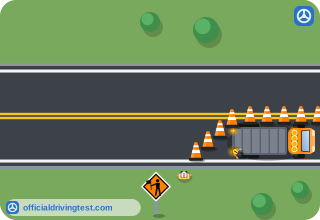
- To collect tolls from drivers entering the work zone
- To stop, slow or guide traffic safely through the area
- To issue citations to drivers who are speeding
- To report crashes in the work zone to police
Show answer
Correct answer: To stop, slow or guide traffic safely through the area
Flaggers are often used in road work zones to stop, slow or guide traffic safely through the area.
Source: Arizona Driver License Manual and Customer Service Guide (Revised March 2026), page 44
-
What do flaggers wear in work zones?
- Yellow-green vests only
- White uniforms
- Red helmets and gloves
- Orange vests or jackets
Show answer
Correct answer: Orange vests or jackets
Flaggers wear orange vests or jackets.
Source: Arizona Driver License Manual and Customer Service Guide (Revised March 2026), page 44
-
What do flaggers use to direct traffic through work zones?
- Red flags or stop/slow panels
- Blue flags or lighted wands
- Whistles and hand signals only
- Green flags or go/stop lights
Show answer
Correct answer: Red flags or stop/slow panels
Flaggers use red flags or stop/slow panels to direct traffic through work zones.
Source: Arizona Driver License Manual and Customer Service Guide (Revised March 2026), page 44
-
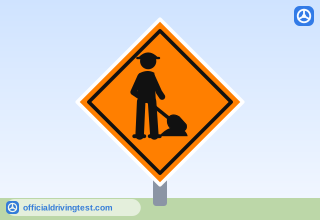
What are construction and maintenance signs used for?
- To mark the end of a work zone and cancel its limits
- To notify drivers of possible danger in or near work areas
- To regulate the speed limit on freeways nearby
- To direct pedestrians across the road safely
Show answer
Correct answer: To notify drivers of possible danger in or near work areas
Construction and maintenance signs are used to notify drivers of possible danger in or near work areas.
Source: Arizona Driver License Manual and Customer Service Guide (Revised March 2026), page 44
-
What do electronic message signs give advance warning of?
- Only speed limit changes and school zones in session
- Only crashes and stalled vehicles ahead
- Only the distance to the next exit
- Construction zones, road closures or weather conditions
Show answer
Correct answer: Construction zones, road closures or weather conditions
Electronic message signs are used on some roadways to give advance warning of construction zones, special traffic directions, road closures or even weather conditions.
Source: Arizona Driver License Manual and Customer Service Guide (Revised March 2026), page 44
-
What is the purpose of cones, drums and barricades?
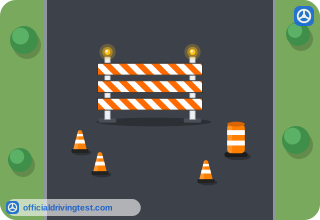
- To alert and guide you safely through the work area
- To mark where the work zone ends for drivers
- To show the speed limit inside the work area
- To block all traffic from entering the road
Show answer
Correct answer: To alert and guide you safely through the work area
Cones, drums and barricades are used to alert you and to guide you safely through the work area.
Source: Arizona Driver License Manual and Customer Service Guide (Revised March 2026), page 44
-
How may cones, drums and barricades be equipped at night?
- With flashing arrow panels
- With reflective flags only
- With warning lights
- With loud warning bells
Show answer
Correct answer: With warning lights
At night, cones, drums and barricades may be equipped with warning lights.
Source: Arizona Driver License Manual and Customer Service Guide (Revised March 2026), page 44
-
When are flashing arrow panels used?
- Only at night
- Both day and night
- Only during daylight hours
- Only when workers are present
Show answer
Correct answer: Both day and night
Flashing arrow panels are used both day and night to give advance warning to drivers.
Source: Arizona Driver License Manual and Customer Service Guide (Revised March 2026), page 44
-
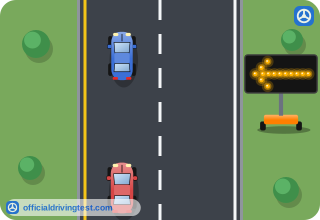
What should you do when you see a flashing arrow panel?
- Speed up and pass the panel before the lane closes
- Stop and wait for the flagger to wave you ahead
- Merge opposite to the direction of the arrow
- Slow down and prepare to merge in the direction of the arrow
Show answer
Correct answer: Slow down and prepare to merge in the direction of the arrow
Slow down and prepare to merge in the direction of the arrow.
Source: Arizona Driver License Manual and Customer Service Guide (Revised March 2026), page 44