Alabama: Emergencies
Crashes, skids, blowouts, brake failure, stalled vehicles and other driving emergencies. Split into 4 shorter tests so you're not stuck in one long quiz.
Independent educational site · not affiliated with any government agency or DMV
Choose a part
Emergencies — Part 1
Questions in this part include: “What does the manual remind motorists a layman can give?”
StartEmergencies — Part 2
Questions in this part include: “After being involved in an accident, when may you proceed?”
StartEmergencies — Part 3
Questions in this part include: “What are often the warning signs of the loss of a wheel?”
StartEmergencies — Part 4
Questions in this part include: “If smoke comes from under the hood of your car, what should you do?”
StartAll 67 Emergencies questions with answers
Choose a part above to take a practice test, or study every question and answer here.
Show the questions and answersHide the questions
-
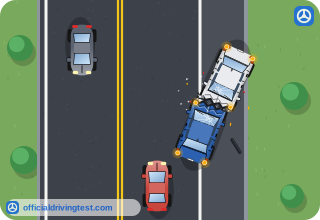
If you are involved in a traffic crash, what must you do?
- Stop only if someone appears to be injured
- Move your vehicle away and call the police from home
- Drive to the nearest police station before stopping
- Stop at once and aid any injured persons
Show answer
Correct answer: Stop at once and aid any injured persons
You must stop at once and aid any injured persons, calling for medical help if necessary.
Source: Alabama Driver Manual (November 2024), page 37 · Open this page in the manual (Manual page 37)
-
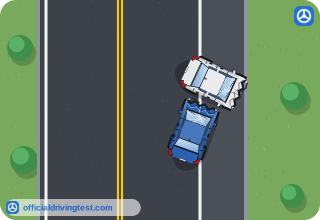
Before the police arrive at a crash, what does the manual say to do to warn other traffic?
- Use whatever means are available, such as flags or flares
- Turn off your headlights and hazard flashers
- Stand in the travel lane and wave traffic around
- Wait in your vehicle, since warning traffic is the police’s job
Show answer
Correct answer: Use whatever means are available, such as flags or flares
Before the police arrive, use whatever means available to warn other traffic, such as flags or flares.
Source: Alabama Driver Manual (November 2024), page 37 · Open this page in the manual (Manual page 37)
-
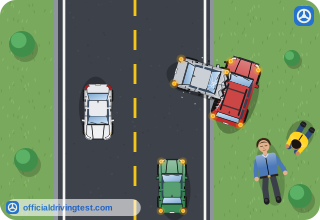
When should injured persons be moved at a crash scene?
- As soon as possible, to a nearby parked vehicle or building where they can rest
- Whenever the injured person asks to be moved somewhere
- Only when absolutely necessary, such as to get them away from fire or other danger
- Whenever they are bleeding or in noticeable pain
Show answer
Correct answer: Only when absolutely necessary, such as to get them away from fire or other danger
The manual says to avoid moving the injured unless it is absolutely necessary to remove them from areas threatened by fire or other dangers.
Source: Alabama Driver Manual (November 2024), page 37 · Open this page in the manual (Manual page 37)
-
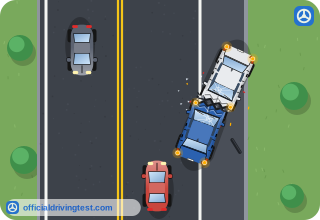
In what position should injured persons be kept until competent medical aid arrives?
- Standing in one place
- Lying or sitting down
- Walking slowly around
- Kneeling on the ground
Show answer
Correct answer: Lying or sitting down
The manual says to keep the injured lying or sitting down until competent medical aid arrives.
Source: Alabama Driver Manual (November 2024), page 37 · Open this page in the manual (Manual page 37)
-
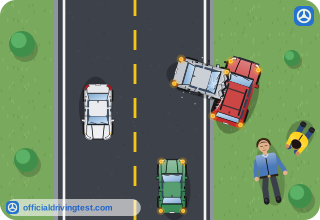
Besides making injured persons as comfortable as possible, what does the manual say to treat them for?
- Fever
- Dehydration
- Frostbite
- Shock
Show answer
Correct answer: Shock
The manual says to apply first aid, make the persons comfortable and treat for shock.
Source: Alabama Driver Manual (November 2024), page 37 · Open this page in the manual (Manual page 37)
-
What does the manual remind motorists a layman can give?
- Too much first aid
- Too little first aid
- Medicine for pain
- Directions to the nearest hospital
Show answer
Correct answer: Too much first aid
The manual says a layman can give "too much first aid."
Source: Alabama Driver Manual (November 2024), page 37 · Open this page in the manual (Manual page 37)
-
What does the manual say is wise for every motorist to do about first aid?
- Carry a full set of medical tools in the vehicle
- Leave all first aid to the police officers only
- Become familiar with first aid by taking a training course
- Memorize the phone numbers of nearby hospitals and clinics
Show answer
Correct answer: Become familiar with first aid by taking a training course
It is wise for every motorist to become familiar with first aid treatment by enrolling in Red Cross sponsored or other training courses.
Source: Alabama Driver Manual (November 2024), page 37 · Open this page in the manual (Manual page 37)
-
What must you give to other persons involved in a crash?
- Your name and address and your Social Security number
- Your name, address and registration number, and show your driver license
- Your name and insurance policy number, but not your license
- Your driver license number, without showing the license itself
Show answer
Correct answer: Your name, address and registration number, and show your driver license
You must give your name, address and registration number and show your driver license to the other persons involved.
Source: Alabama Driver Manual (November 2024), page 37 · Open this page in the manual (Manual page 37)
-
How must an injury or fatal crash be reported?
- By a letter sent within 10 days
- In person at the nearest ALEA office
- By e-mail within 48 hours
- By the quickest means of communication
Show answer
Correct answer: By the quickest means of communication
The manual says an injury or fatal crash must be reported by the quickest means of communication.
Source: Alabama Driver Manual (November 2024), page 38 · Open this page in the manual (Manual page 38)
-
To whom must an injury or fatal crash be reported if it occurs within a municipality?
- The local police
- The State Troopers
- The Safety Responsibility Unit
- The nearest hospital
Show answer
Correct answer: The local police
Within a municipality, an injury or fatal crash must be reported to the local police.
Source: Alabama Driver Manual (November 2024), page 38 · Open this page in the manual (Manual page 38)
-
To whom must an injury or fatal crash be reported if it happens on a state highway?
- The local police
- The Driver License Division
- The State Troopers
- The county clerk
Show answer
Correct answer: The State Troopers
On a state highway, an injury or fatal crash must be reported to the State Troopers.
Source: Alabama Driver Manual (November 2024), page 38 · Open this page in the manual (Manual page 38)
-
At the scene of a crash, whose names and addresses should you secure?
- Only the other driver
- Only the passengers of the other vehicle
- Only the responding police officers
- The persons involved and any witnesses
Show answer
Correct answer: The persons involved and any witnesses
The manual says to secure the names and addresses of persons involved and any witnesses.
Source: Alabama Driver Manual (November 2024), page 38 · Open this page in the manual (Manual page 38)
-
Which of these is an acceptable action if your vehicle hits an unattended vehicle?
- Leave without a note if no one is around to see the damage
- Leave a written notice with your name and address in a conspicuous place on it
- Call the other owner’s insurance company instead of the police or owner
- Move the damaged vehicle to a legal parking space nearby
Show answer
Correct answer: Leave a written notice with your name and address in a conspicuous place on it
You may notify the police, try to locate the owner, or leave a written notice with your name and address in a conspicuous place on the unattended vehicle.
Source: Alabama Driver Manual (November 2024), page 38 · Open this page in the manual (Manual page 38)
-
What should you do if a crash damages property other than a vehicle?
- Nothing, if the damage is small
- Leave a note on the nearest vehicle
- Report it only if someone was injured
- Notify the property owner
Show answer
Correct answer: Notify the property owner
If a mishap damages any other type of property, you must notify the property owner.
Source: Alabama Driver Manual (November 2024), page 38 · Open this page in the manual (Manual page 38)
-
What do crash reports help ALEA and highway traffic officials do?
- Evaluate crashes so they can improve highway and traffic conditions
- Decide which drivers lose their licenses after crashes
- Set the price of automobile insurance for each driver in the state
- Count the number of licensed drivers in each county
Show answer
Correct answer: Evaluate crashes so they can improve highway and traffic conditions
Crash reports help officials evaluate traffic crashes so they can improve highway and traffic conditions.
Source: Alabama Driver Manual (November 2024), page 38 · Open this page in the manual (Manual page 38)
-
When you witness a crash and request aid, what should you be sure to give?
- Your name, address and license number only, without any details of the scene
- The make and model of every vehicle involved in the crash
- The exact location, whether the road is blocked, and the probable damage and injuries
- The name of the driver who you think was at fault in the crash
Show answer
Correct answer: The exact location, whether the road is blocked, and the probable damage and injuries
You should give the exact location, whether the road is blocked, and the probable damage and injuries so police can respond quickly.
Source: Alabama Driver Manual (November 2024), page 38 · Open this page in the manual (Manual page 38)
-
Which crashes does the manual say should be reported to the law enforcement agency that has jurisdiction?
- Only crashes with injuries
- All crashes
- Only crashes on state highways
- Only crashes with damage over $500
Show answer
Correct answer: All crashes
The manual says all crashes should be reported to the law enforcement agency that has jurisdiction.
Source: Alabama Driver Manual (November 2024), page 38 · Open this page in the manual (Manual page 38)
-
After being involved in an accident, when may you proceed?
- Only after complying with the procedure defined by law
- As soon as the other driver has left the scene
- After checking your own vehicle for damage
- Whenever no one is injured
Show answer
Correct answer: Only after complying with the procedure defined by law
After an accident you may proceed only after complying with the procedure defined by law.
Source: Alabama Driver Manual (November 2024), page 61 · Open this page in the manual (Manual page 61)
-
Why are emergencies worse at night than during the day?
- Traffic is heavier and help arrives more slowly
- Hazard flashers do not work after dark
- Your choices are limited and the danger is greater
- Speed limits are higher at night
Show answer
Correct answer: Your choices are limited and the danger is greater
At night traffic is lighter, choices are limited and danger is greater.
Source: Alabama Driver Manual (November 2024), page 70 · Open this page in the manual (Manual page 70)
-
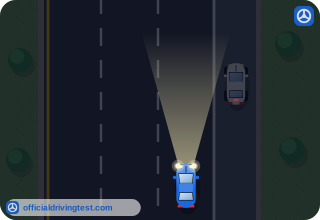
What should you do in a night road emergency?
- Stop in your lane, turn off all lights and keep honking the horn
- Pull well off the highway, activate four-way flashers and raise the hood
- Park on the road with your high beams on and the trunk open
- Leave the vehicle immediately and walk along the right edge
Show answer
Correct answer: Pull well off the highway, activate four-way flashers and raise the hood
The manual says to pull well off the road, activate four-way flashers and raise the hood.
Source: Alabama Driver Manual (November 2024), page 70 · Open this page in the manual (Manual page 70)
-
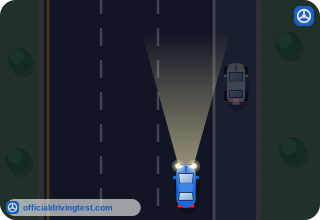
After a night breakdown, what does the manual say to do if possible until help comes?
- Walk to the nearest town at once
- Flag down passing drivers from the road
- Wait in a nearby ditch
- Stay with the car
Show answer
Correct answer: Stay with the car
The manual advises staying with the car, if possible, until help comes.
Source: Alabama Driver Manual (November 2024), page 70 · Open this page in the manual (Manual page 70)
-
If you MUST walk along a road at night after a breakdown, where should you walk?
- On the left edge of the road or shoulder, facing the traffic
- On the right edge of the road, with your back to the traffic
- In the middle of the lane, facing the traffic
- On the right edge of the road, walking with the traffic
Show answer
Correct answer: On the left edge of the road or shoulder, facing the traffic
You should carry a light and walk on the left edge, facing traffic.
Source: Alabama Driver Manual (November 2024), page 70 · Open this page in the manual (Manual page 70)
-
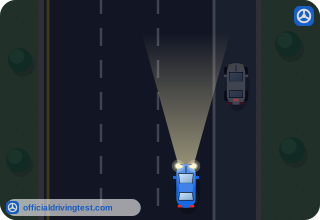
Where should flares or reflectors be placed after a night breakdown?
- 10 to 50 feet to the rear of your vehicle
- 100 to 500 feet ahead of your vehicle
- 100 to 500 feet to the rear of your vehicle
- Next to the front bumper of your vehicle
Show answer
Correct answer: 100 to 500 feet to the rear of your vehicle
Flares or reflectors go 100 to 500 feet behind the vehicle on the right-hand edge of the highway.
Source: Alabama Driver Manual (November 2024), page 70 · Open this page in the manual (Manual page 70)
-
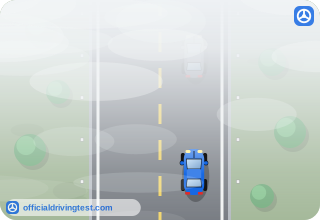
If it is impossible to see in fog or snow, or you become weary of straining your eyes, what should you do?
- Stop in your lane and turn off the lights until it clears
- Slow to a crawl and keep driving until it clears
- Stop on the shoulder, turn your lights off and wait
- Pull completely off the road, leave the lights on and park
Show answer
Correct answer: Pull completely off the road, leave the lights on and park
Pull completely off the road, leave the lights on and wait until visibility improves.
Source: Alabama Driver Manual (November 2024), page 73 · Open this page in the manual (Manual page 73)
-
Why is carbon monoxide poisoning more likely during wintertime driving?
- Cold air makes exhaust fumes heavier and keeps them inside the car
- You are more apt to drive with windows closed and warm the engine first
- Winter fuel burns less cleanly and gives off more fumes
- Snow tires leak exhaust fumes into the car through the floor
Show answer
Correct answer: You are more apt to drive with windows closed and warm the engine first
In winter drivers tend to keep the windows closed and to warm up the engine.
Source: Alabama Driver Manual (November 2024), page 73 · Open this page in the manual (Manual page 73)
-
What is true of carbon monoxide fumes?
- They have a strong smell that warns you
- They are visible as blue smoke
- They are harmless in small amounts
- They are odorless and deadly
Show answer
Correct answer: They are odorless and deadly
The manual says carbon monoxide fumes are odorless and deadly.
Source: Alabama Driver Manual (November 2024), page 73 · Open this page in the manual (Manual page 73)
-
Which is a symptom of carbon monoxide poisoning?
- Sudden weariness
- Increased alertness
- Sudden thirst and hunger
- Itching and sneezing
Show answer
Correct answer: Sudden weariness
Symptoms are sudden weariness, yawning, dizziness and nausea.
Source: Alabama Driver Manual (November 2024), page 73 · Open this page in the manual (Manual page 73)
-
What is the only cure for carbon monoxide poisoning?
- Drinking plenty of cold water and resting
- Turning the heater up to full blast
- Going to an adequate supply of fresh air
- Resting with the windows closed tightly
Show answer
Correct answer: Going to an adequate supply of fresh air
The only cure is to get an adequate supply of fresh air.
Source: Alabama Driver Manual (November 2024), page 73 · Open this page in the manual (Manual page 73)
-
Which is a precaution against carbon monoxide poisoning?
- Warming up the motor in a closed garage first
- Having the exhaust system checked regularly for leaks
- Idling the motor with all the windows closed tight
- Checking only the tire pressure regularly
Show answer
Correct answer: Having the exhaust system checked regularly for leaks
A leaking exhaust system can let deadly fumes into the car.
Source: Alabama Driver Manual (November 2024), page 73 · Open this page in the manual (Manual page 73)
-
Where should you not warm up the motor of your vehicle?
- In a driveway
- On a quiet street
- Outdoors with the windows open
- In a closed garage
Show answer
Correct answer: In a closed garage
Warming up the motor in a closed garage is listed as a carbon monoxide danger.
Source: Alabama Driver Manual (November 2024), page 73 · Open this page in the manual (Manual page 73)
-
Which window habit does the manual list as a precaution against carbon monoxide poisoning?
- Not idling or driving with all the windows closed tightly
- Not idling or driving with any window open
- Keeping all the windows closed whenever the heater is on
- Opening the windows only when the car is parked
Show answer
Correct answer: Not idling or driving with all the windows closed tightly
Do not idle or drive with all the windows closed tightly.
Source: Alabama Driver Manual (November 2024), page 73 · Open this page in the manual (Manual page 73)
-
What is the one basic rule that applies in all driving situations, especially emergencies?
- React instinctively as fast as you can
- Brake first, then steer
- Think before you act
- Speed up to leave the hazard
Show answer
Correct answer: Think before you act
The basic rule is to think before you act, since an instinctive reaction may be wrong.
Source: Alabama Driver Manual (November 2024), page 73 · Open this page in the manual (Manual page 73)
-
What is a blowout?
- A sudden loss of engine power
- A sudden collapse of a tire
- A rupture in the exhaust system
- A sudden loss of brake fluid
Show answer
Correct answer: A sudden collapse of a tire
A blowout is a sudden collapse of a tire that throws the vehicle out of control.
Source: Alabama Driver Manual (November 2024), page 73 · Open this page in the manual (Manual page 73)
-
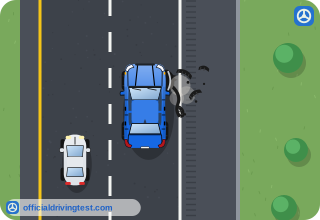
How do you regain control of the vehicle after a blowout?
- Brake hard and steer toward the shoulder as fast as you can
- Let go of the steering wheel and let the car straighten itself
- Accelerate hard and steer straight to stay ahead of traffic
- Hold the wheel tightly, steer straight and ease up on the accelerator
Show answer
Correct answer: Hold the wheel tightly, steer straight and ease up on the accelerator
Hold tight, steer straight, ease off the accelerator and do not brake until in control.
Source: Alabama Driver Manual (November 2024), page 73 · Open this page in the manual (Manual page 73)
-
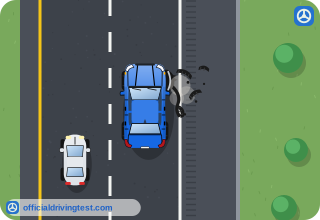
What may warn you of an impending blowout?
- A thumping sound caused by a bulge in the tire
- A high whine from the engine
- A burning smell from the brakes
- A sudden drop in the steering wheel's weight
Show answer
Correct answer: A thumping sound caused by a bulge in the tire
A thumping sound from a bulge in the tire can warn of a blowout.
Source: Alabama Driver Manual (November 2024), page 73 · Open this page in the manual (Manual page 73)
-
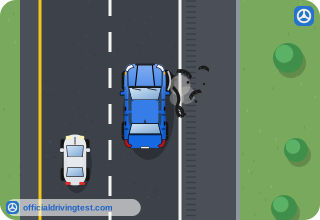
Which is one of the most common reasons for blowouts?
- Worn windshield wiper blades
- Low windshield washer fluid
- Under-inflation
- A weak battery
Show answer
Correct answer: Under-inflation
The manual says under-inflation is one of the most common reasons for blowouts.
Source: Alabama Driver Manual (November 2024), page 74 · Open this page in the manual (Manual page 74)
-
What are often the warning signs of the loss of a wheel?
- A hissing sound and an overheating engine
- A thumping noise and/or a pulling to one side
- Smoke from under the hood
- A brake pedal that sinks slowly
Show answer
Correct answer: A thumping noise and/or a pulling to one side
The warning signs are a thumping noise and/or pulling to one side.
Source: Alabama Driver Manual (November 2024), page 74 · Open this page in the manual (Manual page 74)
-
If you suddenly lose control of your steering, what should you do?
- Brake hard immediately to slow the vehicle
- Shift into a lower gear to slow down quickly
- Press harder on the accelerator to keep control
- Ease up on the accelerator, but do not brake
Show answer
Correct answer: Ease up on the accelerator, but do not brake
The manual says to ease up on the accelerator without braking.
Source: Alabama Driver Manual (November 2024), page 74 · Open this page in the manual (Manual page 74)
-
Why should you not brake or shift gears when your steering fails?
- A sudden change in speed may throw the vehicle off balance
- The brakes do not work at all when steering fails
- Shifting gears locks the steering wheel in place
- The engine will stall at once and the car will stop
Show answer
Correct answer: A sudden change in speed may throw the vehicle off balance
A sudden change in speed could throw the car off balance.
Source: Alabama Driver Manual (November 2024), page 74 · Open this page in the manual (Manual page 74)
-
After steering failure, as the car slows down, what may you be able to do?
- Brake hard to stop as quickly as possible
- Shift into reverse to slow the car down
- Brake very gently to help bring it to a stop
- Shift to a higher gear to slow the engine
Show answer
Correct answer: Brake very gently to help bring it to a stop
Once the car has slowed, very gentle braking may help stop it.
Source: Alabama Driver Manual (November 2024), page 74 · Open this page in the manual (Manual page 74)
-
If your brake pedal suddenly sinks all the way to the floor, what should you try first?
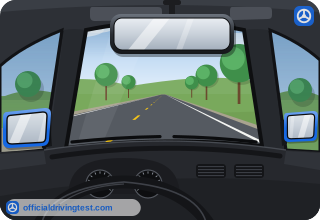
- Turning off the ignition at once
- Pumping the pedal to build up the pressure
- Shifting into reverse
- Pulling the parking brake as hard as you can
Show answer
Correct answer: Pumping the pedal to build up the pressure
The first step is to pump the pedal to build up pressure.
Source: Alabama Driver Manual (November 2024), page 74 · Open this page in the manual (Manual page 74)
-
What gives advance warning that your brakes are starting to fail?
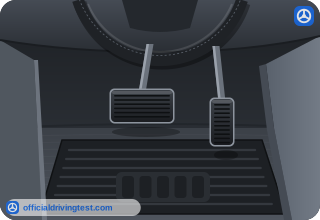
- The pedal becomes very hard to push down at once
- A loud squeal each time you stop the vehicle
- The pedal vibrates strongly at all speeds
- The pedal feels spongy and slowly continues to sink
Show answer
Correct answer: The pedal feels spongy and slowly continues to sink
A spongy pedal that slowly continues to sink warns of brake failure.
Source: Alabama Driver Manual (November 2024), page 74 · Open this page in the manual (Manual page 74)
-
If pumping does not build brake pressure, how should you apply the emergency or parking brake?
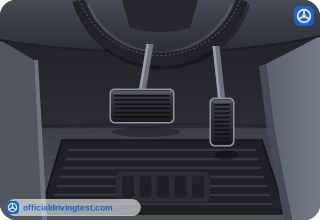
- Gently, so you do not lock the brakes and skid
- Firmly, all the way down at once to stop fast
- Only after you have turned the engine off
- Only when driving faster than 35 mph
Show answer
Correct answer: Gently, so you do not lock the brakes and skid
Apply it gently to avoid locking the brakes and causing a skid.
Source: Alabama Driver Manual (November 2024), page 74 · Open this page in the manual (Manual page 74)
-
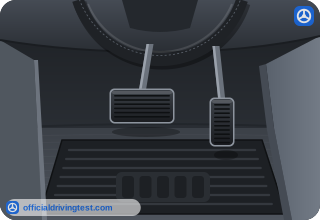
How can the engine help you slow down after brake failure?
- Shift into neutral
- Shift into reverse
- Shift to a lower gear
- Shift into park while moving
Show answer
Correct answer: Shift to a lower gear
Shifting to a lower gear lets the engine slow the vehicle.
Source: Alabama Driver Manual (November 2024), page 74 · Open this page in the manual (Manual page 74)
-
What happens to power steering and power brakes when you turn off the engine?
- They keep working normally for several minutes
- You lose this assistance
- Only the power brakes are lost
- They become stronger
Show answer
Correct answer: You lose this assistance
Turning off the engine takes away power steering and power brake assistance.
Source: Alabama Driver Manual (November 2024), page 74 · Open this page in the manual (Manual page 74)
-
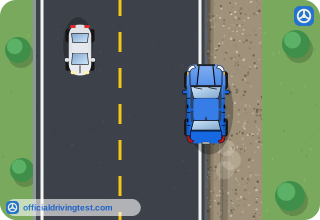
If your wheels drift onto the shoulder of the road, what should you do?
- Swerve sharply back onto the pavement right away to stay in your lane
- Brake hard until stopped, then turn back onto the pavement
- Accelerate back onto the pavement as fast as you can
- Stay on the shoulder and slow down, then turn gently back onto the pavement
Show answer
Correct answer: Stay on the shoulder and slow down, then turn gently back onto the pavement
Swerving back might throw the car off balance, so slow down first and turn back gently.
Source: Alabama Driver Manual (November 2024), page 74 · Open this page in the manual (Manual page 74)
-
If you see a car coming toward you in your lane, what should you do?
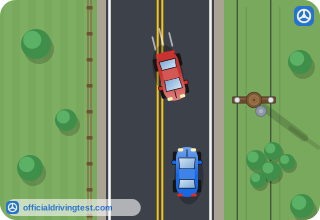
- Pull to the right, slow down and sound your horn
- Pull into the left lane and speed up to get past
- Brake hard and stop in the middle of your lane
- Speed up and try to pass the car on the right
Show answer
Correct answer: Pull to the right, slow down and sound your horn
Pull to the right, slow down and sound the horn.
Source: Alabama Driver Manual (November 2024), page 74 · Open this page in the manual (Manual page 74)
-
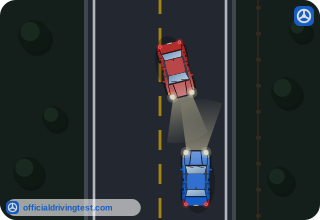
At night, if a car is coming toward you in your lane, what should you do in addition to sounding your horn?
- Turn off your lights
- Turn on only your parking lights
- Flash your lights
- Turn on your four-way flashers
Show answer
Correct answer: Flash your lights
Flashing your lights may wake a drowsy or inattentive driver.
Source: Alabama Driver Manual (November 2024), page 74 · Open this page in the manual (Manual page 74)
-
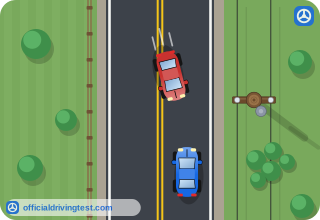
Why should you not turn into the left lane when a car is coming toward you in your lane?
- The left lane is always reserved for faster passing traffic
- The oncoming driver might wake up and swing back into your path
- Changing lanes while sounding the horn is against the law
- Your headlights would not reach that lane at night
Show answer
Correct answer: The oncoming driver might wake up and swing back into your path
The oncoming driver could swing back into your path.
Source: Alabama Driver Manual (November 2024), page 74 · Open this page in the manual (Manual page 74)
-
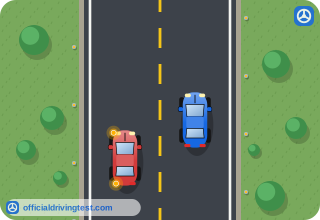
A car is passing you and can complete the pass with your help. What should you do?
- Speed up and stay beside the passing car until it falls back
- Move into the left lane to give the car room
- Move onto the shoulder and stop right away
- Slow your speed to allow the driver to move ahead of you quickly
Show answer
Correct answer: Slow your speed to allow the driver to move ahead of you quickly
Slowing lets the passing driver get ahead quickly.
Source: Alabama Driver Manual (November 2024), page 74 · Open this page in the manual (Manual page 74)
-
A car is trying to pass you, a crash is almost certain, and the right shoulder is adequate. What should you do?
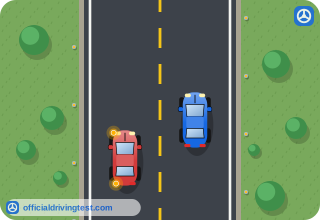
- Move quickly onto the shoulder to let the passing car into your lane
- Brake hard in your lane and keep sounding your horn loudly
- Swerve into the left lane to get out of the way of the car
- Stop in your lane and wait for the other car to finish
Show answer
Correct answer: Move quickly onto the shoulder to let the passing car into your lane
Moving onto an adequate right shoulder lets the passing car move into your lane.
Source: Alabama Driver Manual (November 2024), page 74 · Open this page in the manual (Manual page 74)
-
If your car plunges into deep water but does not sink, what should you do?
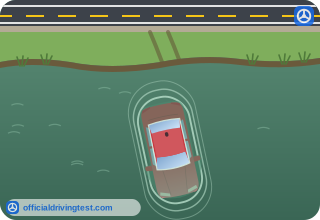
- Immediately escape through a window
- Open a door right away and swim out
- Wait inside for the car to sink first
- Stay inside until help arrives
Show answer
Correct answer: Immediately escape through a window
Escape through a window immediately.
Source: Alabama Driver Manual (November 2024), page 75 · Open this page in the manual (Manual page 75)
-
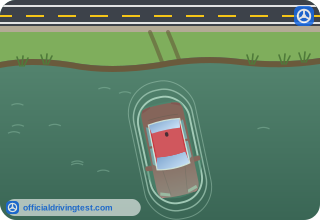
Why should you not open a door if your car plunges into deep water?
- Doors cannot be opened once the car is under water
- Doors lock automatically as soon as they touch water
- Opening a door will let water enter the car more rapidly
- An open door sets off the car's alarm system
Show answer
Correct answer: Opening a door will let water enter the car more rapidly
An open door lets water in faster.
Source: Alabama Driver Manual (November 2024), page 75 · Open this page in the manual (Manual page 75)
-
If a car sinks beneath the surface, which end goes down first?
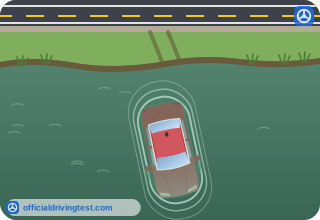
- The back end, because of the weight of the trunk
- The front end, because of the weight of the engine
- Both ends at the same rate
- The side the driver is sitting on
Show answer
Correct answer: The front end, because of the weight of the engine
The weight of the engine forces the front end down first.
Source: Alabama Driver Manual (November 2024), page 75 · Open this page in the manual (Manual page 75)
-
If a car sinks in deep water, where does an air pocket usually form?
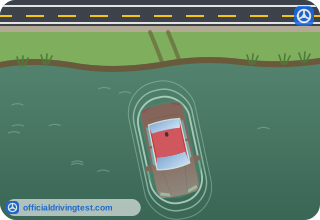
- In the front of the car
- Under the seats
- Near the pedals
- In the back of the car
Show answer
Correct answer: In the back of the car
An air pocket usually forms in the back of the car, where you can breathe before escaping through a window.
Source: Alabama Driver Manual (November 2024), page 75 · Open this page in the manual (Manual page 75)
-
If smoke comes from under the hood of your car, what should you do?
- Get off the road and turn off the ignition
- Open the hood immediately to see the flames
- Keep driving to the nearest service station
- Pour water on the engine to cool it
Show answer
Correct answer: Get off the road and turn off the ignition
Get off the road and turn off the ignition.
Source: Alabama Driver Manual (November 2024), page 75 · Open this page in the manual (Manual page 75)
-
If no fire extinguisher is available for a car fire, what should you use to smother the fire?
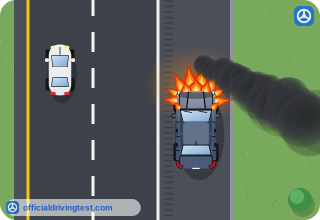
- Water
- Engine coolant
- Dirt or sand
- Windshield washer fluid
Show answer
Correct answer: Dirt or sand
Dirt or sand smothers the fire.
Source: Alabama Driver Manual (November 2024), page 75 · Open this page in the manual (Manual page 75)
-
Why should you not use water on a car fire?
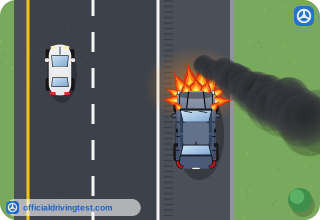
- Water will freeze on the hot engine and crack it
- Burning gasoline will float on it and spread the blaze
- Water will damage the battery and the wiring
- Water turns the smoke into poisonous fumes
Show answer
Correct answer: Burning gasoline will float on it and spread the blaze
Burning gasoline floats on water and spreads the blaze.
Source: Alabama Driver Manual (November 2024), page 75 · Open this page in the manual (Manual page 75)
-
How can you help prevent overheating in slow-moving traffic?
- Keep the car in drive and ride the brake lightly at stops
- Turn the engine off at every stop for a minute
- Keep the car in park with the engine idling slowly
- Shift into neutral and race the engine briefly during stops
Show answer
Correct answer: Shift into neutral and race the engine briefly during stops
This speeds up the fan and the water pump.
Source: Alabama Driver Manual (November 2024), page 75 · Open this page in the manual (Manual page 75)
-
If steam comes from under the hood, what should you do?
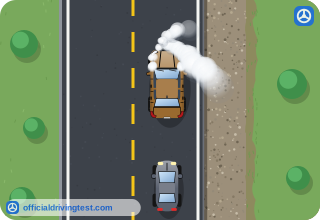
- Pull to the side, turn off the engine and leave the radiator cap shut
- Open the radiator cap slowly to let the steam out and cool it
- Keep driving slowly so the moving air cools the engine down
- Pour cold water into the radiator at once to cool it down
Show answer
Correct answer: Pull to the side, turn off the engine and leave the radiator cap shut
Steam means the cooling system is boiling; pull over, turn off the engine and leave the radiator cap closed.
Source: Alabama Driver Manual (November 2024), page 75 · Open this page in the manual (Manual page 75)
-
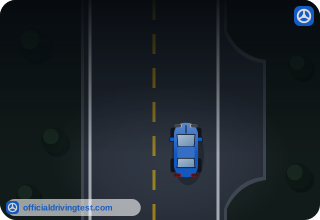
If your headlights suddenly fail, what should you try first?
- Your high beams
- Stopping in the traffic lane
- Your parking lights and directional signals
- Turning off the ignition and coasting
Show answer
Correct answer: Your parking lights and directional signals
One of the two may give you enough light to leave the road.
Source: Alabama Driver Manual (November 2024), page 75 · Open this page in the manual (Manual page 75)
-
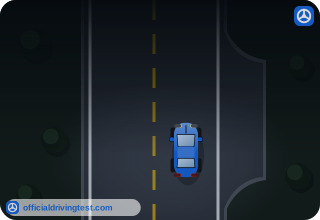
If all your lights fail on a dark, deserted highway, what should you do?
- Stop immediately where you are in the lane and wait for another car
- Slow down and stay on the pavement until you can reach the shoulder safely
- Drive onto the shoulder at once, before you slow down much
- Keep your speed up until you reach a lighted area of road
Show answer
Correct answer: Slow down and stay on the pavement until you can reach the shoulder safely
Slow down on the pavement first, then move onto the shoulder.
Source: Alabama Driver Manual (November 2024), page 75 · Open this page in the manual (Manual page 75)
-
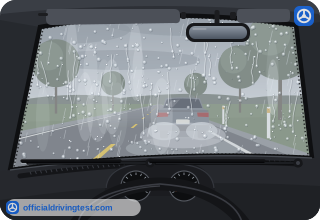
If your windshield wipers suddenly fail in blinding rain or snow, what should you do?
- Stop in the traffic lane and wait for the storm to pass
- Speed up to drive out of the storm as quickly as you can
- Switch on your high beams and lean toward the windshield
- Slow down, roll down your side window and put your head out to see
Show answer
Correct answer: Slow down, roll down your side window and put your head out to see
Slow down, put your head out the side window to see, then move off the highway.
Source: Alabama Driver Manual (November 2024), page 75 · Open this page in the manual (Manual page 75)
-
If your hood suddenly opens and blinds you while driving, what procedure should you use?
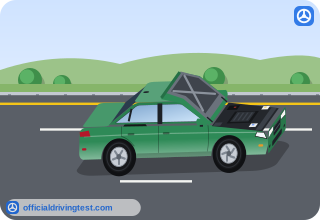
- Slow down, roll down your side window and put your head out to see
- Stop immediately in the traffic lane and wait for help to come
- Speed up and steer by the center line to get off the road
- Shield your eyes with your hand and keep driving at speed
Show answer
Correct answer: Slow down, roll down your side window and put your head out to see
The manual says to use the same procedure as for wiper failure.
Source: Alabama Driver Manual (November 2024), page 75 · Open this page in the manual (Manual page 75)
-
If your accelerator pedal sticks, how may you be able to free it?
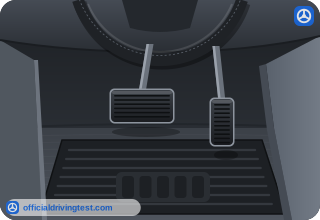
- By pressing the brake and the accelerator together hard
- By shifting into reverse while the car is moving fast
- By hooking your toe under the pedal and attempting to raise it
- By pulling the parking brake hard while driving fast
Show answer
Correct answer: By hooking your toe under the pedal and attempting to raise it
Hooking your toe under the pedal and raising it may free it.
Source: Alabama Driver Manual (November 2024), page 75 · Open this page in the manual (Manual page 75)
-
If you cannot free a stuck accelerator pedal, what can you do to slow the vehicle?
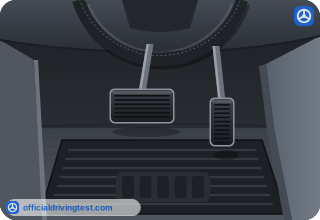
- Shift into park
- Turn the engine off
- Shift into reverse
- Pull the parking brake hard
Show answer
Correct answer: Turn the engine off
Turning the engine off slows the vehicle; if you have power steering or power brakes, you lose that assistance.
Source: Alabama Driver Manual (November 2024), page 75 · Open this page in the manual (Manual page 75)
-
According to the Parent/Teen Driving Agreement, when may the teen leave the scene of an accident, no matter how minor?
- With police or parent permission
- As soon as no one is hurt
- When the damage is small
- When the other driver agrees
Show answer
Correct answer: With police or parent permission
The teen will not leave the scene of an accident, no matter how minor, without the permission of police officers and/or parents.
Source: Alabama Driver Manual (November 2024), page 82 · Open this page in the manual (Manual page 82)