Alabama: Emergencies — Part 2 Practice Test
Questions in this part include: “After being involved in an accident, when may you proceed?” · “What is the only cure for carbon monoxide poisoning?”
Independent educational site · not affiliated with any government agency or DMV
Ready? Test yourself
- Instant feedback with an explanation
- Every answer cites its source in the manual
- Your best score is saved on this device
Questions are original and based on the official manual "Alabama Driver Manual" (November 2024), Alabama Law Enforcement Agency (ALEA), Driver License Division.
All 17 questions in this practice test
Take the test above first, then use this list to study. Tap “Show answer” to see the correct answer and explanation.
Show the questions and answersHide the questions
-
After being involved in an accident, when may you proceed?
- Only after complying with the procedure defined by law
- As soon as the other driver has left the scene
- After checking your own vehicle for damage
- Whenever no one is injured
Show answer
Correct answer: Only after complying with the procedure defined by law
After an accident you may proceed only after complying with the procedure defined by law.
Source: Alabama Driver Manual (November 2024), page 61 · Open this page in the manual (Manual page 61)
-
Why are emergencies worse at night than during the day?
- Traffic is heavier and help arrives more slowly
- Hazard flashers do not work after dark
- Your choices are limited and the danger is greater
- Speed limits are higher at night
Show answer
Correct answer: Your choices are limited and the danger is greater
At night traffic is lighter, choices are limited and danger is greater.
Source: Alabama Driver Manual (November 2024), page 70 · Open this page in the manual (Manual page 70)
-
What should you do in a night road emergency?
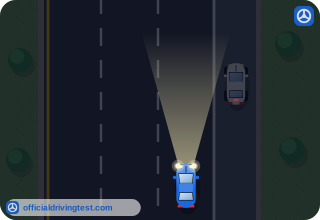
- Stop in your lane, turn off all lights and keep honking the horn
- Pull well off the highway, activate four-way flashers and raise the hood
- Park on the road with your high beams on and the trunk open
- Leave the vehicle immediately and walk along the right edge
Show answer
Correct answer: Pull well off the highway, activate four-way flashers and raise the hood
The manual says to pull well off the road, activate four-way flashers and raise the hood.
Source: Alabama Driver Manual (November 2024), page 70 · Open this page in the manual (Manual page 70)
-
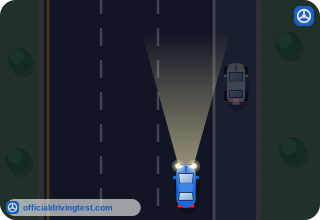
After a night breakdown, what does the manual say to do if possible until help comes?
- Walk to the nearest town at once
- Flag down passing drivers from the road
- Wait in a nearby ditch
- Stay with the car
Show answer
Correct answer: Stay with the car
The manual advises staying with the car, if possible, until help comes.
Source: Alabama Driver Manual (November 2024), page 70 · Open this page in the manual (Manual page 70)
-
If you MUST walk along a road at night after a breakdown, where should you walk?
- On the left edge of the road or shoulder, facing the traffic
- On the right edge of the road, with your back to the traffic
- In the middle of the lane, facing the traffic
- On the right edge of the road, walking with the traffic
Show answer
Correct answer: On the left edge of the road or shoulder, facing the traffic
You should carry a light and walk on the left edge, facing traffic.
Source: Alabama Driver Manual (November 2024), page 70 · Open this page in the manual (Manual page 70)
-
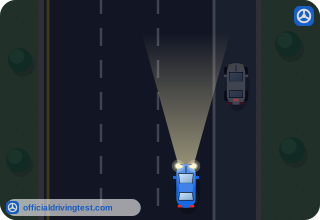
Where should flares or reflectors be placed after a night breakdown?
- 10 to 50 feet to the rear of your vehicle
- 100 to 500 feet ahead of your vehicle
- 100 to 500 feet to the rear of your vehicle
- Next to the front bumper of your vehicle
Show answer
Correct answer: 100 to 500 feet to the rear of your vehicle
Flares or reflectors go 100 to 500 feet behind the vehicle on the right-hand edge of the highway.
Source: Alabama Driver Manual (November 2024), page 70 · Open this page in the manual (Manual page 70)
-
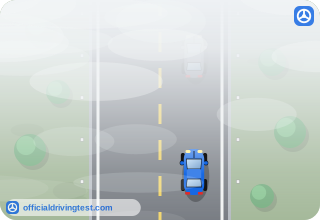
If it is impossible to see in fog or snow, or you become weary of straining your eyes, what should you do?
- Stop in your lane and turn off the lights until it clears
- Slow to a crawl and keep driving until it clears
- Stop on the shoulder, turn your lights off and wait
- Pull completely off the road, leave the lights on and park
Show answer
Correct answer: Pull completely off the road, leave the lights on and park
Pull completely off the road, leave the lights on and wait until visibility improves.
Source: Alabama Driver Manual (November 2024), page 73 · Open this page in the manual (Manual page 73)
-
Why is carbon monoxide poisoning more likely during wintertime driving?
- Cold air makes exhaust fumes heavier and keeps them inside the car
- You are more apt to drive with windows closed and warm the engine first
- Winter fuel burns less cleanly and gives off more fumes
- Snow tires leak exhaust fumes into the car through the floor
Show answer
Correct answer: You are more apt to drive with windows closed and warm the engine first
In winter drivers tend to keep the windows closed and to warm up the engine.
Source: Alabama Driver Manual (November 2024), page 73 · Open this page in the manual (Manual page 73)
-
What is true of carbon monoxide fumes?
- They have a strong smell that warns you
- They are visible as blue smoke
- They are harmless in small amounts
- They are odorless and deadly
Show answer
Correct answer: They are odorless and deadly
The manual says carbon monoxide fumes are odorless and deadly.
Source: Alabama Driver Manual (November 2024), page 73 · Open this page in the manual (Manual page 73)
-
Which is a symptom of carbon monoxide poisoning?
- Sudden weariness
- Increased alertness
- Sudden thirst and hunger
- Itching and sneezing
Show answer
Correct answer: Sudden weariness
Symptoms are sudden weariness, yawning, dizziness and nausea.
Source: Alabama Driver Manual (November 2024), page 73 · Open this page in the manual (Manual page 73)
-
What is the only cure for carbon monoxide poisoning?
- Drinking plenty of cold water and resting
- Turning the heater up to full blast
- Going to an adequate supply of fresh air
- Resting with the windows closed tightly
Show answer
Correct answer: Going to an adequate supply of fresh air
The only cure is to get an adequate supply of fresh air.
Source: Alabama Driver Manual (November 2024), page 73 · Open this page in the manual (Manual page 73)
-
Which is a precaution against carbon monoxide poisoning?
- Warming up the motor in a closed garage first
- Having the exhaust system checked regularly for leaks
- Idling the motor with all the windows closed tight
- Checking only the tire pressure regularly
Show answer
Correct answer: Having the exhaust system checked regularly for leaks
A leaking exhaust system can let deadly fumes into the car.
Source: Alabama Driver Manual (November 2024), page 73 · Open this page in the manual (Manual page 73)
-
Where should you not warm up the motor of your vehicle?
- In a driveway
- On a quiet street
- Outdoors with the windows open
- In a closed garage
Show answer
Correct answer: In a closed garage
Warming up the motor in a closed garage is listed as a carbon monoxide danger.
Source: Alabama Driver Manual (November 2024), page 73 · Open this page in the manual (Manual page 73)
-
Which window habit does the manual list as a precaution against carbon monoxide poisoning?
- Not idling or driving with all the windows closed tightly
- Not idling or driving with any window open
- Keeping all the windows closed whenever the heater is on
- Opening the windows only when the car is parked
Show answer
Correct answer: Not idling or driving with all the windows closed tightly
Do not idle or drive with all the windows closed tightly.
Source: Alabama Driver Manual (November 2024), page 73 · Open this page in the manual (Manual page 73)
-
What is the one basic rule that applies in all driving situations, especially emergencies?
- React instinctively as fast as you can
- Brake first, then steer
- Think before you act
- Speed up to leave the hazard
Show answer
Correct answer: Think before you act
The basic rule is to think before you act, since an instinctive reaction may be wrong.
Source: Alabama Driver Manual (November 2024), page 73 · Open this page in the manual (Manual page 73)
-
What is a blowout?
- A sudden loss of engine power
- A sudden collapse of a tire
- A rupture in the exhaust system
- A sudden loss of brake fluid
Show answer
Correct answer: A sudden collapse of a tire
A blowout is a sudden collapse of a tire that throws the vehicle out of control.
Source: Alabama Driver Manual (November 2024), page 73 · Open this page in the manual (Manual page 73)
-
How do you regain control of the vehicle after a blowout?
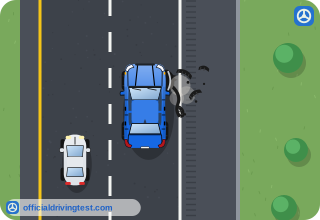
- Brake hard and steer toward the shoulder as fast as you can
- Let go of the steering wheel and let the car straighten itself
- Accelerate hard and steer straight to stay ahead of traffic
- Hold the wheel tightly, steer straight and ease up on the accelerator
Show answer
Correct answer: Hold the wheel tightly, steer straight and ease up on the accelerator
Hold tight, steer straight, ease off the accelerator and do not brake until in control.
Source: Alabama Driver Manual (November 2024), page 73 · Open this page in the manual (Manual page 73)