Wyoming: Health and driving Practice Test
How vision, hearing, illness and other health conditions affect your driving.
Independent educational site · not affiliated with any government agency or DMV
Ready? Test yourself
Answer to start, or tap Start below:
What should drivers do about their physical or mental limitations?
- Instant feedback with an explanation
- Every answer cites its source in the manual
- Your best score is saved on this device
- Keyboard: press 1 to 4 to answer and Enter for the next question
Questions are original and based on the official manual "Rules of the Road: State of Wyoming Driver License Manual" (2021 (August 2021)), Wyoming Department of Transportation (WYDOT), Driver Services.
All 11 questions in this practice test
Take the test above first, then use this list to study. Tap “Show answer” to see the correct answer and explanation.
Show the questions and answersHide the questions
-
What should drivers do about their physical or mental limitations?
- Ignore them whenever they seem to be minor
- Drive only on weekends
- Drive only on rural roads
- Recognize them and compensate, or not drive
Show answer
Correct answer: Recognize them and compensate, or not drive
Drivers should recognize their limitations and compensate or simply not drive when they are impaired.
Source: Rules of the Road: State of Wyoming Driver License Manual (2021 (August 2021)), page 86 · Open this page in the manual (Manual page 86)
-
What can drivers with good vision do sooner?
- Pass other vehicles
- Identify critical objects
- Reach their destination
- Recover from fatigue
Show answer
Correct answer: Identify critical objects
Good vision lets drivers identify critical objects sooner and so have time to predict, decide and execute.
Source: Rules of the Road: State of Wyoming Driver License Manual (2021 (August 2021)), page 87 · Open this page in the manual (Manual page 87)
-
How must drivers with poor side vision look to the sides?
- By moving only their eyes
- By using only their mirrors
- By moving the head as well as the eyes
- By slowing to a stop each time they look
Show answer
Correct answer: By moving the head as well as the eyes
Drivers with poor side vision move their head as well as their eyes and look back over the shoulder when changing lanes.
Source: Rules of the Road: State of Wyoming Driver License Manual (2021 (August 2021)), page 87 · Open this page in the manual (Manual page 87)
-
Driving at speeds 10 to 15 mph slower than other traffic can be what?
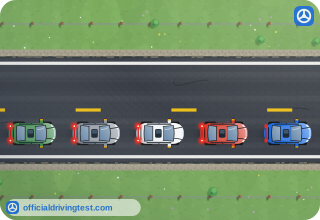
- Safe if the headlights are on
- Required for drivers with poor night vision
- Safer than driving at the speed limit
- Extremely hazardous
Show answer
Correct answer: Extremely hazardous
Driving much slower than traffic is a hazard, even though slower speeds help with poor night vision.
Source: Rules of the Road: State of Wyoming Driver License Manual (2021 (August 2021)), page 88 · Open this page in the manual (Manual page 88)
-
What should people with poor night vision limit their driving to?
- High speeds on dark roads
- Slower speeds on lit streets or daytime only
- Following large trucks at night closely
- Rural highways at night
Show answer
Correct answer: Slower speeds on lit streets or daytime only
Poor night vision is a major problem, so limit driving to slower speeds on well-lighted streets or to the daytime.
Source: Rules of the Road: State of Wyoming Driver License Manual (2021 (August 2021)), page 88 · Open this page in the manual (Manual page 88)
-
What can help if your eyes do not adjust quickly after passing glaring bright lights?
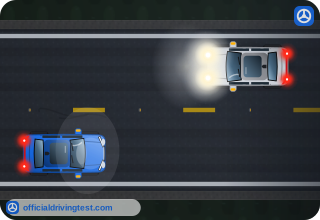
- Looking to the right, away from the glare
- Looking directly at the bright lights
- Closing one eye
- Turning on your high beams
Show answer
Correct answer: Looking to the right, away from the glare
Looking to the right side of the road away from the glare helps.
Source: Rules of the Road: State of Wyoming Driver License Manual (2021 (August 2021)), page 88 · Open this page in the manual (Manual page 88)
-
What is the best solution for a driver whose eyes do not adjust quickly after glaring bright lights?
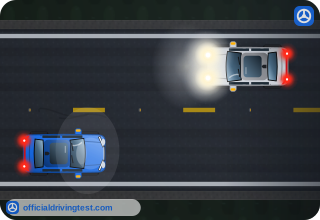
- Wearing tinted glasses at night
- Driving only on freeways
- Limiting driving to daylight hours
- Driving only in the right lane
Show answer
Correct answer: Limiting driving to daylight hours
Slow glare recovery is a very serious problem, and the best solution is to drive in daylight only.
Source: Rules of the Road: State of Wyoming Driver License Manual (2021 (August 2021)), page 88 · Open this page in the manual (Manual page 88)
-
What is often the best way to compensate for loss of hearing?
- Driving with all the windows closed
- Hearing aids and outside rearview mirrors
- Turning the radio up
- Driving only at night
Show answer
Correct answer: Hearing aids and outside rearview mirrors
Hearing aids and outside rearview mirrors are often the best way, along with being extra alert and looking farther to the sides.
Source: Rules of the Road: State of Wyoming Driver License Manual (2021 (August 2021)), page 88 · Open this page in the manual (Manual page 88)
-
What should drivers with normal hearing do about sounds in their vehicle?
- Turn the radio up when on highways
- Play music only through headphones
- Keep the windows up at all times
- Limit the loudness of sounds inside
Show answer
Correct answer: Limit the loudness of sounds inside
Loud sounds in the vehicle can keep you from hearing critical sounds such as sirens and trains.
Source: Rules of the Road: State of Wyoming Driver License Manual (2021 (August 2021)), page 88 · Open this page in the manual (Manual page 88)
-
What is helpful in determining whether a person with an illness, disease or disability is capable of driving safely?
- A friend's opinion
- A recent trip without a crash
- Any passing score on a vision screening
- A doctor's advice
Show answer
Correct answer: A doctor's advice
A doctor's advice helps, but you must still judge your condition each day.
Source: Rules of the Road: State of Wyoming Driver License Manual (2021 (August 2021)), page 89 · Open this page in the manual (Manual page 89)
-
When should you drive if you have an illness, disease or disability?
- Only if you are fully able
- Whenever you feel a little better
- Whenever a friend says it is fine
- Only on short trips
Show answer
Correct answer: Only if you are fully able
You must judge your condition and drive only if you are FULLY able.
Source: Rules of the Road: State of Wyoming Driver License Manual (2021 (August 2021)), page 89 · Open this page in the manual (Manual page 89)